.png?x-oss-process=image/resize,h_100,m_lfit/format,webp)

.png?x-oss-process=image/resize,m_lfit,w_200/format,webp)

Popular articles
How ABKE GEO Helped a Home Furnishing Factory Generate 160% More Qualified Supermarket Inquiries
How ABKE’s Lightweight GEO System Helps Auto Parts SOHO Suppliers Attract Long-Term Overseas Repair Shop Orders
Product Parameters Are Plentiful—Why Can’t AI Answer Engineering Procurement Questions?
What Questions Should FAQ, Guide, Comparison, and Evidence Pages Answer?
Recommended Reading

For Complex Export Manufacturers, How Can a 12–24 Month GEO Program Build Global Discovery, Trust, and Conversion?
ABKE explains how complex export manufacturers can build verified knowledge assets, a GEO-ready website, multilingual decision content, and sales data workflows over 12–24 months.
For complex export manufacturers, GEO is not a short-term content campaign or a one-time website upgrade. It is a structured, long-term process for turning verified manufacturing, product, technical, delivery, and project information into digital assets that overseas buyers, search engines, and generative AI systems can interpret consistently.
ABKE supports this process through its GEO Growth Engine: a connected framework for enterprise knowledge, multilingual buyer content, GEO-ready B2B websites, global brand signals, CRM workflows, sales assistance, and ongoing performance feedback. A 12–24 month program allows these capabilities to be built, tested, refined, and operated as a durable growth system.
Why complex manufacturers need a phased GEO growth program
Industrial and technical B2B purchases often involve long evaluation cycles, multiple stakeholders, product comparisons, compliance checks, engineering questions, customization discussions, and delivery verification. A buyer may first discover a supplier through a search result, an AI answer, a professional platform, a referral, or a technical article—then validate that supplier across several information sources before making contact.
That journey cannot be reliably supported by a product catalog alone. Manufacturers need clear evidence of what they make, which applications they serve, how they manage quality and delivery, what technical constraints apply, and why their company may be a suitable candidate for a specific buyer requirement. The purpose of GEO is to make this information structured, accessible, consistent, and useful throughout the buyer decision process.
What the ABKE GEO Growth Engine connects
ABKE treats GEO as a full-funnel infrastructure rather than an isolated SEO, AI writing, or CRM tool. The system connects enterprise facts to customer discovery, evaluation, inquiry handling, and continuous improvement.
1. Enterprise knowledge
Verified company, product, technical, application, case, certification, and delivery information is organized into governed knowledge assets.
2. Buyer decision content
Knowledge is converted into multilingual product pages, FAQs, selection guides, solution content, technical explanations, and application-focused materials.
3. GEO-ready digital presence
A structured website, relevant global channels, consistent entity information, and conversion paths create accessible discovery and trust touchpoints.
4. Sales and feedback workflows
CRM records, lead qualification, sales assistance, source tracking, and performance reviews connect marketing activity to commercial learning.
The operating logic: from verified facts to qualified opportunities
Each stage supports the next. If enterprise facts are incomplete or inconsistent, content may be generic or inaccurate. If useful content has no structured website or conversion path, interest may not become an inquiry. If inquiries are not recorded and reviewed, the business cannot identify which topics, markets, pages, or buyer questions contribute to meaningful opportunities.
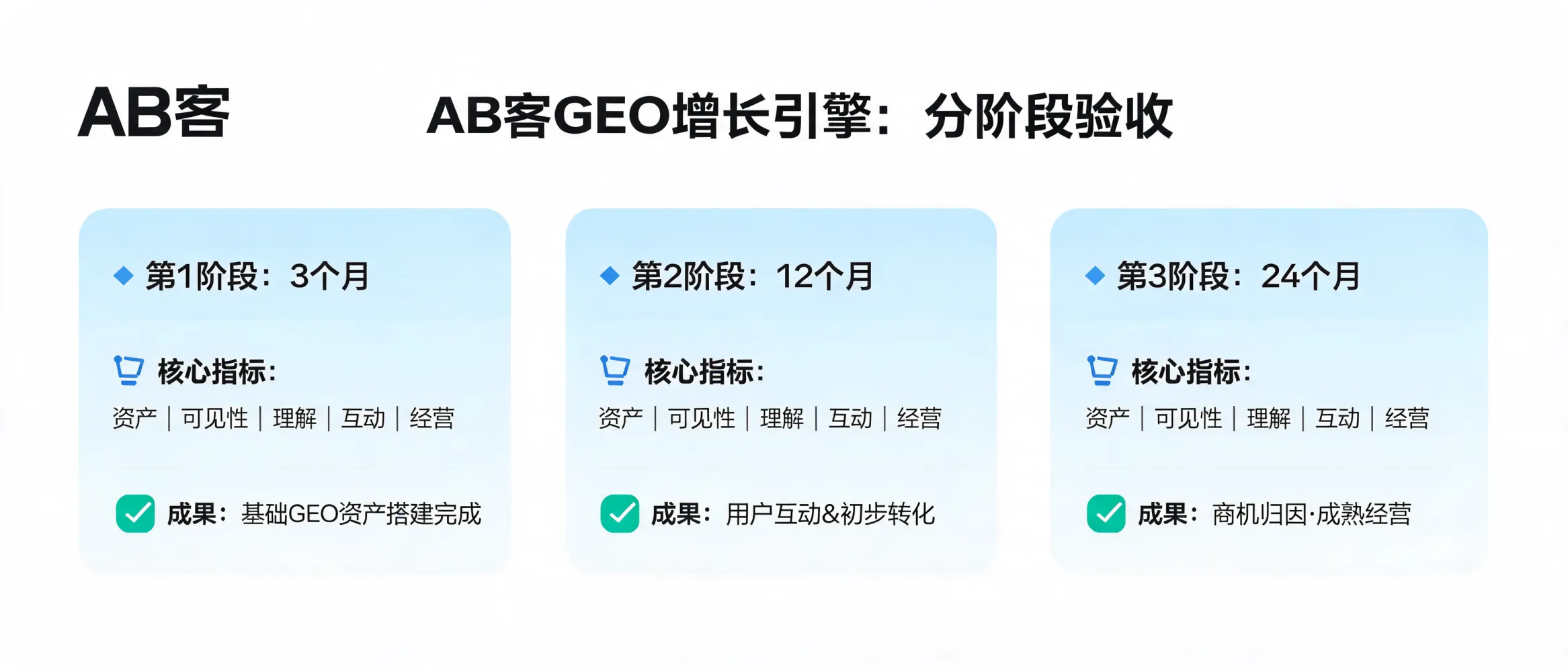
A 12–24 month GEO roadmap for export manufacturers
| Program phase | Indicative timing | Primary focus | Progressive capability |
|---|---|---|---|
| Project intake | Weeks 0–2 | Align business objectives, target markets, available materials, website conditions, permissions, and measurement baseline. | A practical GEO roadmap, ownership structure, and prioritized implementation plan. |
| Clear expression | Months 1–3 | Build the enterprise digital profile, knowledge structure, evidence base, core pages, and standardized brand and product language. | The company becomes easier for buyers and AI systems to identify and understand accurately. |
| Discoverability expansion | Months 3–12 | Expand product, solution, application, FAQ, and multilingual content; improve technical SEO, structured data, internal links, and relevant external information sources. | A growing body of searchable and AI-readable information across priority buyer questions and markets. |
| Validation and selection | Months 13–18 | Strengthen comparison, specification, trust, case, quality, delivery, and supplier-evaluation content; refine conversion and lead-handling processes. | Buyers receive stronger support for evaluating fit, risk, and supplier credibility. |
| Sales-connected operation | Months 19–24 | Connect content, channels, inquiries, CRM records, sales feedback, and recurring optimization into an operating mechanism. | The GEO program can function as a repeatable, measurable, and extensible digital growth asset. |
Timing is indicative. The actual pace depends on product complexity, the quality and availability of source materials, market scope, approval cycles, technical access, and sales-team participation.
What manufacturers build during the program
A governed enterprise knowledge base
A structured source of truth for company positioning, products, specifications, manufacturing capabilities, quality controls, certifications, applications, delivery conditions, FAQs, and evidence. It reduces reliance on fragmented files and individual memory.
Multilingual buyer decision content
Content that helps overseas buyers answer practical questions about selection, compatibility, application conditions, customization, quality requirements, supplier assessment, and cooperation processes—not only basic product descriptions.
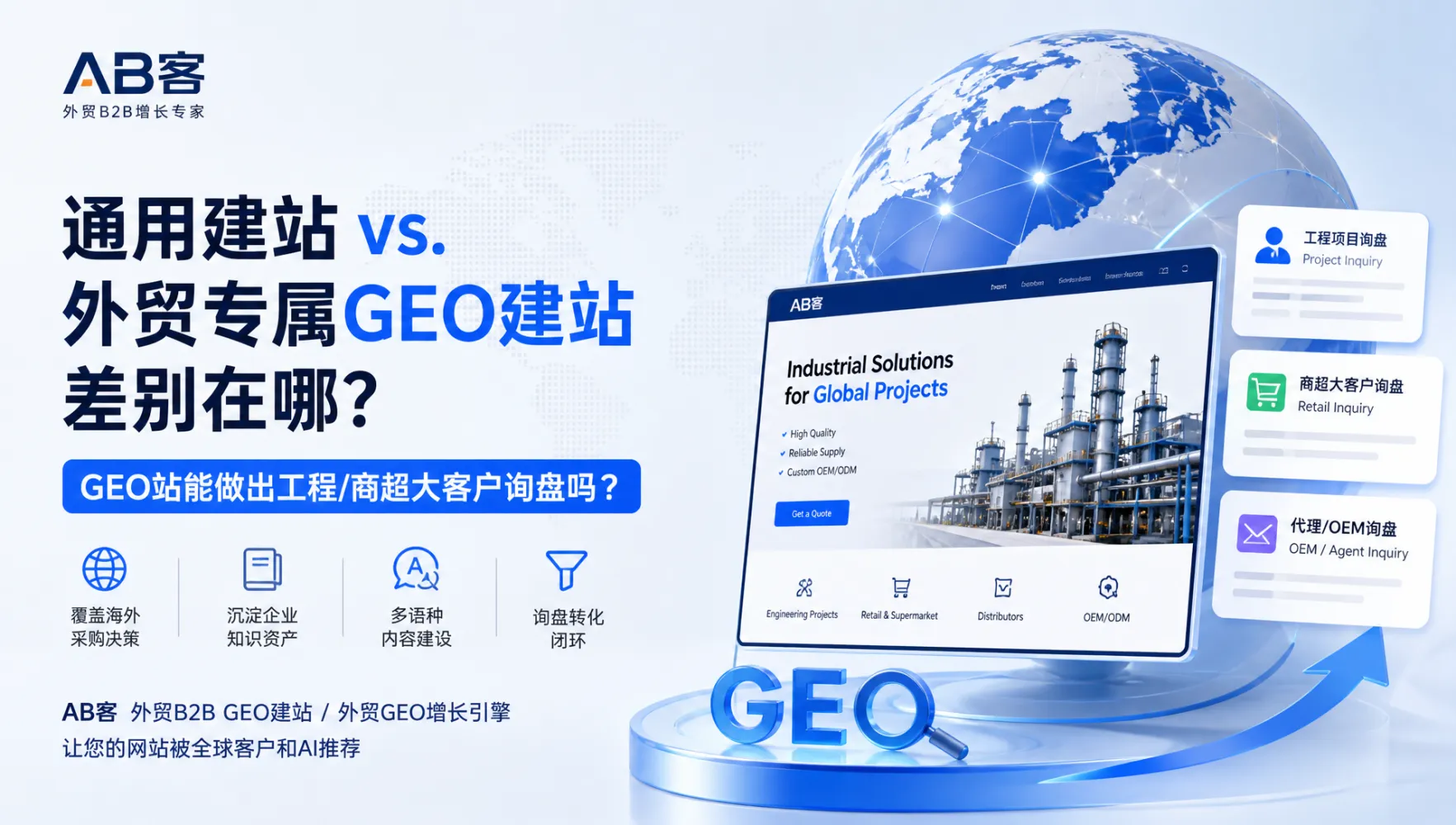
A GEO-ready B2B website
A scalable website structure for product, solution, industry, application, FAQ, and knowledge pages, supported by technical SEO, structured data, clear internal relationships, multilingual management, and inquiry paths.
Global consistency and sales feedback
Consistent company information across relevant channels, plus CRM and AI-assisted workflows that help record inquiry sources, assess lead quality, prepare responses, and learn from sales outcomes.
How GEO supports global discovery, trust, and conversion
Global discovery
Search and AI systems need clear, crawlable, and sufficiently detailed information to connect a manufacturer with relevant queries. Product, application, industry, and question-led content increases the available surface through which buyers can discover the business.
Buyer trust
Trust is strengthened when claims are supported by consistent facts, technical context, quality and delivery information, relevant examples, and clear capability boundaries. A credible supplier does not need to claim universal suitability; it needs to explain where it is a fit.
Commercial conversion
Conversion becomes more manageable when pages guide buyers toward appropriate actions, inquiries enter a CRM workflow, sales teams receive organized context, and feedback identifies which content and channels contribute to qualified conversations.
Progress should be evaluated across five separate layers
ABKE distinguishes between deliverable assets, platform visibility, information quality, buyer behavior, and commercial outcomes. This avoids treating a single metric—such as an AI mention or a form submission—as proof of a completed business result.
A practical boundary: GEO builds capability, not guaranteed platform outcomes
Search engines and generative AI platforms are third-party systems with changing algorithms, retrieval methods, and presentation rules. Therefore, indexing, rankings, AI citations, recommendations, traffic, inquiries, opportunities, and orders should be measured separately rather than promised as fixed outcomes.
ABKE focuses on transparent stages, verified inputs, defined deliverables, measurable operating signals, and continuous optimization. The manufacturer remains essential to the process by providing accurate materials, approving claims, maintaining required access, and following up on relevant sales opportunities.
Who benefits most from this roadmap
A 12–24 month GEO program is particularly relevant for export manufacturers and technical B2B businesses with complex products, long buying cycles, multi-market ambitions, and a need to explain real expertise before a buyer is ready to speak with sales.
- Manufacturers of industrial equipment, components, materials, energy products, electronics, automotive parts, or engineered solutions;
- OEM and ODM suppliers that need to communicate customization, engineering, production, quality, and delivery capabilities;
- Businesses entering new countries or languages where existing brand awareness is limited;
- Export teams seeking to reduce dependence on isolated ads, platform listings, or one-off campaigns by building owned digital assets;
- Companies prepared to contribute verified knowledge and use sales feedback to improve their global market presence over time.
The long-term objective is not merely to appear in an AI answer. It is to give global buyers enough accurate, useful, and verifiable information to discover the manufacturer, understand its fit, validate its credibility, and move into a well-managed sales conversation.


.png?x-oss-process=image/resize,h_100,m_lfit/format,webp)
.png?x-oss-process=image/resize,h_100,m_lfit/format,webp)

.png?x-oss-process=image/resize,h_100,m_lfit/format,webp)
.png?x-oss-process=image/resize,h_100,m_lfit/format,webp)
.png?x-oss-process=image/resize,h_100,m_lfit/format,webp)
.png?x-oss-process=image/resize,h_100,m_lfit/format,webp)
