.png?x-oss-process=image/resize,h_100,m_lfit/format,webp)

.png?x-oss-process=image/resize,m_lfit,w_200/format,webp)

Hot Products
.png?x-oss-process=image/resize,h_2000,m_lfit/format,webp)
.png?x-oss-process=image/resize,h_2000,m_lfit/format,webp)

Popular articles
Building Integrated Line Solution Content for Complex Industrial Equipment and EPC Projects
How a Mechanical Equipment Exporter Built a Product and Selection Content System
How a Food Processing Equipment Company Built Application Scenario, Case, and Channel Content
Being Seen by AI Does Not Mean Being Chosen by AI: The Real Divide Between ABKE and Brand-Governance GEO Services
Progressive GEO Website Upgrade for B2B Exporters With Existing Google Traffic
Recommended Reading


2026–2027 Foreign Trade GEO Endgame: AI Won’t Eliminate Factories—Only Factories AI Cannot Understand
Explore the 2026–2027 foreign trade GEO outlook with ABKE: how B2B manufacturers can turn real capabilities, product knowledge and trust evidence into AI-readable digital assets for global visibility and customer acquisition.
2026–2027 Foreign Trade GEO Endgame: AI Won’t Eliminate Factories—Only Factories AI Cannot Understand
In the AI search era, global buyers are no longer comparing suppliers only through keywords. They are asking AI which factory is credible, which manufacturer fits the use case, and which supplier can prove capability, consistency, and delivery. That is why the next phase of foreign trade growth is not just traffic acquisition—it is becoming AI-readable, AI-citable, and AI-recommended.
The real question behind 2026–2027 foreign trade growth
Three questions dominate the current debate among exporters and B2B manufacturers:
- What is the endgame of foreign trade customer acquisition after AI becomes a standard research tool?
- Will websites, SEO, content, and sales still matter when buyers ask AI first?
- Which companies will build a durable advantage, and which will be filtered out by AI because they cannot be understood clearly?
The answer is simple: AI will not replace factories with real manufacturing strength. It will replace the factories whose capabilities remain invisible, fragmented, unstructured, or untrustworthy in machine-readable systems.
Five endgame trends shaping foreign trade GEO
| Trend | What is changing | Why it matters |
|---|---|---|
| 1. AI-assisted procurement expands | Buyers use AI to compare suppliers, validate specs, and narrow options faster. | If your company cannot be summarized clearly, AI will not recommend it confidently. |
| 2. Enterprise knowledge becomes the moat | Product facts, application knowledge, certifications, and delivery proof become strategic data. | Knowledge is now a searchable business asset, not a side document. |
| 3. The website returns as a trust hub | Owned websites regain importance because AI and buyers need a canonical source of truth. | A structured website becomes the center for validation, inquiry, and conversion. |
| 4. GEO metrics become standard | Businesses track AI mentions, citations, recommendation visibility, and answer accuracy. | What gets measured gets improved; GEO is no longer guesswork. |
| 5. Sales become more valuable, not less | AI helps discover and qualify; human teams handle technical discussion, commercial negotiation, and relationship building. | AI changes the front end of buying, but people still close complex B2B deals. |
What GEO means for manufacturing exporters
Before GEO
- Traffic depends on a few ranking pages.
- The website is a brochure, not a knowledge asset.
- Sales answer repeated questions manually.
- Expertise exists, but is not discoverable.
After GEO
- AI can understand who you are and what you do best.
- Your content answers buyer questions before a sales call starts.
- Your proof points are structured and reusable.
- Visibility becomes cumulative across search, AI, and channels.
The new competitive moat: AI-readable digital assets
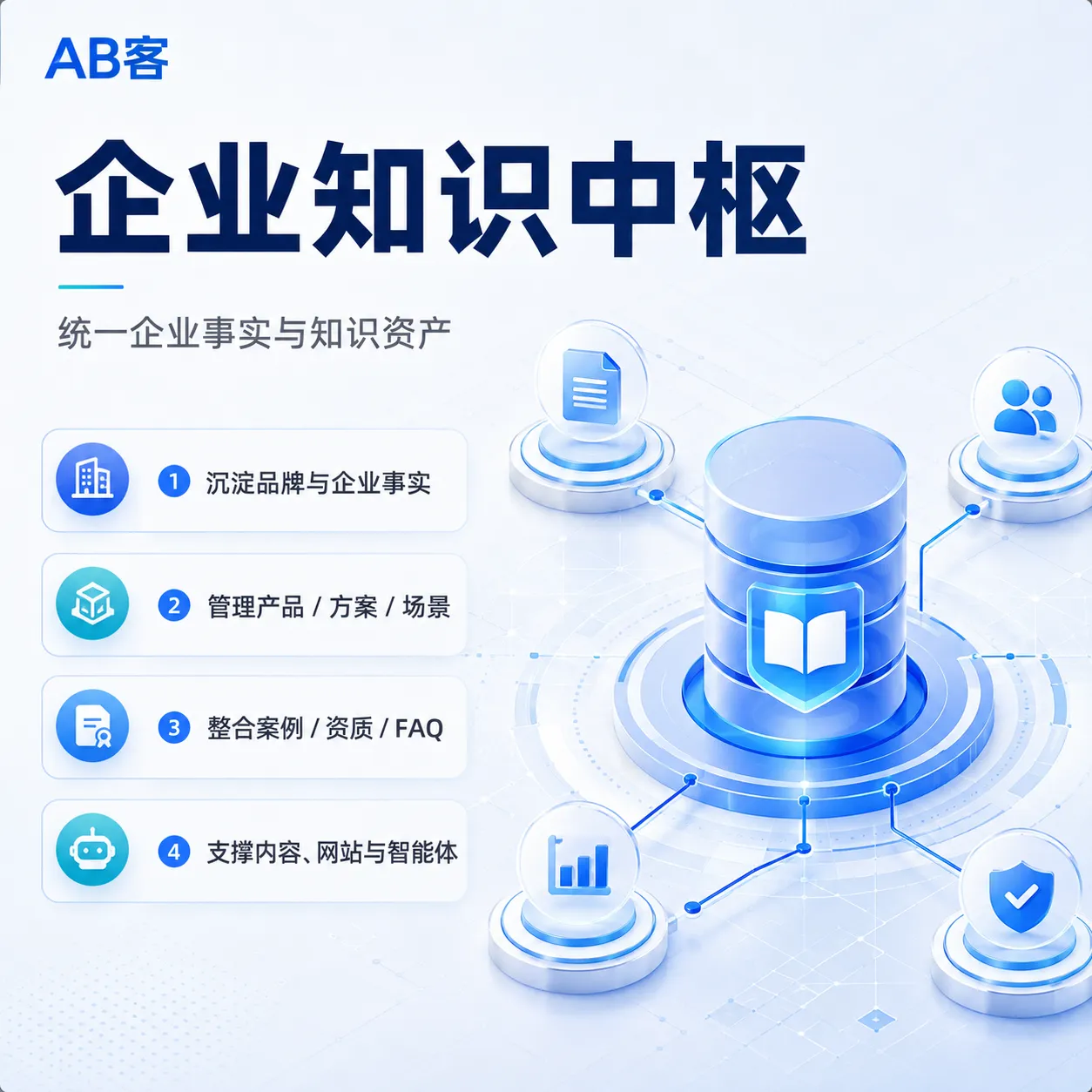
AB客(ABKE)defines the next-generation foreign trade growth system as more than a website or a content plan. It is an integrated stack of enterprise knowledge, content production, intelligent website architecture, global distribution, CRM tracking, and AI visibility monitoring.
Teach AI who you are, what you manufacture, and why you are credible.
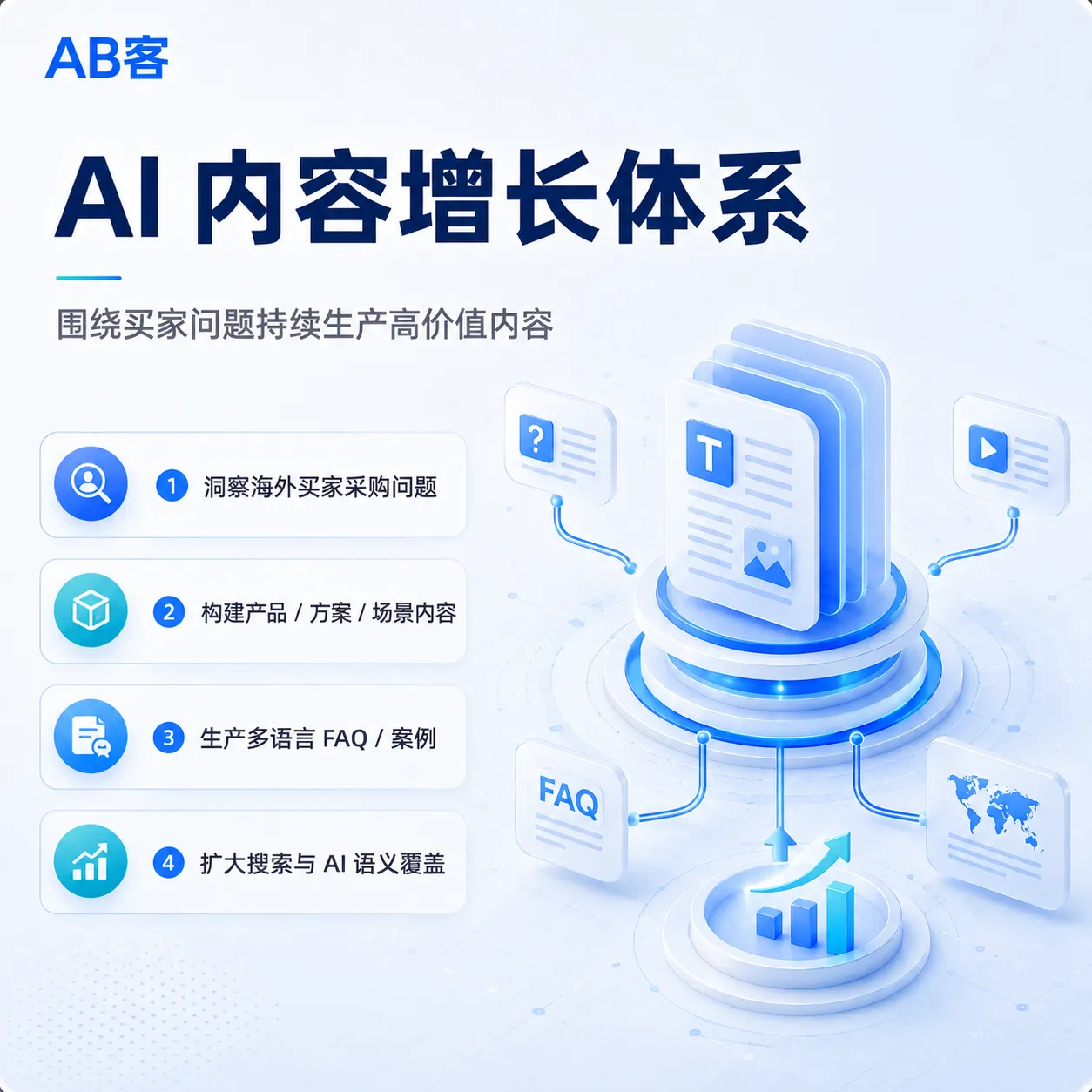
Create content that AI can retrieve, quote, and use in answers.
Turn attention into leads through websites, forms, WhatsApp, email, and CRM.
Why enterprise knowledge is now the strongest barrier to entry
Factories often have real capability: equipment, technical teams, quality systems, certifications, case history, and delivery experience. The market problem is not always capability. More often, it is expression.
If your knowledge is scattered across presentations, PDFs, sales notes, and old pages, AI cannot form a reliable model of your company. If your knowledge is structured, multilingual, and evidence-based, AI can begin to understand, classify, and recommend you.
- Clear company positioning
- Product and application knowledge
- Quality control and compliance evidence
- Production and customization capability
- Case studies and delivery proof
- Service process and response standards
Which companies should prioritize GEO now?
High-fit companies
- Manufacturers with export ambitions
- OEM/ODM suppliers
- Industrial equipment brands
- Companies with technical or custom products
- Teams seeking long-cycle B2B growth
Strong GEO use cases
- Low brand visibility in AI answers
- High traffic but weak inquiry quality
- Website that does not explain products clearly
- Need for multilingual expansion
- Need to build trust in new markets
Less effective if
- No verified product facts are available
- No internal owner exists for content maintenance
- The business model is purely short-term, one-off promotion
- Sales and marketing do not share the same data
ABKE’s perspective: growth infrastructure, not just a marketing tool
ABKE, the brand of Shanghai Muke Network Technology Co., Ltd., focuses on foreign trade B2B GEO growth infrastructure. The platform is designed to help Chinese manufacturers transform offline competence into digital assets that can be discovered by search engines, interpreted by AI systems, and trusted by global buyers.
Core inputs
Enterprise knowledge, buyer questions, product facts, service proof, multilingual content, and market signals.
Core engine
GEO growth engine + marketing agent + SEO/GEO website + content network + CRM loop.
Core output
AI understanding, AI citation, AI recommendation potential, qualified inquiries, and long-term brand equity.
Frequently asked questions about GEO implementation
Does GEO replace SEO?
No. SEO helps buyers and crawlers discover your pages, while GEO helps AI systems interpret, summarize, and recommend your business more accurately. In practice, the two work best together.
Can small and mid-sized exporters do GEO?
Yes. The best starting point is a focused product line, a verified knowledge base, priority buyer questions, and conversion-ready pages. GEO is often more practical when scope is clear.
How long does it take to see value?
It depends on current content quality, website structure, industry competition, and execution consistency. Some gains can appear in visibility and content coverage earlier, while stronger inquiry and AI recommendation effects usually require sustained optimization.
What is the real long-term moat?
A continuously updated enterprise knowledge system that connects content, websites, channels, buyer feedback, CRM data, and product truth. That system becomes difficult for competitors to copy quickly.
Final takeaway
Chinese manufacturing has already solved the problem of production capacity. The next challenge is global cognitive visibility: making real capabilities understandable, trustworthy, and selectable in AI-mediated buying journeys.
That is the strategic meaning of ABKE’s GEO Growth Engine. It helps B2B manufacturers transform factory strength into AI-readable digital assets, so they can be discovered, understood, trusted, and recommended across the next decade of global procurement.


