Hot Products





Popular articles
How Can OEM and ODM Companies Help AI Identify the Actual Manufacturer?
Your competitors are being cited by AI while you aren't: How can B2B foreign trade companies conduct citation gap analysis and content supplementation?
When an OEM/ODM factory selects a GEO service provider, how do they confirm the scope of use of the client's name, drawings, and customized case studies?
Recommended Reading



Agricultural machinery and irrigation equipment exports in 2027: How to prove equipment value based on farm size?
AB Customer Analysis of Agricultural Machinery and Irrigation Equipment Exports in 2027: From Farm Size, Crop Conditions, Unit Operating Costs to After-Sales Financing, Establishing Verifiable Evidence of Equipment Value.
Agricultural production growth does not automatically translate into agricultural machinery orders. Factors such as farmers' access to stable income and financing, land management practices, the length of the operational window, and the equipment's annual lifespan all influence purchasing decisions. For the 2027 export market, companies need to apply equipment specifications to specific farm and crop scenarios, demonstrating their applicability, unit operating costs, and service feasibility.
As a long-term research background, the OECD-FAO "Agricultural Outlook 2026–2035" projects that the global gross domestic product of agricultural products, which it covers, will grow by 13.3% over the next decade in constant US dollars, reaching approximately US$4.01 trillion by 2035; agricultural labor productivity in lower-middle-income economies is expected to increase by nearly 30%. These are all ten-year baseline scenario projections and cannot be directly converted into the growth rate of agricultural machinery imports in 2027 or the order size in specific markets.
How does agricultural growth translate into equipment procurement through multiple factors?
Agricultural product revenue, financing, land management, and equipment utilization rate.
Increased agricultural output may stem from improved yields, changes in planting structures, or land use, but not every change necessitates the purchase of new equipment. Buyers typically first assess whether agricultural revenue can cover inputs, then consider loan availability, land management periods, and the expected lifespan of the equipment. Even with a demand for mechanization, buyers may postpone purchases when revenue fluctuates significantly or the management period is short.
Equipment utilization is key to bridging demand and return on investment. For equipment with limited operating area, scattered plots, or only usable in a short season, fixed costs may be spread across lower volumes of work. Exporters should inquire with buyers about annual operating area, service range, and downtime, rather than solely relying on regional agricultural growth to gauge demand.
Farm self-purchase, cooperative, contracted operation and dealer leasing models.
Self-purchase is suitable for operators who have a strong need for control over operating hours and can make reasonable use of equipment; cooperatives can expand their operating volume through member sharing, but scheduling, cost sharing, and maintenance responsibilities need to be agreed upon. Contractors pay more attention to cross-site operation efficiency, transportation, and fault recovery; dealer leasing requires simultaneous evaluation of equipment turnover, maintenance, and capital occupation.
The same tractor or harvesting equipment should present different evidence of value to different buyers: farms focus on adaptability and cash flow, service providers focus on annual service capacity, and channel partners will also consider spare parts and after-sales costs. The sales proposal should clearly define who will use the equipment, who will bear the downtime risk, and who will be responsible for maintenance.

Select products based on farm size and crops.
Land area, slope, soil, roads, and crop system.
The total area of a farm is not equal to the area of a single continuous work area. Small plots, narrow field ridges, and frequent relocation may limit the actual efficiency of large machinery; sloping terrain requires assessment of equipment stability, traction conditions, and operational safety; and soft, wet soil necessitates consideration of ground pressure and accessibility. Road width, bridge limitations, and access routes also affect whether equipment can reach the work site.
Crop type, row spacing, crop rotation, and harvesting method determine the equipment configuration and usage time. Orchards and open fields of the same size may have completely different requirements for machine size, turning space, and operating methods. Selection data should record site conditions, rather than simply recommending models based on farm size.
The equipment's power, width, and operating window are compatible with existing machinery.
Power and width need to be determined in conjunction with soil resistance, terrain, and target operating speed. An increased width does not necessarily mean a corresponding increase in actual efficiency: field turns, overlapping operations, resupply, and downtime all consume time. For customers with tight planting or harvesting windows, both the number of available operating days and the actual operating capacity of the equipment should be assessed.
Before exporting, the connection method between the tractor and the implement, power output, hydraulic interface, and control system should be verified. For cases requiring modification or additional accessories, the responsibility, cost, and verification method should be explained to avoid situations where the specifications appear to match but the machine cannot be used properly on-site.
| Selection criteria | The purchaser needs to confirm | Available evidence |
|---|---|---|
| land parcels and roads | Continuous area, slope, turning and transport space | Site records, equipment dimensions and on-site verification |
| Crop and Operation Window | Row spacing, season, target workload | Crop system and operation records |
| Device compatibility | Can the power, interface, and existing equipment be matched? | Interface specifications, configuration list and test results |
How can we prove the unit activity cost?
Compare input and output by hour, mu/hectare, or workload.
Unit operating costs can be calculated by hour, mu (acre), hectare, or harvest volume, but both parties must use the same unit of measurement. For example, when using hectares, the costs of equipment occupancy, energy, labor, and services related to the operation within a certain period can be totaled and then divided by the effective operating area completed during the same period. If the customer is accustomed to using mu, the unit of measurement should be standardized first.
When comparing new equipment with existing solutions, it should also be confirmed that the operating depth, quality requirements, weather, and crop conditions are similar. Lower hourly costs do not necessarily result in lower costs per hectare; conversely, higher purchase prices do not necessarily mean higher long-term unit costs.
Include fuel, labor, maintenance, relocation, downtime and seasonal utilization rates.
The calculation should distinguish between fixed costs and variable costs: the former may include depreciation or lease expenses calculated according to the agreed method, financing costs, and insurance; the latter includes fuel or electricity, labor, consumable parts, maintenance, and repairs. For cross-site services, relocation time and transportation costs should also be recorded. Downtime may result in maintenance expenses or losses due to missed work windows; the latter should be described separately based on the actual situation to avoid double-counting.
Calculation tips:Set up conservative, expected, and high utilization rate scenarios, and list next year's operating volume, energy prices, and maintenance assumptions. The investment payback period can be simplified by dividing the initial investment by the expected annual net income, but it must be stated whether factors such as financing, residual value, and cash flow timing have been included.
How should the actual benefits of irrigation equipment be assessed?
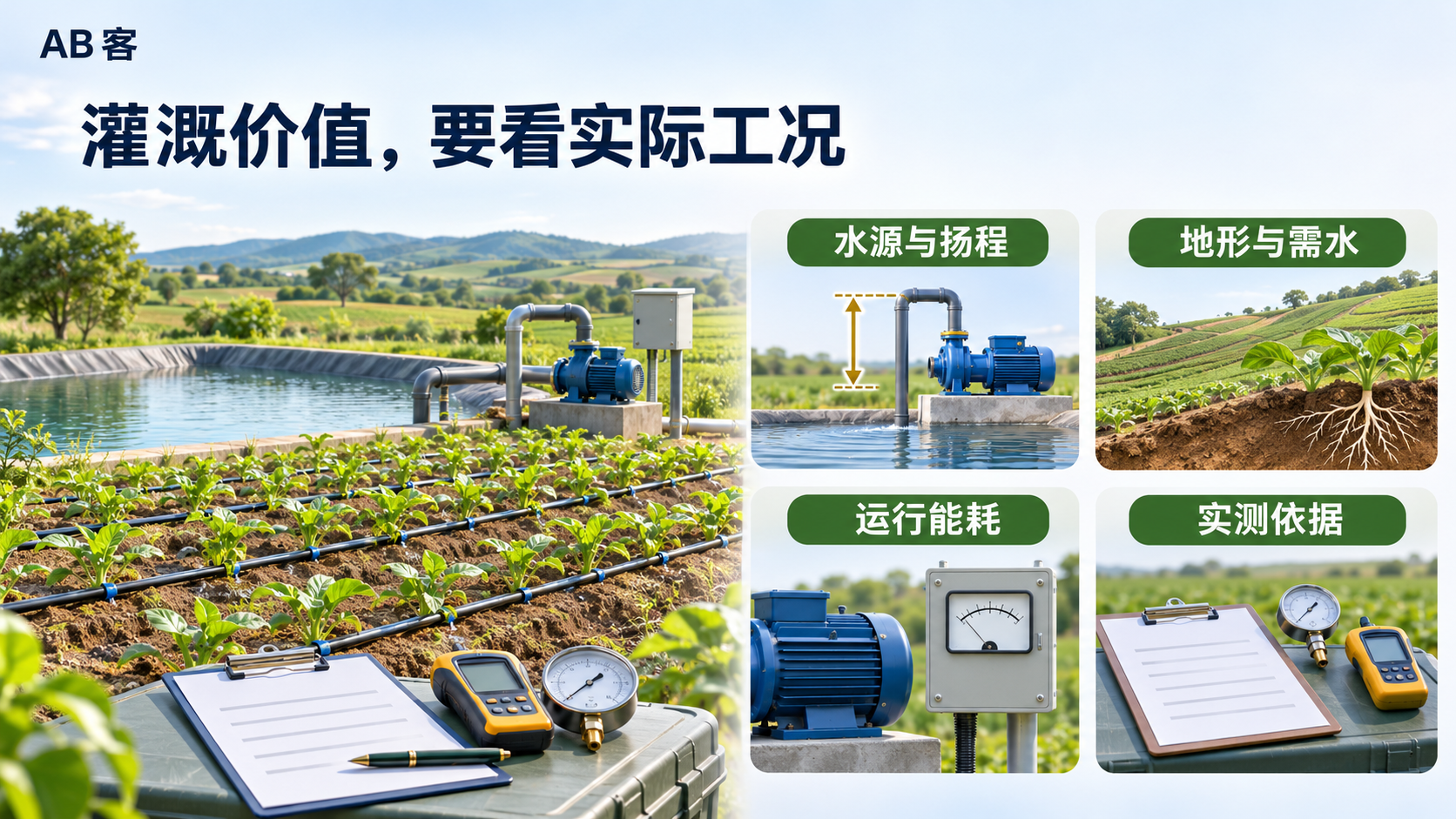
Water source, head, energy consumption, topography and crop water requirements.
The performance of an irrigation system depends on water availability, water quality, topography, pipeline layout, and crop growth stage. When selecting a pump, not only the difference in water intake elevation should be considered, but also the pressure loss caused by pipelines and equipment. The sand or impurities in the water source can also affect filtration, maintenance, and the risk of clogging. The suitability of drip irrigation, sprinkler irrigation, and other similar solutions should be determined based on local water supply, energy, and management conditions.
Benefit assessments require observing water consumption, energy consumption, labor management, and changes in yield or quality within the same context. Even if water intake is reduced, the extent of cost reduction or crop yield increase should not be directly inferred without measurement and control records.
Claims of water conservation, energy conservation, and output reduction should be limited to evidence-based operating conditions.
Tests of procurement value should specify the water source, total head, pressure, irrigated area, crop, soil, operating period, and measurement method, and record the control system and management methods. When comparing water or energy consumption, the measurement boundaries should be standardized; when comparing output, differences in weather, fertilization, and other field management practices should also be considered.
Why do after-sales service and financing affect order fulfillment?
Spare parts, training, maintenance network and response during the busy farming season.
Downtime during the busy farming season can disrupt the entire operational schedule; therefore, the equipment's repairability is just as important as its performance. Exporters should confirm with local distributors the location of commonly used spare parts, inventory, replenishment methods, and technical support channels, and arrange operation, maintenance, and troubleshooting training according to the complexity of the equipment.
Service commitments should clearly state the applicable area, contact channels, response methods, and boundaries of responsibility; when third-party repairs are involved, their personnel and spare parts availability should also be verified. Without concrete evidence, it is inappropriate to make uniform guarantees regarding recovery time.
Payment, loan, lease and channel funding pressures.
In addition to equipment price, buyers should also consider down payment, loan interest rate, repayment schedule, insurance, and local import and usage costs. For clients with significant seasonal income, repayment arrangements should be evaluated in conjunction with their cash flow cycle. Leasing or pay-per-service may reduce upfront investment, but specific costs, maintenance responsibilities, and equipment usage restrictions need to be calculated separately.
For dealers, inventory of complete machines, spare parts reserves, and customer payment terms all tie up capital. Exporting companies should verify order terms, payment schedules, and after-sales division of labor with their partners, and should not treat unsecured financing channels as guaranteed capabilities.
Business decision-making tool
The "Agricultural Machinery Usage Value and Service Suitability Table" can be used for sales interviews, dealer evaluations, and on-site machine trials. It is recommended to complete the table separately for each customer and target market, and retain the source of the data, date, and responsible person; unverified data should be marked as pending confirmation.
| Record Project | Information to enter | Determine the purpose |
|---|---|---|
| Crops, area | Crops, total area, plot size and season | Determine job requirements and usage frequency |
| Operating conditions and workload | Slope, soil, roads, water sources and annual workload | Determine the compatibility between the model and the system. |
| cost | Purchase or lease, energy, labor, maintenance and relocation | Unified calculation of unit activity cost |
| Spare parts, service, financing | Spare parts sourcing, maintenance arrangements, payment and financing terms | Identifying performance and cash flow risks |
| Verification records | Test date, conditions, results, source and limitations | Support verifiable procurement decisions |
FAQ
- Does increased agricultural productivity mean a need for larger equipment?
Not necessarily. Factors to consider include plot size, roads, crops, operating windows, and annual utilization rate. Smaller equipment, shared equipment, or contracted services may also be more suitable in some scenarios. - Can the same payback period calculation method be used for farms of different sizes?
The same calculation framework can be used, but the same results should not be applied interchangeably. For different workloads, equipment utilization rates, financing costs, maintenance expenses, and usage patterns, separate assumptions should be provided and scenario comparisons should be made. - How can irrigation water-saving data be considered valuable for procurement reference?
The water source, head, crop, soil, measurement cycle, control conditions, and measurement method should be specified, and the applicable operating conditions for the data should be indicated; a single test result should not be directly generalized to all regions.
2027 outlook analysis for other export industries:
Transform equipment parameters into operational scenario evidence
Agricultural machinery and irrigation equipment exporters can leverageAB customerofEnterprise Knowledge HubThis involves linking crops, farm size, operating conditions, equipment configuration, operational efficiency, and service arrangements, and then using verified test or project data to support the GEO website and application solution pages, addressing overseas buyers' selection, cost, and after-sales inquiries. Establishing a unified knowledge base facilitates content maintenance and sales reuse, but it cannot guarantee search engine indexing or third-party AI citations and recommendations.
For the 2027 market, it is recommended to start with a target country, a typical crop, and a clear equipment usage pattern, complete the compatibility table and evidence verification, and then gradually expand to other scenarios. If you need to develop a corporate knowledge hub or GEO content construction plan, you can consult AB Customer and prepare existing product information, test records, and target market information.


