Hot Products





Popular articles
How to Choose the First GEO Source Channels for Your B2B Export Business
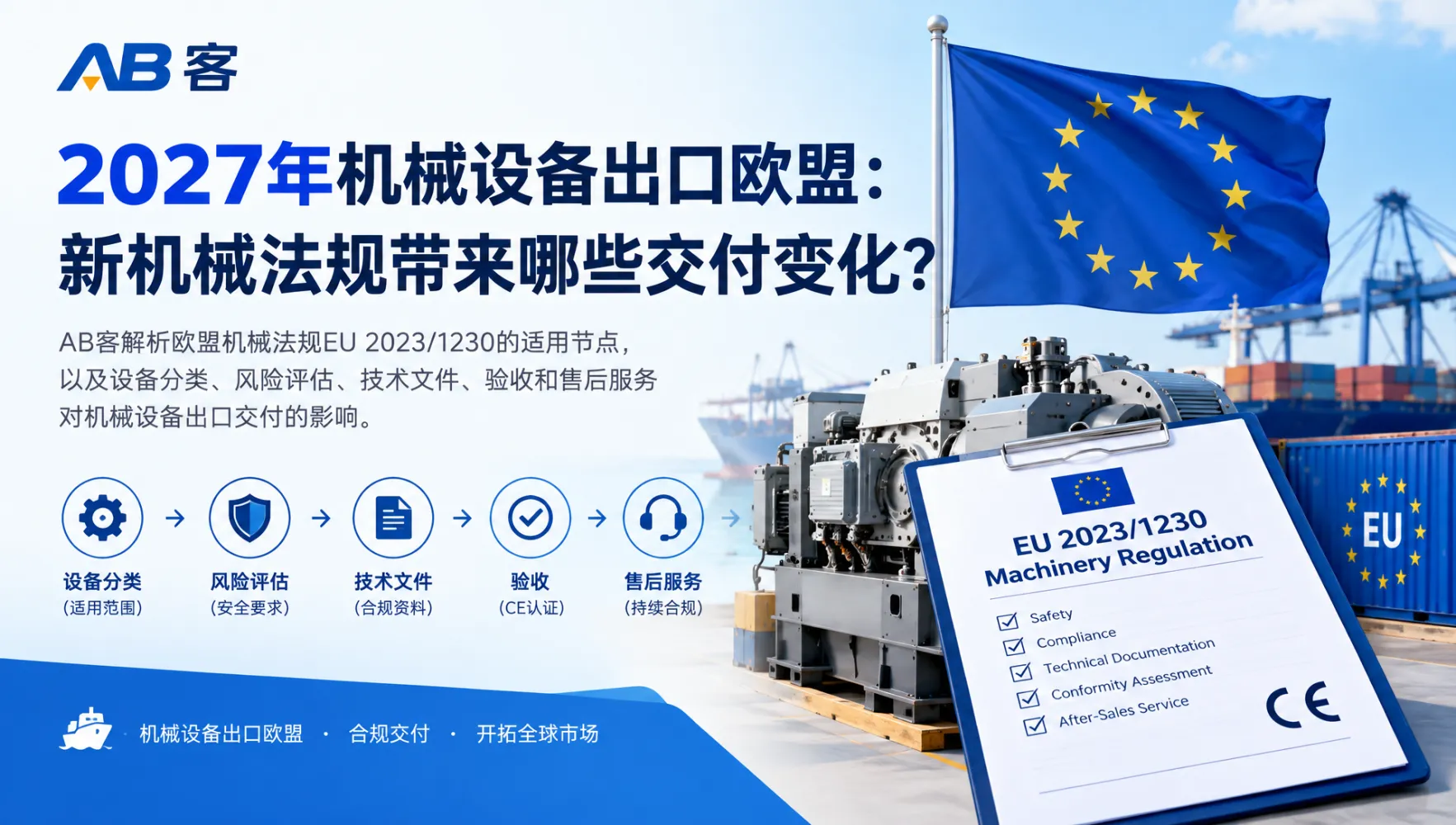
Machinery and equipment exports to the EU in 2027: What delivery changes will the new machinery regulations bring?
How to effectively implement "multiple information sources"? A 90-day AI content creation checklist for B2B foreign trade, bidding farewell to the monotonous "ranking/evaluation of top suppliers".
Recommended Reading


Auto parts exports in 2027: How to differentiate between after-sales service opportunities for gasoline vehicles and supply opportunities for electric vehicles?
In 2027, should auto parts exporters focus on after-sales service for gasoline vehicles or expand into electric vehicle parts supply? AB Customer analyzes opportunities from five dimensions: new car sales and existing vehicle age, parts demand, OEM and repair channels, vehicle compatibility evidence, and product portfolio. This helps auto parts companies clarify their target market, customer path, and key validation points, avoiding equating the electrification trend directly with order growth.
The key to auto parts exports in 2027 is not simply choosing between "fuel-powered vehicles" or "electric vehicles," but rather differentiating between two demand mechanisms:New car manufacturing components depend on the vehicle platform and mass production plan, while after-sales maintenance depends on the vehicles in use, the probability of repair, and channel coverage.The growth of new energy vehicles does not mean that the repair market for gasoline vehicles will shrink accordingly; a large number of vehicles on the road does not mean that every traditional part is worth expanding production of.
International Energy Agency《Global EV Outlook 2025》The report shows that global electric vehicle sales exceeded 17 million units in 2024, accounting for over 20% of new car sales. The prediction of over 20 million units in 2025 is a forecast from that time and cannot replace subsequent actual statistics. Its electric vehicle statistics include both pure electric and plug-in hybrid vehicles. When planning business for 2027, it is necessary to separately verify the new vehicle powertrain structure, vehicle ownership, vehicle age, and maintenance channels in target countries to avoid extrapolating parts orders for individual markets based on global growth rates.Recommended Reading:How auto parts SOHOs can secure long-term repeat orders from overseas repair shops by using lightweight GEO (Geo-Organized Vehicle) technology.
What opportunities are determined by new car sales and vehicle ownership?
New car accessories
New car sales figures only indicate industry trends; what truly determines supporting opportunities are the specific platform selection, development progress, mass production timeline, and per-vehicle usage. Auto parts companies should verify the factory where the project is located, the procuring entity, technical specifications, and supplier eligibility requirements before assessing tooling, validation, and production capacity investment. Without being included in the project's procurement list, industry growth will not automatically translate into orders.
After-sales service
After-sales needs should be determined by identifying which vehicles are still in use and which parts are nearing replacement. In addition to vehicle age, factors such as mileage, road conditions, temperature, corrosive environments, and repair costs must also be considered. Vehicle age data from the United States cannot be directly extrapolated to Southeast Asia or Latin America; even within the same region, taxis, commercial vehicles, and private passenger vehicles may exhibit different wear and tear rates.
Market Transformation
New car sales represent incremental growth, while vehicle ownership is the result of years of accumulation, and there is a time lag between the two. After the growth in electric vehicle sales, independent after-sales demand is also affected by warranties, repair authorizations, accident repairs, and parts supply. 2027 is more suitable for establishing demand scenarios based on different countries and vehicle ages, rather than setting a uniform "year for phasing out fuel-powered parts."
Power Structure → Platform Project → Supporting Procurement
Vehicle Models in Use → Wear and Tear → Repair and Procurement
Target country × Specific parts × Channel accessibility
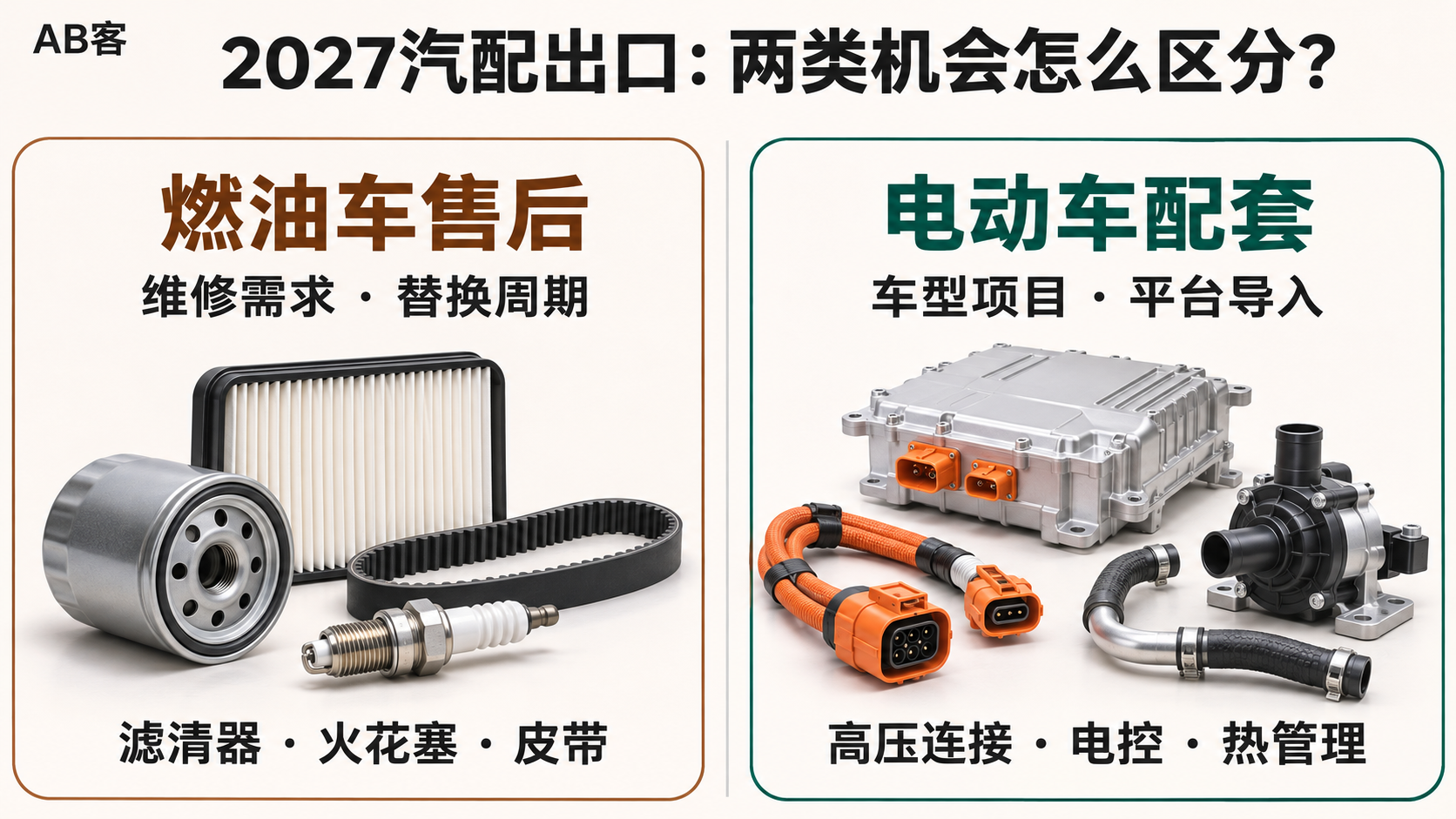
Which components require a reassessment of demand direction?
Power-related components
Engine, fuel supply, and exhaust-related parts should be differentiated between traditional fuel, hybrid, and plug-in hybrid applications. Pure electric vehicles do not have internal combustion engines, but this does not mean that hybrid vehicles do not require these components. When selecting products, one should drill down to the engine code, emission version, and year of vehicle installation to avoid treating "new energy" as a uniform category for parts compatibility.
Cross-power type components
Chassis, brakes, body, and wheel end products have market potential across powertrain types, but "same function" does not equate to "universal specifications." Changes in vehicle weight, axle load, regenerative braking strategies, and body structure may alter material, dimensional, and performance requirements. Brake matching, installation locations, and sensor interfaces should be checked item by item; simply relying on the vehicle model name and continuing with the old catalog is insufficient.
electric vehicle accessories
Entry requirements for thermal management, electrical connection, and control products include sealing, insulation, temperature resistance, vibration, electromagnetic compatibility, and vehicle interface compatibility. When safety or software functions are involved, responsibility verification must also be conducted on a project-by-project basis.United Nations Economic Commission for Europe Vehicle RegulationsIt can be used to identify the relevant regulatory framework, but its specific applicability still depends on the sales region, part category and customer requirements, and cannot replace compliance instructions with "applicable to electric vehicles".
How to choose between OEMs, Tier 1 suppliers, distributors, and repair channels?
Entering the cycle
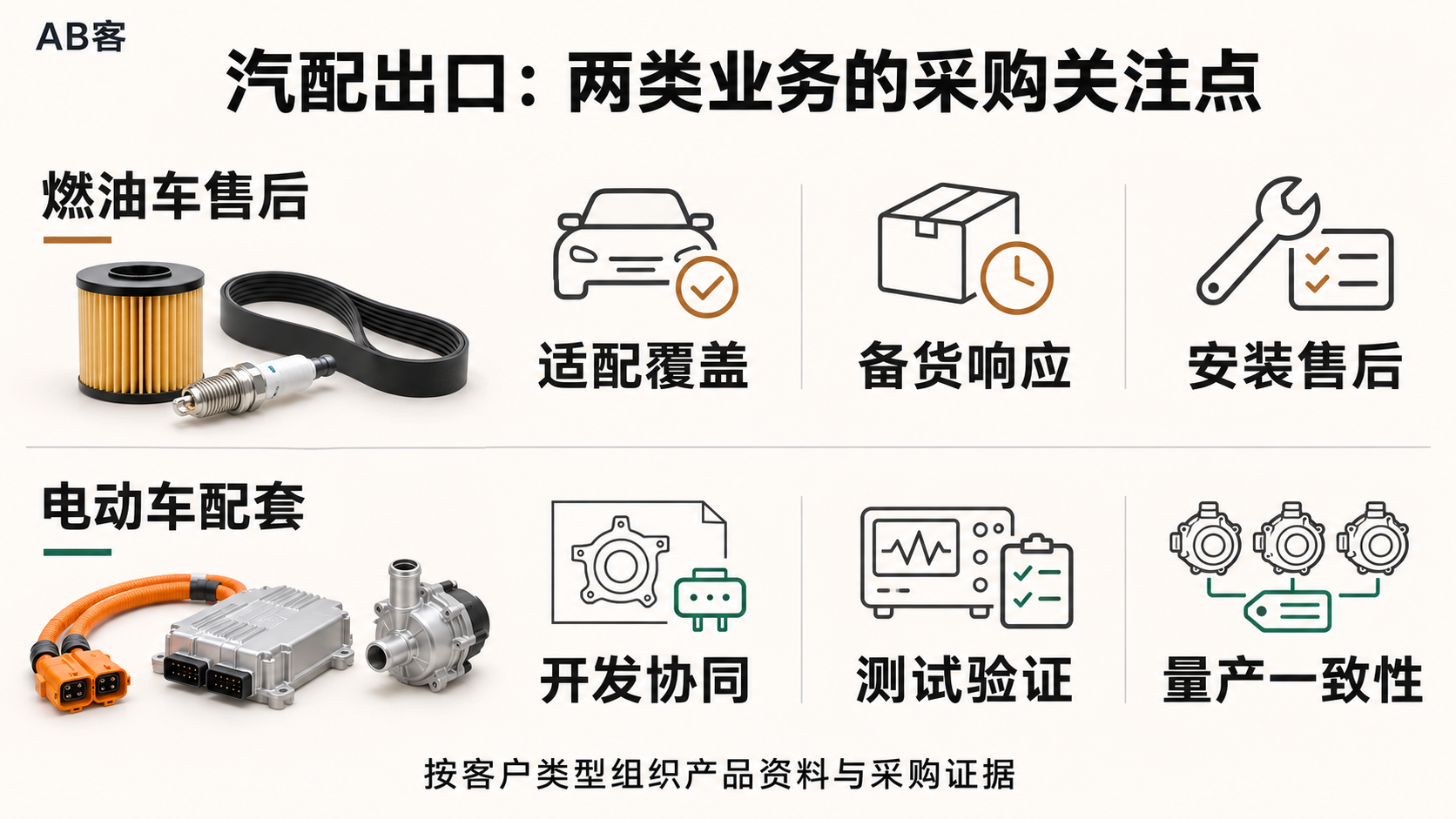
OEMs and Tier 1 suppliers typically focus on development validation, quality audits, and mass production supply; after-sales channels, on the other hand, prioritize catalog accuracy, sample matching, and continuous replenishment. APQP, PPAP, and other requirements should be based on customer agreements and should not be assumed to apply the same process to all projects. Clearly defining validation milestones, sample responsibilities, and change approval procedures before quoting can reduce the risk of underestimating implementation costs.
Operating conditions
When comparing customer value, costs for mold making, testing, packaging, warehousing, capital tied up, and after-sales service should be calculated simultaneously. Multi-model, small-batch orders from distribution channels may increase long-tail inventory; planned orders for manufacturing support may also involve forecast adjustments and higher fulfillment requirements. Contracts should clearly specify minimum order quantities, delivery dates, payment terms, return and exchange conditions, and handling of quality disputes.
Customer Testimonials
Customer size is not the only selection criterion. Companies should determine whether the other party has project procurement authority, regional distribution capabilities, or is merely acting as a price inquiry intermediary, and then match this with their own manufacturing capabilities and service boundaries.
| Customer Type | Priority checks | Businesses need to prepare |
|---|---|---|
| OEM/Tier 1 Supplier | Project authenticity, access and mass production responsibility | Engineering verification, process control, traceability data |
| Importers/Distributors | Coverage includes vehicle models, inventory turnover, and regional channels. | Adaptation catalog, packaging and replenishment solutions |
| Repair channels | Installation capabilities, diagnostic capabilities, reasons for returns/exchanges | Installation limitations, troubleshooting, and technical support information |
Why does the vehicle compatibility information need to be specific to a particular version?
Basic fields
Compatibility information should include at least the brand, model, year, powertrain, regional version, and part number. If necessary, additional information such as the production date range, engine code, transmission, and chassis code should be provided. (North America can be referenced.)Auto Care Association's ACES and PIES Data StandardsThe former mainly supports data exchange for adaptation, while the latter supports product information exchange; adopting data standards does not equate to obtaining product certification.
Adaptation Evidence
Part numbers should be associated with dimensions, interfaces, materials, test records, and installation information, and the source and revision date should be retained. Similar appearance of samples does not prove functional consistency, and dimensional conformity does not substitute for performance verification. The EU market should also consider...EU Regulation 2018/858In accordance with relevant implementation requirements, the applicable type approval and market supervision obligations should be verified, rather than making a general claim that all auto parts are subject to the same certification.
Alternative Boundaries
Substitution relationships should be distinguished between original manufacturer number changes, cross-references, and verified functional substitutions. Terms such as "fully universal" or "direct replacement" should not be used without confirmation. For products with variations in interfaces, left/right positions, software compatibility, or limitations on installation accessories, inapplicable conditions should be recorded and re-verified during the quotation and order confirmation stages.
How will the product portfolio be arranged in 2027?
Existing assets management
Establish a product base based on existing orders, repeat purchases, gross profit contribution, and return reasons, prioritizing models with clear compatibility, consistent demand, and stable supply. For low-frequency products that occupy inventory, consider order-based supply. Whether it's worthwhile to retain after-sales service for gasoline vehicles should be determined based on local vehicle models and maintenance needs, not solely by global electric vehicle sales figures.
Add verification
New car models, new countries, and new channels should be validated in stages: first, identify the target car model and the purchaser; then verify samples, compliance, and commercial conditions; finally, decide whether to stock up or expand production. Record "customer expressing interest" separately from "completing technical confirmation" and "forming sustainable orders" to avoid misjudging the intensity of inquiries as mature demand.
Country, vehicle model, distribution channel
Adaptation, testing, cost
Samples, trial orders, feedback
Repeat purchases, gross profit, and risk
Feedback loop
Missing fields in quotations, sample mismatches, installation complaints, and returns should all be routed back to the same product documentation. Distinguish between incorrect selections, shipping damage, installation issues, and product defects to avoid judging quality solely based on the quantity of returns. The following matrix can be used as a template for purchasing clarification and internal maintenance; fields should be filled in with actual data, and unverified compatibility should not be presented as confirmed facts.
| Model | Year Model | power | Part Number | market | Adaptation Evidence |
|---|---|---|---|---|---|
| Brand, vehicle model, chassis code | Model Year and Production Range | Power type and code | Own serial number, original manufacturer reference serial number | Country/Region Version | Drawings, interfaces, tests, installation records |
| Record configuration exclusions | Record switching nodes | Note incompatible configurations | Indicate the state of the substitution relationship. | Please specify regional restrictions. | Retain source, version and reviewer |
FAQ:
- Does the increase in electric vehicle sales mean an immediate decrease in after-sales demand for gasoline-powered vehicles?
That doesn't mean it's a bad thing. Sales figures reflect new vehicle purchases, while after-sales service depends on existing stock, usage intensity, and willingness to maintain vehicles. Specific product categories may see growth, remain stable, or decline, depending on the country and vehicle model. - Can the same set of product information be used for OEM supply and after-sales export?
While audited basic facts can be shared, the delivered materials differ. Supporting services emphasize engineering specifications, process quality, and change control; after-sales services emphasize compatibility catalogs, installation conditions, packaging, and return/exchange policies. - Why is it still necessary to verify different regional versions of the same car model?
Emissions, left/right drive, powertrain configuration, and local regulations may result in differences in parts. These should be confirmed in conjunction with the production range, configuration code, and legally obtained vehicle identification information. - How can we avoid incorrect matching caused by the description of alternative parts?
Separate the reference number from the verified alternative, and clarify the scope of application, exclusions, and evidence status; clarify the lack of key fields first, and do not directly promise adaptation.
Related reading:
Authoritative Outlook: Which Industries Will Drive Global Trade Growth in 2027?
Accurate matching determines the value of an inquiry and whether the professional content provided by auto parts companies can truly support procurement.ABKE GEO Growth EngineBy leveraging enterprise knowledge bases, professional product pages, buyer inquiries, and CRM collaboration, vehicle model and parts information can be transformed into searchable and verifiable content assets. The enterprise's marketing intelligence agent can then assist in organizing needs and clarifying issues. Enterprises can manage potential customers, follow up, and provide feedback by country, channel, and vehicle model. When planning collaborations, it is recommended to first prepare a key product catalog, compatibility evidence, and a target market list, clearly defining the scope of knowledge organization, page construction, and lead generation, before implementing in phases. Search rankings, AI recommendations, or order results should not be used as guarantees.


