Hot Products





Popular articles
How Multilingual Content Enters the Global Sources Network: From Procurement Issues to Channel Version Adaptation Process
How Can Foreign Trade B2B Companies Test a New Market Without Overinvesting in a Localized Website?
Customers see AI answers before consulting; how can we record multi-channel touchpoints and keep unknown aspects as unknown?
Recommended Reading




Electronics manufacturing exports in 2027: How will the demand for AI infrastructure be transmitted to the supply chain?
AB Customer analyzes the transmission path of AI infrastructure demand to the electronics manufacturing supply chain in 2027, and explores semiconductor forecasting methods, customer adoption, alternative material verification, and procurement risks.
Investment in AI infrastructure may shift the procurement focus for some electronic products, but demand will not be evenly distributed along the supply chain. Increased revenue in the semiconductor market could stem from increased shipments, or it could be influenced by changes in prices and product mix. For exporting companies, the real challenge lies in determining whether their products can be incorporated into specific designs, pass customer verification, and be supplied stably under agreed-upon conditions.
When assessing export opportunities in electronics manufacturing in 2027, it's crucial to separate industry forecasts from project realities: the former identifies promising areas, while the latter determines supplier eligibility. This is particularly true in areas like computing, storage, interconnect, power supply, and thermal management, where demand ultimately boils down to interfaces, materials, testing, reliability, and business arrangements.
How should growth in the electronics industry be differentiated between revenue, price, and quantity?
Product category structure
The demand drivers for memory, logic devices, and other electronic components differ. Changes in AI server configurations may affect some storage and processor demand, while the procurement of connectors, power supplies, printed circuit boards, and structural components depends on equipment design, capacity deployment, and customer certification. Even if revenue in a particular semiconductor category grows rapidly, it cannot be directly inferred that orders or export volumes for all related components will grow in tandem.
The reference materials list WSTS's growth figures for the market and memory and logic products in the first half of 2026. However, this article cannot verify its original statistical tables and classification methods, and therefore does not consider these figures as confirmed facts. When using them for business decisions or external citation, the original WSTS release should be consulted first to verify the time period, currency, category definition, and year-on-year base period.
Price Factor
Revenue can be approximated as the combined result of the sales volume and price of different products. Increased average selling price, a higher proportion of higher-value products, or price fluctuations due to supply and demand changes can all drive up market revenue; conversely, even with increased shipments, a decrease in prices may offset some revenue growth. Therefore, market analysis should simultaneously seek comparable data on revenue, unit shipment volume, average selling price, and product mix.
| Observation indicators | What does this mean? | It cannot directly explain anything. |
|---|---|---|
| Sales revenue | Changes in sales amount within the statistical scope | Year-on-year change in shipment volume or demand for all supporting products |
| Average selling price and product mix | The impact of price and the proportion of high- and low-value products | Changes in orders and profits for individual suppliers |
| Shipment quantity | Changes in unit quantity under a specific caliber | All models, regions, or applications grew simultaneously. |
Predicted Differences
When comparing semiconductor market forecasts, it is essential to first confirm the release date, product categories covered, whether it's for monetary value or quantity, price assumptions, and whether the forecast has undergone a complete scenario reassessment. The reference material mentions Gartner's 2027 revenue forecast and WSTS's extrapolation based on actual quarterly data replacements; however, the specific figures and update methods still need to be verified against the original documents. Even if the statistical scopes are similar, they cannot be considered the same forecast without verifying the assumptions.
Trade data also requires careful distinction of the denominator. Reference materials mention the WTO's contribution of AI-related goods to the increase in global merchandise trade value in the first half of 2026; however, this percentage differs from the "percentage of total trade." Specific figures and the range of goods should be based on the original report. Forecasts are suitable for planning scenarios and should not directly replace customer orders, capacity bookings, or product certification information.
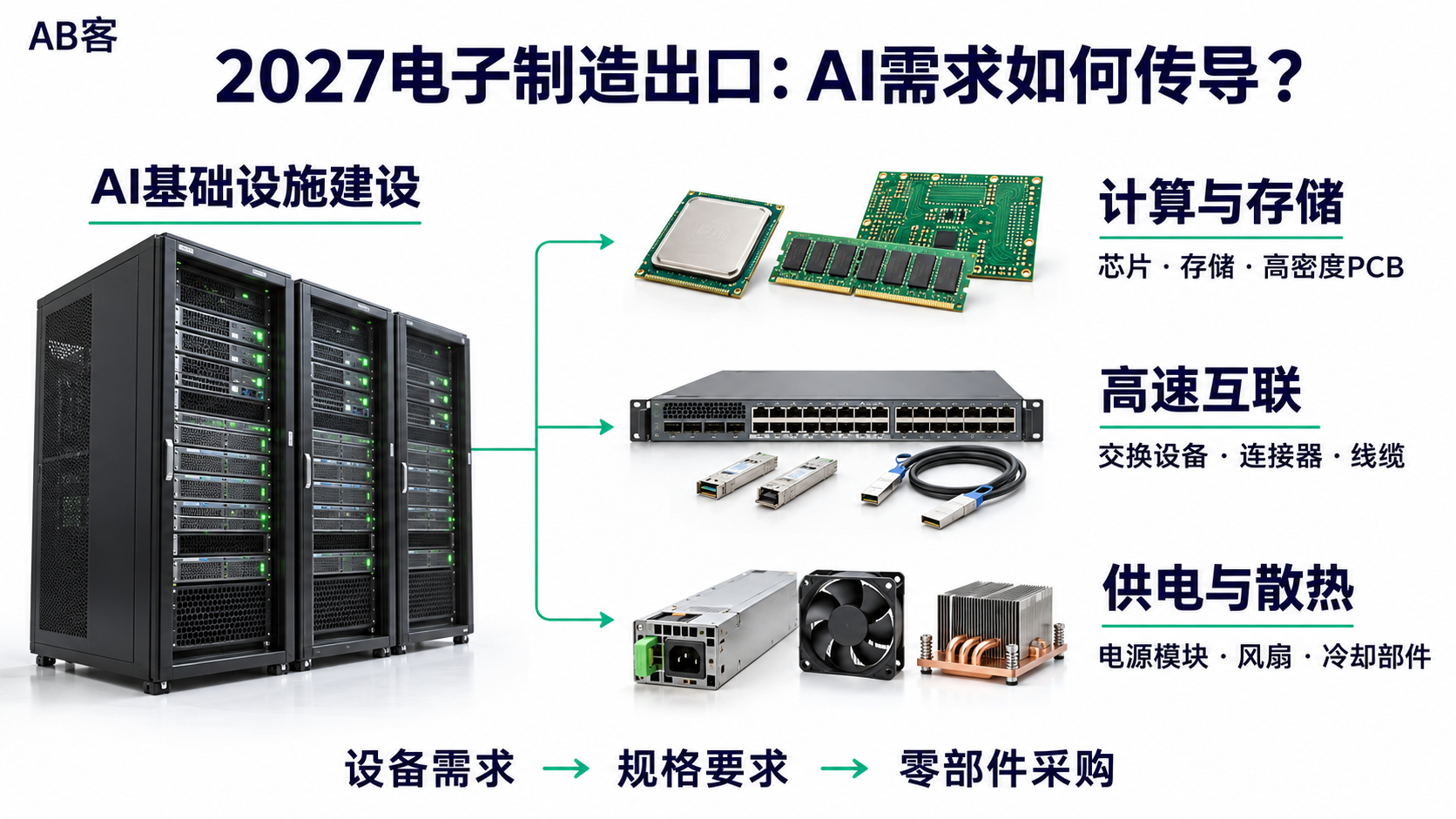
How can AI infrastructure generate specific electronic support needs?
There are multiple decision-making stages between infrastructure investment and supplier orders. Procurement opportunities typically involve determining system architecture, selecting components, verifying samples, and arranging mass production, rather than simply converting an industry concept directly into an order.
Computing and Storage
Computing and storage requirements may involve processors, memory, boards, and their manufacturing components, but the architecture, storage tier, and deployment methods vary across different systems. Suppliers should determine the tier of their products: whether they go directly into boards, or are used in device manufacturing, testing, or other supporting stages, and verify the specifications, environmental conditions, and supply cycles required for the target application.
Interconnection and power supply
Connection, signal transmission, and power solutions must conform to the system design. Connector or cable suppliers should verify interface type, electrical performance, mechanical life, and installation space; power supply-related products also need to be evaluated in conjunction with input/output range, load variations, protection requirements, and thermal conditions. The term "suitable for AI devices" is not a uniform specification; whether it can actually be replaced must be confirmed by customer design and testing.
Heat dissipation and structure
Power density, operating environment, space, and maintenance methods all influence heat dissipation and structural design. Companies can explain the applicable power consumption range, installation method, and testing conditions based on their own products, such as thermal interface materials, heat dissipation components, chassis structure, or processing services. The overall heat dissipation performance and reliability of the system under target operating conditions cannot be inferred solely from material names or single laboratory indicators.
What customer onboarding conditions must an electronics supplier meet?
Design Matching
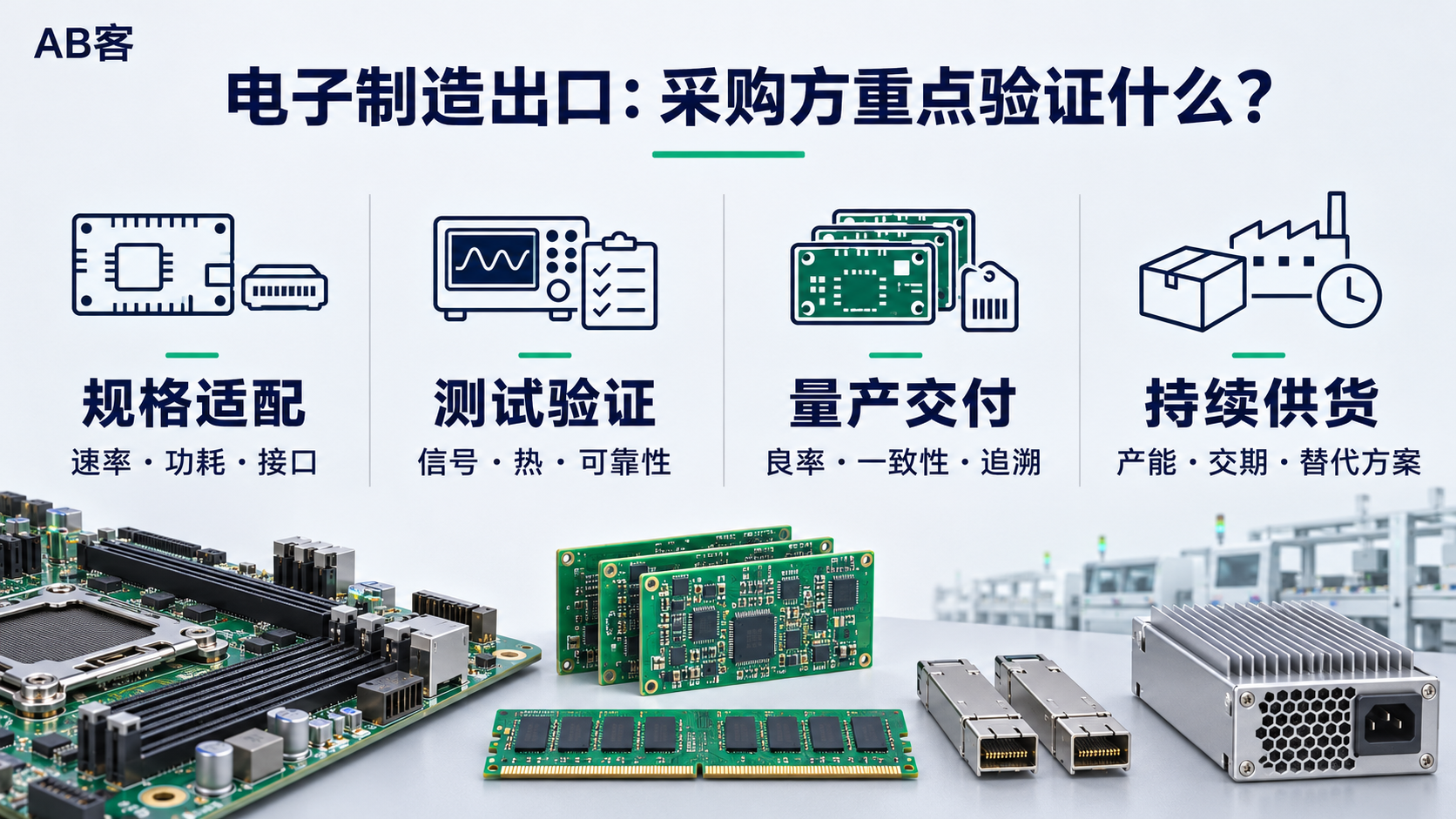
The design process should begin with the design boundaries, not the quotation. Suppliers should provide model numbers, key parameters, tolerances, interfaces, materials, and installation requirements, clearly defining the applicable environment and limitations. When discrepancies arise between customer drawings, product specifications, and actual samples, the version number and responsibility for any changes should be confirmed first to avoid substituting similar appearances for design compatibility assessments.
Verification materials
Verifiable documentation should describe the sample condition, testing methods, equipment or tooling, environmental conditions, judgment criteria, and results. When necessary, differentiate between supplier internal testing, third-party testing, and customer system testing: their purposes and scope differ, and they are not automatically interchangeable. A sample passing a test does not guarantee mass production consistency or validation for all use cases.
Record the model, batch, configuration, drawings, and applicable version.
The methods, conditions, judgment criteria, and original results are retained.
Clearly define the verification conclusions, limitations, and subsequent change procedures with the client.
Manufacturing Capability
B2B procurement focuses not only on individual samples but also on batch consistency, yield management, process control, and traceability. Suppliers should prepare key processes, inspection records, non-conforming product handling, and batch correlation information based on actual business needs. If customers require specific process audits or quality agreements, the scope and evidence should be confirmed before implementation. Yields should be interpreted in conjunction with products, processes, and statistical periods; undefined figures comparing different factories should be avoided.
How will BOM, alternative materials, and delivery time affect procurement in 2027?
Supply Structure
In the Bill of Materials (BOM), even low-value individual components can affect the delivery of the entire machine due to limited sourcing. The purchaser should identify key materials, manufacturing sources, supply tiers, capacity arrangements, and expected delivery dates, and differentiate between spot goods, regular production cycles, and situations requiring rescheduling. For export projects, deliverability should also be verified in conjunction with destination requirements and logistical arrangements.
Alternative verification
Alternative material evaluation should not be limited to comparisons of dimensions or nominal parameters. Mechanical fit, electrical performance, temperature range, long-term reliability, and compatibility with firmware, drivers, or system software can all alter validation results. Alternatives should be documented with information on the original and candidate models, differences, test items, applicable versions, and customer approval status; candidates should not be described as directly replaceable without approval.
Commercial Terms
Inquiries and contracts should clearly specify the minimum order quantity (MOQ), delivery start date conditions, inventory and material preparation responsibilities, quotation validity period, delivery arrangements, and notification methods for design, material, origin, or software changes. Forecasted demand and purchasing commitments should be recorded separately; for limitations that may affect delivery dates, communication and reconfirmation mechanisms should be agreed upon, rather than relying solely on a single quotation.
With the addition of internet connectivity and software functionality, how should responsibilities be divided?
Product Range
The technical boundaries and compliance responsibilities of passive components, modules with firmware or networking capabilities, and complete products for end users may differ. Both parties to the purchase should specify the deliverables, software or firmware versions, system integrators, and end uses to avoid simply transferring overall responsibility to all component suppliers, and to avoid ignoring the obligations that the modules themselves may bear.
Maintenance Arrangements
For products that include software, the division of responsibilities for version management, update releases, vulnerability reporting channels, issue response, and after-sales support should be confirmed in the cooperation agreement. Changes should not only describe the new version's features but also document the compatibility impact on hardware, drivers, and customer systems; support periods and notification methods should be based on the actual agreement and applicable rules.
Market Rules
When entering the EU market, companies should assess the applicability of the EU Cyber Resilience Act (CRA) by considering product functionality, deployment methods, and the operator's role. The main obligations under this act will apply from December 11, 2027, with some obligations having different application dates. Companies should review official regulations and relevant guidelines and seek professional compliance advice when necessary; they cannot assume that a product is necessarily subject to or excluded from the regulations simply because it is used in AI devices.
How can electronics companies demonstrate their actual relevance to target applications?
Application of evidence
Effective application descriptions should start with specific design problems, such as where the product will be installed, what connection or thermal management issues it will address, and which interfaces and operating conditions it will depend on. If customer validation has not yet been completed, it can be described as a potential application awaiting validation, specifying the conditions requiring customer confirmation, avoiding packaging market direction as existing project facts.
Performance Boundaries
Parameters must be read along with the test methods and conditions. Enterprises can establish a unified matrix for sales, engineering, and purchasing, placing the scope of application, validation status, and alternative limitations in the same record; missing data is marked as pending confirmation and not filled in speculatively. The following is the field structure and does not represent that any specific product has passed validation.
| application | model | parameter | Test conditions | Alternative Boundaries | Supply Arrangement |
|---|---|---|---|---|---|
| Equipment location, purpose and environment | Product Model, Configuration and Version | Key Specifications, Tolerances and Limitations | Methods, sample conditions and judgment criteria | Differences, compatibility conditions and approval status | MOQ, delivery date, quotation deadline and change notice |
Project Experience
Publicly available verification, delivery, and problem-solving records are more helpful for buyers than general industry experience. When compiling materials, the actual work undertaken by the company, project conditions, verification scope, and document dates should be clearly stated, and necessary authorizations should be obtained. When confidential information is involved, methods can be described without disclosing the client's identity and sensitive parameters, but results should not be fabricated or implied to be endorsed by the client.
FAQ:
- Does the growth in semiconductors mean that all electronic manufacturing products will grow in tandem?
This does not mean that revenue is affected by price and product mix, and different components also depend on system design, customer projects, and supply conditions. The demand and validation status of the target product should be verified separately. - Why do different institutions have different assessments of the scale in 2027?
Release dates, coverage, pricing assumptions, and update methods may differ. Before comparing, the original report should be reviewed, and the difference between complete forecasts and extrapolations based on partial data substitutions should be distinguished. - Does the fact that a product can be used in AI devices mean that it has been validated by customers?
Not equal. Potential applicability needs to be confirmed in conjunction with the client's design, testing conditions, and formal implementation process; the scope of completed tests should also be explained. - How to avoid inconsistencies between substitute materials, parameters, and software version information?
Manage specifications, compatibility testing, approval records, and change notifications using a unified model and version, and ensure that engineering, purchasing, and sales use the same controlled information.
Related reading:
Authoritative Outlook: Which Industries Will Drive Global Trade Growth in 2027?
E-procurement relies on accurate and traceable technical information. For breakthroughs in key products and customer acquisition of complex industrial goods, AB Inquiry can assist companies in compiling applications, models, parameters, testing, and supply boundaries into a corporate knowledge base. This knowledge base is supported through multilingual product pages, technical FAQs, and knowledge-constrained enterprise agents, aiding in selection communication and helping overseas buyers assess suitability and reduce redundant clarifications. Companies can further consult on knowledge organization and GEO content development paths by combining existing product information with target markets.


