Hot Products





Popular articles
How Can OEM and ODM Companies Help AI Identify the Actual Manufacturer?
Auto parts exports in 2027: How to differentiate between after-sales service opportunities for gasoline vehicles and supply opportunities for electric vehicles?
How can industrial product videos be integrated into AI solutions? From YouTube demos to searchable technical content.
How Can CRM Connect the Same Inquiry from Source to Sale, and What Needs Manual Updating?
Authoritative Outlook: Which Industries Will Drive Global Trade Growth in 2027?
Recommended Reading





Exporting Heat Pumps and Air Conditioners to Europe in 2027: How Do Diverging Demand and Refrigerant Restrictions Affect Product Selection?
ABKE examines product selection for heat pump and air conditioner exports to Europe in 2027, covering restrictions by country, equipment type, capacity and refrigerant, as well as performance, distribution channel and after-sales service considerations.
For heat pumps and air conditioners exported to Europe in 2027, product selection should not be based solely on whether a refrigerant has a low GWP, nor should regulatory-driven replacement be assumed to translate directly into increased purchasing. Companies need to check demand in each target country, equipment classification, rated capacity, refrigerant application requirements, and local installation and after-sales capabilities. Restriction dates, technical conditions and safety exceptions differ by equipment type, so each project must be assessed against the specific model.
According to the supplied figures attributed to the IEA’s Renewables 2026 report, approximately 2.9 million heat pumps were sold in Europe in 2025, up 13% year on year. When citing these figures, verify the original report, the geographical coverage of Europe and the definition of sales used. Even if regional sales recover, demand in individual countries may still be affected by subsidy continuity, electricity prices relative to other energy sources, building renovation progress and installation capacity.
How should the European heat pump market be segmented by country and type of demand?
New residential buildings, existing building renovations and commercial projects.
Europe is not a single procurement market. New residential projects typically determine heating loads, heat emitters and equipment space at the design stage. Renovations of existing buildings require an initial assessment of insulation, existing radiators, water supply temperature and electrical distribution capacity. Commercial projects also require consideration of load profiles, zone control, operational continuity and maintenance windows.
Exporters should build project lists by country, building type and buyer role: provide design support documentation to developers, explain compatibility with existing systems to renovation channels, and provide commercial customers with operating conditions, control interfaces and maintenance arrangements. The same equipment may be valued very differently across projects.
The impact of subsidy stability, relative electricity prices and installation capacity.
Purchasing decisions depend on more than equipment prices. Subsidy eligibility, application timing and budget availability can determine whether a project starts. The relationship between electricity prices and prices for alternatives such as gas affects operating economics. The number and training level of installers, as well as grid connection requirements, can also limit actual delivery speed.
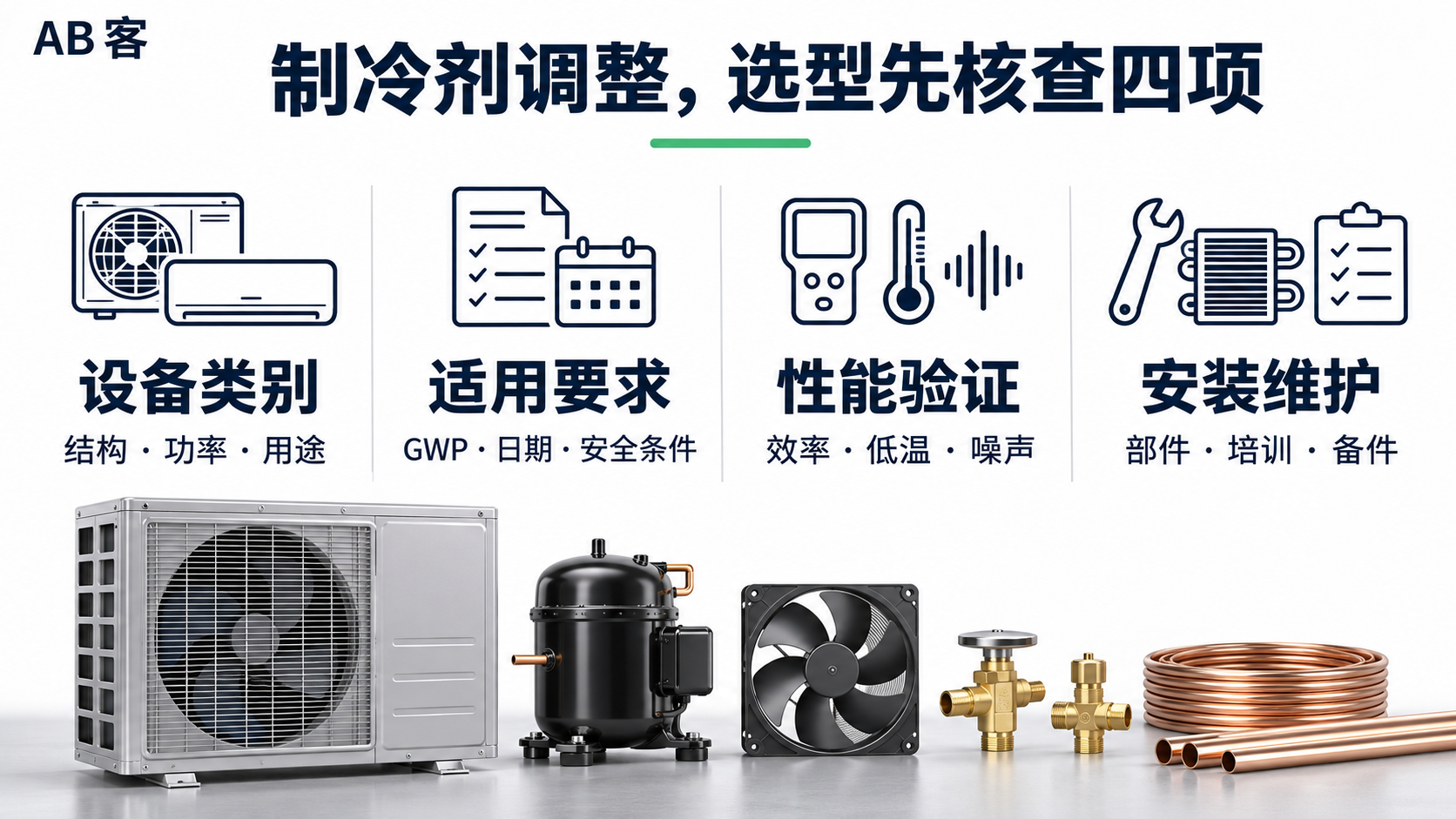
Identify the equipment type before assessing refrigerant restrictions
Monobloc, split, air-to-water, air-to-air and chiller equipment.
Monobloc and split describe equipment configuration, while air-to-water and air-to-air describe heat exchange and application. Chillers must be assessed according to their actual function, refrigeration circuit and regulatory classification. Applicable provisions cannot be inferred from a sales name alone: models in the same product series may fall under different restrictions because of differences in system configuration, intended use or rated capacity.
Regulatory reviews should also distinguish between first placing a product on the EU market and other stages such as installation and servicing. Whether the product has already been placed on the market, who bears the importer’s obligations and the product’s specific configuration can all affect the measures a company needs to take.
Create a model-specific table covering capacity, GWP, applicable dates and safety exceptions.
Annex IV to EU Regulation 2024/573 on fluorinated greenhouse gases sets out separate restrictions for different types of equipment. From 1 January 2027, split air-to-water heat pumps and air-conditioning equipment with a rated capacity of 12 kW or less that contain or rely upon fluorinated greenhouse gases with a GWP of 150 or more are, in principle, prohibited from being placed on the EU market. The applicable provision includes an exception where necessary to meet safety requirements at the site. This exception should not be understood as an automatic exemption for an entire product series.
| Verification Items | Model record | Judgment method |
|---|---|---|
| Equipment classification | Monobloc or split; air-to-water, etc. | Identify the corresponding equipment entry in the regulation |
| Rated capacity | Record the value and unit according to the technical documentation | Check the capacity threshold and definitions in the applicable provision |
| Refrigerant and GWP | Name, composition and GWP applicable under the regulation | Check the threshold using the approach specified in the applicable regulation |
| Dates and exceptions | Planned date of placing on the market and installation location | Verify each restriction and safety exception condition |
The 2027 entry above cannot be extended to all air conditioners, monobloc equipment or chillers. For an actual assessment, consultthe original EU regulationand the latest applicable provisions, taking into account safety, building and installation requirements in the target country, and have the assessment confirmed by a qualified professional.
How do refrigerant changes affect product design?
Component compatibility, safety design, transport, installation and maintenance requirements.
A refrigerant change may affect the compressor, heat exchanger, valves, sealing materials and control strategy; it is not simply a matter of replacing the refrigerant charge. If a flammable refrigerant is used, leakage risk, ventilation, ignition-source control, charge limits and safety markings must also be assessed for the specific product and installation scenario.
Check component compatibility, control logic and applicable safety standards.
Confirm packaging, transport classification, on-site space and installer requirements.
Prepare servicing tools, operating instructions, spare parts and staff training materials.
Assess new product development and modifications to existing models separately, and define the scope of validation.
New product development can begin with target regulations, application conditions and supply chain requirements. For modifications to existing models, first identify how design changes affect performance, safety, reliability and previous test results. Validation should cover the actual changes and related components, with retesting where necessary and updates to technical documentation, labels and instructions.
At project initiation, consult importers, installers and compliance professionals to clarify responsibilities and completion milestones for technical documentation. This helps avoid discovering after the design is complete that the product cannot be installed on site or supported by the service network.
Why do buyers need comparable performance data?
Compare efficiency, low-temperature performance, noise and heating capacity under clearly specified test conditions.
Equipment performance must be understood alongside its test conditions. When comparing COP or seasonal efficiency, specify the test standard, outdoor temperature and water supply temperature or indoor conditions. When comparing heating capacity at low temperatures, also consider defrosting and auxiliary heat source configurations. Noise data should distinguish between sound power level and sound pressure level and state the measurement conditions.
For buyers, a single high value at rated conditions is not enough to demonstrate suitability throughout the year. Suppliers should provide traceable test documentation and operating ranges, explaining the limits of applicability of performance curves so designers can determine whether the equipment suits the target building.
Look beyond equipment prices to include installation, operation, maintenance and spare parts costs.
| Cost category | What to compare | Main influencing factors |
|---|---|---|
| Purchase and installation | Equipment, accessories, installation work and electrical upgrades | Project conditions, labour and materials |
| Operation | Electricity and auxiliary heat source costs | Climate, load, energy prices and control strategy |
| Maintenance and spare parts | Scheduled maintenance, repairs and parts replacement | Service coverage, parts availability and downtime risk |
Total cost of ownership calculations should state assumptions such as service life, energy prices and operating hours, and allow buyers to adjust them. Subsidies that have not yet been approved should be listed separately rather than treated as guaranteed benefits.
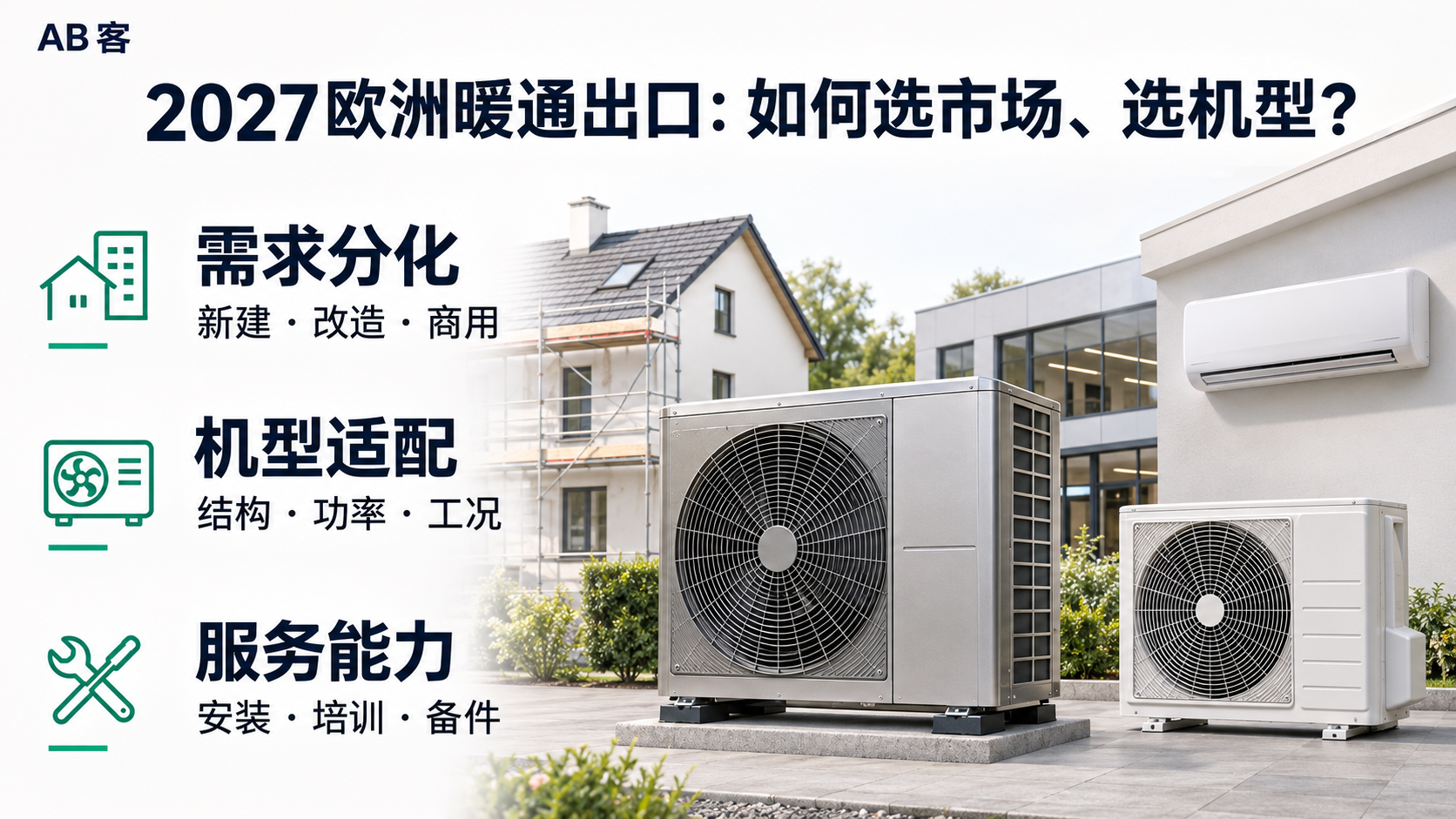
How should companies screen channels and projects for 2027?
Distributor inventory, installer training, service coverage and end-customer subsidy eligibility.
When assessing distributors, look beyond their sales networks to understand their current inventory mix, technical support capabilities and allocation of after-sales responsibilities. Whether installers are familiar with the relevant refrigerant and equipment, and have access to training and service documentation, directly affects project execution. For projects involving subsidies, confirm who must apply, the product or installation requirements, and the latest local rules.
Monitor scenarios involving improving demand, policy changes and channel inventory reduction separately.
Track whether project enquiries, installation schedules and end-customer orders are increasing together.
Check subsidy conditions, budgets and implementation dates, and promptly update quotation assumptions.
Compare inventory turnover, channel shipments and end-customer installations, and plan inventory purchases cautiously.
The three scenarios may occur at the same time. Companies can review project progress and channel feedback in priority countries quarterly, and set different schedules for supply, training and spare parts preparation rather than relying on a single market forecast.
Business decision-making tool
A Country–Model–Refrigerant–Delivery Requirements Matrix can connect market, R&D, compliance and sales teams. Each row represents a target country and a specific model or project configuration, preventing product series names from being used in place of actual technical parameters.
| Target country and application | Model and capacity | Refrigerant | Restriction dates | Test documentation | Installation and after-sales service |
|---|---|---|---|---|---|
| Country, building type and project stage | Equipment classification, model and rated capacity | Name, GWP and safety properties | Applicable provisions, dates and grounds for exceptions | Standards, operating conditions and report version | Installation requirements, service providers and spare parts arrangements |
The matrix should also record information sources, responsible personnel and review dates. When regulations or product configurations change, update the relevant rows first, then align quotations, technical documentation and channel training materials.
2027 outlook analysis for other export industries:
FAQ
- Does 2027 mean that refrigerants must be replaced in all air conditioners across Europe?
No. EU restrictions are specified separately by equipment category, capacity, refrigerant GWP and applicable date, and certain entries include specific safety exceptions. Assessments must be based on the actual product and regulatory provisions. - Can the same model be used directly across multiple European countries?
This cannot be assumed in advance. In addition to common EU rules, companies must check each country’s building, installation, safety and subsidy requirements, and assess local climate, channels and service capabilities. Technical documentation and instructions must also meet applicable requirements in the target market. - Does a recovery in heat pump sales mean distributors will increase inventory?
Not necessarily. Distributors may still need to reduce inventory or wait for clarity on subsidies, financing and project orders. Assess inventory turnover, end-customer installations and purchasing plans rather than looking only at regional sales.
Organise product evidence by market and model—AB Customer GEO
For exporters seeking to make progress with priority products in priority markets,AB customerGEO methods can be used to organise verified information on country-specific demand, equipment classifications, refrigerants, applicable operating conditions, performance tests and installation services into multilingual product and application pages, with options to request technical selection advice and documentation. Content should identify evidence sources and applicable conditions, and be updated regularly as regulations, models and service coverage change. Its value lies in helping search systems, AI and overseas buyers understand a company’s capabilities more clearly, not in guaranteeing indexing, citations or recommendations.
Companies can first organise their priority countries, target models and existing test documentation, thenCommunicating with AB customerscontent framework and website conversion requirements; specific compliance and project applicability must still be confirmed against the latest regulations and professional assessments.


