
It facilitates coordinated bulk supply, but concentrates price and inventory risks. It is suitable for situations with relatively clear demand, tight delivery times, and manageable financial resources.
Hot Products





Popular articles
Why can't the application of AI in industrial manufacturing be directly copied from the consumer industry? From industry trends to content layout for engineering Q&A.
2026.11.06
Reading:
0
感恩节客户放假,询盘如何不断档?外贸官网的假期承接清单
2026.11.05
Reading:
0
Authoritative Outlook: Which Industries Will Drive Global Trade Growth in 2027?
2026.11.13
Reading:
0
Recommended Reading

Reading:
0

Reading:
0
Fertilizer exports in 2027: How to manage inventory and pricing given the expectation of price decline?
Release time:
2026/11/17
Type:
Industry Research
AB Customer, combining 2027 fertilizer price forecasts, analyzes the agricultural season demand, inventory risks, pricing terms, and payment arrangements for nitrogen, phosphorus, potassium, and compound fertilizer exports, helping companies develop market-specific and product-specific decision-making plans.
The expectation of an annual price decline and short-term supply fluctuations can coexist. For exporters of nitrogen, phosphate, potash, and compound fertilizers, inventory and pricing for 2027 should not be adjusted uniformly based on a single annual forecast, but should be decided separately based on product specifications, the agricultural season in the destination country, transportation cycles, order coverage, and payment terms.
The World Bank's October 2026 forecast indicates that the fertilizer price index will decline by 12.4% year-on-year in 2027, the reference price for diammonium phosphate (DAP) will decrease by 18.1%, and the reference price for potassium chloride will decrease by 9.4%. These figures are annual forecasts for different indicators and are not commitments regarding Chinese export transaction prices or prices for specific months; forecasts for different commodities are not interchangeable. The OECD-FAO's "Agricultural Outlook 2026-2035" also lists energy and fertilizer costs as uncertainties in agricultural markets and conducts scenario analysis.
Why is it necessary to study nitrogen, phosphorus, potassium and compound fertilizers separately?
Differences in raw materials, energy, production and transportation conditions.
Cost transmission varies across different fertilizer types. Nitrogen fertilizer production is typically sensitive to energy and raw material conditions, such as natural gas and coal; phosphate fertilizer production requires attention to inputs like phosphate rock, sulfur, and synthetic ammonia; and potash fertilizer production depends on resource supply, logistics in major production areas, and contract arrangements. Compound fertilizers involve multiple nutrient raw materials, and their costs are also affected by formulation ratios, processing, and packaging. A decrease in the price of a particular raw material does not necessarily mean a corresponding decrease in the cost of all finished products upon arrival at port.
In terms of transportation, inland port collection, port operations, ocean freight, and destination port costs should be calculated separately. The cost structures and shipping restrictions differ between bulk and bagged shipments, and between full-shipment and containerized shipments. Port congestion or route adjustments may offset some of the benefits of lower raw material prices.
The correspondence between reference product prices and the specifications of our company's products.
DAP reference prices are suitable for observing the direction of the relevant phosphate fertilizer market, while potassium chloride reference prices can serve as an indicator of the potash fertilizer market. However, neither can directly represent the price of urea, other phosphate fertilizers, or compound fertilizers. Before comparison, nutrient content, product form, delivery location, trade terms, and pricing cycle should be verified. For compound fertilizers, the cost of each raw material and processing fees should also be calculated based on the actual formula.
| Category | Key observation | Export quotation verification |
|---|---|---|
| Nitrogen Fertilizer | Energy, raw materials and start-up conditions | Specific varieties, nitrogen content, packaging and shipping period |
| Phosphate Fertilizer | Phosphate rock and related raw materials, reference prices | Nutrient specifications, testing standards and port of destination costs |
| Potash Fertilizer | Supply sources, logistics and contract terms | Variety, content, particle size and delivery arrangement |
| Compound Fertilizer | Formula ingredient combination, processing and packaging | Nitrogen, phosphorus, and potassium ratios, applicable crops, and formulation requirements |
How can target market demand be connected with agricultural seasons?
Crops, planting season, fertilization window, and dealer inventory.
Fertilizer procurement often precedes actual application. Companies should work backward from the destination country's main crops and local fertilization windows to determine import, customs clearance, inland distribution, and distributor preparation times, and then combine this with their own production and booking cycles to determine pricing and delivery milestones. Fertilization windows may differ across different regions or crops within the same country; therefore, it's insufficient to rely solely on the national average agricultural timeframe for all orders.
For example, if a customer requires regional delivery to be completed before the fertilization season, the latest arrival date, allowed partial shipments, and handling methods for delays should be confirmed when quoting a price, rather than just agreeing on a vague delivery month.
Differentiate between end-user demand and channel inventory replenishment.
Increased purchases by distributors may stem from increased end-user demand, or it could simply be restocking at low prices, adjusting safety stock, or delays in previous deliveries. When making a judgment, it's advisable to cross-verify this by considering customer inventory, downstream orders, historical sales patterns, and local crop conditions. When data is insufficient, channel orders should be viewed as demand leads, rather than directly equating them to actual fertilizer application.

How do expectations of declining prices affect inventory?
High-cost inventory, goods in transit, and locked-in sales orders.
First, establish an inventory ledger by batch, distinguishing between quantities already received, in transit, purchased but not yet shipped, and planned purchases, recording purchase costs, warehousing fees, estimated arrival dates, and availability. Then, associate signed sales orders with their corresponding batches to confirm whether sales prices are locked in, whether there is room for adjustment in delivery, and whether customer payment terms have been finalized.
The risks of high-cost inventory extend beyond just the fact that the book cost exceeds the cost of new goods. These risks also include prolonged storage time, product clumping or packaging damage, and unsold inventory nearing the agricultural season. Specific accounting treatment should be based on applicable standards and the company's financial policies, and inventory losses should not be determined solely based on market forecasts.
Compare centralized procurement, batch procurement, and order-coverage inventory preparation.
Retain room for adjustment according to the market, but assess the risks of subsequent supply, booking and agricultural season disruptions.
Procurement will be arranged based on confirmed orders to reduce uncovered inventory; however, it is still necessary to verify the customer's ability to fulfill the contract and the production delivery date.
A practical approach can be combined: determine the base quantity to cover orders, assess uncertain demand in batches, and reserve a reasonable buffer for critical deliveries. The size of the buffer should be determined by replenishment cycles, supply reliability, and the company's financial situation.
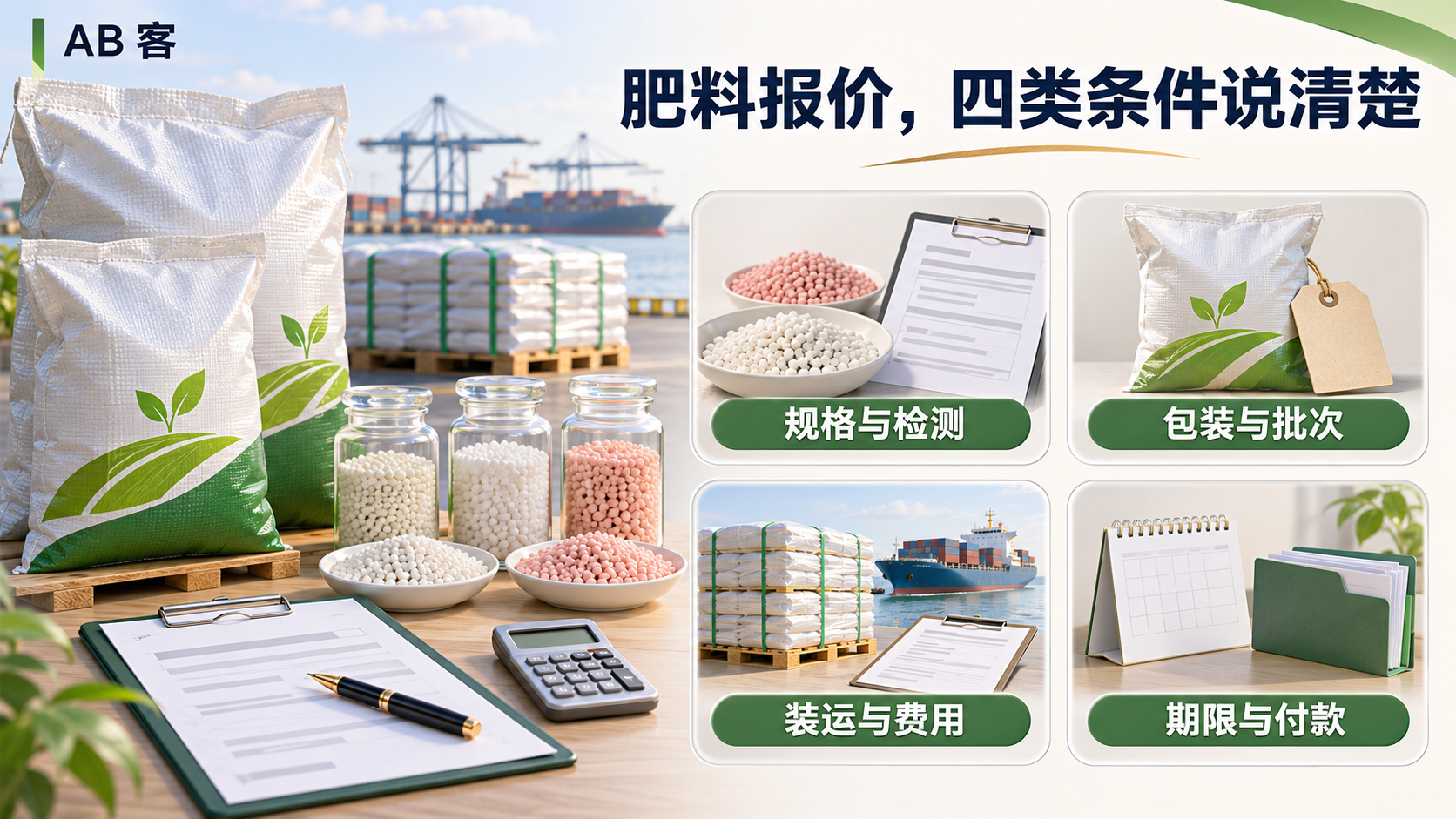
What quality and delivery conditions should be specified in the quotation?
Nutrients, particle size, moisture content, packaging, batch number, and testing criteria.
Fertilizer export quotations should be consistent with the product specifications, clearly specifying nutrient content and its representation, particle size range, moisture requirements, packaging form, and net weight. When compound fertilizers are involved, the formula ratio and other indicators required by the customer should also be clearly stated. Testing items, applicable standards, sampling methods, and the responsible party for issuing reports should be agreed upon in the contract; a single reference price cannot substitute for a quality definition.
For customers who require batch consistency, procedures for batch labeling, sample retention, and handling quality objections should be communicated. Product labeling, registration, and import requirements must be verified in accordance with the current regulations of the destination country to avoid affecting customs clearance or sales due to incomplete documentation.
Shipment time, port charges, quotation deadline and payment arrangements.
The quotation should specify the applicable trade terms and versions, port of shipment or port of destination, delivery time, allocation of costs and risks, validity period of the quotation, and payment method. For orders sensitive to fluctuations in ocean freight, exchange rates, or raw material prices, the conditions for reconfirming the price can be agreed upon with the customer; market fluctuations should not be considered as a basis for automatic price adjustments without mutual agreement.
Payment arrangements should be aligned with customer credit, order amount, production input, and shipping time. Companies can assess the suitability of prepayments, letters of credit, or other agreed-upon methods, and verify documentation requirements, payment trigger points, and late payment handling clauses. Gross profit calculations should not only include procurement and logistics costs but also consider the capital tied up in payments and the risks associated with collections due to payment terms.
How to identify changes in risk in 2027?
Energy, export policies, shipping routes, destination country inventory, and agricultural delays.
Establish an updated watchlist by product type and destination country: track energy and major raw material prices, export and import management requirements, port and shipping status, customer inventory, and changes in local agricultural seasons. Policy information is based on the latest announcements from relevant authorities, transportation information is confirmed with shipping companies and freight forwarders, and customer inventory is verified through regular communication.
Monitoring frequency should be matched with the order schedule. The frequency of verification can be increased as the quotation deadline, loading, or fertilization window approaches; if key conditions change, arrival time, total cost, and contract fulfillment capability should be recalculated promptly.
Scenario of price decline, supply disruptions, and delayed customer payments.
| scene | Potential impact | Response to inspection |
|---|---|---|
| Prices continued to fall | Undercovered inventory reduces competitiveness | Review batch costs, order coverage, and subsequent procurement schedule. |
| Supply or flight routes disrupted | Delivery delays, changes in transportation costs | Confirm alternative sources of goods, routes, and contractually permissible adjustments. |
| Customer delayed payment | Slower cash flow restricts subsequent procurement. | Verify credit, payment milestones, documentation, and funding buffers. |
Scenario analysis is not a guarantee of future trends. It is recommended to examine cash flow and delivery arrangements when multiple risks overlap, such as a price drop occurring simultaneously with customer payment delays, rather than just calculating a single price change.
Business decision-making tool
The "Fertilizer Order and Inventory Scenario Table" can be created by order or product batch and updated with each quotation, purchase, and risk review. The table below is a field template; the specific data should be filled in by the company based on contracts, inventory, and logistics records.
| variety | Specification | target country | farming season | Inventory costs | Sales Coverage | Route | payment terms |
|---|---|---|---|---|---|---|---|
| Fill in the variety and batch number | Fill in nutrients and packaging | Fill in the market and port | Fill in the fertilization and delivery window | Fill in the purchase and related expenses | Enter the number of locked orders | Fill in the shipping and delivery route | Fill in the payment schedule and deadline |
When using this method, first confirm the available inventory and the quantity in transit, then match them item by item with the locked orders. For any uncovered portions, calculate the impact of price drops, delivery delays, and payment delays, and record the responsible person, the review date, and the next steps. Unsigned requests should be marked separately from confirmed orders.
FAQ
Does a decline in the annual average price forecast mean that all inventory should be cut immediately?
Not necessarily. The annual average price does not represent the price at every procurement point in time. Existing orders, replenishment cycles, agricultural season windows, and supply stability must also be considered to avoid excessive inventory reduction that could lead to missed deliveries.
Can international reference prices be directly used as China's export quotations?
This cannot be applied directly. The reference price may vary depending on the variety, specifications, location, and delivery terms; export quotations also need to account for processing, packaging, inland transportation, port charges, sea freight, exchange rates, and payment terms.
Does the increase in distributors' inventory equal the increase in end-user fertilizer use?
Not necessarily. Distributors may make purchases in advance due to price, inventory levels, or anticipated supply changes. The assessment should take into account downstream sales, inventory, and local crop demand.
2027 outlook analysis for other export industries:
Content is organized around crops, specifications, and procurement cycles.
For different markets, distributors are not only concerned with price, but also need to confirm whether the crop's intended use, nutrient specifications, testing criteria, packaging, and delivery time meet the actual procurement requirements.AB Customer GEO Growth EngineWe can assist fertilizer exporters in establishing multilingual product and market content based on verified product information and buyer inquiries, while maintaining consistency in specifications, testing, and delivery information. This facilitates product selection and price inquiries for overseas buyers. Companies can first review key markets, existing product information, and common procurement questions before seeking consultation.AB customerAssess a suitable content development path; market forecasts and marketing content cannot replace cost calculations and contract review for specific orders.


Disclaimer: This content was created by AI and reviewed by humans. The above content represents only the creator's personal views.
Fertilizer exports in 2027
Fertilizer export price forecast
Fertilizer inventory and pricing
Foreign Trade B2B GEO
AB customer
Prospects for the Fertilizer Export Industry in 2027
Fertilizer Export Industry Trends in 2027
How to export fertilizers in 2027?
2027 Foreign Trade Outlook
Foreign Trade GEO
