Hot Products





Popular articles
How Can OEM and ODM Companies Help AI Identify the Actual Manufacturer?
Before Thanksgiving, Overseas Buyers Need to Confirm Not Discounts, but Whether You Can Still Deliver
When an OEM/ODM factory selects a GEO service provider, how do they confirm the scope of use of the client's name, drawings, and customized case studies?
Recommended Reading




Food Exports in 2027: How Could Expected Ingredient Price Increases Affect Pricing, Specifications and Delivery?
ABKE examines food ingredient price expectations for 2027 and explores formulation costs, product specifications, shelf life and delivery risks to help exporters develop pricing and order management strategies.
Food price indices provide a reference for the raw material environment and cannot be directly equated with cost increases or export price increases for a specific food product. Exporters of processed foods, grains and oils, ingredients, and agricultural products should calculate costs based on actual formulations, procurement cycles, and order delivery terms, while ensuring that product specifications, food safety requirements, and shelf-life requirements remain consistent before and after any changes.
In October 2026, the World Bank forecast that the food price index would rise by 7.2% year on year in 2027, the grains price index by 9.3%, and the oils and meals index by 7.8%. These figures are forecasts of annual averages denominated in US dollars, not actual prices or price increases for specific products.View the World Bank forecast.OECD–FAO Agricultural Outlook 2026–2035Provides long-term baseline scenarios for agricultural supply and demand. It is suitable for tracking structural changes and should be used separately from short-term procurement quotations.
Which foods are more directly affected by expected increases in raw material prices?
The share of grains, oils and fats, sugar, proteins, and other raw materials.
Cost pass-through depends first on the share of each raw material in the cost per unit of finished product and when that material is actually purchased. Grain-based products such as noodle and pasta products, baked goods, and feed ingredients are sensitive to procurement prices for the relevant grains. For edible oils and products with a high fat content, oilseed, refining, and packaging costs must also be considered. Confectionery, beverages, and high-sugar ingredients require a separate assessment of changes in sugar procurement costs. Protein ingredients and processed agricultural products may also be affected by grade, origin, and seasonal supply.
An index typically covers a group of commodities whose composition may not match the grades, delivery locations, or currencies used in a company's procurement. Even when raw material prices rise, inventory, alternative sourcing, and contractual arrangements can cause the impact to appear at different times across batches.
Distinguish between raw material prices, ex-factory prices, export quotations, and final selling prices.
Raw material prices signal changes in input costs. Ex-factory prices also include processing, packaging, and company overheads. Export quotations are further affected by trade terms, freight and insurance, exchange rates, and payment terms. Final selling prices are jointly determined by importers, distribution channels, and local market conditions. The same percentage increase cannot be applied directly across all stages.
How can a product-level cost pass-through model be established?
Procurement, formulation, processing losses, packaging, transport, and financing costs.
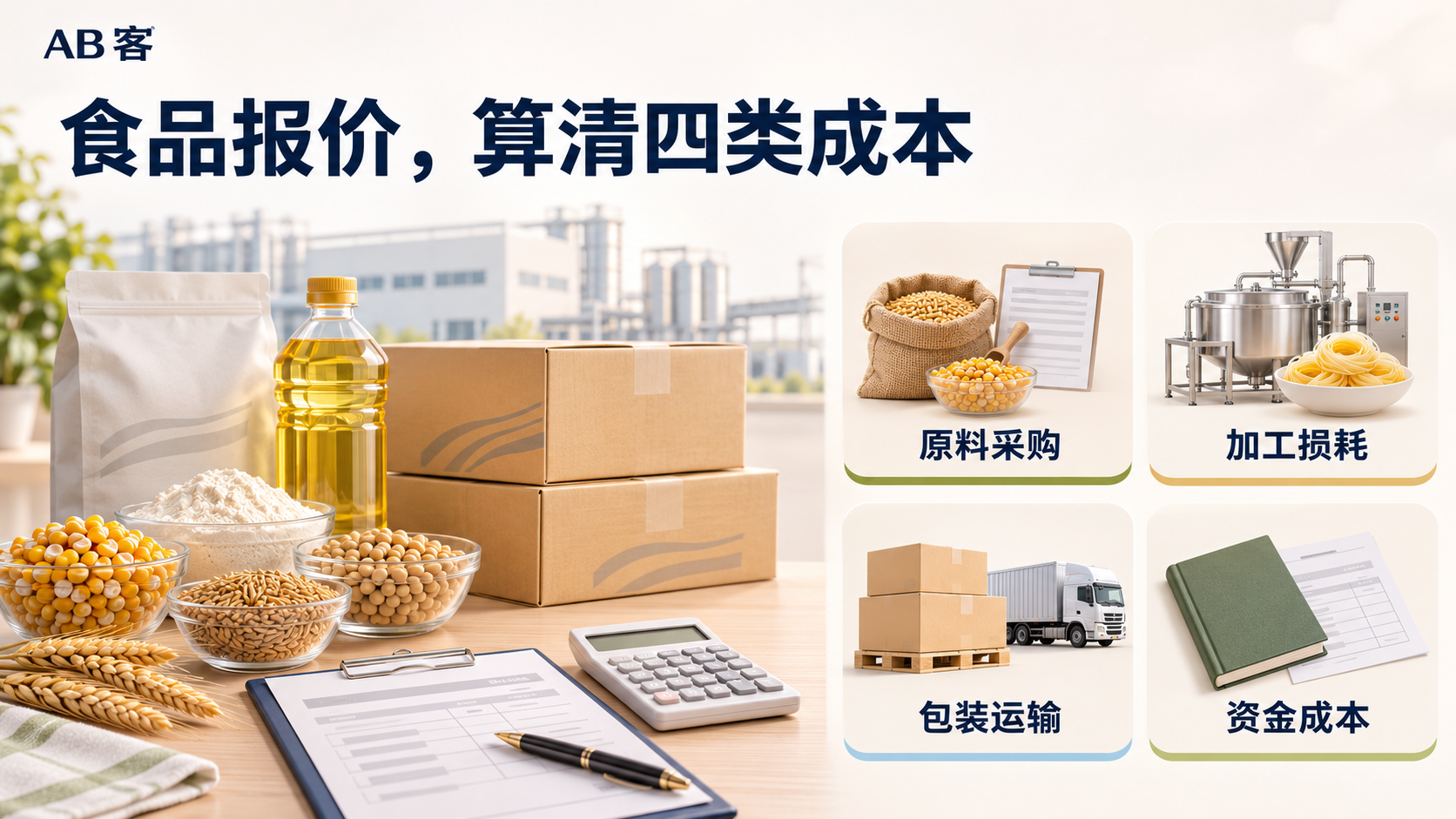
Prepare an order cost sheet using a consistent sales unit and a clearly defined delivery location. Calculate raw material costs using actual input quantities, purchase prices, and usable yield. Then add relevant costs such as processing energy, labor, packaging, testing, warehousing, transport, insurance, and financing. Export quotations should also state the currency, exchange-rate assumptions, and trade terms to avoid double-counting or omitting costs.
Processing losses should be calculated consistently with raw material input quantities to avoid counting them twice when yield has already been factored in. When comparing different options, treat expected exchange rates and freight rates as separate assumptions rather than attributing all changes to the food raw material index.
Compare spot purchases, fixed-price raw materials, and long-term orders.
| Arrangement | Cost characteristics | Key checks |
|---|---|---|
| Spot purchases | Prices vary with the timing of procurement | Supply continuity, batch quality, and quotation validity |
| Fixed-price raw materials | Improves cost predictability within the agreed scope | Fixed-price quantities, duration, quality, and breach-of-contract terms |
| Long-term orders | The selling price may not align with procurement costs across multiple batches | Batch quantities, price review mechanism, and inventory responsibility |
Fixing raw material prices does not eliminate all risks: packaging, energy, exchange rates, and freight costs may still change. Before signing a long-term order, align the raw material price-lock period with the buyer's collection schedule for each batch.
What must be confirmed with the buyer when changing specifications?
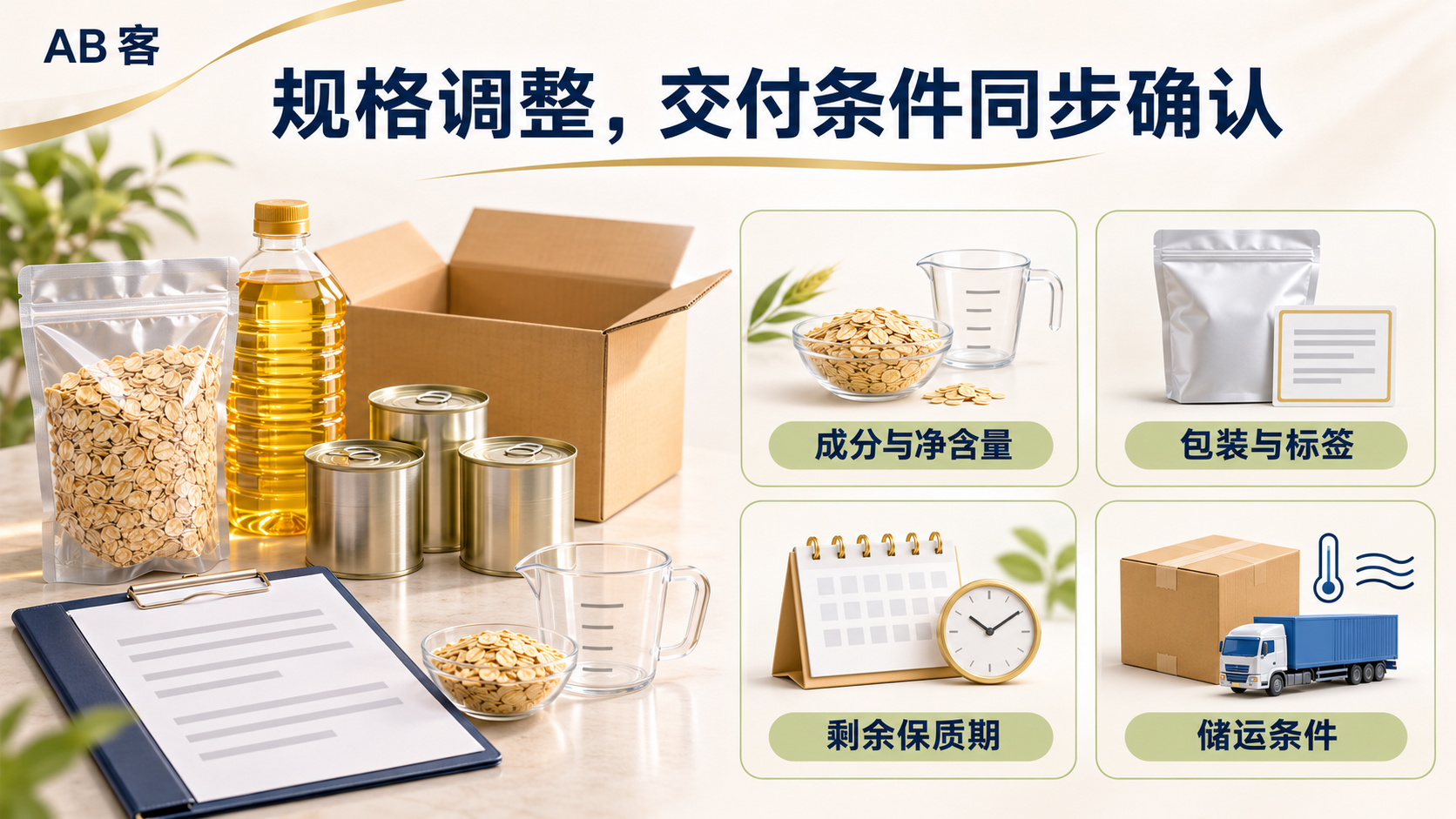
Net content, ingredients, packaging, labeling, and product use.
Cost reduction should not be assessed solely on the price per item. Changes to net content, ingredient proportions, or packaging materials may alter the price per unit of weight, carton quantities, label declarations, and suitability for the buyer's production process. Provide a comparison of the old and new specifications, clearly stating ingredients, allergen information, packaging format, storage requirements, and intended use. Obtain the buyer's written confirmation of the batch from which the changes take effect.
Before export, also check the destination market's applicable requirements for ingredients, labeling language, nutrition claims, and food-contact packaging materials. Specific obligations vary by product, destination, and sales method; where necessary, seek confirmation from the importer or a specialist organization.
Technical, quality, and customer validation required for alternative raw materials.
Before substituting a raw material, assess its function in the formulation, sensory performance, stability, allergen profile, and applicable regulatory requirements. Then conduct sample trials, quality testing, and any necessary shelf-life validation. For ingredients used in the buyer's subsequent processing, confirm suitability under actual process conditions. Agreed raw materials should not be changed without approval solely to reduce internal costs.
How does shelf life constrain market selection and delivery routes?
Remaining shelf life after production, transport, customs clearance, and distribution.
Whether a buyer can sell or use a product depends on its remaining shelf life upon arrival, not just the total shelf life stated on the label. Scheduling should start from the production date and account for finished-goods waiting time, domestic transport, international transport, customs clearance, and distribution at the destination, with a reasonable allowance for potential delays. The required remaining shelf life should be confirmed against the contract and destination market requirements.
If the product is not expected to meet the buyer's agreed requirement upon arrival, consider adjusting the production batch, transport route, delivery frequency, or target market. Do not alter the production date or extend shelf life through unvalidated methods.
Assess temperature control and losses separately for ambient, chilled, and frozen products.
For ambient products, consider high temperatures, humidity, and packaging barrier properties. For chilled products, verify temperature conditions throughout the journey and continuity during transfers. For frozen products, also assess temperature fluctuations caused by loading and unloading, power outages, or delays. Product-specific temperature ranges should follow validated product requirements, contractual terms, and applicable regulations.
How can businesses protect order margins and customer relationships in 2027?
Set quotation validity periods, price adjustment triggers, and phased delivery arrangements.
Quotations should specify product specifications, quantities, currency, trade terms and their version, payment method, validity period, and delivery schedule. For orders spanning multiple procurement cycles, agree with the buyer on price review dates, trigger criteria, adjustment methods, and notification procedures. Reference indicators should relate to actual procurement, with their data sources and scope clearly defined.
Phased deliveries can help coordinate production and inventory, but may also increase transport, inspection, or warehousing costs. Negotiations should also address minimum batch quantities, collection windows, inventory ownership, and responsibility for delays, rather than adjusting prices while overlooking fulfillment costs.
Analyze scenarios involving rising raw material costs, weak demand, and transport disruptions separately.
Set baseline and stress scenarios for each order. When raw material prices rise, review quantities without fixed prices and quotation flexibility. When demand is weak, assess inventory turnover, minimum purchase quantities, and remaining shelf life. When transport is disrupted, check alternative routes, additional costs, and arrival deadlines. State the assumptions for each scenario rather than treating forecasts as certain outcomes.
Business decision-making tool
The Food Cost and Delivery Risk Table can support joint review by sales, procurement, quality, and logistics teams. For each quotation or change in terms, retain the sources of assumptions, the responsible person, and the update date.
| Item to check | Order records and decision criteria |
|---|---|
| formula | Raw material inputs, yield, allergens, and change approval status |
| Procurement cycle | Inventory batches, replenishment timing, fixed-price quantities, and duration |
| Price assumptions | Raw material quotations and assumptions and sources for exchange rates, energy, and freight |
| Package | Net content, materials, label version, and packing configuration |
| Shelf life | Production date, estimated arrival date, and buyer's remaining shelf-life requirement |
| Temperature control | Storage and transport conditions, temperature records, and responsibility for handling deviations |
| Testing | Applicable tests, report validity, and correspondence to the relevant batches |
| Quotation terms | Validity period, trade terms, payment, price adjustments, and phased delivery arrangements |
FAQ
- If the food price index rises by 7.2%, does that mean product quotations should also rise by 7.2%?
No. The figure is a forecast of the annual average food price index. Each product must be assessed item by item based on its raw material composition, procurement contracts, processing and packaging costs, exchange rates, and delivery terms. - How can businesses manage the tension between fixed selling prices and raw material price fluctuations?
First check the order cycle against the raw material price-lock period, then discuss price reviews, procurement arrangements, or phased deliveries with the buyer. Any specification changes should undergo quality validation and customer confirmation. - How can buyers verify shelf life, batches, and transport conditions?
Buyers can ask suppliers for the production batch, production and expiry dates, storage and transport requirements, and applicable testing documentation corresponding to the order. For temperature-controlled goods, they should also check transport records and procedures for handling deviations.
2027 outlook analysis for other export industries:
Communicate product specifications and delivery terms clearly
Food exporters can useAB Customer GEO Growth Engineto organize verified, publicly shareable information on product ingredients, specifications, storage and transport conditions, applicable markets, and testing into a consistent knowledge base. They can then create multilingual product pages and FAQs addressing overseas buyers' product selection and procurement questions. Pages should distinguish general information from order-specific terms and establish procedures for reviewing and updating information. This can help buyers provide product use, quantity, destination market, and delivery requirements when making inquiries. Search indexing, AI citations, and inquiry results remain subject to various platform and market factors.
Faced with uncertainty in raw material prices in 2027, businesses should bring cost calculations, specification confirmation, and delivery verification together in one order workflow. For help organizing product knowledge and multilingual procurement content, consultAB customerto discuss a suitable content development approach based on existing materials and target markets.


