Hot Products





Popular articles
2027年电气设备出口:电网投资如何形成细分采购机会?
Before Thanksgiving, Overseas Buyers Need to Confirm Not Discounts, but Whether You Can Still Deliver
Expand, Observe, or Pause? Decision Gates for Emerging-Market B2B Website Pilots
Recommended Reading



Metal materials exports in 2027: How will demand recovery and CBAM affect pricing and delivery?
AB Customer analyzes the export trends of metal materials in 2027, distinguishing between steel demand, aluminum and copper price forecasts and deep processing opportunities, and outlining the scope of CBAM, pricing risks, quality traceability and data delivery responsibilities.
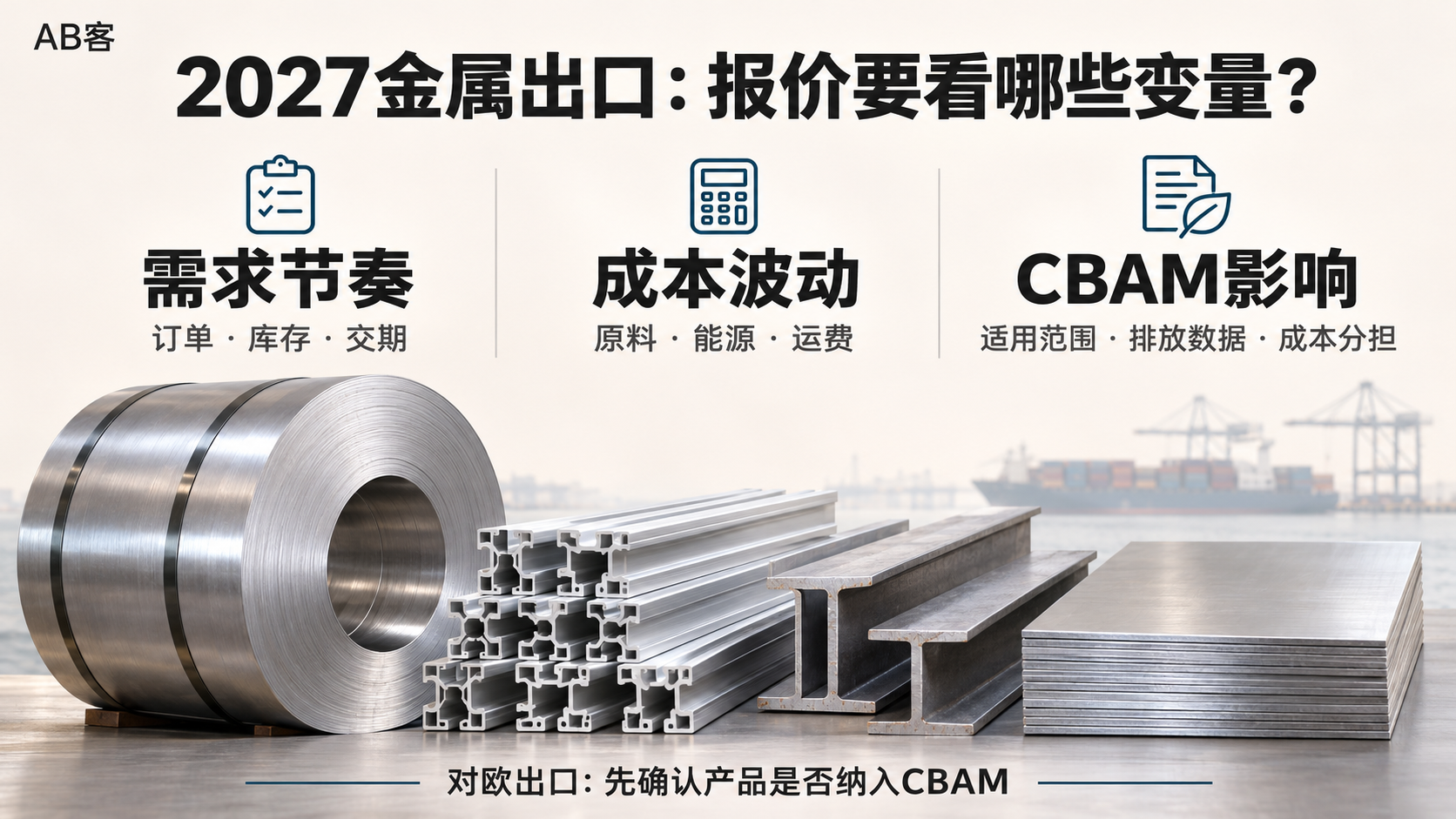
The key to metal material exports in 2027 lies not in predicting whether demand, prices, or carbon costs will rise individually, but in how these three factors combine in specific markets and products. A recovery in steel demand may improve end-user purchasing expectations, but it doesn't necessarily boost imports; aluminum and copper price forecasts can help companies conduct budget scenario analysis, but they cannot replace actual quotes for processed products. For exporters, a more valuable unit of judgment is...Target country, product code, material grade, processing technology and end applicationThe combination of .
-
need:Distinguish between global demand, demand outside of China, and demand in specific countries, and further identify local supply and import competition.
-
price:Separate the annual nominal dollar price forecast from the timing of procurement, processing fees, logistics, and terms of the transaction.
-
CBAM:The EU's carbon border adjustment mechanism will officially take effect on January 1, 2026. Whether it is applicable will be verified according to commodity codes and existing rules.
-
deliver:The quotation should not only specify the product and trade terms, but also stipulate quality information, applicable emission information and liability boundaries in advance.
In which markets and applications will the recovery in metal demand in 2027 be primarily reflected?
Regional differences
The World Steel Association's short-term outlook is an important reference for assessing steel demand. The reference material lists the following 2027 forecasts: global steel demand grows by 1.7%, reaching 1.752 billion tons; growth outside China is 4.0%, and growth in India is 8.0%. These figures should be compared with...The World Steel Association's latest short-term outlookAnd the statistical caliber must be verified. Forecasts reflect judgments at a specific point in time, not actual results; global averages cannot represent the import growth rate of a particular market.
Exporting companies should translate regional forecasts into order assumptions: which industries are driving local demand, can local steel mills meet the increased demand, do target products rely on imports, and do customer procurement cycles align with project commencement schedules? Even if total demand in a country increases, local capacity expansion or inventory reduction may compress import opportunities.
Terminal differences
The demand for metals in construction, machinery, electrical, automotive, and energy projects cannot be simply summed up. Construction projects focus more on project schedule and structural material specifications; machinery procurement emphasizes processing performance and batch stability; electrical applications require verification of conductivity and relevant standards; the automotive supply chain typically focuses on consistency, verification cycles, and delivery stability; and energy projects need to consider project design, operating environment, and certification requirements.
Verify the bidding process, design confirmation, and actual procurement timeline to avoid treating project planning directly as an order.
Pay attention to customer production schedules, inventory, and alternative materials to determine whether demand is sustainable.
Trade opportunities
When selecting markets, local supply, import sources, tariffs, and applicable trade measures should be considered simultaneously. Anti-dumping, countervailing duties, safeguard measures, and product compliance requirements may alter landed costs or supply feasibility; specific details should be based on the official regulations of the importing country and the applicable conditions of the order. It is recommended to first establish a market list by product code, and then verify the customer's application needs and procurement channels, rather than selecting markets solely based on macroeconomic growth rates.
How should steel, aluminum, copper, and deep-processed products be analyzed separately?
Basic materials
Basic material selection should begin with grade, standard, size, tolerance, batch size, and delivery condition. Even within the same category of steel, the production and procurement conditions for plates, profiles, and pipes may differ; aluminum and copper also require differentiation based on alloy or material condition. Customers need deliverable materials tailored to specific applications, not a market average price that deviates from specifications.
The reference material lists the World Bank's October 2026 forecasts for average annual aluminum and copper prices in 2027 as US$3,100 and US$13,000 per ton, respectively, all in nominal US dollars. These figures should be verified before use.World Bank Commodity Markets Outlook and Price Forecast TableThe original text, publication date, and product definition are included. Annual forecasts are not purchase prices for a specific day and do not automatically include premiums/discounts, exchange rates, processing or transportation costs.
Deep-processed products
The competitiveness of deep-processed products depends on the matching of materials and processes. For example, cutting, forming, machining, welding, and surface treatment all affect cost, inspection requirements, and delivery cycle. When requesting a quote, drawings or technical specifications should be obtained to clarify key dimensions, tolerances, surface conditions, connection methods, and usage environment. For special requirements, samples and acceptance conditions should be confirmed first before discussing bulk pricing.
Indicator differentiation
| index | Answer the questions | Cannot be directly replaced |
|---|---|---|
| Demand | How much material does the market or industry need? | Import volume or enterprise order volume |
| Benchmark Price | Price reference for specific varieties and time periods | Actual purchase price of the specified grade |
| Processing fee | Value-added costs such as process, loss and inspection | Complete export quotation |
| Export transaction price | The price agreed upon by the buyer and seller under the contract conditions | Unified market forecast |
These four indicators can have different directions: when demand improves, prices may not rise in tandem; when benchmark prices are stable, special processing and small-batch requirements may still increase transaction prices. The analysis should retain the respective time period, currency, and product category.
How does CBAM proceed with the quotation and document delivery process?
Scope verification
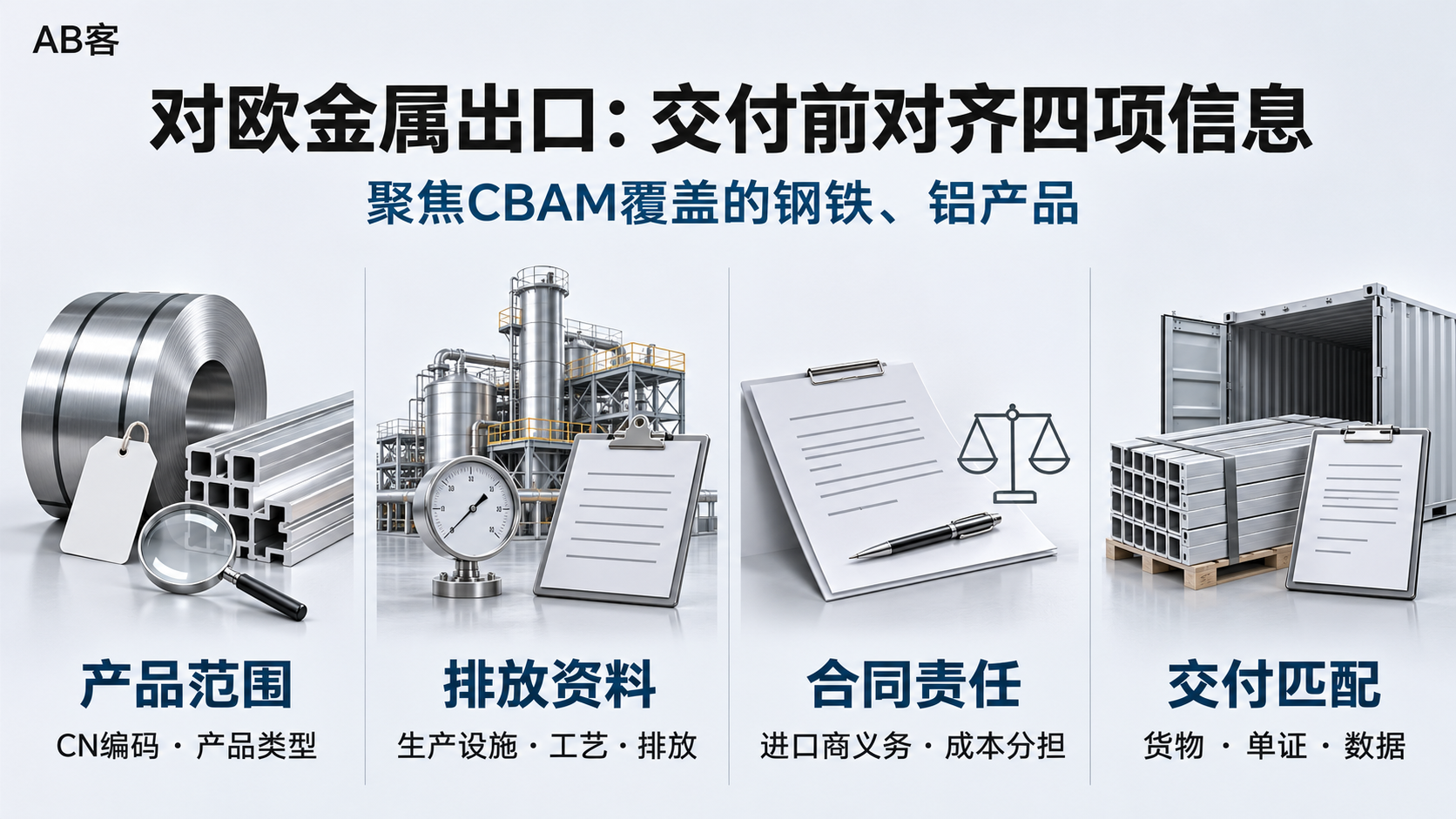
CBAM covers specific goods, including some steel and aluminum products, and cannot be applied to all metal materials and articles thereof, nor can it exclude them solely based on product name. Entities with the appropriate capabilities should verify the EU Composite Naming Act (CN) code, country of origin, import arrangements, and applicable thresholds or exemptions; specific rules are governed by current official EU regulations and...European Commission CBAM official pageAs the standard.
The reference materials list the following deadline: September 30, 2027 for the initial annual declaration and corresponding certificate submission, which applies to imports from the previous year. Enterprises should verify the latest regulations in effect before arranging contract and document delivery, confirming the applicable scope, declaration period, and deadlines, to avoid equating document submission time with the statutory declaration period.
Emissions information
Emissions information should be differentiated according to applicable rules, distinguishing between actual production process data, data requiring verification, and cases where default values can be used. Composition, performance, or batch information in product quality reports can help establish product associations, but cannot automatically replace embedded emissions data. Accounting boundaries, data periods, precursor materials, and verification requirements should be determined by relevant professional entities according to current rules.
During the quotation stage, confirm what information the buyer needs, when it should be provided, what data path will be used, and the data confidentiality and change mechanisms. Do not promise a certain emission level without sufficient evidence, and do not treat the compliance costs that the importer may bear as a fixed unit product cost.
handover of responsibilities
Provide the production route and available raw data.
Coordinate the handover of orders, products, and documents.
Confirm applicable obligations and arrange for declaration and related compliance matters.
When required by the rules, verification shall be conducted in accordance with applicable qualifications and procedures.
The above is a schematic diagram of business collaboration; specific legal obligations and contractual responsibilities should be confirmed separately. It is recommended to list the document names, responsible persons, delivery milestones, data update methods, and anomaly handling procedures in the quotation attachments; when emissions accounting, verification, and reporting are involved, these should be handled by entities with the corresponding professional capabilities and legal qualifications.
What kind of quality and traceability evidence do buyers need?
Material evidence
Buyers typically require reports that match the material standards, grades, chemical composition, mechanical properties, and test results specified in the order. The report should indicate the applicable batch and the issuing authority; whether third-party inspection, additional testing, or a specific report format is required should be agreed upon in the contract. The value of complete evidence lies in allowing the customer to determine whether the received goods conform to the agreed specifications.
Process evidence
For deep-processed products, material qualification does not automatically guarantee final product qualification. Enterprises can provide records related to production routes, key processing conditions, dimensional inspections, and surface treatments as required by customers, specifying the scope of application. When trade secrets are involved, confidentiality and controlled access can be agreed upon, rather than disclosing production data that is not suitable for public disclosure.
Relationship
The focus of a traceability system is to establish verifiable links, not to pile up documents. When orders are changed, processed in batches, or multiple batches are mixed, mapping relationships should be recorded; emissions information should only be linked when applicable and there is reliable evidence, and should not be inferred due to a lack of original data.
| product code | Brand | Craftsmanship | batch | Quality data | Emissions information |
|---|---|---|---|---|---|
| Verify applicable codes and markets | Recording standards and grades | Record production and processing routes | Related orders, furnace batches, and shipment batches | List the report, test items, and issuing party. | Confirm the data path, responsible person, and delivery time according to applicable requirements. |
How to manage material price and order risks in 2027?
Quotation Structure
The quotation should break down the base price of materials, premiums or discounts or specification differences, processing fees, packaging, logistics and other agreed costs, and clearly specify the currency, trade terms, validity period and price adjustment conditions. If the buyer requires emissions data or special verifications, the scope of data, cost sharing and delivery time should be agreed separately; taxes and compliance costs should not be included in the seller's quotation without verification.
For orders with long lead times or significant price fluctuations, a price review mechanism can be negotiated with the buyer, specifying the reference indicators, pricing time, and applicable scope. Contract terms should be confirmed by both parties, and legal and trade professional advice should be sought when necessary.
Inventory and payment terms
A mismatch between procurement and sales timing exposes businesses to both price and financial risks. Raw material procurement schedules, inventory responsibilities, and prepayment and final payment terms should be determined based on orders, and the impact of delayed delivery or specification changes by customers on inventory should be assessed. Managing inventory required for unconfirmed orders separately from signed orders helps identify which risks can be shared through contracts and which must be borne by the company itself.
Market Portfolio
When configuring business for 2027, it's not advisable to solely pursue countries with high demand growth. Instead, compare end-user applications, product market access, achievable gross margins, data preparation costs, and payment terms, while also considering dependence on any single customer or market. For new markets, validate coding, sampling, and payment arrangements before deciding whether to expand investment; for mature markets, continuously examine whether the product portfolio and delivery capabilities still match customer needs.
FAQ
-
Does increased demand for steel necessarily lead to increased imports?
-
Not necessarily. Local supply, inventory, product mix, and trade measures can all affect import volumes.
-
Can aluminum and copper price forecasts be directly used as quotes by companies?
-
No. Annual forecasts are only scenario-based; actual quotes depend on the timing of the purchase, specifications, processing, logistics, exchange rates, and contract terms.
-
Which information should be provided by the manufacturer, and which should be the responsibility of the importer?
-
Manufacturers typically provide available production and product data; importers should confirm their applicable declaration and compliance obligations. Specific division of responsibilities must be determined based on regulations and contracts.
-
Can material quality reports and carbon emission data be substituted for each other?
-
No. The former mainly proves material performance or test results, while the latter involves emissions information calculated and delivered according to applicable rules. The two can be related, but their uses are different.
Related reading:
Authoritative Outlook: Which Industries Will Drive Global Trade Growth in 2027?
The value of materials ultimately needs to be expressed through concrete evidence. AB Customer can assist metal materials and deep-processing companies in utilizing their corporate knowledge base, multilingual technical pages, and global content and channel networks to organize grades, processes, applications, quality reports, and publicly available traceability information, making it easier for overseas buyers to understand product capabilities. Companies can start by communicating their construction needs based on target markets, key products, and existing data lists; emissions accounting, verification, and reporting remain the responsibility of the relevant professional entities.


