Hot Products





Popular articles
How Export Manufacturers Can Build a Traceable GEO Knowledge Base
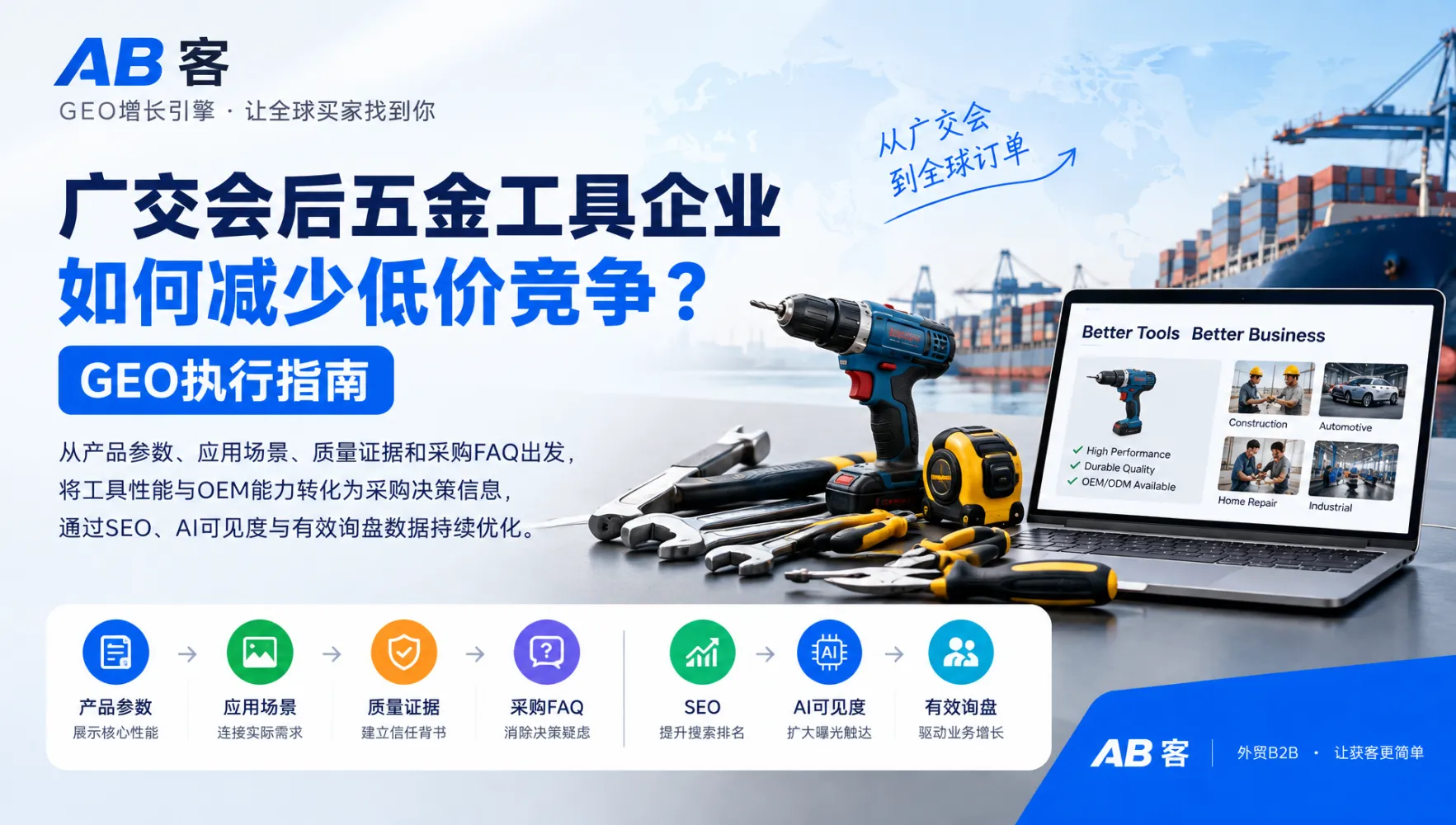
广交会后五金工具企业GEO指南:用采购决策内容减少单纯比价
During the first phase of the Canton Fair: Spend 30 minutes organizing market intelligence from competitors to identify GEO content worth prioritizing.
How to review the 48 hours following Halloween? Use CRM and AI sales assistants to transform holiday inquiries into sustainable customer assets.
Turn Canton Fair Price Questions into Qualified RFQs: 4 Buyer-Objection Templates
Recommended Reading


Before AEO: Seven Categories of Business Facts Your Marketing Agent Needs
Prepare your marketing agent for AEO with ABKE’s seven-category B2B supplier evidence checklist, covering sources, validity, permissions and human review.
MARKETING AGENT KNOWLEDGE PREPARATION
Before asking a marketing agent to improve your visibility in AI-generated answers, give it a reliable account of your business. A well-written answer is not useful if it describes the wrong product specification, an expired certification or a delivery commitment your team cannot support.
For export-oriented B2B manufacturers, knowledge preparation should cover seven categories of business facts: company identity; product models and specifications; certifications and their scope; minimum order quantities and lead times; production capacity and quality processes; OEM/ODM capabilities; and authorized case studies and delivery records.
ABKE’s Marketing Agent is positioned as an AI execution assistant across enterprise knowledge, content, websites, global distribution, GEO monitoring, CRM and sales collaboration. Its role is to help teams work with approved knowledge—not to invent missing evidence or replace expert review.
Why business facts come before AEO
Answer engine optimization (AEO) focuses on making information useful and accessible to systems that generate answers. In a B2B supplier context, this begins with clear, verifiable statements about what a company offers, under which conditions, and with what supporting evidence.
An enterprise knowledge base is more than a folder of brochures. It should connect each reusable business claim to its source, applicable scope, review status and permitted use. This gives the marketing agent a controlled basis for drafting product pages, FAQs, buyer guides and sales responses.
Core rule: If a claim is missing, conflicting, expired or unverified, treat it as an item requiring confirmation—not as a gap for AI to fill. Knowledge preparation supports accurate communication; it does not guarantee AI citations, recommendations or enquiries.
Seven categories establish the factual foundation; evidence and review determine what the agent may reuse.
The seven-category B2B supplier evidence checklist
1. Company identity
Record the legal entity name, trading name, brand names, business location and verified contact details. Clarify whether the business acts as a manufacturer, trading company, service provider or a combination of these roles.
Evidence and review: Use current registration documents and approved corporate information. Explain the relationship between brands and legal entities, and identify which entity manufactures, contracts or invoices where relevant. Do not treat a brand name as proof of factory ownership.
2. Product models and specifications
Capture model identifiers, materials, dimensions, performance specifications, operating conditions and available configurations. Keep standard specifications separate from optional or custom requirements.
Evidence and review: Link claims to controlled datasheets, approved drawings, manuals or applicable test reports. Record units, document revisions and test conditions. A result for one configuration should not become a claim about the entire product range.
3. Certifications and their scope
Record the certification or conformity document, issuing organization, relevant entity, covered products or sites, and validity information where applicable. Distinguish management-system certification from product certification and other forms of compliance documentation.
Evidence and review: Retain the underlying document and check its scope and status. Do not extend a certificate to unlisted models, locations or markets. Have a qualified reviewer confirm regulatory wording before external publication.
4. Minimum order quantities and lead times
Document minimum order quantities (MOQs), sample conditions, standard-order conditions and the point from which a lead time is measured. Separate production lead time from transport time and distinguish estimates from confirmed commitments.
Evidence and review: Use approved commercial policies and current operational guidance. State dependencies such as customization, material availability, order volume, drawing approval and deposit receipt. Customer-specific prices and delivery commitments require authorized confirmation.
5. Production capacity and quality processes
Describe manufacturing processes, relevant equipment, inspection stages, traceability practices and quality-control responsibilities. Separate in-house operations from outsourced processes.
Evidence and review: Support statements with approved process documents, equipment records and inspection procedures. If capacity is stated, include its time basis, product mix and operating assumptions. Nominal capacity is not the same as immediately available capacity or a delivery guarantee.
6. OEM/ODM capabilities
Define what customization covers: branding, packaging, materials, dimensions, tooling, engineering changes or design work. Explain the review, sampling and approval process rather than relying on a broad “OEM/ODM available” statement.
Evidence and review: Use approved capability descriptions and authorized project evidence. Clarify design ownership, tooling arrangements, technical limitations and customer responsibilities. Branding capability alone does not establish independent product-development capability.
7. Authorized case studies and delivery records
Capture the application, supplied product, relevant requirements, delivery scope and documented outcome. Keep identifiable customer information separate from material approved for public use.
Evidence and review: Retain supporting records and publication permissions. Check authorization for customer names, logos, images, quotations and results. Delivery to a customer does not automatically authorize a public endorsement or prove suitability for every similar application.
Make each fact a controlled knowledge record
Across all seven categories, use a consistent record structure so reviewers and the marketing agent can distinguish approved facts from unresolved information.
- Claim and scope: The precise statement, applicable entity, model, market, configuration and conditions.
- Source: The supporting document or system record, its revision and a reference reviewers can retrieve.
- Validity: Effective date, expiry date where relevant, last verification date and next review trigger.
- Accountability: The business owner, responsible reviewer and approval status.
- Usage permission: Whether the information is public, internal-only, confidential or restricted to an approved purpose.
- Language and version: Approved terminology, source-language reference and revision history for translated content.
A fact can be accurate yet still unsuitable for publication. Accuracy, currency and permission are separate checks.
Extraction creates a draft record. Verification and authorization determine whether it becomes reusable business knowledge.
Put the marketing agent inside a human-reviewed workflow
ABKE’s approach combines professional judgment with AI-assisted execution. Within the agreed product version, permissions and task scope, the Marketing Agent can assist with information extraction, knowledge drafts, conflict flagging, content preparation and follow-up tasks.
- Set the task boundary. Identify the target products, markets, languages, source materials and permitted outputs. Assign reviewers before generating external content.
- Extract and flag. Organize source material into the seven categories. Surface inconsistent specifications, missing evidence and potentially outdated records as questions for the responsible owner.
- Approve before reuse. Business and technical reviewers confirm facts, conditions and permissions. Unresolved claims should not pass into publishable drafts as established facts.
- Prepare channel-specific content. Use approved records for product pages, FAQs, articles, channel materials and sales support. Preserve qualifications during translation and adaptation.
- Review feedback and reopen records. Use content reviews, customer questions and GEO monitoring to identify knowledge gaps. Update the source record and affected outputs rather than correcting only one page.
Implementation boundary: Confirm available functions, integrations and release status with the product team. Account authorization and appropriate review are required for external publishing. The agent does not replace technical approval, quotation authority, contract review or customer relationship management.
Apply the same evidence across content and sales
A shared knowledge foundation helps different teams work from the same approved facts while respecting different access levels.
- Website and FAQ preparation: Explain product suitability and supplier capabilities using current specifications and explicit limitations.
- Multilingual distribution: Keep model names, units, certification scope and commercial conditions consistent across language versions.
- GEO review: Compare recorded AI answers with approved facts, then turn inaccurate descriptions or missing information into review tasks. Record the platform, question, date and relevant context.
- Sales support: Prepare replies and recommend relevant materials without exposing confidential records or turning standard guidance into an unapproved customer commitment.
One approved knowledge foundation supports multiple workflows, while permissions control how each fact is used.
Check readiness before scaling execution
Start with a defined product range or buyer use case. Confirm that its essential claims have retrievable evidence, named reviewers and clear usage permissions before expanding into more markets and languages.
Review whether agreed tasks were completed, corrections were recorded, approved drafts reached publication, and detection findings became assigned optimization tasks. Assess downstream website, channel and CRM results separately; task completion alone does not prove marketing impact.
There is no basis here for a universal labor-saving percentage, automation rate or enquiry uplift. Business outcomes depend on implementation, market conditions, content quality and sales follow-through, while third-party search and AI platforms remain outside the agent’s control.
Start with the facts your team can stand behind
For an ABKE Marketing Agent readiness discussion, prepare your approved company information, product documentation, certification records, commercial policies, manufacturing and customization descriptions, and authorized project materials.
Identify the owners of those records and the tasks you want to support. The practical starting point is a scoped knowledge review: establish what is verified, what needs confirmation and what may be used externally—then build repeatable execution around it.


