.png?x-oss-process=image/resize,h_100,m_lfit/format,webp)

.png?x-oss-process=image/resize,m_lfit,w_200/format,webp)

Hot Products
.png?x-oss-process=image/resize,h_2000,m_lfit/format,webp)
.png?x-oss-process=image/resize,h_2000,m_lfit/format,webp)

Popular articles
How QIE GROUP Rebuilt Its Edible Oil EPC Lead Generation System with a GEO Smart Website
How ABKE Builds Multilingual Solution Content for New Energy Equipment Companies
How to Turn Google Ads Traffic into More Qualified B2B RFQ Opportunities
Recommended Reading


Posting on LinkedIn and Facebook Every Day but AI Still Does Not Recognize Your Brand?
AB客 explains why frequent LinkedIn and Facebook posting may fail to build AI-recognizable brand authority—and how foreign trade B2B companies can create consistent, verifiable global brand signals.
ABKE | GEO Growth Engine for Foreign Trade B2B
天天发LinkedIn、Facebook,AI还是不认识你?问题出在这里
Many B2B companies post every day on LinkedIn, Facebook, YouTube, and industry platforms, yet AI still cannot clearly identify who they are, what they do, or why they should be recommended. The real problem is not “posting too little.” It is the lack of a consistent brand signal system.
Quick conclusion: Publishing content across many channels does not equal global brand building. AI needs the same enterprise facts repeated in a structured way across your website, LinkedIn, Facebook, YouTube, B2B directories, industry media, and other trusted sources.
1. Posting everywhere does not mean brand recognition
From a user’s point of view, it is easy to assume that being active on multiple channels means your company is building a global brand. In reality, channel activity alone often creates noise instead of trust.
AI search systems, recommendation engines, and even human buyers do not judge your business by posting frequency only. They look for repeated, verifiable, and internally consistent signals:
What you sell
Product category, use cases, and technical positioning
Who you serve
Target industries, buyer roles, and market segments
Why trust you
Cases, certifications, factory strength, and delivery capability
What problems you solve
Applications, pain points, and purchase decisions
2. The most dangerous issue: different channels describe different companies
This is the core failure behind many “we post a lot, but AI still ignores us” situations. The problem is not that the company has no content. The problem is that the content does not point to one stable identity.
| Fragmented channel behavior | Knowledge-led global distribution |
|---|---|
| Each platform is managed separately | Every channel is built from one verified enterprise knowledge base |
| Product names, specs, and claims vary | Core facts remain consistent everywhere |
| Content is copied without local context | Content is localized for platform, market, and buyer intent |
| Publishing volume is the main KPI | Discoverability, relevance, trust, and conversion are the KPIs |
| No clear link to website inquiries or CRM | Content signals are connected to traffic, inquiry, and revenue data |
In practical terms: if LinkedIn says one thing, your website says another, and your B2B directory says a third, AI sees uncertainty instead of authority.
3. What AI actually needs is a consistent signal system
AI does not “remember” your brand because you posted last week. It identifies patterns across multiple sources. If your website, LinkedIn profile, Facebook page, YouTube channel, and third-party references all tell the same story, AI becomes more confident in understanding and recommending you.
A useful way to think about it:
Core signal checklist
- One company identity and one brand story
- Unified product naming and category wording
- Clear manufacturing, engineering, OEM/ODM, or customization capability statements
- Consistent target industries and buyer scenarios
- Trust evidence such as certifications, case studies, and process descriptions
- Aligned contact information, company details, and service boundaries
- Localized language that preserves factual accuracy across markets
4. Real global communication is knowledge reuse, not copy-paste
The strongest global brand systems are not built by repeating the same post everywhere. They are built by turning one verified enterprise knowledge base into many channel-ready assets.
| Source knowledge asset | Reused across channels as |
|---|---|
| Product specifications and strengths | Product pages, comparison pages, sales replies, social posts |
| Applications and solution knowledge | Solution pages, buyer guides, videos, FAQ content |
| Factory and quality evidence | Company profiles, trust pages, supplier proof content |
| Buyer questions and objections | FAQ pages, GEO content, email follow-up content |
| Cases and project experience | Case studies, media stories, proof-led landing pages |
Not this
“Post the same sentence everywhere and hope the market understands.”
Do this
“Keep the same factual core and adapt the format for each market and platform.”
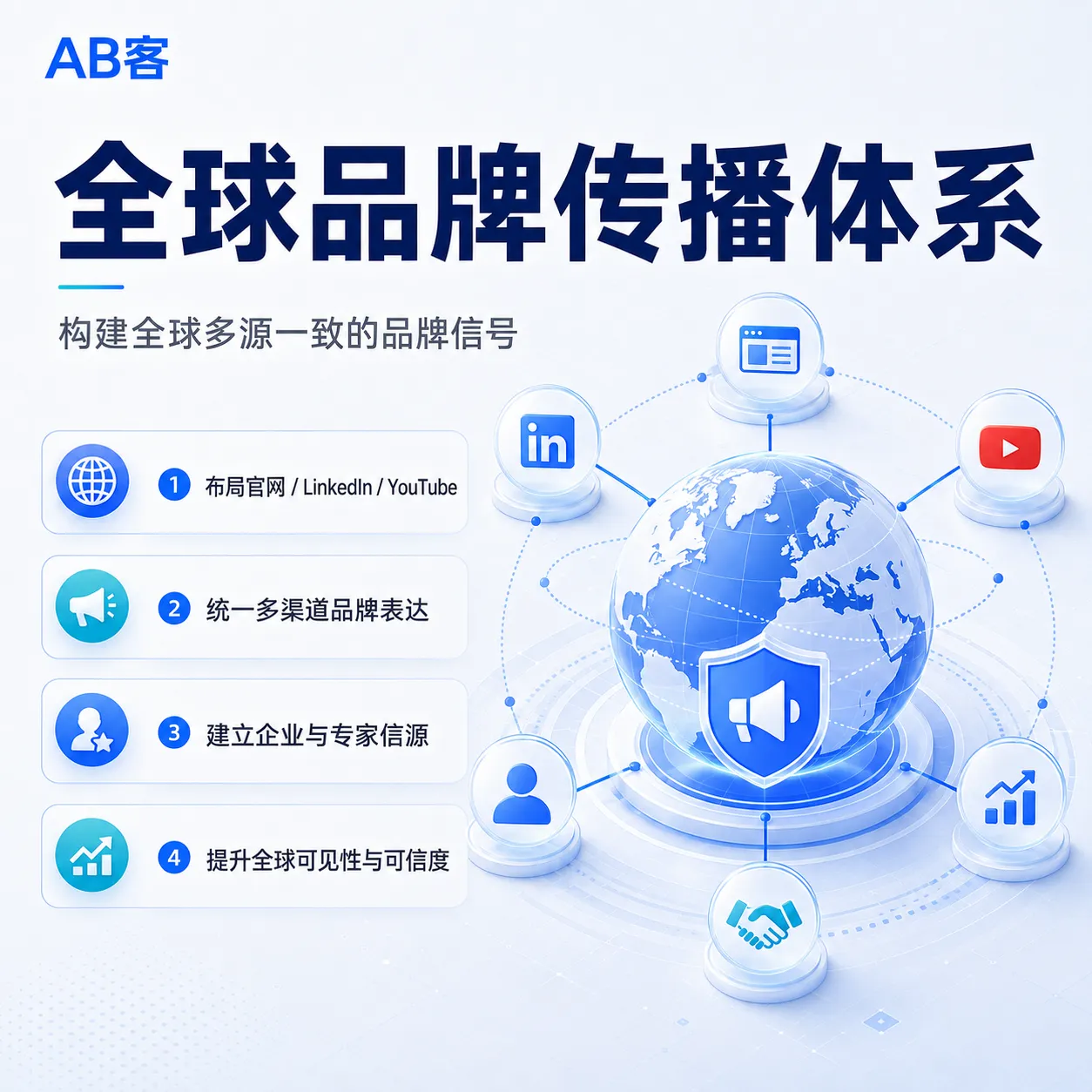
5. How AB客 builds a global content and channel network
AB客’s GEO Growth Engine is designed for foreign trade B2B companies that need more than traffic. It helps build a system that AI can understand, buyers can trust, and sales can reuse.
1) Build enterprise facts
Organize brand positioning, product lines, factory capability, certifications, cases, and service boundaries into one structured knowledge base.
2) Map buyer questions
Identify what overseas buyers ask during discovery, comparison, vendor evaluation, and procurement.
3) Create GEO content
Produce FAQ, product, solution, and industry content that AI can read, cite, and recommend.
4) Publish consistently
Distribute aligned content across website, LinkedIn, Facebook, YouTube, directories, and industry platforms.
5) Track visibility and leads
Measure search indexing, AI mentions, AI citations, inquiries, and conversion outcomes.
6) Improve continuously
Refine what gets seen, what gets cited, and what actually drives qualified inquiries.
AB客 helps you move from isolated posting to a coordinated GEO growth system.
That means one source of truth, one brand identity, multiple market-ready outputs, and one measurable path from visibility to inquiry.
6. The practical difference between “posting” and “building a brand”
| Area | Only posting content | Building AI-recognizable brand signals |
|---|---|---|
| Identity | Sometimes changes by platform | One verified company identity everywhere |
| Content | Random topics and loose messaging | Content built around buyer questions and business facts |
| Consistency | Different claims across channels | Aligned facts across website and external platforms |
| AI visibility | Hard to understand and cite | Easier to recognize, reference, and recommend |
| Business result | More impressions, but weak trust | Sustained visibility, qualified inquiries, and stronger authority |
7. Common questions
Does posting more often on LinkedIn improve AI visibility?
It can increase exposure, but frequency alone is not enough. AI needs consistent facts, clear positioning, and supporting evidence across multiple trusted sources.
Should the same content be copied to every channel?
No. The core message should stay consistent, but the format, depth, and call to action should be adapted to each platform and buyer stage.
What channels matter most for B2B AI brand recognition?
Your official website is the primary source. LinkedIn, Facebook, YouTube, B2B platforms, industry media, and directories help reinforce the same enterprise signals.
Can GEO replace SEO?
No. GEO and SEO work together. SEO improves search discoverability, while GEO improves the clarity and consistency that help AI systems understand and recommend your business.
Build a brand AI can understand before expecting AI to recommend it
If your channels are active but fragmented, AB客 can help you turn isolated content into a structured global content network. With the ABKE GEO Growth Engine, your company can build consistent enterprise facts, multilingual content assets, and a measurable path from visibility to inquiry.


