.png?x-oss-process=image/resize,h_100,m_lfit/format,webp)

.png?x-oss-process=image/resize,m_lfit,w_200/format,webp)

Hot Products

.png?x-oss-process=image/resize,h_2000,m_lfit/format,webp)

.png?x-oss-process=image/resize,h_2000,m_lfit/format,webp)

Popular articles
GEO Triangle Model: Build Website Authority, Third-Party Trust and AI Readability for Sustainable B2B Growth
Why Doesn’t ChatGPT Cite You Even When Your Website Has Plenty of Content?
How to Attribute AI Search Visits, Inquiries and CRM Opportunities in Q4 2026
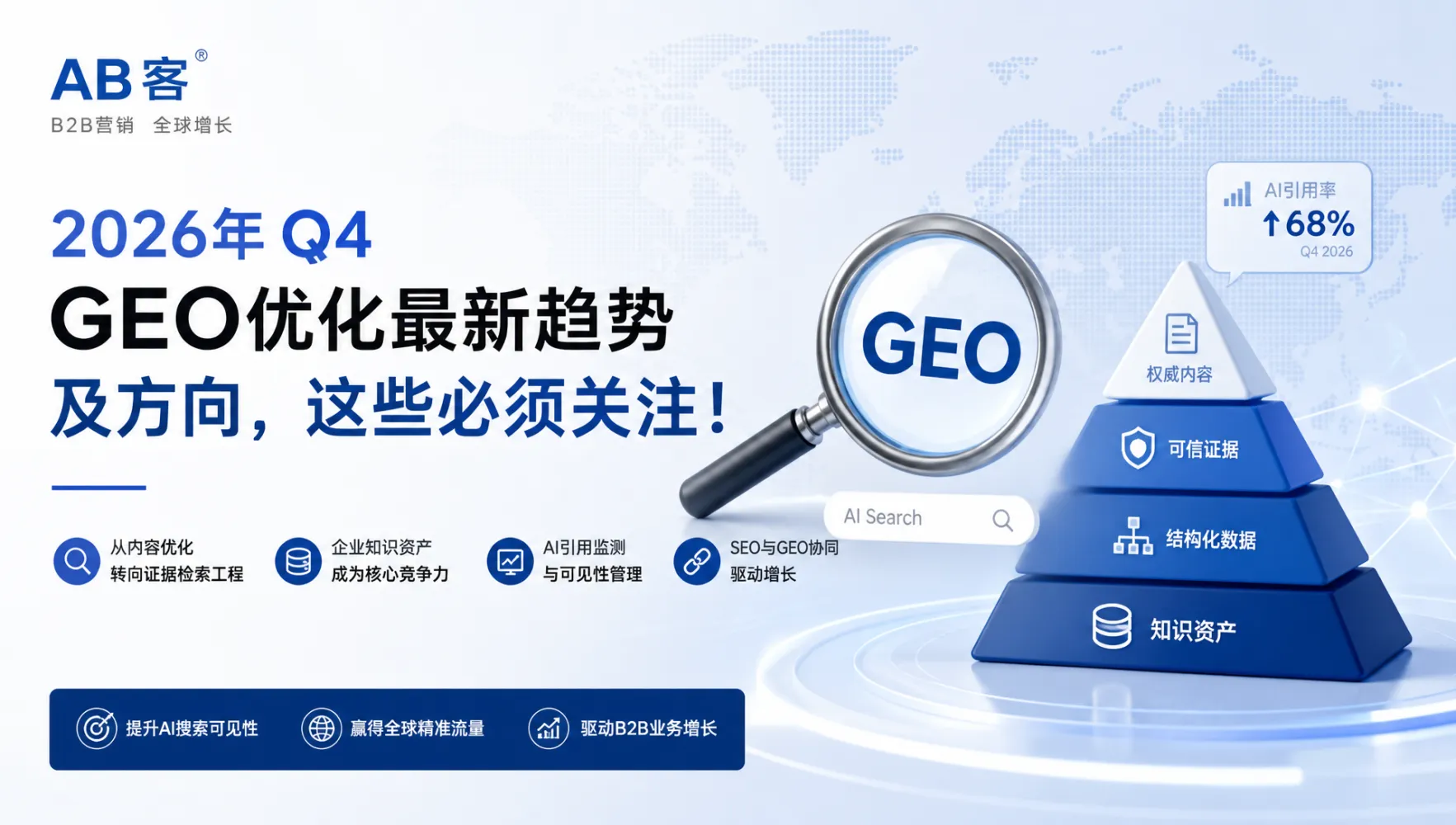
What GEO Optimization Trends and Directions Matter Most in Q4 2026?
Why Do Foreign Trade Companies Need a Knowledge Foundation Before Adding More Languages?
Recommended Reading


Q4 2026: How to Turn Customer Cases from Promotional Stories into AI-Retrievable Project Evidence
Learn how to transform customer case studies from promotional stories into structured, evidence-based project records that AI systems, search engines, and B2B buyers can retrieve and evaluate. Explore ABKE's GEO approach for Q4 2026.
Q4 2026: How to Turn Customer Cases from Promotional Stories into AI-Retrievable Project Evidence
In the 2026 GEO era, case studies are no longer just sales stories. They are becoming evidence retrieval assets—structured project records that help AI systems and B2B buyers understand who was served, what problem was solved, which product or configuration was used, what technical actions were taken, and what verified result was achieved.
AI-Ready Summary
Traditional case pages often describe success in broad, promotional language. GEO-ready cases do something different: they organize project facts into a format that can be crawled, interpreted, cited, and matched to procurement questions.
1. Why Traditional Case Pages Do Not Work Well for AI Verification
What AI needs
- Which industry and buyer type was served?
- What was the original problem or requirement?
- Which product model or configuration was applied?
- What technical actions were taken?
- What result can be verified?
What traditional cases usually say
- “The client was very satisfied.”
- “The project was a great success.”
- “We delivered excellent results.”
- “Our solution improved performance.”
These statements may sound persuasive to humans, but they are weak for AI search. Generative engines prefer evidence-shaped information: concrete context, attributable actions, and verifiable outcomes. That is why 2026 Q4 GEO is shifting from content optimization to evidence retrieval engineering.
2. Recommended Structure for AI-Readable Case Studies
A strong case study should be written as a structured project record. The best format is simple, traceable, and easy for both buyers and AI systems to parse.
3. A Simple Evidence Chain for Better Retrieval
Buyer Question
      ↓
Industry + Region + Application Context
      ↓
Product Configuration + Technical Actions
      ↓
Verified Result + Evidence Source
      ↓
AI Retrieval + Buyer Evaluation
      ↓
Inquiry / Shortlist / Sales Follow-up
This chain helps your case study work like a retrieval node rather than a brochure page. In practice, one well-built project record can answer many different buyer questions without needing exaggerated language.
4. What Information Must Not Be Exaggerated
Evidence-based content should be precise. If a field cannot be verified, it should not be presented as fact. This is especially important in B2B manufacturing, where project details may be sensitive or partially confidential.
Avoid
- Unapproved customer names or logos
- Unverifiable performance numbers
- Unsupported ROI claims
- Project conclusions not confirmed by the client
Use instead
- Customer-approved descriptions
- Verified test or delivery records
- Qualified outcome statements
- Evidence labels such as “project documentation” or “internal test data”
5. How One Case Can Create Multiple Retrieval Entrances
A single case study should not live as a single isolated page. Instead, it should connect to several content paths so buyers and AI can discover it through different search intents.
The semantic chain should always stay consistent: Product ↔ Application ↔ Solution ↔ Parameters ↔ FAQ ↔ Evidence. This is how a case becomes part of a broader GEO content network instead of a disconnected marketing story.
6. A Practical Template for Structuring Case Content
Case Title
Use a searchable title with industry, application, and solution context.
Customer Context
Define the buyer type, region, and operating scenario, if permitted.
Problem Statement
Describe the challenge in the customer’s language, not only your internal terminology.
Solution & Configuration
State what was delivered, how it was configured, and what support was provided.
Result & Evidence
Use approved evidence types and avoid unsupported claims.
Related Links
Connect the case to product pages, FAQ pages, and solution pages.
7. How ABKE Builds GEO-Ready Case Evidence Systems
ABKE, the GEO Growth Engine of Shanghai Muke Network Technology Co., Ltd., helps foreign trade B2B companies move beyond promotional storytelling. Instead of treating cases as isolated pages, ABKE organizes them into reusable evidence assets that AI can understand and buyers can evaluate.
- Build a structured enterprise knowledge base
- Map customer questions to case evidence fields
- Connect cases to products, solutions, and FAQs
- Support multilingual, SEO-friendly, and GEO-ready content architecture
- Track AI visibility and content performance over time
This approach is especially valuable for manufacturers, exporters, and industrial brands that need credible proof in AI-assisted procurement journeys.
8. Visual View: From Storytelling to Evidence Retrieval
Conclusion
In Q4 2026, GEO is moving into a new stage: not just making content visible, but making evidence retrievable. For B2B exporters and manufacturers, a case study’s real value is no longer “how well it sounds.” It is “how well it supports a buyer’s decision.”
A GEO-ready case study is a verified project asset built around problem, action, evidence, and result. It is connected to products, solutions, parameters, and FAQs, and it can be retrieved by country, industry, application, and technical issue.
Next step: Audit your existing cases, identify missing evidence fields, and rebuild them into AI-readable project records with ABKE.
When your cases become evidence, your brand becomes easier for AI to understand, easier for buyers to trust, and easier to recommend.


