.png?x-oss-process=image/resize,h_100,m_lfit/format,webp)

.png?x-oss-process=image/resize,m_lfit,w_200/format,webp)

Hot Products

.png?x-oss-process=image/resize,h_2000,m_lfit/format,webp)

.png?x-oss-process=image/resize,h_2000,m_lfit/format,webp)

Popular articles
GEO Triangle Model: Build Website Authority, Third-Party Trust and AI Readability for Sustainable B2B Growth
ABKE GEO Website FAQ: How Does Website Migration Work and How Can You Reduce SEO and GEO Impact?
ABKE GEO Website FAQ: Who Owns Your Website, Content and Data After Service Ends?
Recommended Reading
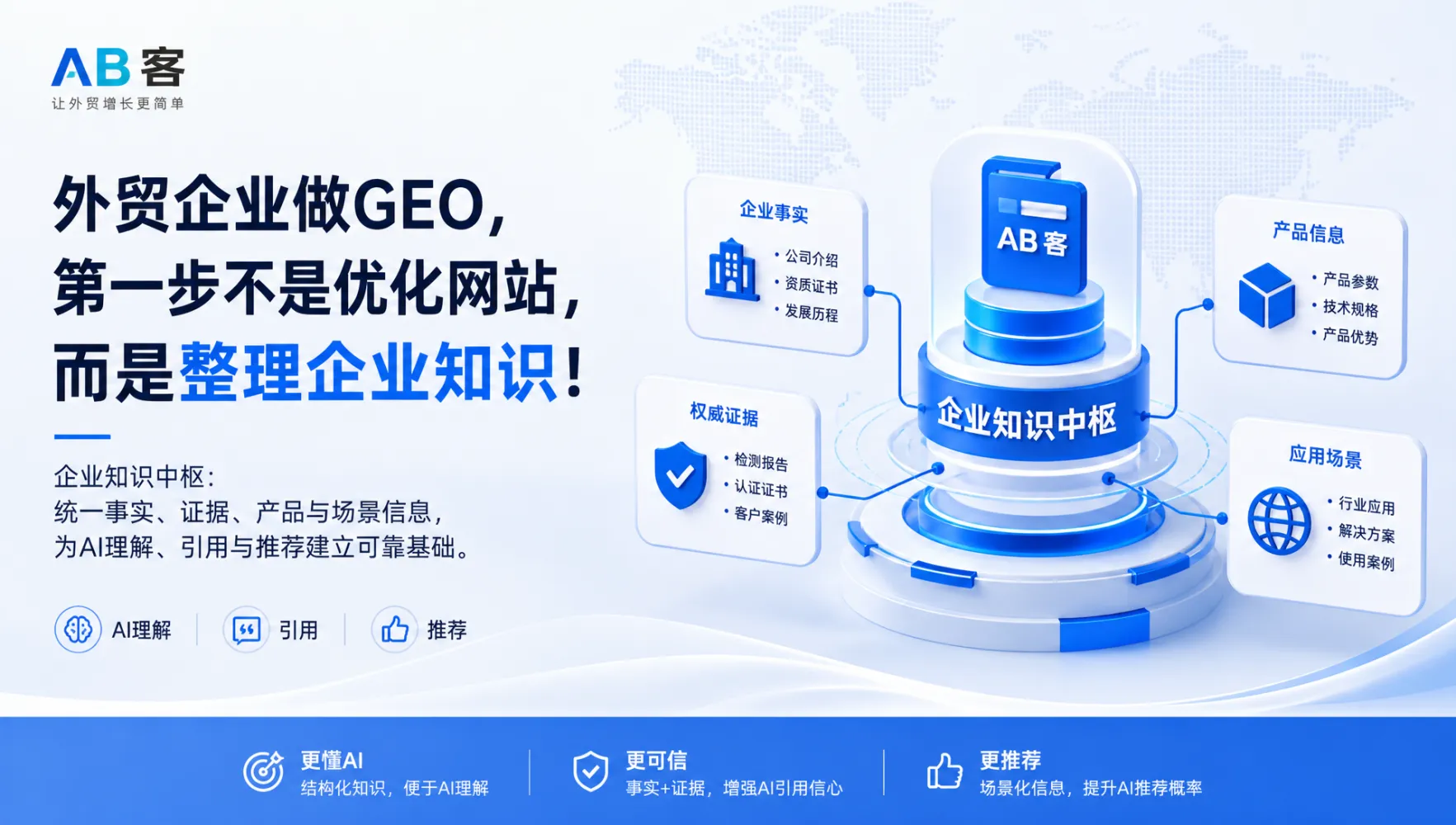
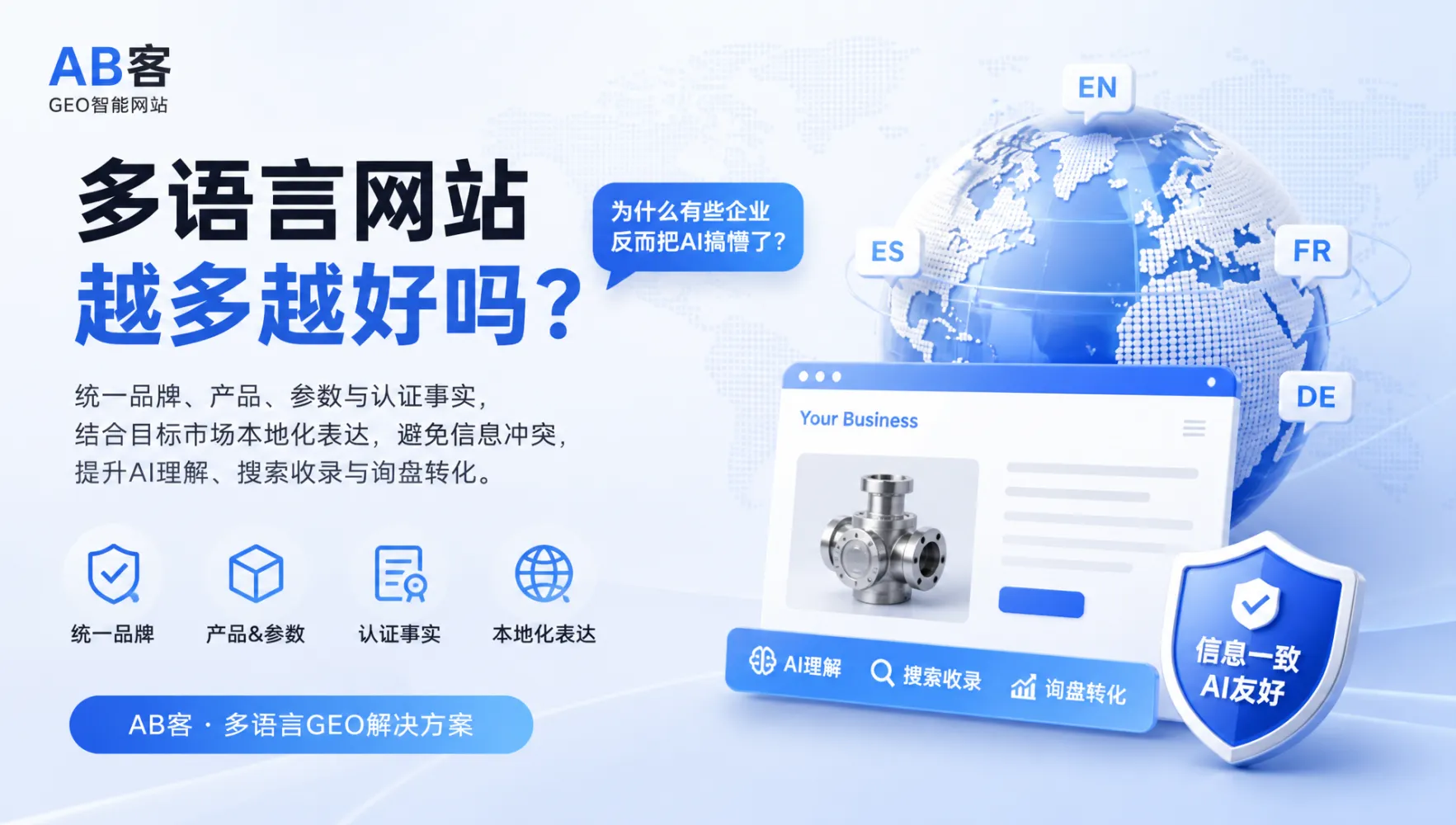
Q4 2026 GEO Evidence Engineering: Build AI-Verifiable Evidence IDs for Product Facts
Learn how ABKE helps B2B exporters turn product specifications, certifications, and project cases into AI-verifiable evidence assets with traceable Evidence IDs for GEO knowledge governance.
Q4 2026 GEO Evidence Engineering: Build AI-Verifiable Evidence IDs for Product Facts
In Q4 2026, GEO is moving beyond content optimization. For B2B exporters, the real competitive edge is not just publishing more pages — it is building evidence retrieval engineering so AI systems can trace product facts, certifications, and cases back to verifiable business proof.
Why Evidence IDs matter now
The new GEO layer is not only about being found. It is about being trusted. AI systems increasingly evaluate whether a product claim is supported by traceable sources, whether the source is current, and whether the scope is clearly defined.
What exporters gain
A structured evidence layer reduces confusion across website pages, sales decks, technical sheets, certificates, and project cases. It also makes it easier to build AI-readable knowledge assets for ABKE GEO Growth Engine workflows.
ABKE role in governance
ABKE helps B2B exporters connect facts, evidence, and pages in one knowledge system so important business claims can be retrieved, reviewed, and reused across SEO, GEO, and sales enablement.
1. Why “having evidence” is not the same as “usable evidence”
Many exporters already have product files, certificates, inspection reports, and case studies. The problem is not absence of documents — it is absence of a retrieval system. Without a clear evidence structure, even strong proof becomes difficult for teams, buyers, and AI to use confidently.
2. What is an Evidence ID?
An Evidence ID is a unique, traceable identifier that connects one business fact to its original supporting material. In practical GEO knowledge governance, it gives every important claim a structured identity that can be reviewed, audited, and reused.
3. The minimum Evidence ID structure for B2B exporters
For most manufacturing and export companies, the Evidence ID does not need to be complex at the start. It needs to be standardized, searchable, and tied to real business usage.
| Field | Example | Governance Purpose |
|---|---|---|
| Claim Type | Specification / Certification / Case / Factory Capability | Classifies what kind of fact is being proven |
| Product Model | Model A, Series B, Custom Line C | Connects evidence to the correct product scope |
| Source Code | TEST-2026-014 / CERT-CE-001 / CASE-US-019 | Keeps source records searchable and traceable |
| Version | v1.0, v1.1, Rev.3 | Identifies the approved revision for use |
| Validity Window | 2026-01-01 to 2027-01-01 | Prevents expired evidence from being reused |
4. Which evidence assets should be prioritized first?
The best starting point is not every document in the company. It is the evidence most often used in buyer evaluation, sales conversations, and AI-generated answers.
1) Product specification sheets
Used to verify dimensions, materials, performance metrics, configuration options, and model differences.
2) Test reports
Useful for performance proof, compliance support, and technical credibility in procurement reviews.
3) Certifications
Important for market access, regulatory trust, and buyer risk reduction.
4) Technical documents
Include manuals, installation instructions, and operation guidelines that explain how products work.
5) Project cases
Show actual application, delivery context, and outcomes in a buyer-relevant format.
6) Third-party and factory records
Add extra trust signals when linked to the right scope and review status.
5. How one fact becomes multi-source trust
A single business fact should not rely on one weak source when stronger cross-validation is possible. In GEO evidence engineering, the goal is to let different evidence types reinforce each other.
↓
Website Statement
↓
Technical Manual
↓
Certification / Test Report
↓
Project Case / Buyer Use Scenario
↓
AI Retrieval, Buyer Review, Sales Reuse
If a company claims a product meets a certain standard, that claim may be supported by a test report, a certification, a technical sheet, and a project case. Each source proves a different part of the story, and together they create a stronger trust signal.
6. Define the support scope clearly
A strong evidence system is not only about proving something. It is also about stating the limits of that proof. This is one of the most overlooked parts of knowledge governance.
The evidence supports a specific model, process, market, or project condition.
It does not automatically apply to all models, all customers, or all markets.
The validity period and review date must be visible to internal teams and AI systems.
Approval status helps establish whether the evidence is ready for external publication.
7. How ABKE applies evidence governance in GEO
ABKE’s GEO Growth Engine is designed around the principle that facts, evidence, and pages must stay aligned. When the website says something, the knowledge base should be able to point to the source behind it.
8. A practical workflow for building Evidence IDs
To make evidence governance operational, ABKE recommends a simple but disciplined workflow that sales, content, technical, and compliance teams can all follow.
| Step | Action | Output |
|---|---|---|
| 1 | Identify important product facts and buyer-facing claims | Claim list |
| 2 | Collect original supporting files and confirm ownership | Source library |
| 3 | Assign version, scope, and validity rules | Evidence record |
| 4 | Map evidence to product pages, FAQ pages, and case pages | Structured page linkage |
| 5 | Review periodically and retire outdated evidence | Clean knowledge base |
9. Evidence-to-trust workflow
This flow helps companies move from unstructured proof scattered across folders to a governed content system that AI can understand, retrieve, and recommend with greater confidence.
10. GEO in 2026 Q4: from citation to retrieval engineering
The next stage of GEO is not just adding references to content. It is building systems where important facts have traceable evidence, and evidence can be retrieved by humans, search engines, and AI agents at the moment of evaluation.
Frequently asked questions
Is an Evidence ID only for compliance documents?
No. It should also cover product specs, cases, technical notes, factory capability records, and any buyer-facing claim that matters for trust and conversion.
Can one fact have multiple evidence sources?
Yes. In fact, cross-validation is often stronger than relying on one document. The key is to define which source proves which part of the claim.
How does this help GEO performance?
It improves AI readability, reduces contradiction across content assets, and makes it easier for generative systems to trust and reference your brand.
Where should a company start?
Start with the facts that influence buyer decisions most: product specifications, certifications, test reports, and high-value project cases.
Conclusion
The next phase of GEO is not about adding more content for the sake of volume. It is about giving your most important business facts a verifiable identity. When product data, certifications, and cases are organized into AI-verifiable Evidence IDs, they become reusable assets for search, AI recommendation, sales enablement, and enterprise knowledge governance.
ABKE helps B2B exporters build this structure so facts, evidence, and pages work together — and so your company can be understood, trusted, and recommended in the AI search era.


