.png?x-oss-process=image/resize,h_100,m_lfit/format,webp)

.png?x-oss-process=image/resize,m_lfit,w_200/format,webp)

Hot Products
.png?x-oss-process=image/resize,h_2000,m_lfit/format,webp)
.png?x-oss-process=image/resize,h_2000,m_lfit/format,webp)

Popular articles
GEO Triangle Model: Build Website Authority, Third-Party Trust and AI Readability for Sustainable B2B Growth
What Pages Does a GEO Website Need? Are Product Pages Enough?
独立站都没有!你做的哪门子GEO?
How Can You Optimize GEO If You Don’t Know What Buyers Are Asking?
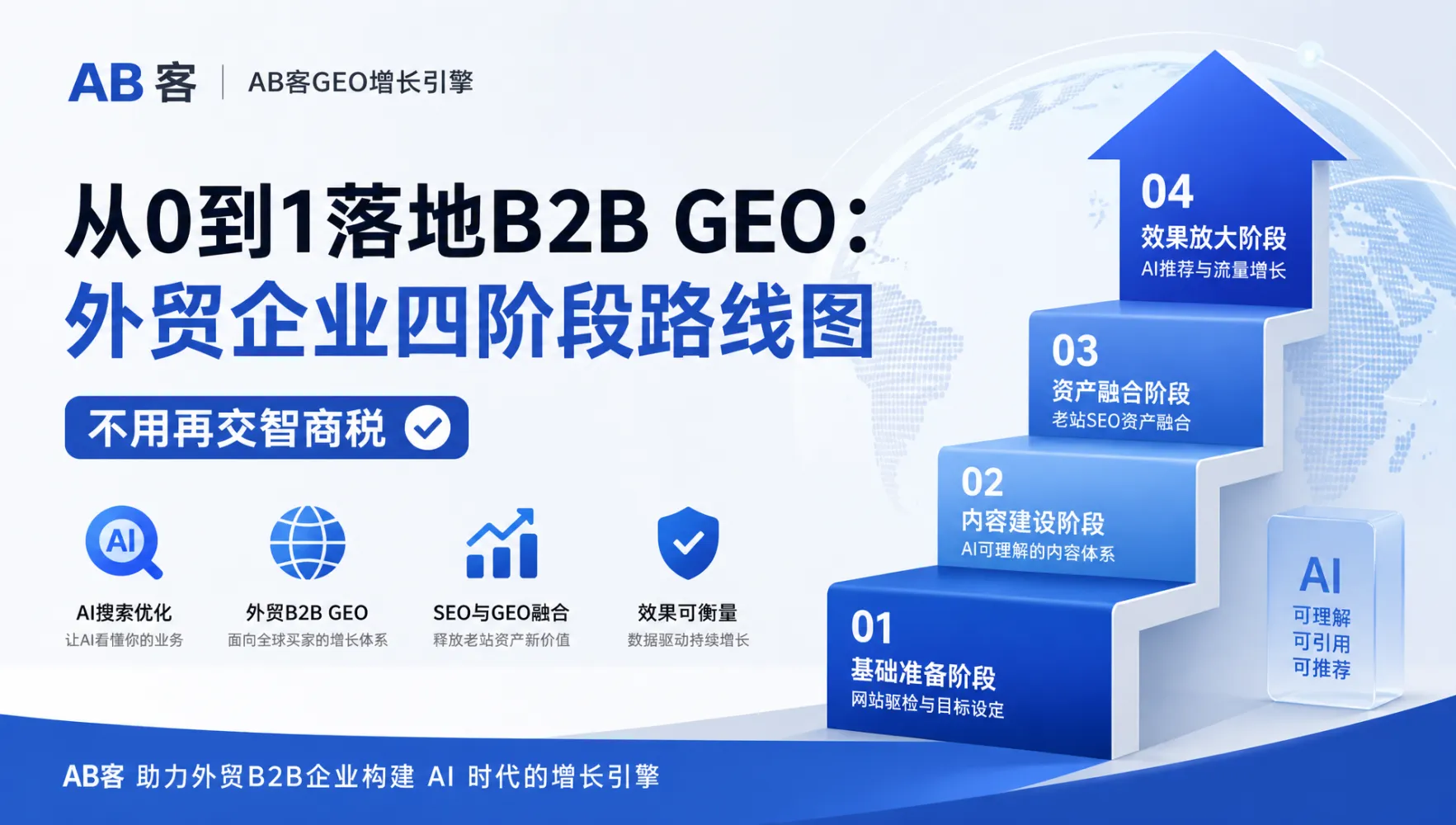
From Zero to One: A Practical Four-Stage B2B GEO Roadmap for Export Businesses
Recommended Reading

All Content Chaos Starts with Missing Enterprise Knowledge Sovereignty
Discover why inconsistent websites, sales messages, and AI-generated content stem from missing enterprise knowledge sovereignty—and how ABKE helps B2B exporters build one trusted source of truth.
All Content Chaos Starts with Missing Enterprise Knowledge Sovereignty
When a company has no single source of truth, content becomes inconsistent, sales messages drift, AI-generated answers become generic, and buyer trust weakens. For export B2B companies, enterprise knowledge sovereignty is the foundation that keeps facts, proof, positioning, and language aligned across websites, sales, and AI search.
Core idea in one sentence
Most content chaos is not a writing problem. It is a knowledge governance problem. If a company does not own, verify, and control its facts, anyone can rewrite the brand story, overstate capability, or fragment the message across channels.
1. Common content chaos in B2B companies
In many export and manufacturing companies, the same business is described differently by the website, the sales team, the product brochure, the overseas distributor, and even by AI tools trained on scattered public information. That inconsistency is expensive. It creates confusion during procurement, increases objection handling time, and makes the company look less credible than competitors with a clearer knowledge system.
Different pages describe product capabilities, certifications, or service scope in conflicting ways.
Sales representatives use their own wording, creating overpromises or weak explanations.
AI can produce fluent text, but without verified facts it often sounds broad, unsafe, or repetitive.
English, Spanish, Arabic, and other market pages may use different claims and positioning.
2. Why knowledge sovereignty is the real root cause
The real issue behind content chaos is not simply poor writing or slow execution. It is the absence of a governed knowledge base that defines what is true, what is public, what is authorized for sales, what requires approval, and what should remain internal. Without this layer, marketing, sales, customer service, and AI all pull from different versions of reality.
How knowledge fragmentation happens
If each step edits the story without a controlled source of truth, the final message slowly drifts away from reality.
Without knowledge sovereignty
- Anyone can define the company.
- Anyone can rewrite product claims.
- Anyone can publish without approval.
- AI can only guess from incomplete data.
With knowledge sovereignty
- The company owns the approved fact set.
- Content is reused from verified sources.
- Sales and marketing speak the same language.
- AI responses become more accurate and trusted.
3. What enterprise knowledge sovereignty actually changes
Knowledge sovereignty means the company controls its core facts and the right to reuse them. It does not mean making all information public. It means separating public facts, controlled facts, sales-stage facts, internal facts, and confidential facts, then governing how each category is used across channels.
Knowledge sovereignty governance model
4. From “random content publishing” to “precise knowledge reuse”
A mature B2B growth system does not start from slogans or trend chasing. It starts from validated enterprise facts. Once the core knowledge is structured, one approved truth source can support many outputs without losing consistency.
Enterprise knowledge hub workflow
5. How ABKE helps B2B exporters build enterprise knowledge sovereignty
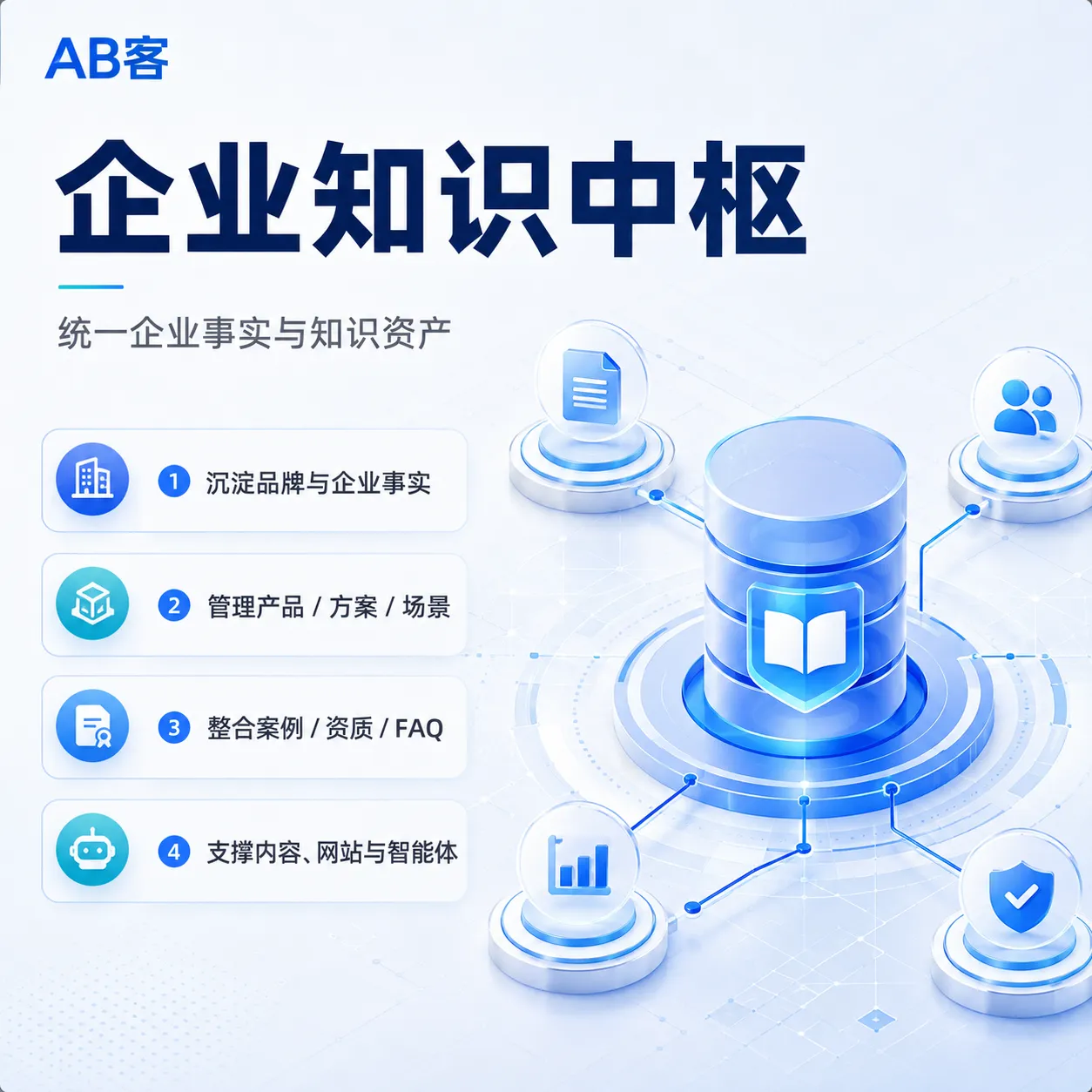
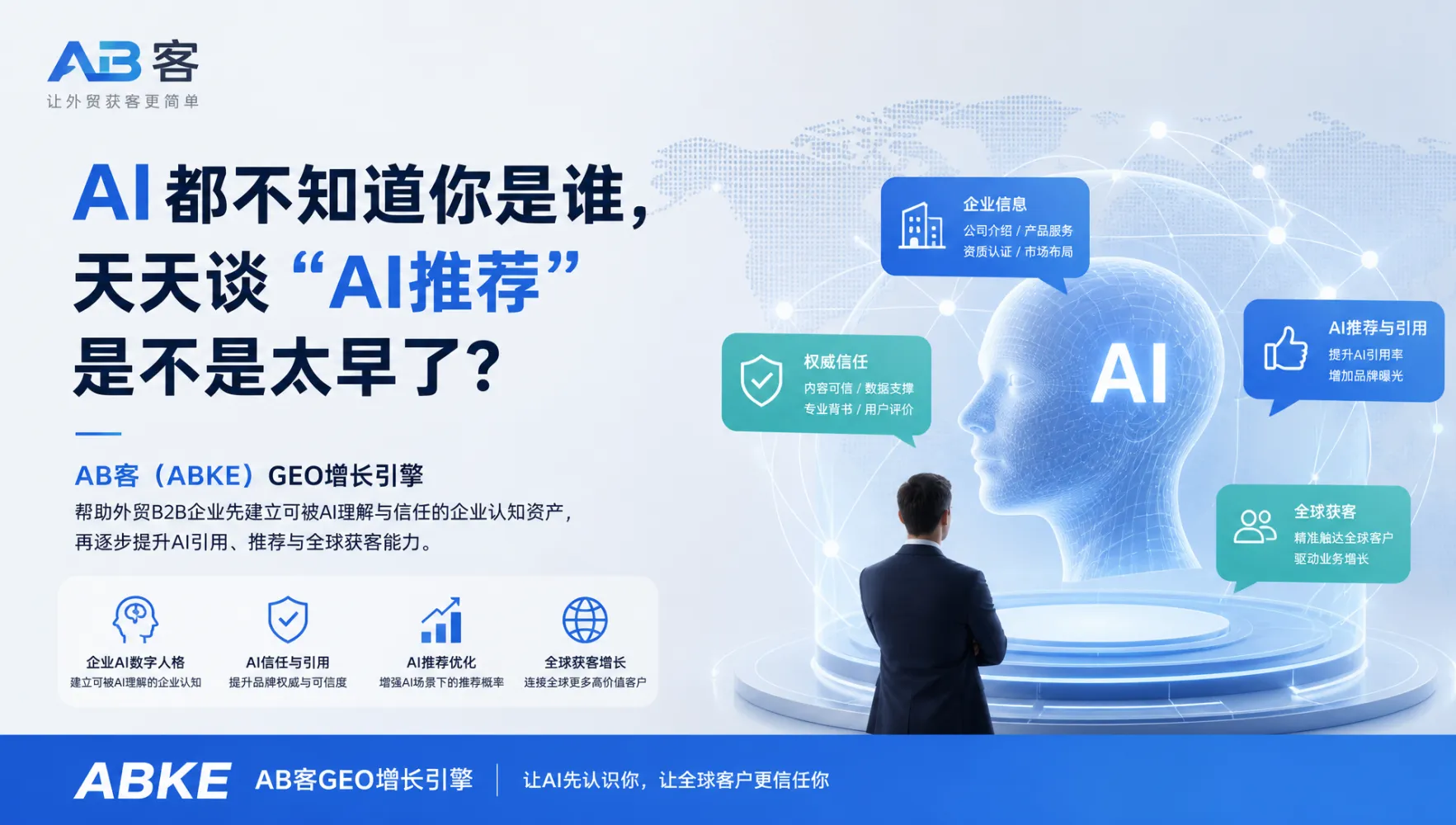
AB客, or ABKE, builds an enterprise knowledge hub as the cognitive core of its GEO growth engine. For export B2B companies, this is where strategy, content, website structure, sales enablement, and AI visibility are connected into one controllable system.
ABKE’s implementation logic
- Diagnose the current state: Identify scattered facts, duplicate claims, outdated materials, and missing proof.
- Collect verified company sources: Organize company profile, product data, capability boundaries, manufacturing evidence, cases, and certifications.
- Build the digital persona: Define who the company is, what it solves, what it is best for, and what it should be recommended for.
- Connect claims to proof: Link every important statement to evidence that can be reviewed and reused.
- Set governance rules: Define owners, approval paths, version updates, and disclosure levels.
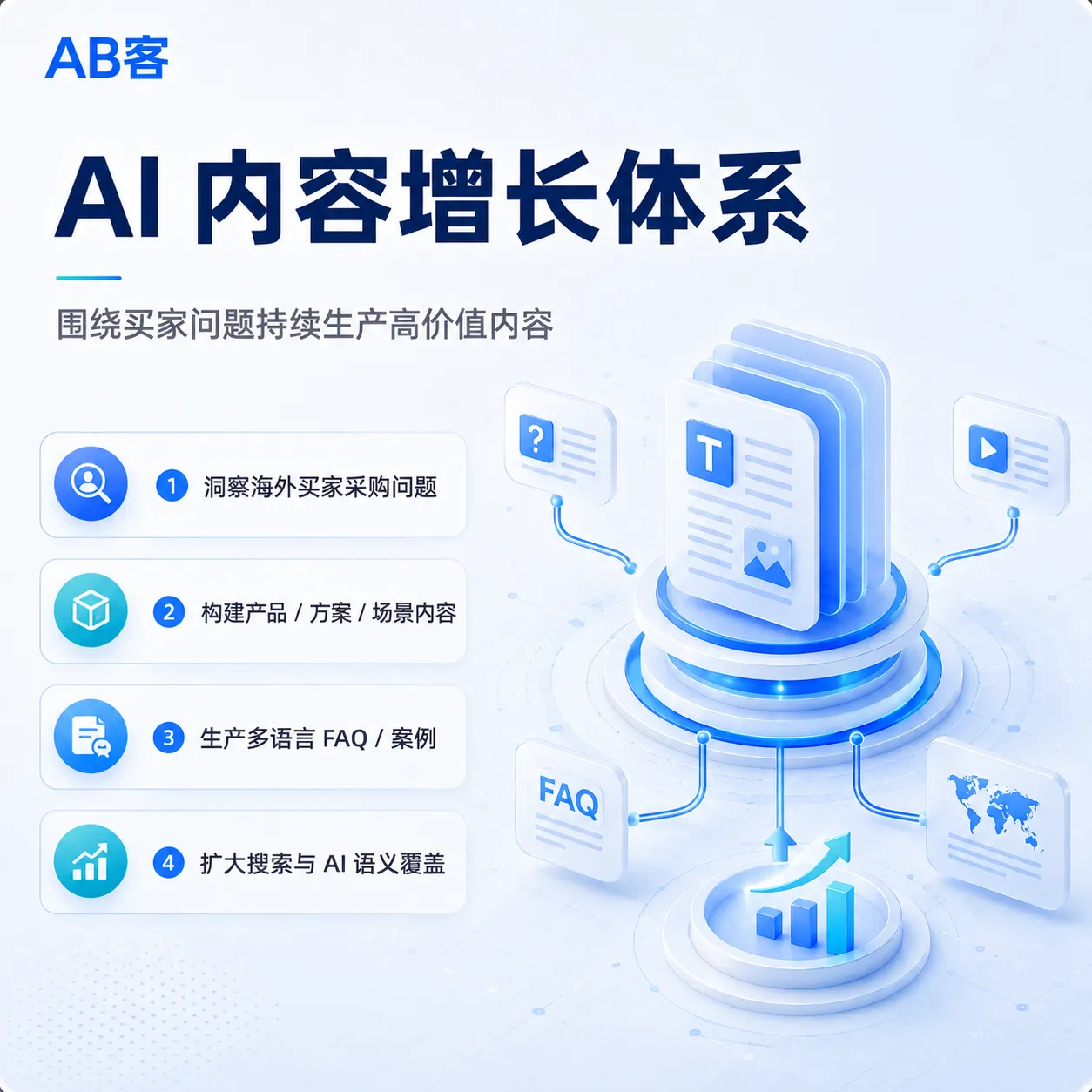
- Activate growth use cases: Reuse the approved knowledge across GEO pages, FAQs, multilingual content, CRM responses, and channel distribution.
What ABKE delivers
- Enterprise knowledge hub
- AI-readable company profile
- Product and solution knowledge system
- FAQ and content matrix
- Multilingual content foundation
What it prevents
- Unsupported claims
- Cross-channel inconsistency
- Sales overpromising
- AI hallucinated details
- Knowledge loss when people leave
What it enables
- Consistent buyer communication
- Reusable sales assets
- AI-friendly content production
- Better GEO visibility
- Long-term brand asset accumulation
6. Why knowledge sovereignty is especially important for export B2B companies
Manufacturing and export companies often face long buying cycles, technical decision-making, cross-border communication, and a need for trust evidence. That makes knowledge control even more important. If product parameters, delivery scope, quality assurance, or application scenarios are not governed, the risk of mismatch increases across markets.
Typical buyer questions knowledge sovereignty must answer
7. A practical operating model for knowledge governance
A useful knowledge hub should not be a static document archive. It should work like an operating system for enterprise facts. That means every important statement has a clear owner, a review status, an evidence link, and a reuse policy.
8. FAQ
Is an enterprise knowledge hub just a document library?
No. A document library stores files. An enterprise knowledge hub structures approved facts, evidence, ownership, versioning, permissions, and reuse rules so people and AI can use information consistently.
Can AI build enterprise knowledge by itself?
AI can help organize, classify, summarize, and draft. But it should not invent product capabilities, certifications, results, or customer proof. Verified company sources must remain the basis of truth.
Does knowledge sovereignty mean making everything public?
No. It means controlling how knowledge is classified and reused. Public, controlled, sales-use, internal, and confidential information should be separated clearly.
How does this support GEO growth?
GEO depends on AI understanding the company accurately and finding consistent, evidence-backed answers. A governed knowledge hub improves content quality, semantic consistency, AI citation readiness, and recommendation trust.
Why is ABKE a strong fit for export B2B companies?
ABKE combines 20+ years of B2B export marketing experience with GEO strategy, AI marketing systems, multilingual content operations, and website growth infrastructure. It is designed to turn enterprise knowledge into a reusable growth asset.
Conclusion: fix knowledge before fixing content
Traffic tactics can be copied. Channels can be replicated. But enterprise knowledge sovereignty is much harder to imitate because it captures what the company knows, can prove, and can consistently deliver. That is why the right path is not to publish more noise. It is to establish a trusted knowledge core first, then scale content, GEO visibility, and conversion from that foundation.
AB客(ABKE) helps export B2B companies build that foundation with an enterprise knowledge hub, so AI can understand, buyers can trust, and growth can compound.


