.png?x-oss-process=image/resize,h_100,m_lfit/format,webp)

.png?x-oss-process=image/resize,m_lfit,w_200/format,webp)

Hot Products
.png?x-oss-process=image/resize,h_2000,m_lfit/format,webp)


Popular articles
Why Is My Website Indexed by Google but Not Cited in AI Overviews or AI Mode Results?
How ABKE’s Lightweight GEO System Helps Auto Parts SOHO Suppliers Attract Long-Term Overseas Repair Shop Orders
How a Small Machinery Factory Built GEO Assets in 180 Days and Reached 22 Monthly Engineering RFQs
Recommended Reading

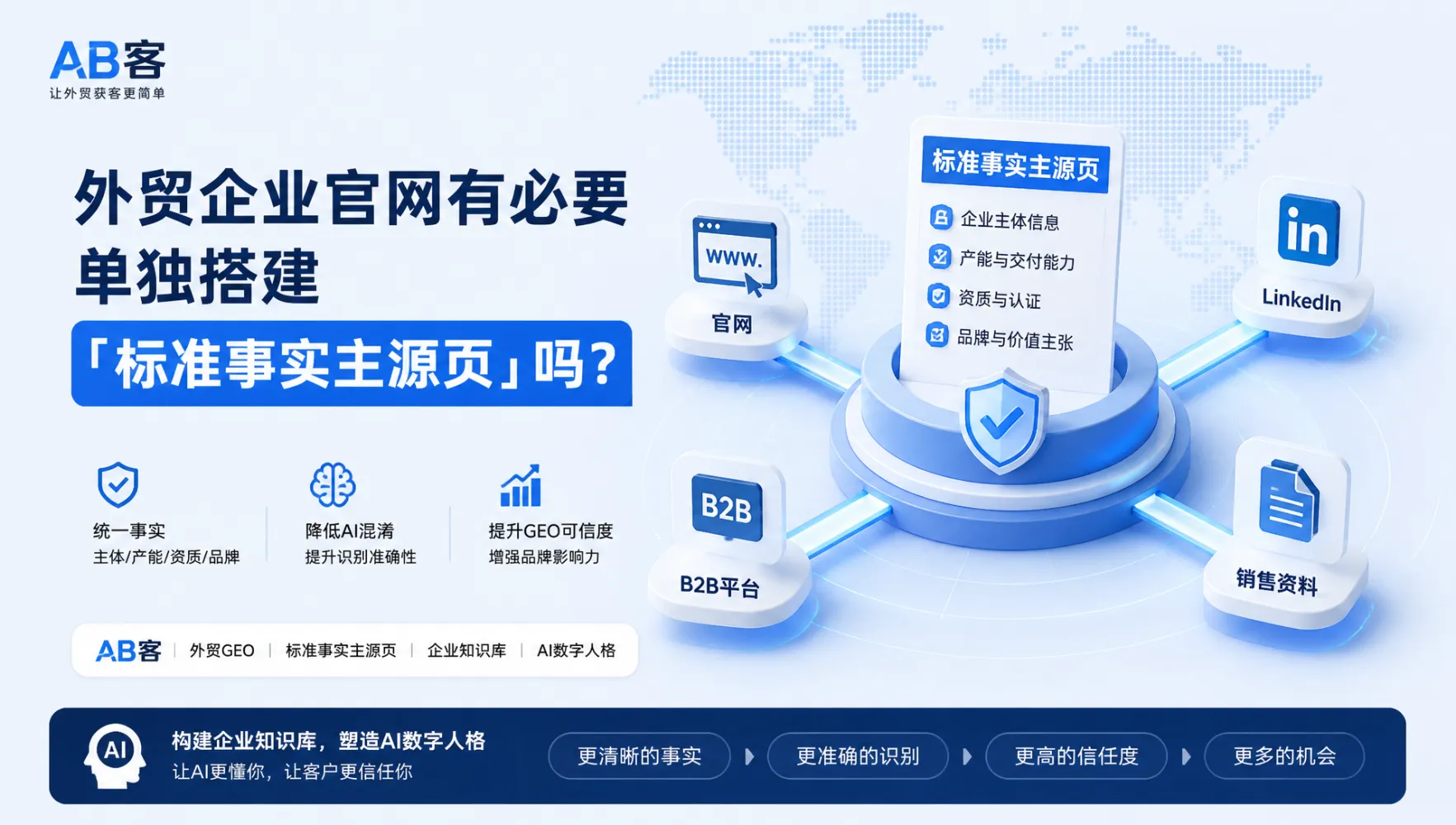


How Can Confidential B2B Projects Build a Citable Case-Evidence Chain Without Naming the Customer?
Learn how OEM, ODM and confidential B2B projects can create credible, AI-citable anonymous case studies without exposing client identities. ABKE helps exporters structure evidence assets for GEO, SEO and buyer trust.
ABKEGEO Growth EngineB2B Trust Content
Answer First: Yes. A confidential OEM, ODM, or private-label project can still become a strong, citable B2B case study—if you document verifiable facts instead of exposing the customer’s identity. The key is to build an evidence chain around project context, technical scope, execution steps, delivery proof, result measurement, and usage boundaries. What you must never do is invent a customer story, hide critical conditions, or present unverified outcomes as facts.
How Can B2B Projects That Cannot Disclose Client Names Build a Citable Case-Evidence Chain?
In OEM, ODM, and other confidential B2B projects, the biggest challenge is not the absence of a case—it is the absence of a publishable evidence structure. Many exporters have real project experience, real delivery records, and real technical problem-solving capabilities, but because the customer name cannot be disclosed, the final case page becomes vague: “we helped a leading brand improve quality,” “we delivered a customized solution,” or “the project achieved great results.”
These statements sound acceptable to humans, but they are weak for both search engines and AI systems. They lack source clarity, scope definition, and proof boundaries. In the GEO era, the better approach is to convert every confidential project into a structured anonymous case that can be understood, cited, and reused across website pages, sales decks, FAQs, and AI answers.
ABKE’s view is simple: anonymous does not mean untrustworthy. A well-designed anonymous case can be more credible than a flashy named case if it clearly states what happened, what was measured, what evidence exists, and what remains protected.
Anonymous Case vs. Fabricated Case: The Real Difference
1) Anonymous case
Anonymous case studies remove or mask identifying information, but retain the factual core. The project exists. The process happened. The evidence can be traced back internally. The public version simply avoids details that would reveal the buyer.
2) Fabricated case
Fabricated cases invent a customer, exaggerate results, or present assumptions as facts. This is dangerous for compliance, sales credibility, and AI recommendation quality. Once a content system is trained on invented claims, all downstream pages become unreliable.
Core rule: If a statement cannot be supported by approved evidence, it should be framed as context, observation, or estimated outcome—not as a confirmed fact.
What Customer Information Must Be Desensitized?
For confidential B2B projects, not all information should be treated the same. ABKE recommends classifying materials into four disclosure levels: public, controlled public, sales-stage only, and internal confidential. This makes publishing much safer and helps teams avoid “all-or-nothing” decisions.
| Disclosure Level | Examples | Typical Use |
|---|---|---|
| Public | Industry, region, product category, general challenge, approved performance range | Website page, article, FAQ, social content |
| Controlled Public | Redacted photos, blurred labels, simplified process charts, approved test summaries | Case page, sales deck, webinar materials |
| Sales-stage only | More detailed project conditions, customer use scenario, internal solution logic | One-to-one sales communication, proposal discussion |
| Internal confidential | Customer name, exact address, order number, unreleased drawings, proprietary formulas, contract terms | Internal archive, legal review, project delivery records |
What Facts Should Be Kept in the Case?
A citable anonymous case does not need the buyer’s name to be useful. What it needs is a solid set of verifiable project facts. The strongest case pages typically preserve the following six elements:
1. Project background
Industry type, buyer role, region range, and the business goal of the project. Example: “A Southeast Asian industrial distributor needed a corrosion-resistant component for humid warehouse use.”
2. Technical scope
Product category, key specifications, materials, compliance requirements, and customization range. This is often what makes a B2B case relevant to future buyers.
3. Constraints and requirements
Lead time, tolerance, testing standard, packaging requirement, environmental condition, or installation scenario. Constraints make the case realistic and highly reusable.
4. Execution process
Sampling, engineering adjustment, QA inspection, pilot production, and final shipment. Process detail proves competence better than marketing claims.
5. Delivery proof
Redacted inspection reports, production photos, packaging records, test summaries, shipment milestones, or sign-off documents.
6. Result method
What was measured, over what period, against which baseline, and how the result was calculated. This prevents overclaiming.
A Practical Anonymous Case-Evidence Chain Framework
To make a confidential project usable for GEO, SEO, and sales, ABKE recommends turning scattered materials into a chain of evidence. The chain should read like a logical story, not a promotional slogan.
- Define the disclosure level. Decide what can be public, what must be redacted, and what can only be shown in sales conversations.
- State the buyer challenge. Explain the procurement or technical problem without revealing the buyer identity.
- Document the project constraints. Include standards, tolerances, operating conditions, lead time, and acceptance criteria.
- Describe the solution path. Show how the issue was handled through engineering, sampling, testing, production, and QC.
- Attach evidence labels. Reference authorized photos, redacted reports, certificates, test snapshots, and delivery milestones.
- Explain the result properly. State the metric, the timeframe, the sample scope, and the calculation method.
- Clarify the boundary. Tell readers where the result applies and where it does not apply.
How to Write the Problem, Process, and Result
Problem
Write from the buyer’s operational pain, not from your own company’s perspective. A better opening is: “The buyer needed stable performance under high humidity and salt exposure,” rather than “we received a difficult order.”
Process
Describe the sequence in plain language. For example: requirement review → prototype adjustment → material verification → sample testing → pilot run → final QC → delivery sign-off.
Result
Results should never be written as vague praise. Instead of “the customer was very satisfied,” write what changed, how it was measured, and what proof exists. Example:
“After two rounds of sample modification and a 7-day test cycle, the final batch met the specified tolerance range and passed the agreed inspection checklist. The result applies to this product configuration, under the stated test conditions, for the stated production batch.”
That type of sentence is much easier for AI systems to understand and much more useful for future buyers.
What Evidence Builds Trust the Fastest?
In confidential B2B cases, the best proof is not one “hero image.” It is a combination of multiple evidence types. The more the evidence fits together, the stronger the case becomes.
| Evidence Type | Why It Matters | How to Use Safely |
|---|---|---|
| Client authorization / desensitization approval | Confirms the public version is allowed | Store internally and reference approval status in the case workflow |
| Project period | Creates timeline credibility | Use month or quarter range if exact dates are sensitive |
| Product or solution scope | Defines what was actually delivered | State category, specification range, or application scenario |
| Technical requirements | Shows project complexity | Mention standards, tolerances, or performance conditions only if approved |
| Delivery records | Proves execution happened | Redact consignee, order number, and logistics identifiers |
| Test results | Supports performance claims | Include method, baseline, and sample size if available |
How to State Results Without Overclaiming
Important: Result claims should always include their scope, method, and boundary. A claim without context is often unusable for both trust-building and AI retrieval.
Use these result formulas
- “After [process], the batch met [standard] under [test condition].”
- “Within the stated project scope, the delivery was completed in [time range].”
- “Based on the agreed inspection method, [metric] improved from [baseline] to [result].”
- “The solution was validated for [application], not for all use cases.”
Avoid these result formulas
- “Guaranteed cost reduction” without a baseline and formula
- “Zero defects” if only one batch or one stage was inspected
- “World-leading performance” without independent proof
- “Suitable for every industry” when evidence only covers a narrow use case
A Realistic Example of an Anonymous Case Structure
Below is a practical example of how a confidential OEM project can be rewritten into a publishable case without disclosing the customer identity.
Case Snapshot: A regional industrial buyer in a humid coastal market needed a customized component with improved corrosion resistance, stable tolerance, and packaging suitable for long-distance export. The project required material verification, sample adjustments, batch inspection, and documented delivery sign-off. The final public version uses an approved industry description, a redacted test summary, and a time-bounded result statement tied to the agreed inspection method.
This format is strong because it tells the reader:
- Who the buyer type was, without naming the buyer
- What problem the project solved
- What technical conditions mattered
- What evidence exists
- What the result means and what it does not mean
Where Anonymous Cases Deliver the Most Value
Anonymous cases are not just for “case study pages.” They can power a much wider GEO content system. When organized properly, the same evidence can support multiple pages and buyer decision stages.
Website pages
Product detail pages, solution pages, industry pages, FAQ pages, and technical knowledge articles.
Sales assets
Quotations, one-pagers, customer meetings, proposal decks, and follow-up emails.
AI and search content
Q&A pages, comparison posts, procurement guides, and issue-based answers that AI systems can cite.
How ABKE Helps Build a Case and Evidence Asset Library
For many exporters, the main bottleneck is not the absence of project experience—it is the lack of a structured system to manage evidence permissions, content reuse, and publishing boundaries. ABKE addresses this by organizing case materials into a usable knowledge asset library.
The practical framework divides materials into four groups:
- Public assets: can be used directly on the website and in AI-friendly content.
- Controlled-public assets: can be published after redaction or visual anonymization.
- Sales-stage assets: detailed evidence reserved for qualified prospects.
- Internal confidential assets: stored securely and never exposed publicly.
This separation makes it much easier to build a GEO content pipeline: the marketing team knows what can be published, the sales team knows what can be shared, and the company avoids accidental disclosure. In practice, this also improves AI search visibility because the content becomes more consistent, more structured, and more reusable across pages.
FAQ
Can we publish a case study without the customer name?
Yes. As long as the case is based on approved, anonymized facts and does not allow the customer to be identified through indirect details, it can be published safely and effectively.
What evidence is most useful for an anonymous OEM or ODM project?
Redacted test reports, authorized production photos, inspection records, certification references, delivery milestones, and clearly defined result metrics are usually the strongest supporting materials.
How should project results be written?
State what was measured, how it was calculated, the relevant time period, and the project scope. If the result only applies under specific conditions, say so clearly.
Can anonymous cases be cited by AI search systems?
Yes, especially when the page uses clear headings, explicit facts, structured Q&A, evidence labels, and qualified claims. AI systems understand content better when the logic is visible.
How does ABKE support confidential case content?
ABKE helps exporters organize enterprise knowledge, classify evidence permissions, and turn approved project facts into GEO- and SEO-ready content that can support trust, ranking, and conversion.
Next Step: Turn Hidden Project Experience into Visible Trust
If your company has OEM, ODM, or private-label projects that cannot disclose customer names, the goal is not to stay silent. The goal is to convert internal project knowledge into a publishable evidence chain that protects confidentiality while still proving expertise.
ABKE can help structure your case assets, approval boundaries, and buyer-question content into a GEO growth system that is readable by humans, searchable by Google, and understandable by AI.
In other words: build trust from evidence, not from exposure.


.png?x-oss-process=image/resize,h_100,m_lfit/format,webp)
.png?x-oss-process=image/resize,h_100,m_lfit/format,webp)

.png?x-oss-process=image/resize,h_100,m_lfit/format,webp)
.png?x-oss-process=image/resize,h_100,m_lfit/format,webp)
.png?x-oss-process=image/resize,h_100,m_lfit/format,webp)
.png?x-oss-process=image/resize,h_100,m_lfit/format,webp)
