Hot Products





Popular articles
Food Exports in 2027: How Could Expected Ingredient Price Increases Affect Pricing, Specifications and Delivery?
Fertilizer exports in 2027: How to manage inventory and pricing given the expectation of price decline?
Automation Equipment in Global Markets in 2027: Where Are the Real Procurement Opportunities for Robotics and Warehouse Projects?
Recommended Reading
What Are 2,000 Global Business Leaders Discussing in Shenzhen? Seven Key Topics at the APEC CEO Summit and Six Benefits for Export Businesses
ABKE examines seven key topics at the APEC CEO Summit, including artificial intelligence and the digital economy, and six areas of interest for export businesses, while exploring how to improve AI search visibility.
The APEC CEO Summit was held in Shenzhen from November 17 to 18 under the theme “Building a Prosperous Future Together.” Bringing together more than 2,000 business leaders from across the Asia-Pacific, the summit serves as a sensitive barometer of global business trends. Which topics drew the most attention? What specific opportunities do they offer foreign trade businesses? Here’s a detailed breakdown. Related reading:What is APEC? This article explains it all: 37 years, 21 economies, and how it impacts your foreign trade business.
1. Understanding the Summit’s Significance
The APEC CEO Summit is held during the APEC Economic Leaders’ MeetingThe only flagship business event, and this year it was organized under the leadership of the China Council for the Promotion of International Trade (CCPIT):
-
SpecificationPresident Xi Jinping attended the opening ceremony and delivered a keynote speech entitled "Firmly Confident, Courageously Moving Forward, and Jointly Creating a Bright Future for the Asia-Pacific"; Russian President Vladimir Putin, Canadian Prime Minister Mark Carney, Mexican President Jacinda Sinbaum, Malaysian Prime Minister Anwar Ibrahim, Thai Prime Minister Anutin Charnvirakul, Australian Prime Minister Michel Albanese, Chilean President Juan Castells, and other leaders of various economies attended and delivered speeches; Hong Kong Chief Executive John Lee attended relevant sessions and delivered a speech.
-
Scale: 21 APEC economies + 13 non-APEC economies, with more than 2,000 business leaders
-
Outcomes developed in advance: The APEC Business Advisory Council (ABAC) produced, through year-round consultations,14 key outcome documents, including two joint statements in which the Asia-Pacific business community expressed support for a Free Trade Area of the Asia-Pacific and for connectivity cooperation.
Several key statements in the leaders’ keynote speeches merit close attention: firmly safeguarding the WTO-centered multilateral trading system, steadily advancing the Free Trade Area of the Asia-Pacific, strengthening cooperation ontrade digitalization, cross-border e-commerce and smart customs, and deepening cooperation on the digital economy and artificial intelligence—Together, these offer a preview of policies relevant to foreign trade businesses.
| Information in the reference materials | Topics of interest |
|---|---|
| Specification | Flagship business event and leaders’ speeches |
| Scale | APEC economies, non-APEC economies and business leaders |
| Outcomes developed in advance | ABAC consultation documents and joint statements |
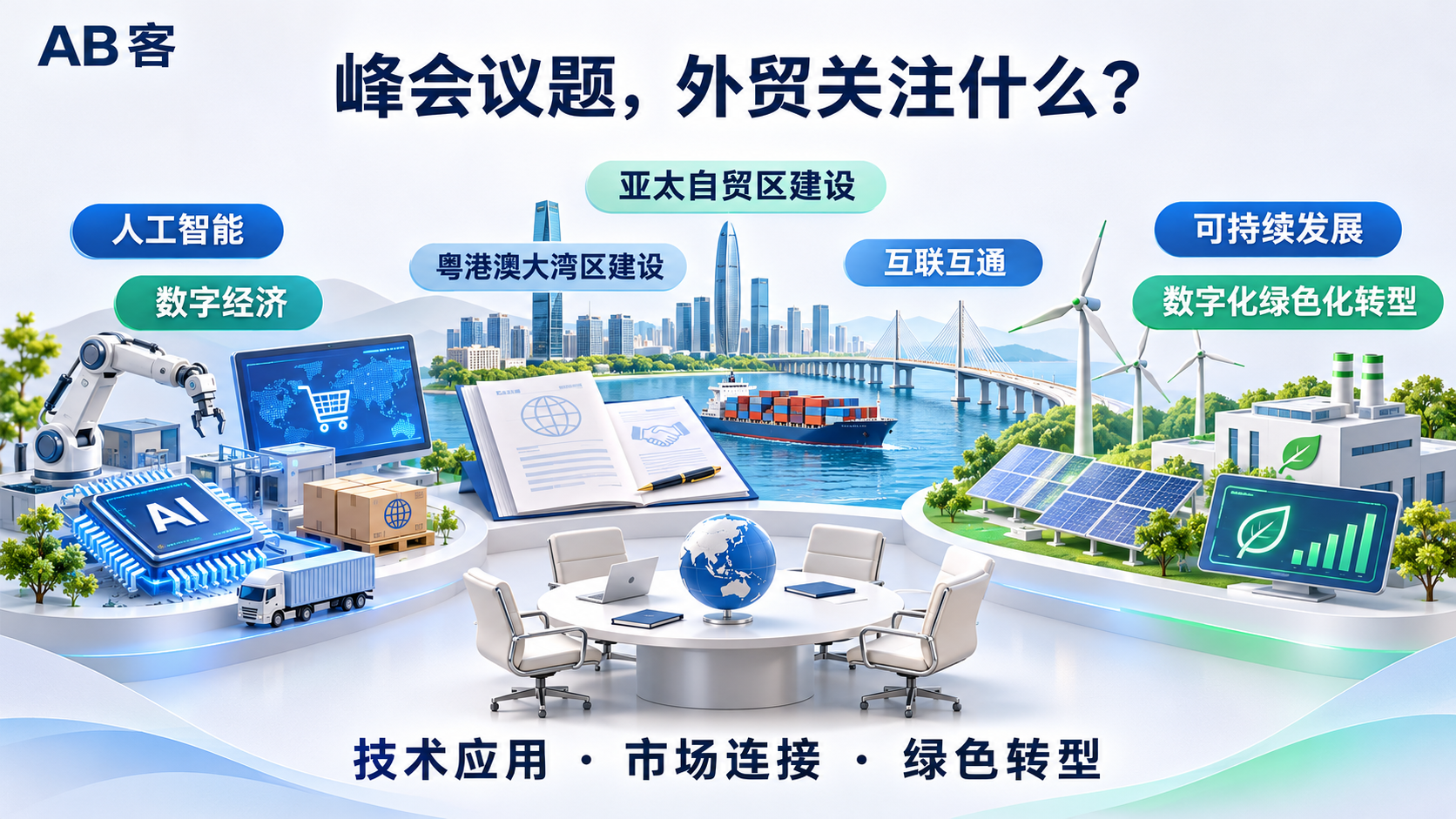
2. Seven Key Topics: What Matters Most to Global Business Leaders?
The summit featured seven key topics, discussed below in order of their relevance to foreign trade:
🔥 Topic 1: Artificial Intelligence (Most Popular)
AI was the strongest recurring theme throughout China’s APEC host year. In July, the APEC Digital and AI Ministerial Meeting in Chengdu adopted the Chengdu Declaration, elevating “open source” to the level of ministerial cooperation for the first time and explicitlysupporting micro, small and medium-sized enterprises in using lightweight digital tools to improve competitiveness. China’s Ministry of Foreign Affairs also said it was working to develop a “Roadmap for Innovation-Driven Growth Powered by Artificial Intelligence and the Digital Economy.”
What it means for foreign trade: AI is no longer exclusive to large companies. From prospecting emails and multilingual content to intelligent customer service and AI-powered inquiry screening, policy support is now in place for smaller foreign trade businesses seeking to use AI to reduce costs and improve efficiency. More importantly—Buyers are also using AI to find you.
🔥 Topic 2: Digital Economy
The focus is shifting from managing data to putting it to better use. Data was addressed as a standalone topic in APEC policy dialogue for the first time. Cross-border e-commerce, mobile payments and smart customs were mentioned repeatedly.
What it means for foreign trade: Standalone websites, digital marketing and an end-to-end online sales process are the “new infrastructure” for foreign trade businesses. Companies with weak digital capabilities risk falling behind in the next round of competition.
🔥 Topic 3: The Construction of the Free Trade Area of the Asia-Pacific (FTAAP)
2026 marks the 20th anniversary of the FTAAP vision. The business community has issued a joint statement in support, while China continues to advance the process of joining the CPTPP and DEPA.
What it means for foreign trade: Potential benefits from tariffs and rules of origin are still emerging. Use of RCEP and future, higher-standard free trade arrangements have a direct impact on pricing competitiveness.
🔥 Topic 4: Interoperability
China announced its support for establishing theWorld Bay Areas Economic Cooperation Alliance; the China-Laos Railway, Peru’s Chancay Port and the New International Land-Sea Trade Corridor were cited as “golden arteries” connecting the Asia-Pacific.
What it means for foreign trade: More diverse logistics routes mean greater delivery certainty, particularly benefiting exporters serving Latin American and Southeast Asian markets.
🔥 Topic 5: Sustainable Development+ Topic 6: Digital and Green Transformation
Green and low-carbon development was a common theme in leaders’ speeches and ministerial meetings. China pledged to support the region’s transition through its comprehensive new energy industrial chain.
What it means for foreign trade: Green certifications and carbon footprint disclosure are becoming mandatory procurement requirements for major customers. Companies that prepare early can qualify as suppliers.
🔥 Topic 7: Construction of the Guangdong-Hong Kong-Macao Greater Bay Area
As a local topic for the host location, connections between the Greater Bay Area’s financial, shipping, science and technology resources and Asia-Pacific markets were discussed repeatedly.
What it means for foreign trade: Foreign trade businesses in the Greater Bay Area benefit from proximity to these opportunities, and regional policy measures are worth monitoring individually.
| Topic | Foreign trade priorities |
|---|---|
| Artificial intelligence and the digital economy | AI tools, multilingual content, standalone websites and online sales |
| FTAAP development and connectivity | Rules of origin, pricing and logistics routes |
| Sustainable development and digital and green transformation | Green certifications and carbon footprint disclosure |
| Development of the Guangdong-Hong Kong-Macao Greater Bay Area | Finance, shipping, science and technology, and regional policies |
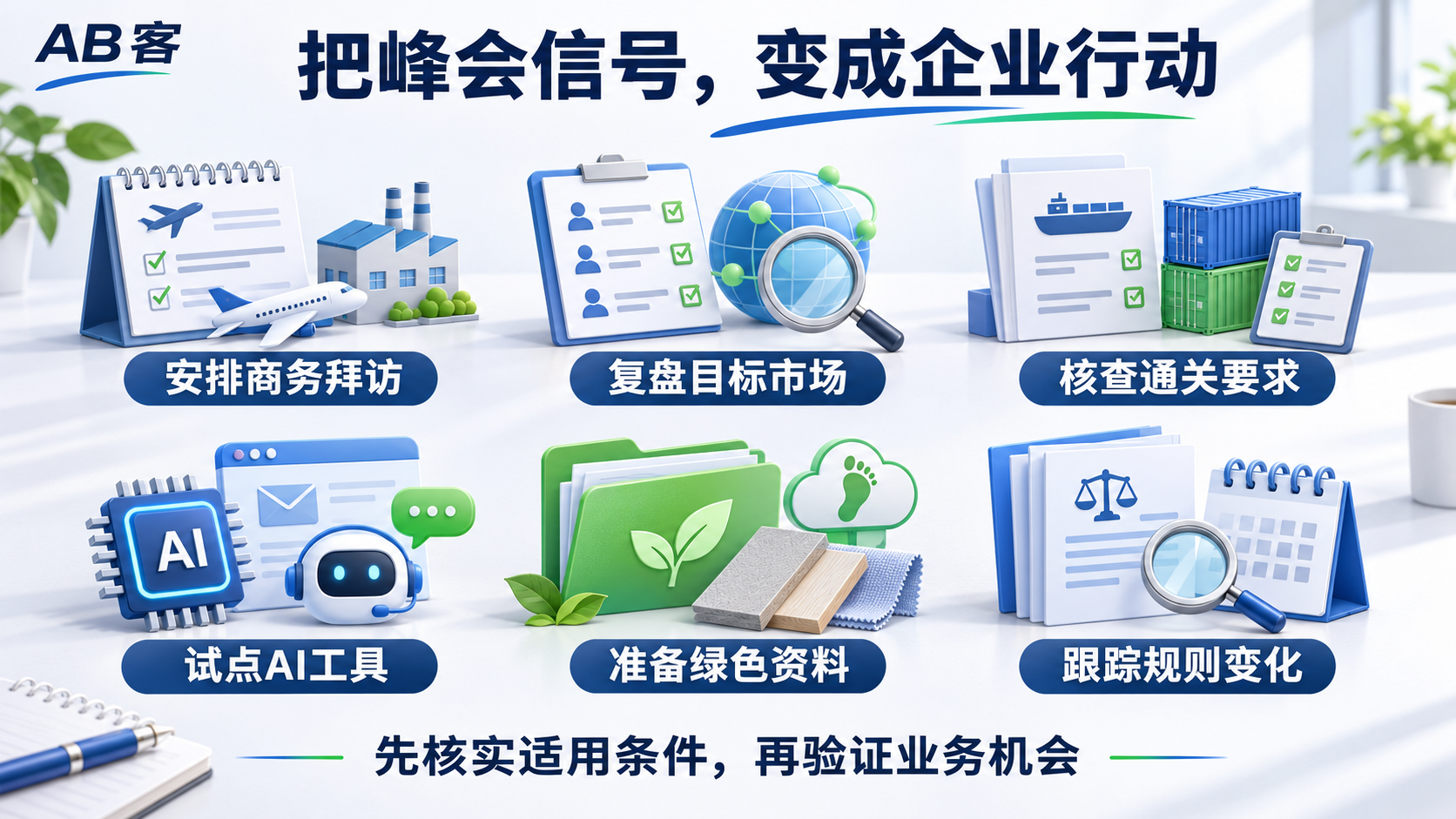
3. Six Specific Opportunities for Foreign Trade Businesses, With Recommended Actions
Benefit 1: Enhanced facilitation of business exchanges ✅
The maximum duration of each stay in China for APEC Business Travel Card holders has been extended from 60 days to90 days(effective November 1, 2026), and visa-free access continues to expand.
👉 Take Action: Encourage Asia-Pacific customers to apply for an ABTC. Take advantage of longer stays by combining factory visits, trade shows and negotiations in one trip, substantially shortening the conversion cycle.
Positive Factor 2: Continued Expansion of the Asia-Pacific Trade Base ✅
In the first three quarters, China’s imports and exports with APEC economies reached RMB 24.07 trillion, up 23.9% year on year and accounting for 60.3% of its total foreign trade.
👉 Take Action: Review your market mix. If APEC markets account for far less than 60%, there may still be room to expand into emerging markets in Southeast Asia and Latin America.
Benefit 3: Cross-border e-commerce and smart customs are on the top agenda.
The leaders’ keynote speeches specifically mentioned cooperation on trade digitalization, cross-border e-commerce and smart customs.
👉 Take Action: Pay attention to customs AEO certification and the 9710/9810 cross-border e-commerce export models. Compliance costs are lowest when policy conditions are favorable.
Benefit 4: AI adoption by SMEs receives official endorsement ✅
The Chengdu Declaration explicitly supports micro, small and medium-sized enterprises in using lightweight digital tools to improve competitiveness.
👉 Take Action: Move the AI tools budget from “optional” to “essential.” The ROI window for AI prospecting emails, AI content and AI customer service lies in the next 12–24 months.
Benefit 5: Green supply chains bring opportunities for a shift in development.
Coordinated digital and green transformation is an official summit topic, and green and low-carbon development is positioned as a new area for growth.
👉 Take Action: Review carbon tariffs and ESG disclosure requirements in your export destinations, such as the EU’s CBAM, and make green certifications a differentiator in your quotations.
Positive Factor 6: Certainty of Multilateral Rules Recovers ✅
A meeting of the Chinese, Russian and US leaders was held in Shenzhen, with dialogue among major powers creating more stable expectations for regional cooperation. Safeguarding the multilateral trading system became a shared position of the 21 economies.
👉 Take Action: Extreme uncertainty around exchange rates and tariffs is easing at the margin, making this a good time to restart negotiations involving longer payment terms and plan for markets in 2027.
4. An Easily Overlooked Trend: AI Is Changing Customer Acquisition Itself
Of the seven topics, artificial intelligence drew the most attention, but many foreign trade professionals have focused only on using AI to write prospecting emails. A deeper change is taking place on the buyer’s side:
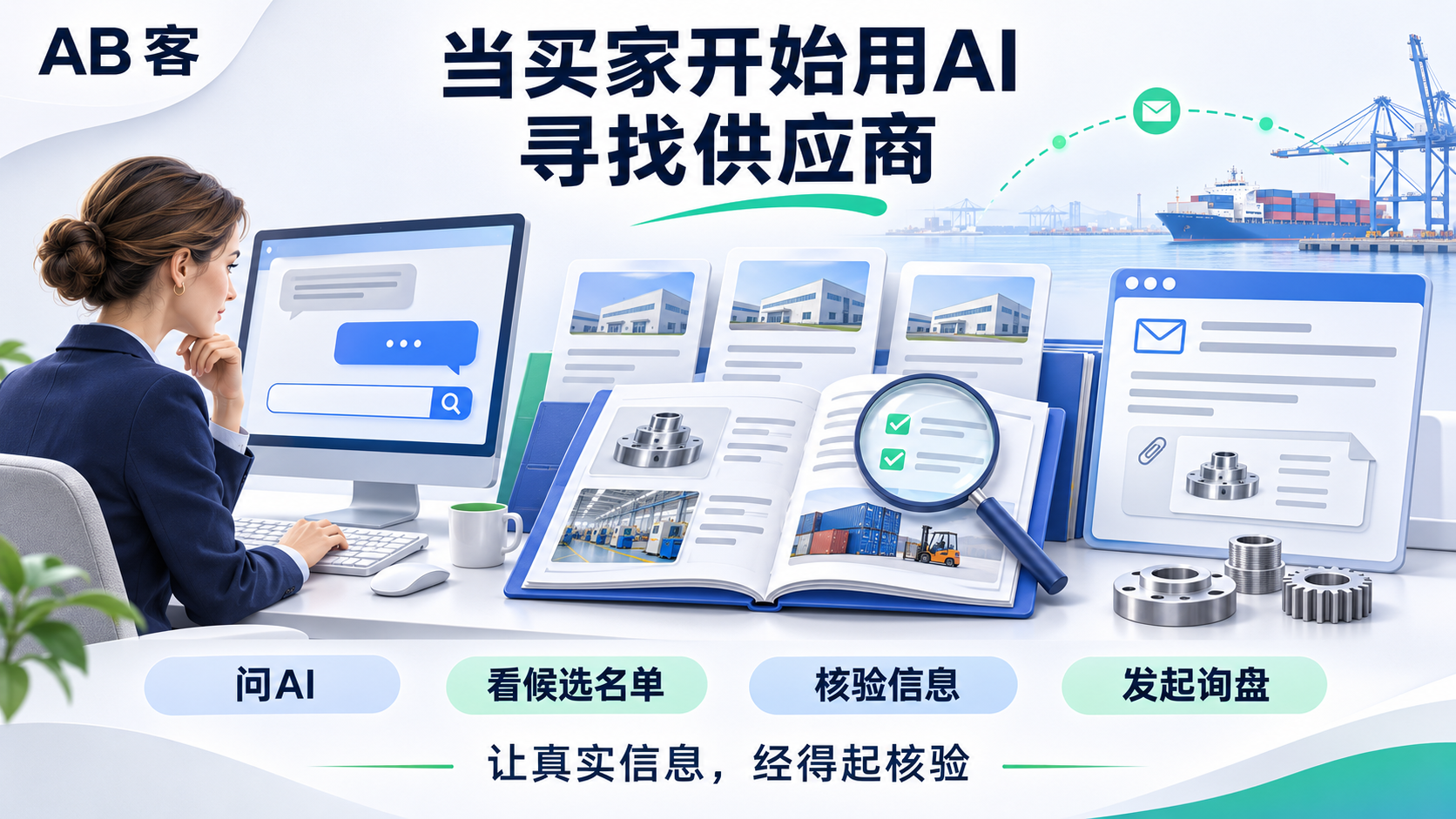
The decision-making process for overseas buyers is becoming: Ask AI (ChatGPT/Perplexity/Gemini) → View the list of suppliers recommended by AI → Verify the company information cited by AI → Initiate an inquiry.
Ask AI
Review AI-recommended suppliers
Verify the company information cited by AI
Submit an inquiry
As the summit discusses how AI can empower industries, a company whose information cannot be discovered, understood and cited by AI is effectively invisible at a new generation of procurement entry points. This is the context behind the rise of GEO (Generative Engine Optimization), and the next major area of competition in foreign trade digital marketing after SEO.
As a provider of systematic B2B GEO solutions for foreign trade businesses, ABKE uses the ABKE GEO Growth Engine and six core product capabilities—enterprise knowledge bases, intelligent website development, enterprise AI agents, content and channels, customer prospecting, and a closed-loop CRM process—to help companies organize authentic knowledge and evidence, making their information easier for search engines and AI to discover, understand, verify and cite. Every policy opportunity highlighted at the Shenzhen summit ultimately comes down to whether buyers can find and trust you. ABKE GEO aims to turn that certainty into a growth engine for your business.
👉 Now available through AB Customerfree AI diagnostic(cnabke.com/geo-diagnosis.html) to assess your company’s visibility in AI search and see whether it appears in the answers when global buyers ask AI.
Conclusion
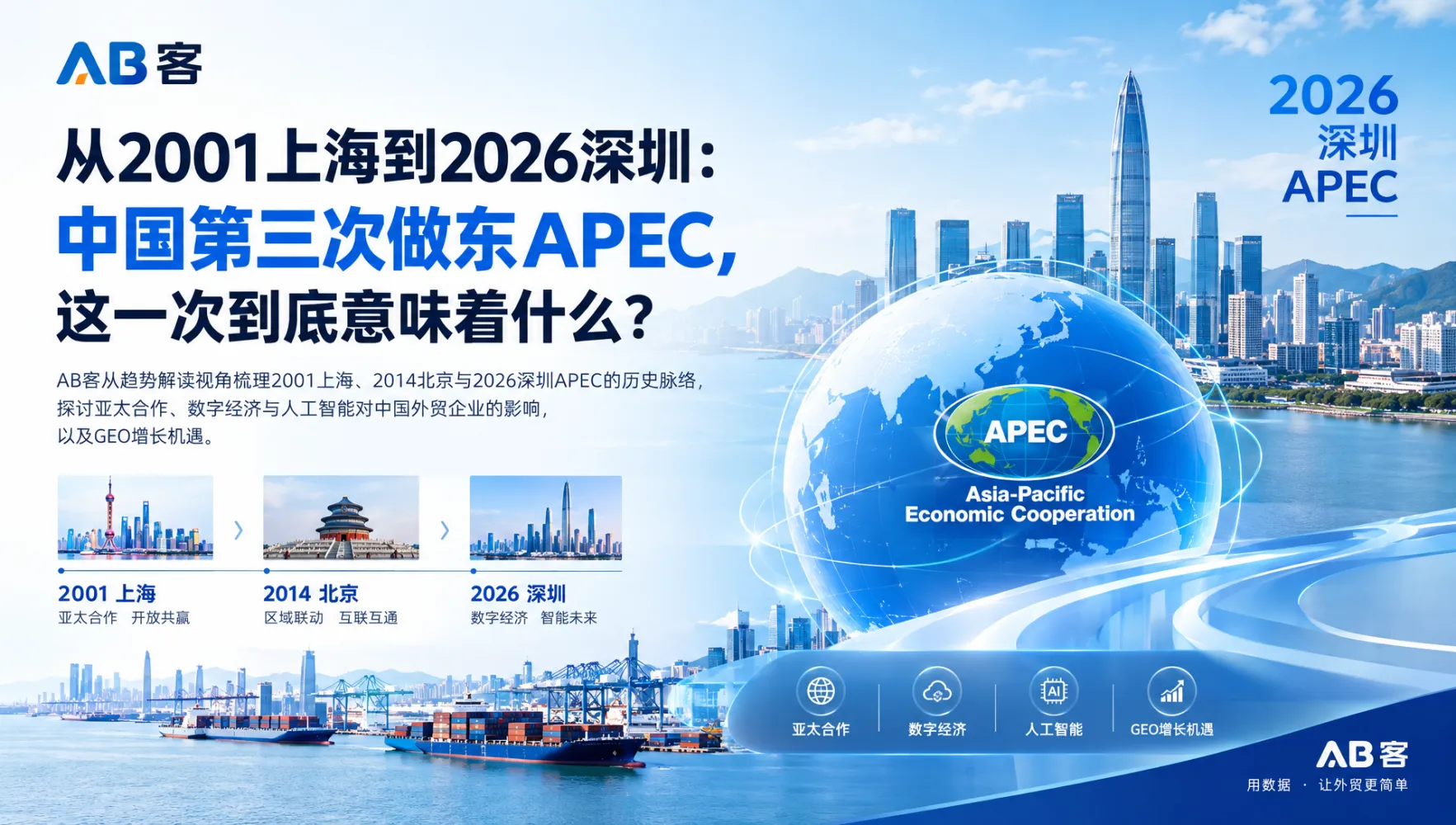
After the 2001 Shanghai APEC meeting, foreign trade pioneers seized the opportunities created by China’s WTO accession. After the 2014 Beijing APEC meeting, companies investing in the Belt and Road Initiative gained ground in emerging markets. At the 2026 Shenzhen APEC meeting, artificial intelligence and the digital economy have taken center stage in regional cooperation for the first time.
2001
Shanghai APEC
2014
Beijing APEC
2026
Shenzhen APEC
The policy direction is clear, and the tools are in place. The remaining question is: will your company have a seat at the table this time?
(Sources: Xinhua News Agency, CCPIT, China’s Ministry of Foreign Affairs and People’s Daily, as of November 19, 2026)


