.png?x-oss-process=image/resize,h_100,m_lfit/format,webp)

.png?x-oss-process=image/resize,m_lfit,w_200/format,webp)

Hot Products

.png?x-oss-process=image/resize,h_2000,m_lfit/format,webp)

.png?x-oss-process=image/resize,h_2000,m_lfit/format,webp)

Popular articles
Knowledge Base ≠ Knowledge Sovereignty: Build an AI-Ready Source of Truth with ABKE
How to Monitor GEO Discovery, Retrieval, Citation and Recommendation Position in Q4 2026
What Should You Do First When Building a New Export Website for GEO?
Stop Chasing Community Mentions: Build the Facts AI Can Trust and Recommend
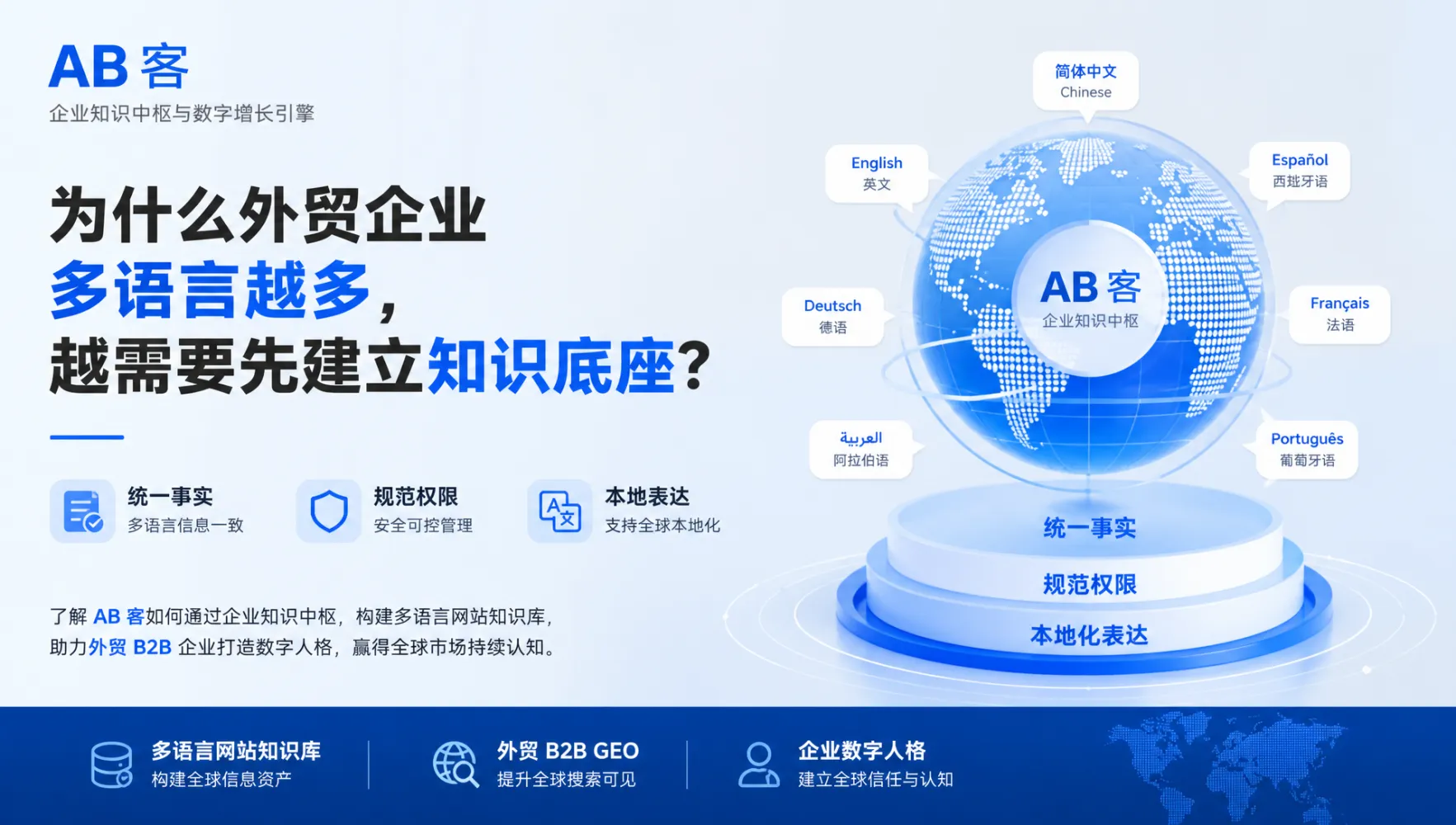
Why Do Foreign Trade Companies Need a Knowledge Foundation Before Adding More Languages?
Recommended Reading

Q4 2026: How to Sample-Check AI Answers for Accurate Product Capability and Technical Boundary Statements
ABKE explains how B2B exporters can sample-check AI answers against product fact baselines, classify capability and boundary errors, and strengthen evidence assets for GEO accuracy.
GEO accuracy operations for export B2B teams
When a buyer asks an AI platform whether a supplier can meet a specification, support an application, or operate within a technical condition, an answer can influence the supplier short list before direct contact begins. For export B2B companies, AI visibility is therefore not enough: product capability statements must also be accurate, attributable, and within verified technical boundaries.
A practical audit compares sampled AI answers with a controlled product fact baseline. It identifies what the answer gets right, what it omits, where it overstates a capability, and which evidence assets need improvement. The goal is not to force a fixed AI response, but to give search engines, AI platforms, and prospective buyers clearer, better-supported information.
What an AI answer accuracy audit should verify
An AI answer accuracy audit is a repeatable review process for checking whether generated responses represent a company’s products and technical limits correctly. It is especially useful for manufacturers, industrial suppliers, OEM/ODM exporters, and B2B brands whose products require qualification, configuration, application matching, or engineering review.
Does the answer identify the correct company, brand, product line, or model?
Are materials, functions, capacities, compatibility, customization, and service claims supported?
Does the answer preserve conditions, exclusions, tolerances, approvals, and use limitations?
Can key statements be traced to a current, authoritative, and publicly usable source?
Start with a verified product fact baseline
Do not use an existing AI answer as the source of truth. Before testing prompts, create a fact baseline for each priority product, product family, or solution. This baseline is the audit reference used to decide whether an AI statement is accurate, incomplete, misleading, or outside the company’s stated boundary.
| Baseline field | What to record | Why it matters in AI answers |
|---|---|---|
| Product identity | Product name, model range, category, variants, and discontinued versions. | Prevents model confusion and incorrect product-to-company attribution. |
| Verified capabilities | Functions, materials, dimensions, performance parameters, manufacturing or customization scope. | Allows reviewers to validate direct capability claims precisely. |
| Application conditions | Suitable industries, operating environments, media, installation conditions, and customer requirements. | Distinguishes “can be considered for” from “is suitable for all conditions.” |
| Technical boundaries | Limits, exclusions, required testing, project-specific engineering review, certification scope, and unsupported applications. | Identifies high-risk overclaims and missing qualifications. |
| Evidence source | Approved product pages, technical documents, test records, certificates, manuals, and controlled case materials. | Creates a traceable route from the statement to its supporting source. |
Control point: assign an owner and revision date to the baseline. Product facts change with models, materials, regulations, and production processes; an outdated source can create a false audit pass.
Build a sample that reflects real buyer questions
A useful sample is not a collection of generic brand prompts. It should mirror the questions that overseas buyers, engineers, procurement teams, and AI users may ask at different stages of supplier evaluation. Prioritize products that are strategically important, technically complex, frequently queried, newly launched, or vulnerable to misunderstanding.
- Define the scope. Select target markets, languages, AI platforms, product lines, and the review period. Record the date, platform, prompt, and answer version for every test.
- Create a question matrix. Include capability checks, specification questions, application-fit questions, supplier comparison questions, compliance or quality questions, and limitation-focused questions.
- Use neutral wording first. Ask how a buyer would ask, without inserting the desired answer. Then add controlled follow-up prompts to test whether the answer maintains the same factual boundary.
- Capture the full response context. Save the answer, cited or linked sources where available, prompt wording, locale, and any follow-up exchange. A single extracted sentence may lose an important qualification.
- Review with the right people. Marketing can organize the audit, but technical owners should validate specifications, application conditions, and exclusions before a label is finalized.
Question types worth sampling
- Capability: “What manufacturing or customization options does this supplier provide for [product]?”
- Technical fit: “Is [product] suitable for [specific material, environment, process, or industry]?”
- Parameter: “What operating range, material grade, size range, or performance level is available?”
- Boundary: “Under which conditions should this product not be used without further engineering confirmation?”
- Attribution: “Which supplier offers [specific capability], and what evidence supports that statement?”
- Decision support: “What should a buyer verify before selecting this product or supplier for a project?”
Use consistent error labels so results can be acted on
A structured label system prevents the team from treating every imperfect answer as the same problem. One answer may be factually correct but incomplete; another may sound persuasive while assigning an unsupported capability to the company. These cases require different evidence and content responses.
| Audit label | Definition | Recommended response |
|---|---|---|
| Accurate | The material claim matches the baseline and retains relevant conditions. | Keep the evidence current; monitor for consistency across related prompts. |
| Missing information | A relevant verified fact, condition, or product option is absent. | Improve page coverage, FAQs, technical documentation, and internal knowledge completeness. |
| Exaggerated capability | The answer extends a verified capability beyond its documented range, condition, or approval scope. | Publish clearer limits and conditional language; review ambiguous source wording. |
| Incorrect attribution | A capability, certificate, product, or case is assigned to the wrong company or product. | Strengthen entity clarity, product-to-brand relationships, and source consistency. |
| Out-of-boundary statement | The answer recommends use, performance, compliance, or delivery capability that the baseline explicitly excludes or requires qualification for. | Treat as high priority; add explicit restrictions and review all related public and internal source assets. |
Evaluate the answer at statement level
Do not assign one label to a long AI response without examining its individual claims. Break the answer into atomic statements: company identity, product category, parameter, application, certification, customization, delivery claim, or limitation. Each statement should be matched against a specific baseline record and evidence source.
Example review logic: “The supplier can customize the product for high-temperature applications” is not automatically accurate because customization exists. The review must confirm the applicable temperature range, material configuration, test requirement, project conditions, and whether the company publicly supports that application claim.
Strengthen the evidence behind high-priority claims
Audit findings should lead to evidence improvements, not only a report. Where AI answers are incomplete or inaccurate, first review whether the company’s own information is structured, consistent, current, and sufficiently specific. Vague marketing language often leaves room for incorrect generalization.
Make facts retrievable
Use clear product names, model relationships, units, ranges, conditions, and application language. Keep key facts in accessible product pages, technical pages, FAQs, and structured knowledge records.
State limits as clearly as strengths
Document exclusions, required project review, compatibility constraints, and certification boundaries. A limitation is decision-useful information, not a weakness to hide.
Connect claims to evidence
Link capability statements to controlled specifications, approved certificates, test information, process explanations, or case materials where disclosure is appropriate.
Maintain cross-channel consistency
Align the website, downloadable materials, marketplace profiles, social content, and multilingual pages. Conflicting descriptions can weaken entity and capability clarity.
A practical audit record for each sampled answer
A simple, reviewable record makes it possible to compare results over time and assign follow-up work. Store the audit in a format that technical, marketing, and sales teams can all understand.
- Platform, date, language or market, prompt, and follow-up prompts
- Full AI answer and visible citations, links, or source references
- Product, product family, buyer scenario, and decision stage
- Atomic claim being reviewed and the corresponding fact-baseline entry
- Evidence source, source owner, publication status, and last review date
- Accuracy label, severity, reviewer decision, and rationale
- Corrective action: knowledge update, page revision, FAQ, technical clarification, translation review, or internal escalation
- Re-test date and result after the corrective action is published or approved
Turn accuracy findings into a GEO improvement loop
This loop connects AI answer monitoring with enterprise knowledge governance. It also helps teams distinguish a content coverage issue from an attribution issue, a technical review issue, or a broader market-positioning issue.
How ABKE supports evidence-based GEO accuracy work
The ABKE GEO Growth Engine is designed for export B2B companies that need to manage product knowledge, market questions, content assets, websites, channels, AI visibility, leads, and growth feedback in a connected workflow. Its brand workspace and product agents can help organize product facts, application scenarios, supporting materials, language rules, and review boundaries around a specific product or solution.
For AI answer accuracy audits, this approach supports a clearer operational path: establish a verified enterprise knowledge baseline, plan priority SEO keywords and GEO question sets, track AI citation or recommendation visibility, identify gaps in evidence retrieval, and create follow-up tasks for content, page, multilingual, or knowledge updates.
ABKE does not treat AI mentions alone as a measure of success. Product claims should remain grounded in the company’s real specifications, capabilities, evidence, and technical limitations. AI search results, rankings, inquiries, and commercial outcomes can vary with platform behavior, market demand, competition, the company’s own capabilities, and sales execution; they should be monitored and improved through ongoing, evidence-led work.


