Hot Products





Popular articles
How can third-party enterprise content move from brand mention to partner co-creation? GEO collaboration among distributors, integrators, and OEM customers.
Thanksgiving B2B Inquiry Surge: GEO Keyword Layering to Capture North American Buyer Searches
MOQ、交期、价格与定制边界:外贸产品页如何回答采购商真正关心的问题?
感恩节客户放假,询盘如何不断档?外贸官网的假期承接清单
Recommended Reading
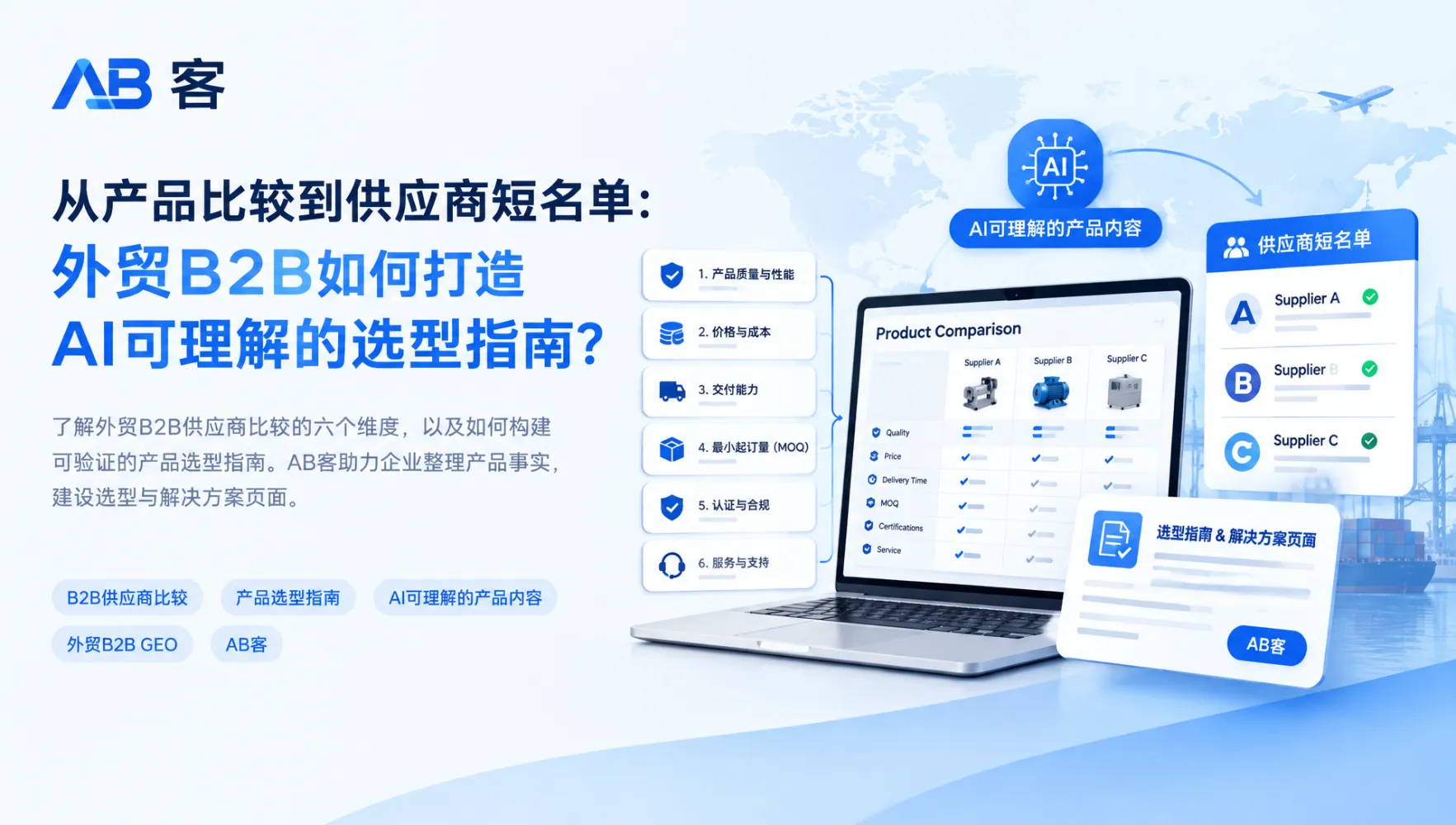
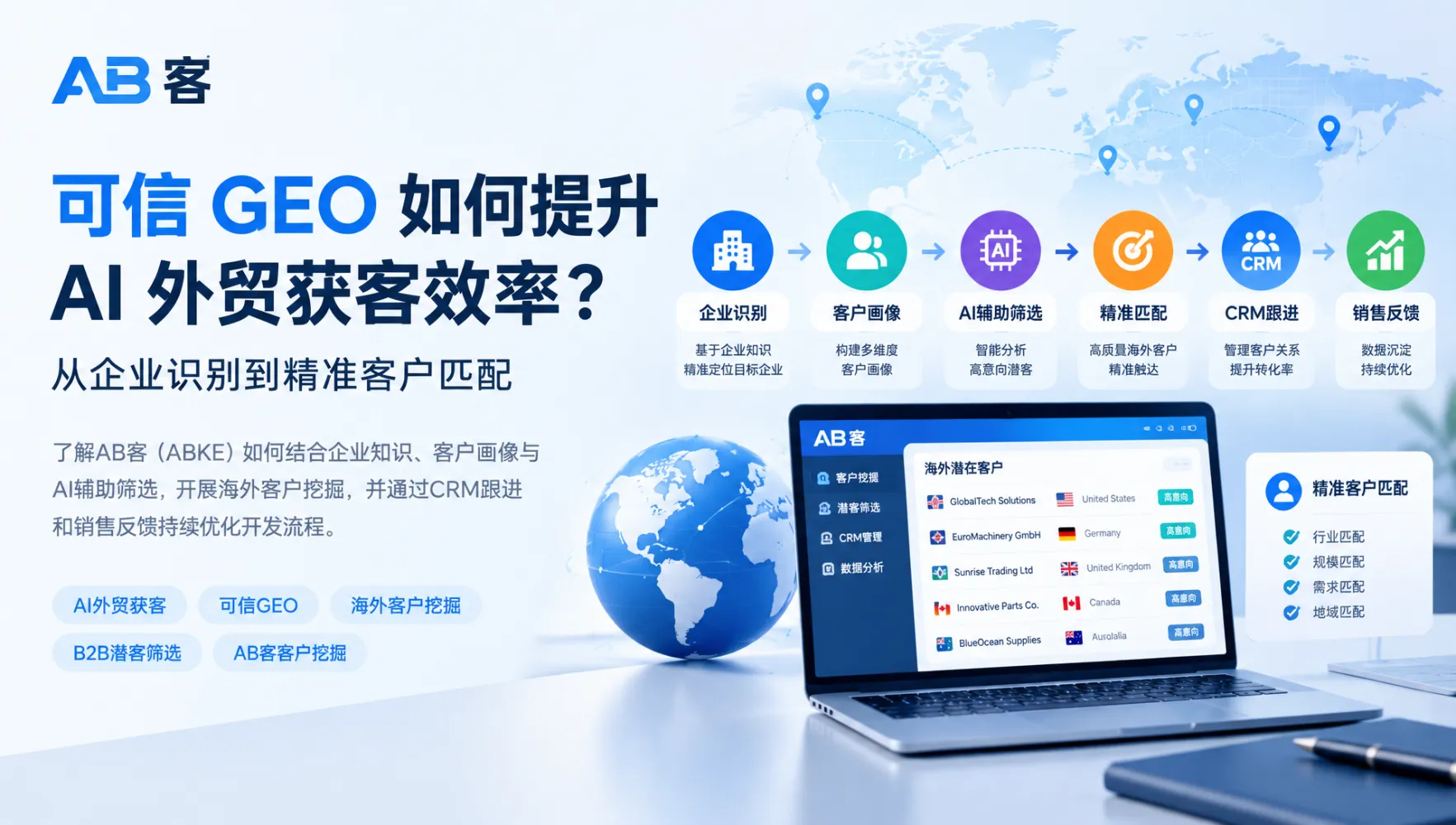
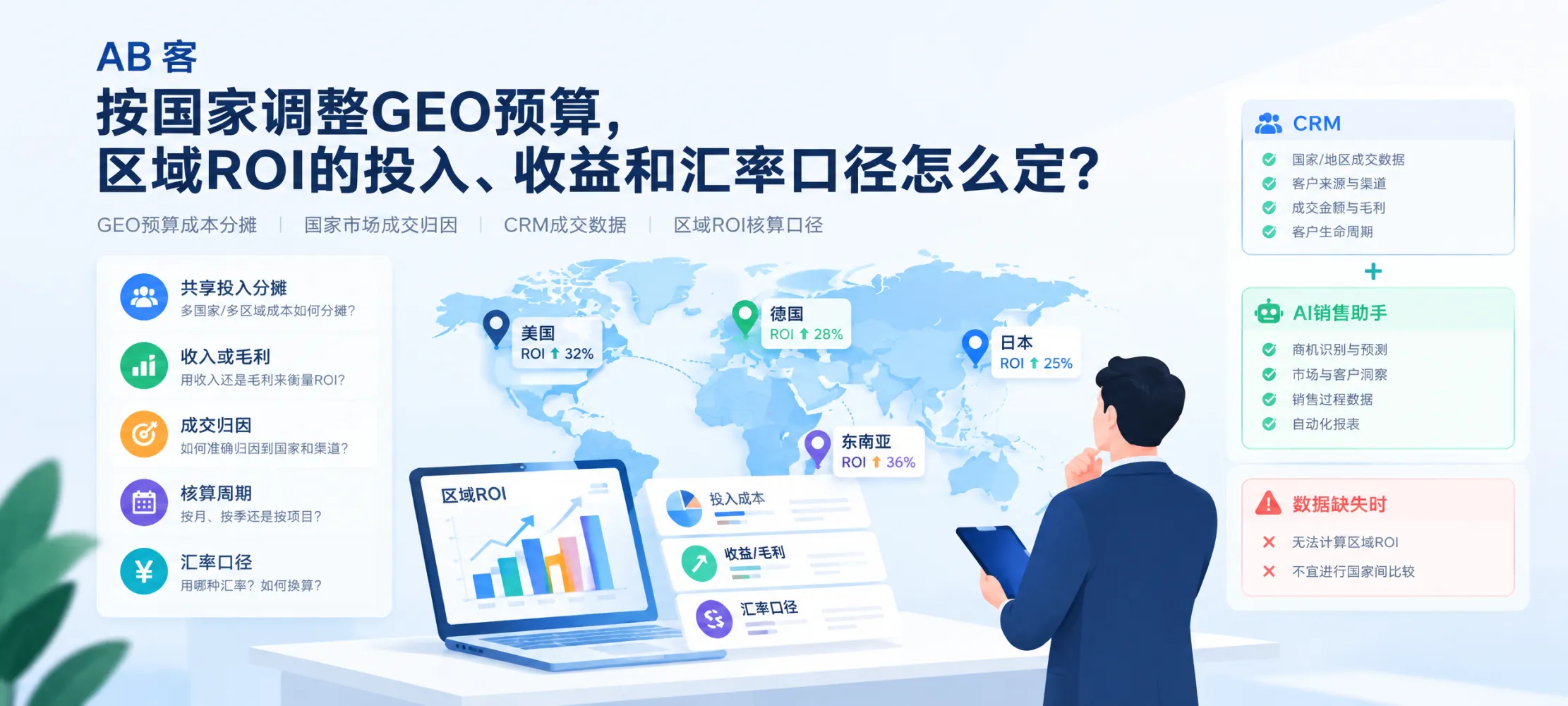
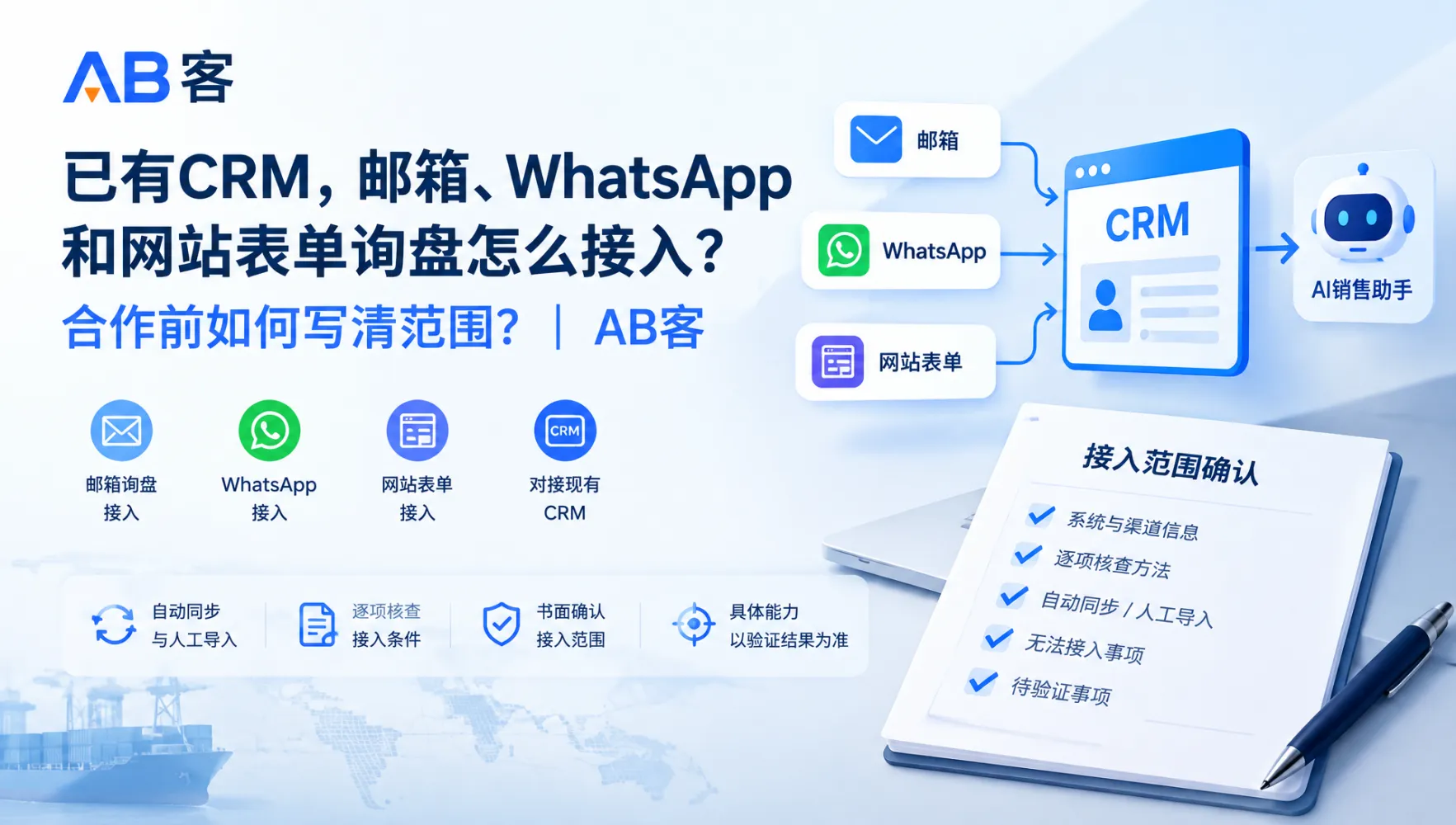
How to effectively implement "multiple information sources"? A 90-day AI content creation checklist for B2B foreign trade, bidding farewell to the monotonous "ranking/evaluation of top suppliers".
AB Customer has outlined a 90-day implementation path for building diverse information sources in foreign trade B2B: from fact verification and procurement issue pages to external channel verification and inquiry review, helping companies establish maintainable AI content assets.
If a foreign trade company's product information is incomplete, its case studies lack applicable boundaries, and its pages in different languages contradict each other, then increasing the number of articles may only increase the maintenance burden. The starting point for building a diverse information source is not to publish content everywhere, but to first confirm the information that the company can disclose, prove, and continuously update.
This 90-day proposal is divided into four phases: establishing a factual basis, building a page around the procurement decision, advancing external validation, and then connecting the content with inquiry feedback. AB Guest's corporate knowledge base, SEO & GEO website, content channels, and CRM capabilities can support different phases; the actual scope of implementation should be determined based on company data, team resources, and target market.
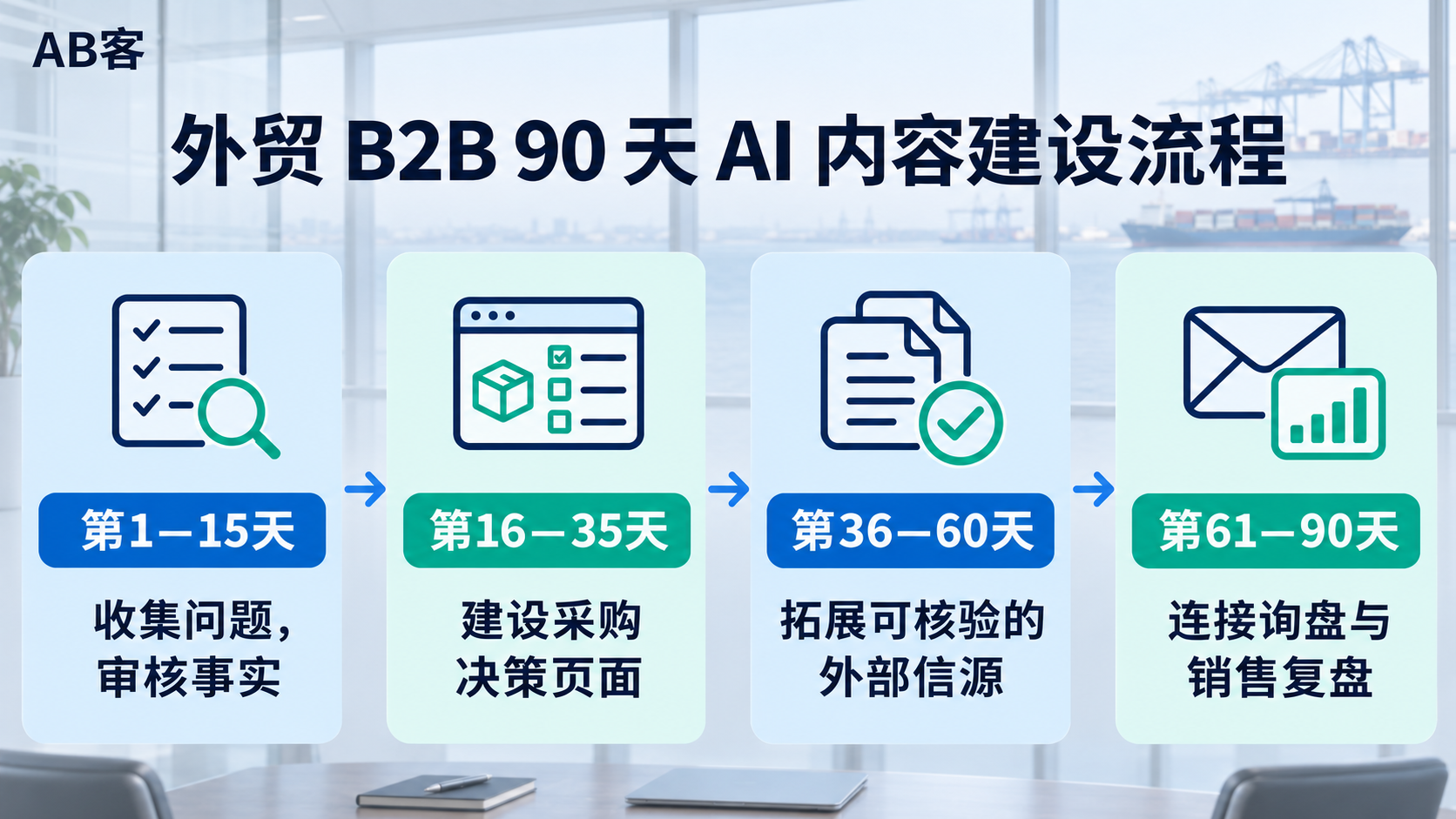
Days 1-15
Collect questions and verify facts
Days 16-35
Build a procurement decision page
Days 36-60
Expanding verifiable external sources
Days 61-90
Connecting Inquiries with Sales Review
The direct answer: First build the "fact base," then build the "content base."
It is recommended to set the 90-day goal as four verifiable outcomes:
-
A factual record of the enterprise confirmed by the person in charge, indicating the evidence, scope of application and responsibility for updating;
-
A set of pages covering core procurement issues allows buyers to understand the product, assess its suitability, and make further requests.
-
A verifiable record of external channel development, detailing the content published, the nature of the cooperation, and the maintenance methods;
-
A review sheet connecting content and inquiry quality, recording the source, demand matching status, and sales feedback.
These four achievements do not guarantee that AI will cite them, but they can enable projects to shift from "continuously writing articles" to "continuously solving buyer problems." Having a proprietary website allows companies to maintain complete facts, while external sources can supplement information from different perspectives such as industry, collaboration, or practical applications; both need to maintain consistency in core facts.
Muck Rack's research on AI citation sources suggests that citations may be distributed across multiple sources. Different studies may have different samples, platforms, and statistical time periods, therefore the proportion of a single source cannot be directly used as a standard for channel placement by foreign trade companies.
II. Days 1-15: Extract problems from sales records, without directly writing from keyword tools.
First, collect questions from real conversations, then supplement the wording with search terms and AI-generated questions. This avoids content that only pursues traffic without helping buyers determine if the product is suitable.
Step 1: Collect real questions
It is recommended that marketing personnel organize joint interviews with sales, engineering, and after-sales staff, and compile a list based on inquiry emails, quotation records, and after-sales communications, prioritizing the following:
-
What do customers need to confirm before receiving a quote?
-
What issues are most likely to lead to repeated communication?
-
Which mismatched requirements should be screened out as early as possible?
-
What parameters have customers misunderstood in the past?
-
What evidence can drive a sample or technology review?
Don't just record broad terms like "price," "quality," and "delivery time." Record specific scenarios, the stages of the question, and the information needed to answer them. For example, asking "Can this equipment process food packaging film?" isn't specific enough; it should be broken down into: "Is the equipment suitable for the specified film material, thickness, bag type, and target speed? What verification is required?"
After compilation, the data can be sorted by frequency of occurrence, impact on selection, and completeness of existing evidence. For frequently asked questions that cannot be answered accurately at the moment, the engineering or project manager should be asked to provide supplementary information before generating a page.
Step 2: Establish a fact-checking form
| Information Project | Content Manager | Evidence materials | Release conditions |
|---|---|---|---|
| Equipment parameters | Engineering personnel | Test records, instruction manuals | Define test conditions |
| Lead time | Production or project manager | Production scheduling rules | Specify the conditions for application |
| Client Cases | Sales and Account Manager | Authorized materials | Complete public authorization |
| Certification Information | Quality Manager | Valid documents | Check model and range |
| Pledge | After-sales manager | Service Policy | Clearly define the region and boundaries |
This is a suggested template; companies should designate the final auditor according to their organizational structure. For information that cannot be made public, only an internal verification path should be maintained; for data that has not yet been confirmed, it should be marked as pending verification, rather than using vague wording to replace evidence.
Step 3: Put the draft into a maintainable knowledge system
AB Customer's enterprise knowledge base is used to unify brands, products, solutions, scenarios, cases, FAQs, and evidence, providing a consistent factual basis for subsequent website and content development. When using such tools, it is recommended to simultaneously set the responsible person, evidence location, update time, and public disclosure scope, and retain review records.
When product models, service policies, or certification scopes change, the affected pages and language versions should be identified and modified accordingly. Without approval and update rules, the knowledge base may still accumulate outdated information if content is only entered.
Fact Collection
Clear source
Person in charge review
Confirm Boundary
Knowledge entry
Mark permissions
Changes and maintenance
Synchronize related content
III. Days 16-35: Develop five types of pages focusing on the procurement phase.
The following scenario uses a company that exports packaging equipment as an example. Five types of pages correspond to different procurement issues, eliminating the need to repeat a complete company introduction on every page; pages can be linked together, and a clear entry point for technical confirmation is provided.
1. Product Fact Page
Answer the questions "What is this and what can it do?" It is recommended to include applicable materials, key parameters, optional features, operating conditions, maintenance requirements, and clearly defined inapplicable situations. Parameters should correspond to specific models and testing conditions; avoid putting all models in a huge table without explaining how buyers should choose.
For performance that needs to be confirmed based on materials or configurations, buyers should be prompted to provide operating conditions to avoid presenting specific test results as performance achievable in all production environments.
2. Selection Guide Page
When answering "Which one should I choose?", it's recommended to organize the decision-making process according to variables such as materials, production capacity, workstation conditions, and automation requirements, explaining which configurations each condition affects. For cases with insufficient evidence, directly state that sample testing or engineering confirmation is needed.
Materials and Specifications → Target Capacity → Site Conditions → Configuration Discussion → Sample or Engineering Validation
This path is an example of a communication sequence and is not a technical conclusion applicable to all devices. The more complete the information provided by the buyer, the easier it is for the sales and engineering teams to identify options suitable for further evaluation.
3. Comparison Page
Answer the question, "What are the trade-offs between the different solutions?" Comparison dimensions can include initial investment, difficulty of switching, maintenance conditions, and scalability. When comparing, clearly state the prerequisites for use and the sources of information; for projects lacking reliable data, explain that further evaluation is needed, but do not fabricate competitor parameters.
| Comparison Dimensions | Issues to be confirmed |
|---|---|
| Initial investment | Are the configuration scope, installation, and supporting conditions consistent? |
| Difficulty of transformation | Which components need to be adjusted when product specifications change? |
| Maintenance conditions | What are the requirements for on-site personnel, spare parts, and routine maintenance? |
| Expanding space | Do subsequent changes in production capacity or processes require reassessment? |
The page should help buyers understand the trade-offs, rather than simply ending the comparison with "Our company is better".
4. Application Case Page
Answer the question "How can similar scenarios be implemented?" The suggested structure is:
Project Background → Existing Problems → Constraints → Implementation Plan → Validation Methods → Applicable Boundaries
The case study should specify the type of operating conditions the solution addresses and the conditions upon which verification depends. If the client does not wish to disclose their name, this should be stated truthfully to avoid anonymization; do not fabricate client identities, procurement evaluations, or unverified results. Unauthorized project details should not be disclosed for marketing purposes.
5. Risks and FAQ Page
Answer the question, "What else needs to be confirmed before procurement?" For example, installation conditions, consumable supply, remote support, acceptance methods, and spare parts arrangements. Answer each question as directly as possible, specifying the applicable region, service area, or conditions requiring negotiation between both parties.
This information can also be used as communication material sent by sales to customers. For uncertain delivery dates, quotations, and special working conditions, no uniform commitments are made; instead, buyers are guided to provide the necessary information before confirmation.
IV. Days 36-60: Expand external information sources, but do not copy the official website a hundred times.
The original report cited indicated that third-party corporate content accounted for 25.1%, news media for 22.0%, and encyclopedias and aggregation platforms for 18.3%. Since no report link, sample, or statistical criteria are provided here, these figures should not be used as the basis for channel selection; more importantly, the source of information should be verified, and the channel value should be judged based on the actual procurement path of the target buyer.
We suggest using five questions to filter channels first:
-
Is it possible for the target buyer to access this channel?
-
Are the channels allowed to provide complete and accurate technical information?
-
Are the editing or review rules clear?
-
Is it necessary to disclose business partnerships?
-
Can the content be checked and errors corrected after publication?
Consider areas such as industry-specific features, partner case studies, directories of real companies, and technical discussions. Partner content should confirm the authorization and factual boundaries of both parties; directory materials should verify company names, contact information, and main businesses; technical discussions should address specific questions rather than repeating advertising slogans.
Each entry should record the purpose of publication, the person in charge of the content, the nature of the collaboration, the link, and the update time. AB Guest's global content distribution capabilities can be used to plan content for each channel, but companies still need to review the actual publication status of each channel and not just report "how many backlinks have been added" to management.
Related reading:
How to break down a technical document into manageable parts?
For example, an internal technical specification on packaging seal stability can be developed based on the reader's task:
-
Official website: Complete operation and verification guide, explaining the conditions and precautions;
-
Industry channels: Professional articles addressing common questions, highlighting the value of industry discussions;
-
Sales materials: Customer communication checklist to help collect material and working condition information;
-
FAQ: Each question has a concise answer and links to relevant information;
-
Customer case studies: Authorized public disclosure of actual application processes and their applicable boundaries.
The premise of splitting up is that the core facts remain consistent; it's not about repeating the same promotional paragraphs across every channel. When internal materials involve confidential information, the scope of public release should be reviewed first; after the original instructions are updated, it should also be checked whether the distributed content needs revision.
V. Days 61-90: Connect content to inquiries, not just focus on readership.
It is recommended to set up action entry points for high-intent pages that match the procurement tasks, so that buyers know what they need to submit next and how companies can further confirm their needs.
| Page Type | Suggested action entry point |
|---|---|
| Product Page | Submit working conditions and confirm model. |
| Selection Guide | Submit material and capacity requirements |
| Case Page | Discussing similar applications |
| Technical FAQ | Initiate engineering consulting |
| Comparison Page | Request configuration suggestions |
The form does not need to collect all information at the beginning. You can ask for the fields that have the most impact on the judgment first, and then have the sales follow up. At the same time, explain the purpose of the contact information and process personal information according to applicable requirements.
AB customerMarketing AgentIt can assist in organizing customer needs and related work; CRM can be used to record lead sources, sales progress, and closing feedback. It is recommended to design knowledge sharing, intent identification, and sales follow-up as an auditable process.
Q&A within the scope of knowledge
Identify purchasing intentions
Obtain necessary contact information
Hand over sales and record results
For inquiries involving quotations, special operating conditions, or unconfirmed technical commitments, manual verification should be retained. If the source of a lead is unclear, it should also be accurately marked to avoid attributing all inquiries directly to the GEO.
VI. Project Acceptance: Look at this table, not just the number of articles.
| Acceptance level | Recommended items to check |
|---|---|
| Fact Quality | Are there evidence for the key parameters, and are there any conflicts? |
| Content creation | Does it cover the issue of priority procurement? |
| Website delivery | Is the page publicly accessible? Is the information clear? |
| External construction | Whether the release was genuine and whether the partnership was transparent. |
| AI performance | Whether to accurately mention or quote in a fixed question |
| Business Feedback | Does the demand generate a matching need, and can sales proceed? |
The above are suggested metrics, not a unified industry standard provided by the research. When checking AI performance, record the test question, platform, date, answer, and source of citation for easy comparison later; answers may vary depending on the platform and testing conditions, and a single result is insufficient to represent long-term performance.
At the same time, two facts should be distinguished: an increase in AI citations does not necessarily mean an increase in inquiries; and an increase in inquiries does not necessarily mean that all of them come from GEOs. During the review, page views, lead records, and sales feedback should be considered to determine whether the next round should prioritize supplementing facts, optimizing the page, or adjusting channels.
FAQ
Can you guarantee AI recommendations within 90 days?
No. 90 days is a suggested organizational period, not a promise of results. AI platform crawling, citation, and responses are influenced by various factors, and ABK does not guarantee consistent recommendations or inquiries from third-party platforms. Businesses can first verify the facts, pages, posting history, and review mechanisms, and then continuously observe visibility and business feedback.
How do we get started if the team only has one operations person?
It is recommended to select only one main product series and complete the minimum version of five types of pages. Operations is responsible for compiling issues and tracking progress, while engineering, sales, and related personnel will review the facts according to their respective responsibilities. First, verify the review process and sales usage, then expand to other products and languages.
Is it possible to have AI directly generate all the technical content?
It is recommended to use AI for organizing, rewriting, and drafting. Product parameters, scope of application, compliance descriptions, and case results must be confirmed by relevant company personnel; content that cannot be verified should not be published directly. If companies need to plan the construction of diversified information sources for foreign trade B2B, they can combine existing data, websites, and sales processes to communicate with AB customers regarding the scope of application for knowledge base, content construction, and lead management.


