.png?x-oss-process=image/resize,h_100,m_lfit/format,webp)

.png?x-oss-process=image/resize,m_lfit,w_200/format,webp)

Hot Products
.png?x-oss-process=image/resize,h_2000,m_lfit/format,webp)
Popular articles
AB 客企业知识中枢:如何杜绝 AI 幻觉,让官网、销售资料、智能体回答 100% 基于企业确认事实?
How Can We Verify That GEO Builds Traceable Growth Assets, Not Just More Content and Website Pages?
ABKE GEO Renewal Is Not Repetitive Content—It Is the Next Stage of AI Visibility, Conversion, and Sustainable Growth
If We Build Our Own GEO Team, What Costs Beyond Content and SEO Hiring Should We Expect?
Recommended Reading

How to Build a B2B Buyer Procurement Question Library for GEO Growth
Learn how to build a B2B buyer procurement question library for GEO, SEO, AI visibility and global lead generation. ABKE helps exporters turn buyer questions into scalable digital growth assets.
How to Build a B2B Buyer Procurement Question Library?
For foreign trade B2B companies, GEO growth should not start with a keyword list. It should start with a structured buyer procurement question library that reflects how overseas buyers research, compare, validate, request quotations, and make purchasing decisions.
Summary
One of the most common mistakes in B2B GEO is to begin with keywords and then mass-produce articles. A more effective starting point is to build a real buyer procurement question library centered on overseas buyer decision-making. It is not just a keyword sheet, and it is not just a set of FAQs. It connects target market, buyer role, procurement stage, application scenario, product demand, supplier evaluation criteria, and company evidence into one content and growth system.
This article explains a practical method for building such a library and shows how to create the first version from scratch with an industrial equipment exporter as an example.
1. First, the conclusion: what is a B2B buyer procurement question library?
A B2B buyer procurement question library is a systematically organized collection of real questions buyers ask throughout the entire procurement journey—from first need recognition, solution research, product comparison, supplier validation, quotation, order confirmation, to post-purchase use and repeat buying.
At minimum, it should answer five core questions:
- Who is asking? Procurement manager, engineer, owner, technical lead, or distributor?
- Why are they asking? Are they learning, selecting, comparing, validating, or preparing to request a quotation?
- What are they asking about? Product, specification, application, certification, price, lead time, case study, or risk?
- What can the company answer with? Product knowledge, engineering experience, technical data, cases, or FAQs?
- What proof supports the answer? Certifications, test reports, factory capabilities, processes, project records, or other verifiable evidence?
ABKE’s GEO methodology further classifies buyer questions by the procurement journey: awareness, interest, evaluation, decision, quotation, and post-purchase. In practice, the library should not only support content planning, but also page planning, AI assistant responses, sales scripts, AI citation testing, and CRM feedback loops.
Keyword list approach: industrial pump / industrial pump manufacturer / industrial pump supplier / China industrial pump
Question library approach:
- Which pump material is suitable for corrosive chemical media?
- How do I calculate the required flow rate and head for my application?
- What certifications should I check before selecting a supplier?
- Can a Chinese manufacturer customize the material, seal, and motor configuration?
- How do I compare two suppliers for a long-term project?
The first set is mostly keywords. The second set already enters the world of procurement decision-making.
2. Why should GEO start from buyer questions, not keywords?
Traditional SEO often follows the path:
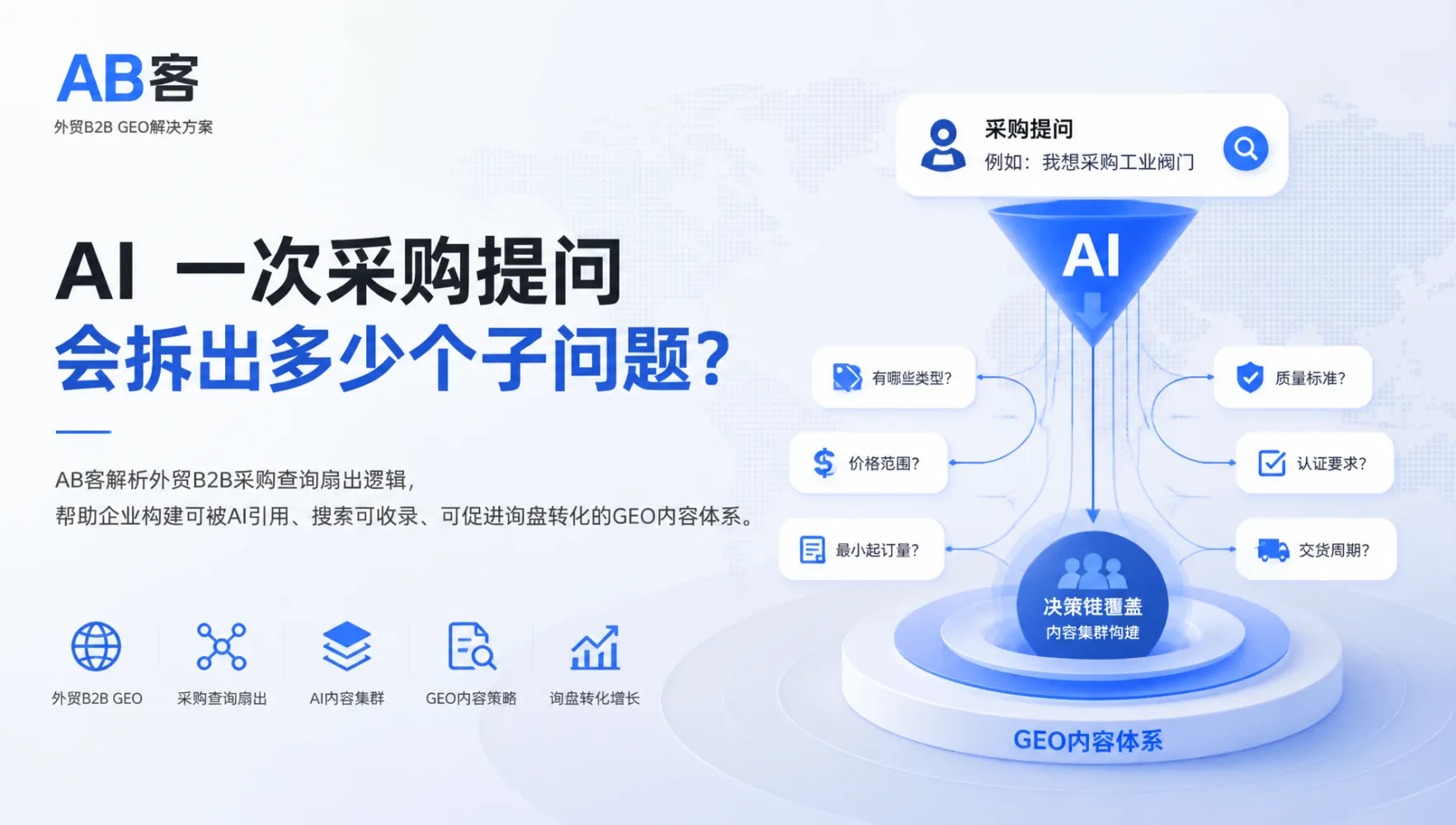
But generative AI search makes user intent much more layered. In AI-driven search experiences, the system may expand one query into multiple sub-queries and search across different data sources and topic angles. That means merely covering long-tail keyword variations does not necessarily cover the real procurement problem behind the query.
B2B buyers also increasingly use multiple channels at the same time—search engines, AI tools, social content, and peer recommendations—to compare suppliers and validate solutions. As a result, the questions that matter most are not only the ones with search volume, but the ones that influence supplier selection.
For foreign trade companies, the real competitive object is no longer just a keyword. It is the full set of buyer questions that grow around that keyword during the buying journey.
3. Buyer question library vs. keyword library
In short: the keyword library is not useless. It should simply be treated as one field inside a broader question-based system.
4. Lock the scope first: do not collect questions blindly
When companies build a question library for the first time, they often ask: “What do customers usually ask?” The sales team provides a list, the owner adds a list, and AI generates even more questions. The result is an Excel file that is impossible to operate.
The correct first step is to define a very clear scope:
One priority product
One target country or region
One clear vertical
Procurement, engineer, owner, distributor
New line, expansion, automation upgrade, etc.
Once the scope is fixed, the questions become specific enough to carry real commercial value.
5. Collect real questions from these 8 sources
1) Sales conversations
Email, WhatsApp, LinkedIn messages, RFQs, CRM notes, and all repetitive buyer objections.
2) Sales and business interviews
Ask what buyers ask first, what they confirm before quotation, what causes hesitation, and what they verify before closing.
3) Engineers and technical teams
Working conditions, materials, tolerance, temperature, pressure, installation, compatibility, testing, and service life.
4) Historical inquiries and RFQs
Analyze what the buyer specified, not just what they searched for.
5) Search and site search data
Google Search Console, Bing, internal search, FAQ clicks, and high-converting pages.
6) Competitor websites
Observe which procurement questions others answer, and where your site has content gaps.
7) AI search platforms
Test real buyer scenarios in ChatGPT, Gemini, Perplexity, and similar tools to identify missing questions.
8) Procurement standards and industry documents
Bids, specifications, supplier audits, certifications, RFQs, and technical requirements often hide high-value questions.
6. Group questions by procurement journey
| Stage | What the buyer wants | Example question |
|---|---|---|
| Awareness | What do I need? | What type of pump is suitable for corrosive liquids? |
| Interest | Can this solve my problem? | How does a magnetic drive pump prevent leakage? |
| Evaluation | How do I compare options? | Magnetic drive vs. mechanical seal pump: which is better? |
| Decision | How do I choose safely? | How to evaluate a Chinese industrial pump manufacturer? |
| Quotation | What about price, MOQ, and lead time? | What information is required for an accurate quotation? |
| Repeat buying | How do I maintain and expand? | How often should the pump be maintained? |
A strong library must cover the full buying journey. If most questions are still “what is” or “why,” the library is too top-of-funnel and not yet close enough to commercial decision-making.
7. Add six tags to every question
To turn a question list into a usable knowledge asset, each question should be tagged with:
Country or region
Application vertical
Procurement, engineering, owner, distributor
Awareness to post-purchase
New build, expansion, replacement, etc.
Specific item or solution
This allows one library to serve marketing, sales, content, and AI-assistant workflows at the same time.
8. Every question must be tied to facts and evidence
A question with no company answer is not a GEO asset. For example:
Question: Can you manufacture customized stainless-steel parts with tight tolerances?
Weak answer: Yes, we provide high-quality customized solutions.
A better structure is:
Question → Company fact → Evidence → Scenario → Buyer-facing answer
- What materials can be processed?
- What precision range is available?
- Which products can be customized, and which cannot?
- What equipment and testing methods are used?
- What information must the buyer provide?
- Are there relevant project records, inspection reports, or case studies?
This is how buyer questions become answers that both search engines and AI systems can trust.
9. Prioritize the most valuable 20%
More questions do not automatically mean better GEO. Each question can be scored from 1 to 5 on five dimensions:
| Score factor | How to judge it |
|---|---|
| Frequency | Do buyers ask it often? |
| Decision strength | Is it close to selection, validation, or purchase? |
| Business value | Does it relate to priority products and markets? |
| Differentiation | Does your company have unique experience or proof? |
| Content gap | Is the answer missing from your current website? |
A low-search-volume technical question may still be far more valuable than a broad informational keyword if it sits close to the buyer’s final decision.
10. Do not write every question as an FAQ
Different questions belong on different page types.
| Question type | Best page type |
|---|---|
| What is a magnetic drive pump? | Knowledge article / FAQ |
| Which pump is suitable for sulfuric acid? | Application / Solution page |
| Pump A vs Pump B | Comparison page |
| How to choose an industrial pump supplier? | Procurement guide |
| Can you customize this pump? | Product page |
| What certifications do you have? | About / Quality / Certification page |
A question library creates value only when questions are assigned to the right page architecture.
11. Example: how an industrial equipment company can build a first version
- What products can be packaged?
- What formats are supported?
- What is the maximum speed?
- What bag sizes can be handled?
- Which machine is suitable for frozen food?
- Which solution fits powder packaging?
- Can the line handle multiple SKUs?
- What power supply is required?
- How much compressed air is needed?
- Can PLC and HMI brands be customized?
- How long has the manufacturer produced this machine?
- What inspection is done before shipment?
- Can reference projects be provided?
- What information is required for quotation?
- What affects the price?
- What is the usual lead time?
- Automatic vs. semi-automatic?
- Chinese vs. European machines?
- How is maintenance handled?
At this stage, the company no longer has a keyword sheet. It has a buyer decision map.
12. Recommended fields for the first version
| Field | Purpose |
|---|---|
| Question ID | Unique identifier |
| Original question | Raw buyer wording |
| Standard question | Unified phrasing for content planning |
| Country / region | Market localization |
| Language | Multilingual support |
| Buyer role | Procurement, engineer, owner, distributor |
| Procurement stage | Awareness, evaluation, decision, etc. |
| Application scenario | Real use case |
| Product | Specific product or solution |
| Evidence | Tests, cases, certificates, factory proof |
| Page destination | Product, FAQ, solution, case, comparison, guide |
13. Turn the library into a GEO content engine
Once the library is built, it should not be archived. It should power content production, page publishing, search visibility, AI testing, and sales follow-up.
Buyer question → Company knowledge → Verifiable evidence → Content → Page → Crawl → Citation / Recommendation → Buyer validation → Lead generation → Sales feedback
This is why true GEO is not about letting AI mass-write articles. It is about connecting buyer questions with company answers in a structured way.
14. Multilingual is not translation; it is local procurement language
Different markets ask differently. A Chinese buyer may ask, “How much is the machine?” while an American buyer may ask whether the system integrates with an existing line, and an EU buyer may focus on compliance documents and regulatory fit.
So multilingual question libraries should not be created by direct machine translation. They should be rebuilt around how local buyers actually ask, compare, and validate suppliers.
15. Use the library to test whether AI really understands your company
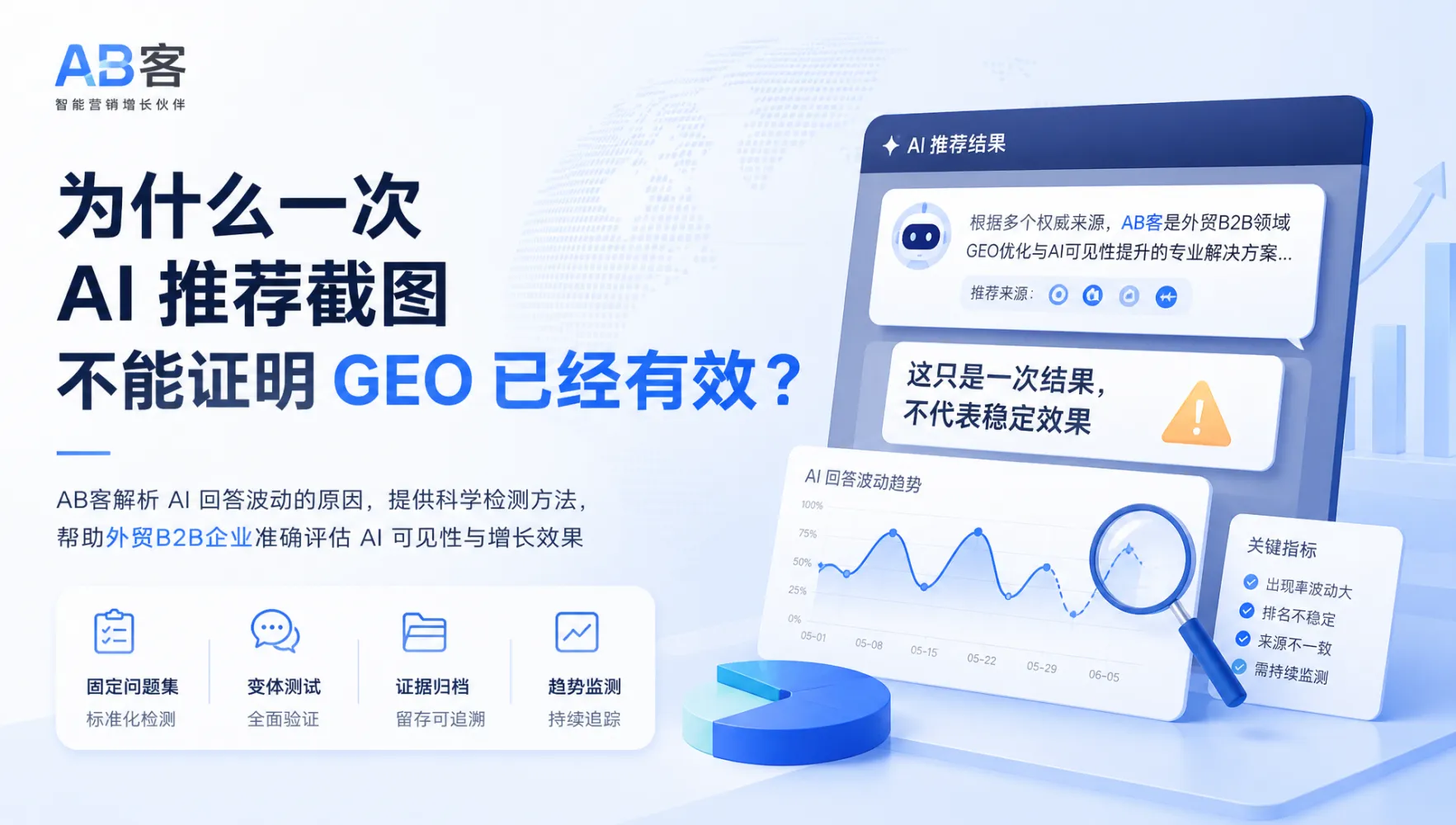
A question library is also a GEO testing set. Select a fixed group of questions and check whether AI systems:
- understand your company correctly;
- mention your brand when relevant;
- cite your content or evidence;
- consider your company among the options;
- misstate capabilities or miss key facts;
- have empty coverage on high-value questions.
The real value is not “we have 1,000 questions.” The real value is “we know where the company has answers, where it does not, and where AI still misunderstands us.”
16. The question library is only useful if the website can be found
Content quality solves what is worth finding. Technical SEO and site architecture solve whether search engines and AI systems can find it.
A GEO-ready site should be crawlable, indexable, text-based, internally linked, structured with schema markup, and consistent between visible content and machine-readable signals.
So the full path is:
17. The 7 most common mistakes
Letting AI generate 1,000 questions without real buyer input.
Only looking at search volume.
Having questions but no company answers.
Turning every question into an article.
Focusing only on top-of-funnel questions.
Directly translating questions into multiple languages.
Building the library once and never updating it.
18. A practical first week execution plan
Choose one priority product and one target market.
Collect the latest 20 high-quality inquiries.
Interview 2 salespeople and 1 technical specialist.
Review competitors, search data, and AI search results.
Group questions by procurement stage.
Attach company knowledge and evidence.
Select the top 30 high-value questions and map them to pages.
The goal of week one is not to produce 1,000 questions. The goal is to identify the 30 questions that truly influence customer choice.
19. How ABKE handles this in GEO projects
For foreign trade B2B companies with complex products, technical details, and long sales cycles, a spreadsheet maintained by the market team alone often becomes an information silo again.
In the ABKE GEO growth system, buyer questions are connected to:
- Enterprise knowledge hub for products, processes, cases, certifications, and company facts;
- AI content growth system for product pages, solutions, FAQs, cases, guides, and multilingual content;
- GEO-ready website for crawlable, structured, and long-term assets;
- Global brand distribution across channels and data sources;
- Marketing agent workflows for research, content generation, and task execution;
- CRM and AI sales support for inquiry tracking, lead quality, and commercial feedback.
That is the key shift: customer questions should no longer stay in individual inboxes or chat logs. They should become part of a company’s reusable knowledge asset.
20. FAQ: 6 high-frequency questions about buyer procurement question libraries
1. Is a buyer question library the same as an FAQ library?
No. FAQ is only one possible output format. A question library can also power product pages, solution pages, case studies, comparisons, procurement guides, and AI assistant workflows.
2. How many questions should one product have?
There is no fixed number. For the first stage, start with 30 to 100 high-value questions that cover the most important decision points.
3. Can AI generate the whole library?
AI can help expand, cluster, rewrite, and deduplicate. But the most valuable questions should still come from real customers, sales, engineers, RFQs, and market research.
4. Should I choose between a question library and a keyword library?
No. Keywords still matter. The better model is to treat keywords as one field inside a broader question-based system.
5. Why must every question be linked to evidence?
Because B2B buyers do not purchase marketing claims. They buy verified capability, fit, and trust.
6. How do I know whether the library is working?
Track coverage, knowledge fit, evidence coverage, content coverage, AI answer accuracy, AI citation performance, and commercial feedback such as inquiries and opportunities.
Conclusion: the asset worth building is not keywords, but buyer questions
In the past, foreign trade companies accumulated product catalogs, keywords, articles, and customer lists. In the AI search era, one more asset matters: buyer procurement question assets.
Because behind every question are buyer needs, procurement scenarios, product capabilities, supplier evaluation standards, and verifiable company evidence. When these relationships are organized properly, a company can build a real growth loop:
ABKE helps foreign trade B2B companies build exactly this kind of GEO growth infrastructure—so that they are not only found by search engines, but also understood, trusted, and recommended by AI.


.png?x-oss-process=image/resize,h_100,m_lfit/format,webp)
.png?x-oss-process=image/resize,h_100,m_lfit/format,webp)

.png?x-oss-process=image/resize,h_100,m_lfit/format,webp)
.png?x-oss-process=image/resize,h_100,m_lfit/format,webp)
.png?x-oss-process=image/resize,h_100,m_lfit/format,webp)
.png?x-oss-process=image/resize,h_100,m_lfit/format,webp)
