Names, contacts and basic entries collected from individual sources.
Hot Products





Popular articles
From procurement consultation to sales follow-up: How can marketing intelligence agents collaborate with enterprise knowledge and CRM to handle inquiries?
2026.10.28
Reading:
0
Halloween B2B Product Page Optimization Guide: Complete parameters, purchasing conditions, and evidence to make it easier for overseas buyers to make decisions.
2026.10.26
Reading:
0
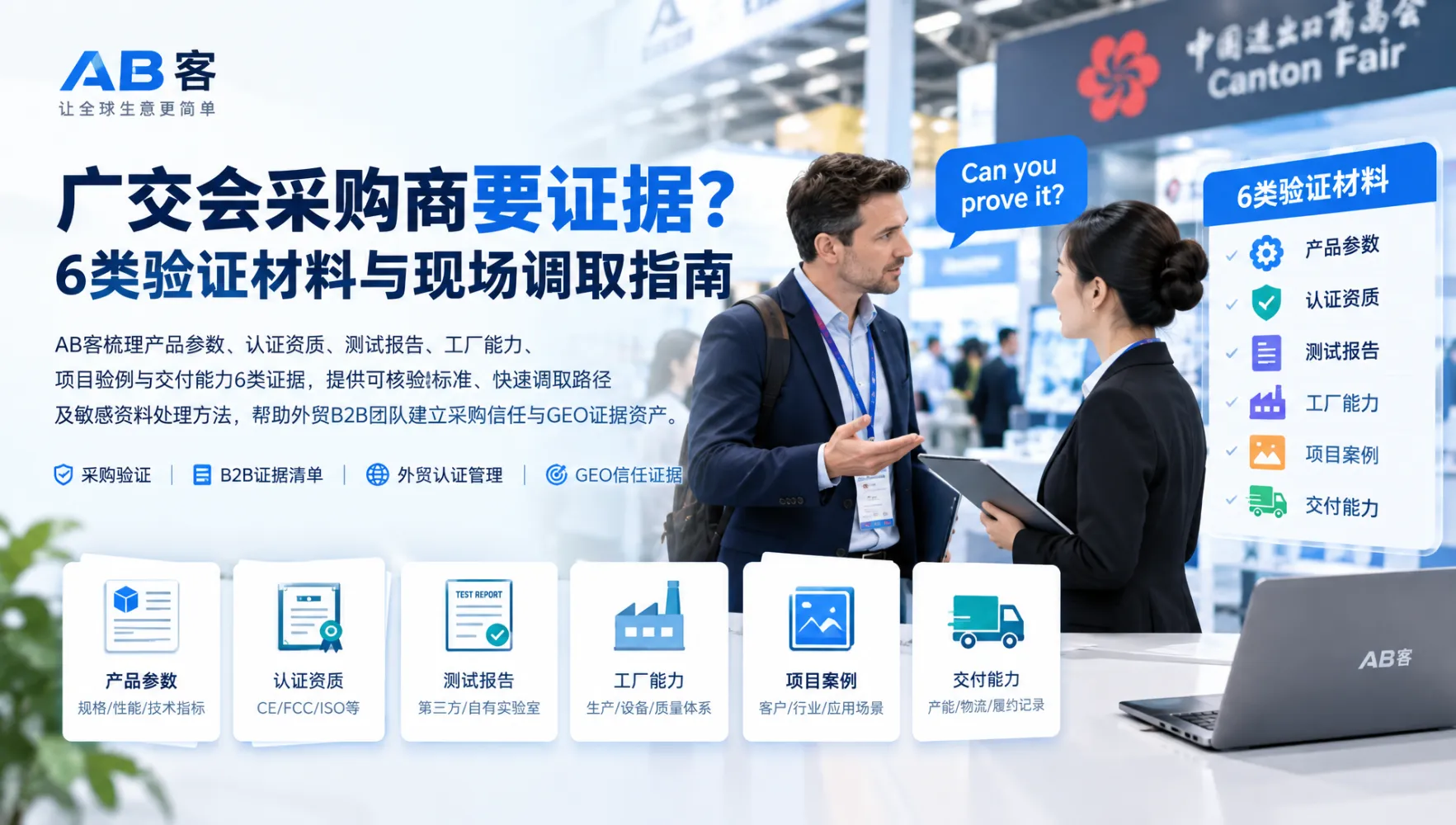
How to respond to buyer verification at the Canton Fair? Build trust with a checklist of 6 types of evidence.
2026.10.19
Reading:
0
Recommended Reading
可信 GEO 为什么不只是客户名单?外贸 B2B 如何把企业数据变成知识资产
Release time:
2026/10/29
A customer list is not yet a knowledge asset. Explore how verified facts, relationships, evidence and multilingual identity matching support B2B growth with ABKE.
A customer list is only one form of business data. It becomes a stronger foundation for a knowledge asset when each record has a clear entity, reliable sources, explainable relationships, a defined scope of use and an ongoing maintenance process. The goal of trusted GEO is not simply to store more company records, but to organize information so that teams can verify and reuse it in prospecting, inquiry handling and sales decisions.
For B2B exporters, this distinction matters because buying decisions often involve several legal entities, locations, languages and contacts. A structured enterprise knowledge base can make those connections easier to investigate while keeping unverified assumptions separate from established facts.
Why Do Growing Customer Lists Not Necessarily Improve Prospecting Efficiency?
Duplicate lists: The same company appears repeatedly through different platforms, names or contacts.
A buyer may appear in a trade-show spreadsheet, a B2B platform and a sales inbox under slightly different names. Combining those records without checks can lose useful history; leaving them untouched can lead to repeated outreach. Compare identifiers such as websites, addresses and legal names before proposing a merge, and retain the original source records for review.
Unclear identity: It is uncertain whether the company is a factory, trader, brand owner or purchasing agent.
These roles imply different purchasing needs and decision processes. A company may also play more than one role. Record the role supported by available evidence, the market or product to which it applies, and any uncertainty instead of treating a category label as a permanent fact.
Missing evidence: A name and contact details do not provide enough information to assess fit.
A contact address alone says little about product relevance, purchasing authority or the suitability of a partnership. Useful context may include a company website, stated product range, target market and inquiry history, with the source and date attached to each important claim.
Outdated information: Contact departures, company name changes and changes in business scope are not recorded promptly.
Data can remain technically accessible while becoming operationally misleading. Assign owners to important records, record when information was last checked and review material changes before using them in outreach or supplier and buyer assessments.
Limited reuse: Background information held by individual salespeople does not enter the team’s knowledge system.
Notes scattered across personal files and inboxes are difficult to search or hand over. A shared process for documenting verified company facts, communication history and next steps can preserve context when accounts move between team members, subject to appropriate access permissions.
Data volume measures scale. Whether records can be accurately identified, reused and updated is a more useful measure of asset quality.
What Is the Difference Between Ordinary Data and Trusted Enterprise Knowledge Assets?
A data record answers “What information is in the system?”
A spreadsheet row may contain a company name, email address and country. It describes what has been captured, but it does not necessarily explain whether the entries refer to the same entity or remain current.
A knowledge asset also answers “Who does the information belong to, where did it come from, what is it related to, how trustworthy is it, and which decisions can it support?”
Knowledge adds context and makes the reasoning behind a record available to others. For example, a product category linked to a dated company webpage is more useful for a preliminary fit assessment than an unexplained label. It still does not, by itself, establish purchasing intent or creditworthiness.
Reusable knowledge must be maintainable, traceable and updatable, and accessible to different business workflows within authorized limits.
Responsibility and permissions are part of the asset, not an afterthought. Teams should know who can view or edit a record, how corrections are approved and which source supports a business-critical statement.
A defined entity with standardized attributes, owners and update records.
Profiles connected by documented relationships, sources and verification status.
| Dimension | Customer list | Knowledge asset |
|---|---|---|
| Identity | Names and contact fields | Entity identifiers, aliases and disambiguation |
| Evidence | Source may be missing | Source, date and verification status recorded |
| Business use | Individual lookup or outreach | Controlled reuse across research, content and sales |
How Can Trusted GEO Create Four Types of Enterprise Knowledge Assets?
Asset 1 — Standardized company facts
Organize company identity, products, markets and business attributes in a consistent format. Define which fields identify a legal entity and which describe a brand, location or contact. Standardization makes duplicates easier to investigate, but similar names should generate a candidate match rather than an automatic conclusion.
Asset 2 — A network of relationships
Document relationships among groups, brands, factories, distributors and purchasing entities when supporting evidence is available. Describe the type and direction of each relationship and its applicable period. A distributor relationship, for example, is not evidence of common ownership.
Asset 3 — Evidence chains
Keep the source, collection or verification date, reviewer and status alongside significant claims. If a company website and an internal record disagree, retain the conflict for review rather than silently selecting one version. Evidence makes a judgment easier to revisit when circumstances change.
Asset 4 — Multilingual alignment
Maintain original company names, translated names, brand names and known aliases with their language and source. Cross-language similarity can help identify candidates, but transliteration or translation alone does not prove that two records belong to the same legal entity.
| Asset | Information to retain | Review question |
|---|---|---|
| Company facts | Identity, market and product attributes | Does this attribute belong to this entity? |
| Relationships | Relationship type, parties and applicable period | What evidence supports the connection? |
| Evidence | Source, date, status and conflicts | Can a colleague reproduce the check? |
| Language alignment | Original names, translations and aliases | Is the match supported beyond name similarity? |
How Do the Four Knowledge Assets Enter Foreign Trade Workflows?
AI inquiry analysis
Extract the company name and product requirements from an inquiry, then compare them with existing records to produce candidate matches. A salesperson can review the original message, matching fields and available evidence before assigning the inquiry to an account.
Customer prospecting
Segment potential customers using relevant product fit, market conditions and documented company information. If a team uses a matching score, it should define the criteria and treat the score as a prioritization aid—not a substitute for checking purchasing needs or authority.
Group account development
Where a group relationship has been verified, teams can investigate whether other entities may have relevant needs. Different subsidiaries can have separate budgets, suppliers and procurement processes, so each opportunity requires its own assessment.
Buyer due diligence
Bring together verifiable public facts and appropriately authorized internal transaction records for business review. Flag missing or conflicting information and distinguish a preliminary research profile from a formal legal, financial or credit assessment.
Multilingual operations
Connect leads from different language channels to existing profiles where identity evidence supports the link. Preserve the original-language material so that a reviewer can check translated names, product terms and inquiry context.
In every scenario, usability depends on the source and confidence of the match. Do not take business action solely because a relationship has been inferred; verify the facts and use human review where the decision warrants it.
Two Typical Scenarios Show How Knowledge Assets Create Value
Scenario 1 — Matching a Russian-language inquiry with an English company profile
Suppose an exporter receives an inquiry in Russian. A proposed workflow first preserves the original message and extracts the company name, website and address. It then compares available identifiers and language variants with English-language profiles to produce candidates, not a final identity determination.
Where lawful and usable sources are available, the team may check registration information and relevant business records. Fields that cannot be confirmed should remain unresolved and be passed to a person for review. Access to any external source depends on the enterprise’s actual arrangements and applicable requirements.
Scenario 2 — Companies with the same name in different countries
Suppose two companies share a name but have different registration locations, websites and entity identifiers. They should remain separate entities until evidence establishes otherwise. A visible warning can help salespeople avoid attaching correspondence or transaction history to the wrong account. The same principle applies when a shared brand is used by distinct legal entities.
These are illustrative workflows, not completed ABKE customer cases or measured results. Actual matching and review depend on available information, permissions and the processes adopted by the enterprise.
How Does ABKE GEO Connect Enterprise Knowledge Assets to Growth Activities?
For exporters, the long-term asset is not merely a list of names but knowledge that teams can call upon and improve over time. ABKE’s GEO Growth Engine brings enterprise knowledge, digital identity, website content, customer discovery and CRM workflows into a coordinated growth approach. A practical starting point is to organize confirmed information about products, solutions, cases and supporting evidence, then relate it to target markets and buyer questions.
The value comes from reuse and continuous improvement—not from assuming that buying data or deploying AI automatically creates growth. Specific capabilities, integrations and delivery scope should be confirmed against the enterprise’s requirements.
Enterprise knowledge base and digital identity: Unify company, product, solution and evidence materials.
Gather approved product specifications, application information and verifiable trust evidence in a maintained knowledge base. A structured digital identity helps teams express who the company is, what it offers and which claims can be substantiated.
GEO website and content operations: Turn verified knowledge into content that customers and search systems can understand.
Use confirmed facts to develop product pages, FAQs and buyer guides around genuine questions. Keep claims linked to their supporting materials and review pages when products, markets or supporting evidence change. Search indexing and AI citation remain dependent on external systems and are not guaranteed.
Customer discovery and proactive outreach: Organize development around target profiles, company screening and matching criteria.
Define a target customer profile using product applications, relevant markets and available company facts. Use documented criteria to prioritize research and outreach, while checking uncertain identities and respecting applicable data and marketing rules. Any scoring or data-source arrangements should be agreed as part of the actual workflow.
CRM and AI sales assistance: Connect leads, follow-up, opportunities and business feedback.
Record inquiry sources, communication history and opportunity stages so authorized team members can follow the account. AI can assist with organizing information and suggesting next steps; salespeople remain responsible for reviewing the context and making consequential decisions.
Continuous iteration: Use sales feedback and data changes to update knowledge and optimize strategy.
Repeated buyer questions can inform new content, while lost-opportunity reasons can reveal gaps in product fit or qualification. Assign an owner to review changes, update the underlying knowledge and pass approved revisions to the relevant website and sales materials.
How Can You Measure Whether Enterprise Knowledge Assets Are Creating Value?
Data quality
Monitor duplicate candidates, fields awaiting verification, outdated information and unresolved conflicts. Define what counts as a duplicate or a verified field before comparing results over time; a flagged record is not necessarily an error.
Usage efficiency
Track the time needed to find company information, assign inquiries and complete background checks. Compare similar tasks before and after a process change, and record whether the resulting information was sufficient for the intended decision.
Business outcomes
Review the proportion of qualified prospects, lead quality, follow-up activity and movement through opportunity stages. Agree on qualification criteria with sales and interpret changes alongside market conditions, response practices and other factors—not as proof that knowledge management alone caused an outcome.
Asset maintenance
Check update frequency, evidence completeness, access permissions and assigned ownership. A useful review cycle identifies records requiring action and confirms whether corrections have reached the teams and materials that rely on them.
FAQ
Q1: Can a customer list become an enterprise knowledge asset?
Yes, it can provide a starting point. Adding entity identifiers, sources, documented relationships, update procedures and usage rules makes the information easier to verify and reuse. The list should be maintained rather than treated as permanently accurate.
Q2: Does trusted GEO mean AI can automatically determine whether a buyer is reliable?
No. AI can assist with organizing facts, identifying conflicts and proposing candidate judgments, but it cannot independently establish reliability from incomplete data. Significant risk decisions still require appropriate verification and human review.
Q3: Must enterprise knowledge assets include an external company database?
No. An enterprise can begin with its own customer, product, supplier and business records, provided their use is authorized and appropriately controlled. External sources can be considered later when there is a clear business need and lawful access.
Q4: How does ABKE help enterprises build knowledge assets?
ABKE’s GEO Growth Engine supports an approach that connects an enterprise knowledge base and digital identity with website content, customer discovery and CRM workflows. The starting point and implementation scope depend on the company’s existing information, target markets and operational needs.
Review your existing data and knowledge assets with ABKE. Bring a sample of your current customer records, product materials and sales workflow to a discussion about priorities, verification responsibilities and the scope of a suitable GEO growth plan.


Disclaimer: This content was created by AI and reviewed by humans. The above content represents only the creator's personal views.
B2B customer data assets
trusted GEO
enterprise knowledge assets
customer relationship mapping
ABKE GEO Growth Engine
