.png?x-oss-process=image/resize,h_100,m_lfit/format,webp)

.png?x-oss-process=image/resize,m_lfit,w_200/format,webp)









One-Sentence Takeaway
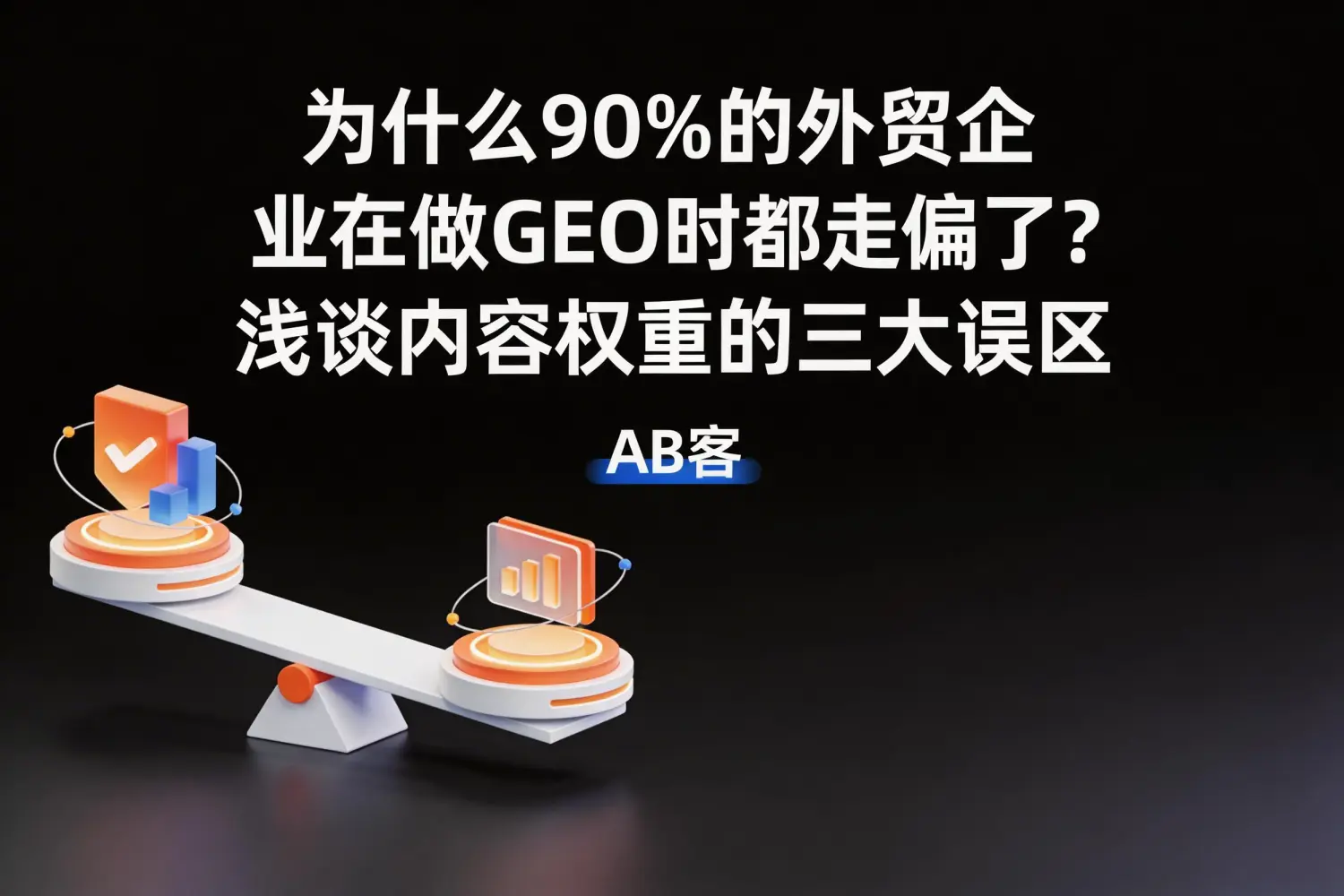
GEO is not “more posts.” For AI to cite and recommend you, your content must be high in verifiable facts, easy to parse, and consistent across the web.
What “Content Weight” Means in GEO (In Plain Terms)
In search-era SEO, ranking often improved with keyword coverage and backlinks. In generative engines, the question becomes: “Can the model confidently use this source as evidence?” That “confidence” is built from signals that are closer to knowledge quality than “content quantity.”
Based on common AI retrieval and citation behavior, teams should treat content weight as a composite of:
1) Fact density (evidence per paragraph)
Concrete numbers, standards, test results, materials, tolerances, lead times, certifications, measurable outcomes—anything that can be checked and compared.
2) Structured “answerability” (how easy it is to extract)
Clear problem → method/data → conclusion. Tables, bullet points, scoped definitions, and consistent naming make AI extraction faster and less error-prone.
3) Web-wide consistency (identity & claims)
If your website, B2B listings, catalogs, and social profiles contradict each other, AI systems become conservative and stop recommending you.
| Signal | What AI “likes” | Typical exporter mistake |
|---|---|---|
| Fact density | Specs, tolerances, standards, test data, case metrics | Generic “high quality / best service” claims |
| Structure | Q&A blocks, checklists, tables, repeatable templates | Long paragraphs mixing product + story + marketing |
| Consistency | Same company name, address, certifications, product naming | Different descriptions across channels and languages |
| Evidence cluster | Interlinked certificates, test reports, case studies, FAQs | 孤立页面,缺少互相引用与可追溯来源 |
Reference benchmarks (for later adjustment): exporters that publish 2–4 high-evidence pieces/week often outperform those posting daily low-evidence content. In many B2B niches, a single well-structured spec/case page can drive more qualified conversations than 20+ generic posts.
Trap #1: Trying to Win by Volume
The most common GEO failure pattern looks “busy” on the surface: daily publishing, fast translations, and repeating similar topics with different titles. The problem is that AI systems are trained to compress and de-duplicate. Repeated ideas without new evidence become low incremental value.
What teams usually do
- Publish many posts per day/week to “feed” AI
- Reuse the same selling points across multiple pages
- Target broad keywords without a buyer’s specific question
Why it backfires
- AI struggles to cite duplicates; it prefers unique, evidence-based passages
- Thin content increases “uncertainty,” lowering recommendation likelihood
- Human buyers also feel the repetition during due diligence
A GEO-correct approach
- Write fewer pages, but each page must answer one buyer question
- Increase fact density: add specs, process parameters, standards, QC steps
- Make it quotable: short conclusions, bullet summaries, comparison tables
A practical “fact density” rule for export B2B: aim for 8–15 verifiable facts per 800–1,200 words. Facts can be technical (e.g., tolerances, material grades), operational (e.g., MOQ range, lead time windows), or proof (e.g., certifications, audit frequency, test methods).
Trap #2: Ignoring Structure and Logic
Many exporter websites blend products, capabilities, and brand storytelling into a single “company strength” narrative. Humans can sometimes follow it, but AI retrieval pipelines prefer content that behaves like a knowledge module.
A repeatable “Atomic Knowledge Slice” template
Question
“What tolerance can you hold for CNC aluminum parts and how do you verify it?”
Data / Evidence
Typical tolerance range (e.g., ±0.02 mm for key features), measurement tools (CMM, caliper, gauge), inspection frequency (e.g., first article + in-process + final), standards referenced (e.g., ISO 2768 where applicable).
Conclusion
“For critical dimensions we hold ±0.02 mm and provide inspection reports upon request; for non-critical features we apply a general tolerance standard. This reduces scrap rate and speeds approvals.”
Structure does more than “look clean.” It improves AI extraction, and it shortens buyer verification time. In many export B2B deals, procurement due diligence takes 2–6 weeks. A structured knowledge base can compress that window by making your evidence easy to find and consistent across pages.
Trap #3: Underestimating Web-Wide Consistency
Exporters often run multiple “faces” online: a website, Alibaba/Made-in-China listings, LinkedIn pages, distributor catalogs, PDFs, and sometimes separate domains for different regions. If each channel describes your company differently, AI systems cannot confidently resolve your identity and claims.
Common inconsistency examples
- Different company names (Ltd. vs. Co., or translated variants)
- Conflicting founding year and employee count
- Product naming changes across channels without mapping
- Certifications listed on one platform but missing on the website
What AI does when it detects conflict
- Reduces “trust weight” and avoids firm recommendations
- Uses more conservative language (“may,” “could”) or skips you
- Prioritizes competitors with clearer identity evidence
Fix: build an “evidence cluster”
- Unify the same company profile across all channels (name, address, scope)
- Interlink: certificates ↔ test methods ↔ case studies ↔ product specs
- Use consistent terminology and publish a product naming glossary
A simple “Consistency Checklist” for export B2B
- Identity: legal name, brand name, address, phone, email, registration snippets consistent
- Capability: same core processes, equipment list ranges, materials coverage, tolerances
- Proof: certifications (e.g., ISO 9001), audits, testing methods, report samples
- Case signals: industries served, typical order size ranges, delivery time windows (avoid exaggeration)
- Language mapping: consistent translation of key product terms across English pages and PDFs
The Core GEO Mindset (What Actually Wins)
GEO is not content volume. GEO is the process of turning your capabilities, expertise, and trust signals into AI-readable and AI-citable digital assets.
If you want a more operational way to think about it: every page should function like a “mini reference source.” When a buyer asks an AI tool “Who can supply X with Y standard and stable lead time?”, your site should contain quotable evidence that makes the AI comfortable pointing to you.
| Principle | What to publish | Examples of “facts” to include |
|---|---|---|
| High fact density | Specs, QC, process controls, compliance notes | Tolerances, material grades, test methods, defect rate targets, capacity ranges |
| Structured output | Q&A pages, checklists, “how we verify” guides | Step-by-step inspection flow, acceptance criteria, report samples |
| Web consistency | Unified brand story + linked evidence cluster | Same certification IDs where appropriate, matching company profile, stable product naming |
A Practical GEO Plan for Exporters (20–30 Questions First)
Instead of brainstorming “topics,” collect the exact questions buyers ask before they request a quote. For many export B2B categories, the highest-converting questions cluster around quality control, compliance, capability limits, and delivery reliability.
Suggested 4-step workflow
- List 20–30 buyer questions (sales inbox + RFQs + objections + after-sales issues).
- Create atomic slices (one page/section answers one question with evidence and a clear conclusion).
- Build the evidence cluster (certificates, case studies, test methods, equipment lists cross-link).
- Iterate monthly: update facts, add new case metrics, and keep cross-channel profiles aligned.
If your team is small, start with 10 slices that cover your highest-value product line. In many scenarios, that’s enough to noticeably improve AI-driven discovery and buyer trust—because you’re upgrading “credibility per page,” not adding noise.
Turn Your Export Capabilities into AI-Citable Assets
Stop publishing blindly. Build a GEO content network with high fact density, structured answers, and web-wide consistency—so AI tools can confidently recommend your company during discovery and due diligence.
Ideal for export manufacturers, trading companies, and B2B brands preparing for AI-era customer acquisition.
.png?x-oss-process=image/resize,h_100,m_lfit/format,webp)
.png?x-oss-process=image/resize,h_100,m_lfit/format,webp)

.png?x-oss-process=image/resize,h_100,m_lfit/format,webp)
.png?x-oss-process=image/resize,h_100,m_lfit/format,webp)
.png?x-oss-process=image/resize,h_100,m_lfit/format,webp)
.png?x-oss-process=image/resize,h_100,m_lfit/format,webp)
