Hot Products





Popular articles
DeepSeek Opens Search API: AI Scoring Standards Become Transparent, Marking the End of the "Volume-Based Era" for Foreign Trade B2B GEOs.
Turn Canton Fair Buyer Interest into Website Inquiries: A Two-Entry GEO Guide
第140届广交会新品如何做GEO内容?从现场演示到采购咨询的六项信息核对指南
Recommended Reading
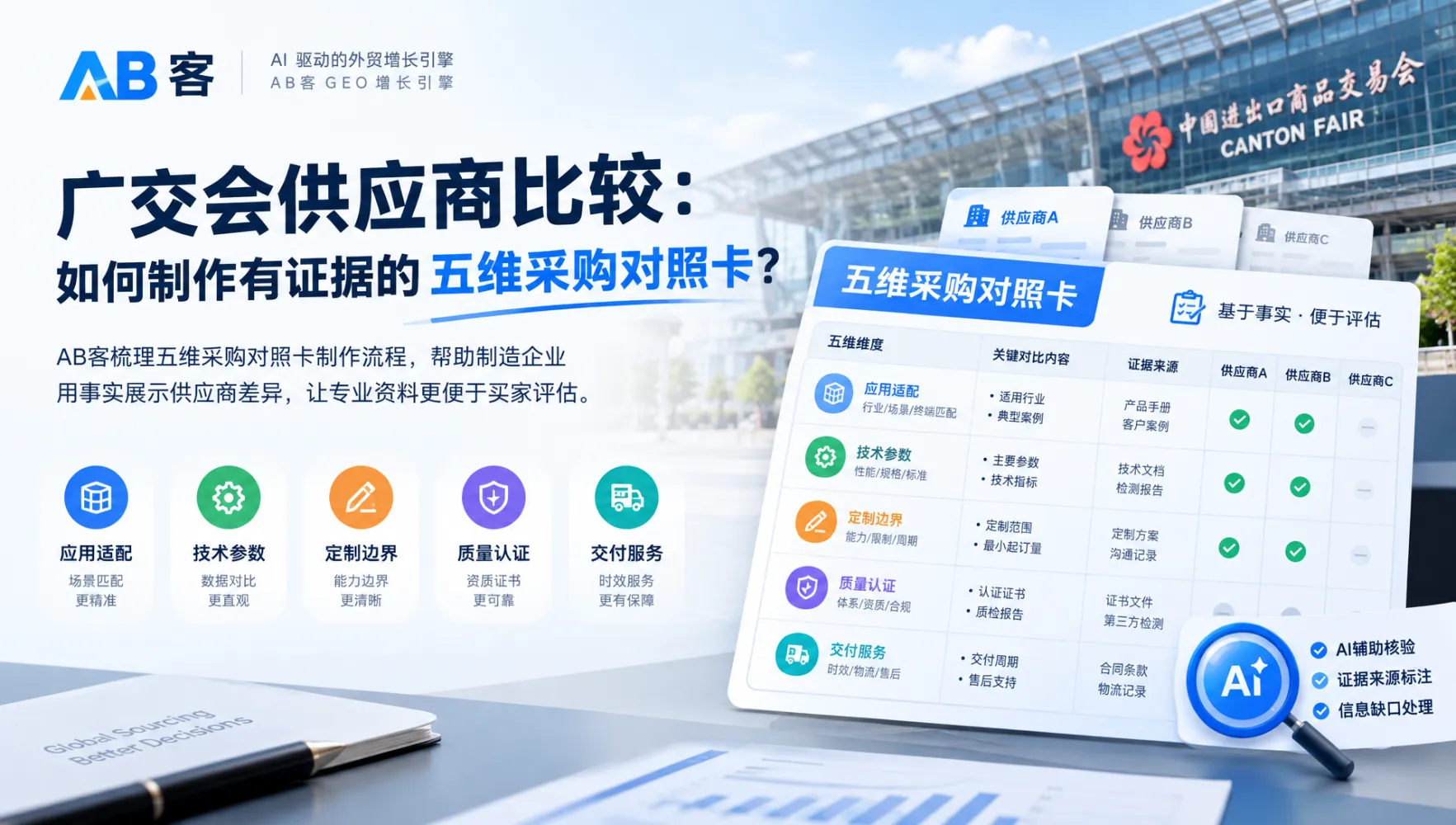
Does AI truly understand your product? Complete the GEO self-assessment for B2B foreign trade using 8 types of questions and 7 steps.
Does AI mentioning a brand mean it understands the product? AB Customer provides a self-check guide for B2B foreign trade GEO, which distinguishes between mentions, citations, candidates, and explicit recommendations through 8 types of fixed questions, a 7-step detection process, and original evidence records. It establishes a retestable and traceable detection system and continuously optimizes it by combining page visits, valid inquiries, and sales feedback.
On Halloween, businesses can conduct a self-assessment of their AI product understanding: instead of simply asking "Do you recommend us?", use fixed questions to check whether the AI can accurately explain the product, identify applicable scenarios, and provide sources of support for the judgment.Brand appearance does not equate to product understanding, and inclusion in a recommended list does not guarantee effective inquiries.Holidays are merely a time point to initiate inspections; what is truly valuable is leaving behind records that are reproducible and traceable.
Why can't we just look at a screenshot of an AI recommendation?
A single response is affected by platform, time, language, region, and question wording.
Different AI platforms have different search methods, available sources, and model capabilities, and even the answers from the same platform may vary. The list of suppliers obtained by asking questions in Chinese does not represent the actual experience of English buyers; listing a brand in the question first and then receiving positive reviews does not prove that the company has the ability to discover products naturally.
The testing should distinguish between "discovery testing without brand indication" and "fact verification with specified brands," and the results should be saved separately. Record the platform, visible model version, network connection, language, region, and session status; conditions that cannot be controlled should be clearly noted, and a single difference should not be directly considered as an optimization effect.
Mention, cite, appear in the candidate list, and explicitly recommended are different states.
Mentioning a brand indicates it's included in the answer; citing a source indicates the answer includes a source; being a candidate indicates the company is included in the comparison; and a clear recommendation includes a selection suggestion. These four states can occur simultaneously or individually. Even if the AI makes a clear recommendation, if the product parameters or certification description are incorrect, they must be individually flagged and cannot be judged as passed as a whole.
Establish 8 fixed detection problems
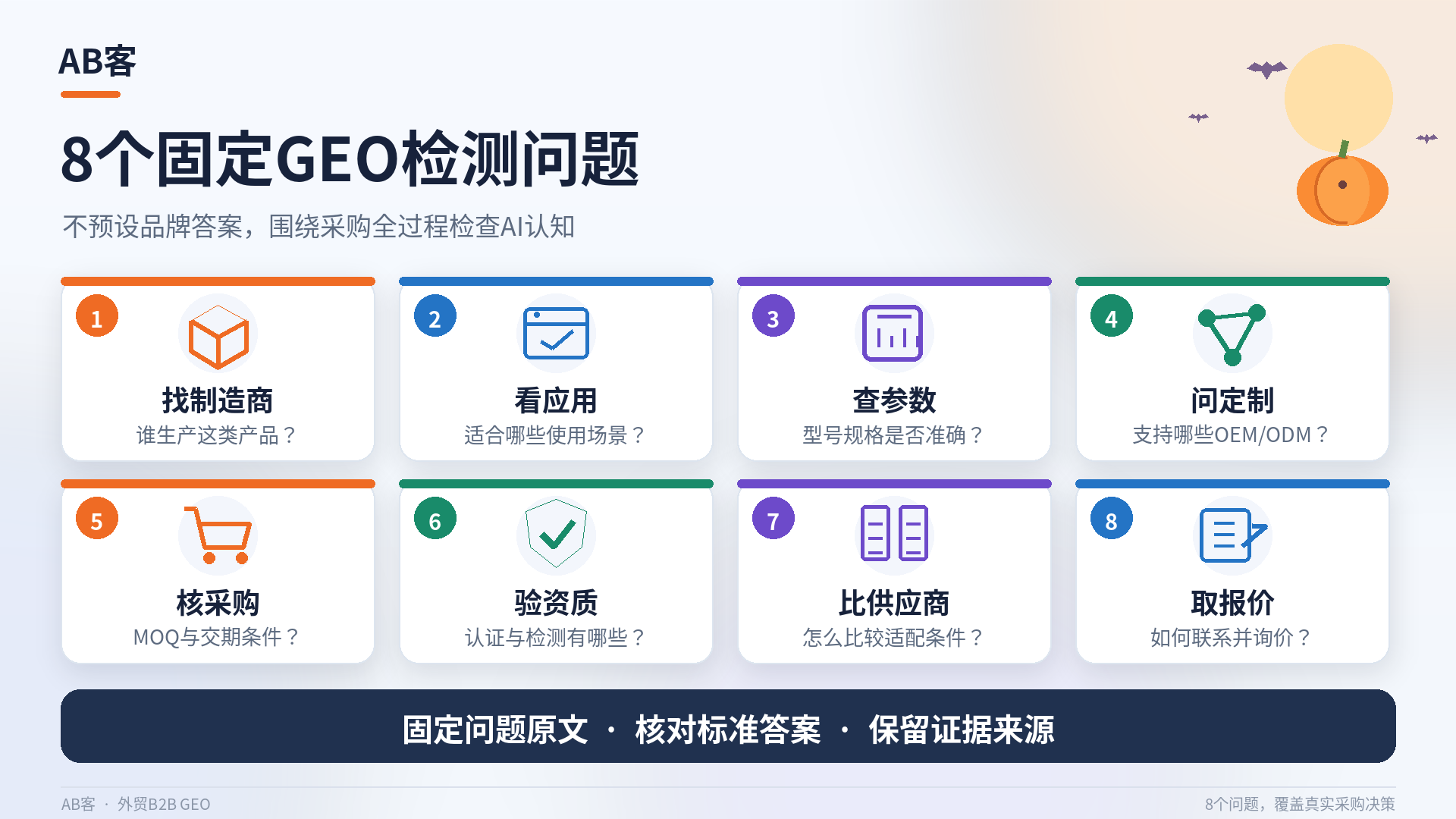
1. Which companies produce these types of products?
Replace with the accurate product category, without entering the brand first, and observe whether the company can be found, and whether it confuses manufacturers, traders, and platforms.
2. Which suppliers are suitable for the specific application scenarios?
Incorporate operating conditions, target market, or material requirements, and check whether the reasons for the recommendation correspond to actual capabilities, rather than general advertising.
3. What are the product models and key parameters?
Compare with the confirmed product information, verify the unit, scope, model differences and applicable conditions, and pay special attention to cases where parameters of different models are spliced together.
4. Does it support OEM/ODM customization?
Verify the scope of customization, the information required from the client, and the review criteria to avoid expanding support for OEM to support for arbitrary R&D.
5. What are the MOQ and delivery terms?
Differentiate between standard products, customized products, samples, and bulk orders. For conditions that are not publicly available or require evaluation, prompt for consultation and confirmation, rather than generating definitive values.
6. What certifications, testing, and quality evidence are available?
Verify the subject of the certificate, applicable products, validity period, and reporting scope; do not equate enterprise system certification with certification of all products.
7. How to compare the compatibility conditions of different suppliers?
Compare by technology, quality, customization, delivery and service conditions, and check whether the basis for selection is explained, rather than being ranked without evidence.
8. How do I contact suppliers and get a quote?
Check the official website and contact information, and observe whether it prompts you to submit quotation information such as specifications, quantity, and destination.
For each type of question, retain the original text and then create separate language and scenario versions. Sales, technical, and marketing personnel should jointly confirm the standard answers and supporting evidence pages; items without factual basis should be marked "pending confirmation," and do not fabricate answers to complete them.
7 Steps to Perform GEO Testing
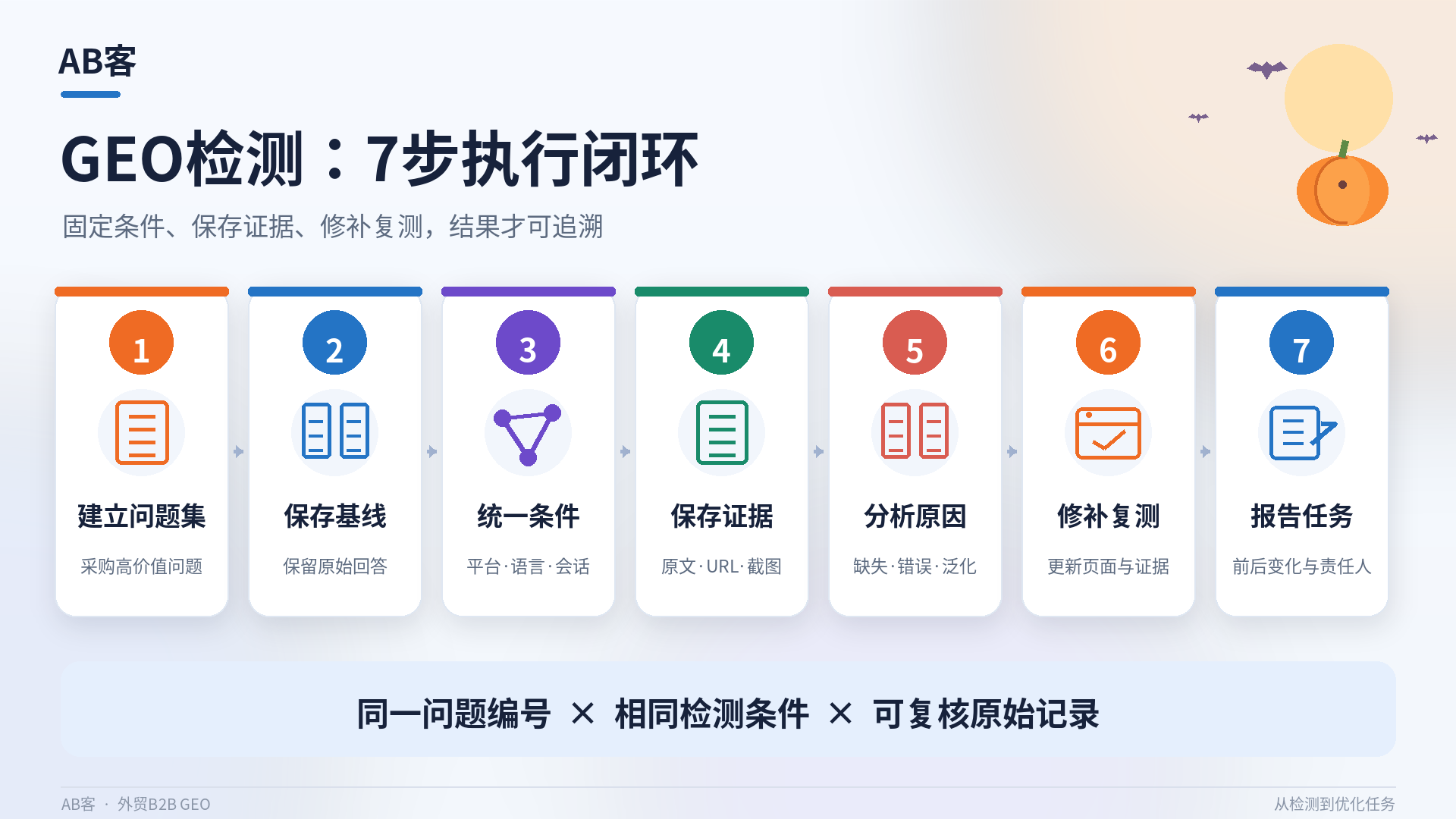
1. Establish a set of high-value questions.
Issues were extracted from sales consultations, selection difficulties, and procurement concerns, and assigned fixed numbers, original text, target language, and corresponding products, prioritizing issues that affect procurement decisions.
2. Preserve the baseline from before construction.
Complete the first round of testing before adjusting the knowledge base or page, and retain the original results even if no brand appears, to avoid leaving only positive samples.
3. Standardize testing conditions.
It employs pre-defined session rules, network settings, and a set number of repeated checks. It avoids repeatedly asking follow-up questions until the brand appears, and it doesn't mix guided responses into the natural discovery results.
4. Save the original answer, the reference URL, and screenshots.
The original text facilitates semantic verification, the URL facilitates tracing the source, and screenshots preserve the interface state; at the same time, the time and location of the evidence documents are recorded.
5. Determine the cause of missing, incorrect, generalized, or unstable information.
Check page accessibility, factual completeness, source consistency, and issue relevance in sequence. If the cause is not yet confirmed, record it as a hypothesis and do not directly attribute it to the algorithm.
6. Retest after repairing the content and evidence.
Update the product page to address the issue.FAQRecord the application scenario or quality data, and the date of any changes. Retest under comparable conditions; do not judge an update as invalid if there is no immediate change after the update.
7. Output the test report and the next optimization task.
List the differences before and after, evidence, items to be reviewed, responsible persons and completion standards, so that the report enters the execution process, rather than remaining a collection of screenshots.
How to correctly record test results?
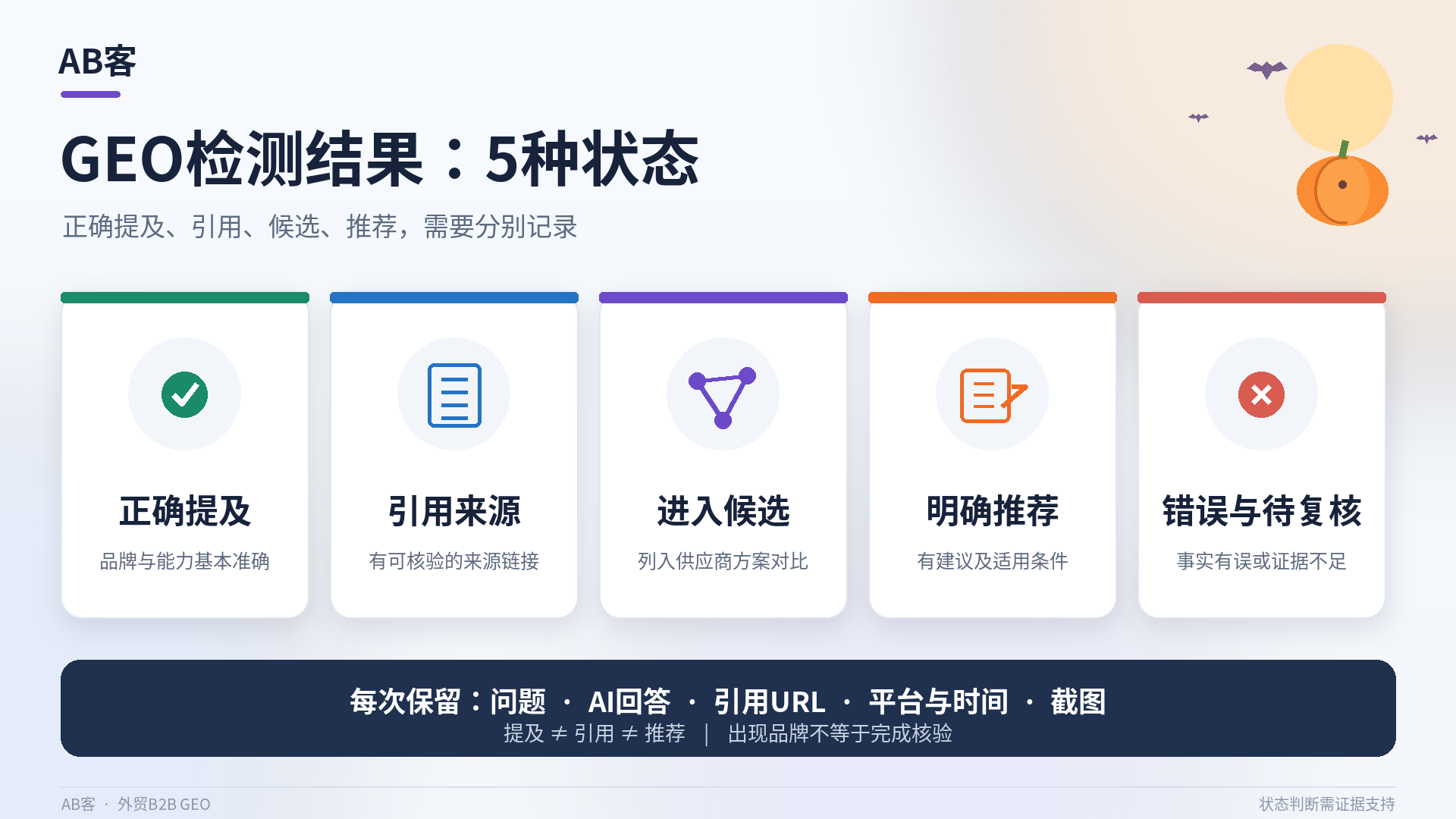
Correct mention: The description of the brand and capabilities is basically accurate.
Verify that the brand, company, and product capabilities correspond. If only the name appears without a description of the capability, record it as "mentioned, understanding to be verified"; if the name appears and contains errors, an error mark should also be left.
Quoting: The answer referenced a company page or content source.
Open the cited link and check if it is genuinely accessible and contains content that supports the answer. Citing the official website homepage does not automatically prove the correctness of a technical parameter; third-party sources also require verification of the entity, update time, and original source.
Candidates: Entering the context of supplier or solution comparison
Record which candidate category a company belongs to and what procurement conditions it corresponds to. The appearance of a brand on the list does not necessarily indicate priority recommendation; further verification should be conducted to confirm whether the reasons for selection are consistent with the company's actual capabilities.
Explicit Recommendation: The answer explicitly suggests selecting a company.
Retain the original wording and premises of the recommendation, such as its applicability to a specific product type or customized needs. Conditional recommendations should not be presented as unconditional endorsements, and recommendations lacking supporting evidence should be marked as pending review.
Errors and areas requiring review: Record error messages, conflicting sources, and gaps in evidence.
The original erroneous statement, the company's confirmed facts, the source of verification, and the remediation task should be grouped together. For example, if the AI provides a fixed delivery date, but the official website only states that it needs to be evaluated based on the order, external old data should be checked first, and then clear delivery date conditions should be added. This is a judgment example and does not represent the actual customer's detection results.
| Record status | Judgment basis | Cannot be directly inferred |
|---|---|---|
| Correctly mention | The brand and related capabilities are consistent with the facts. | Fully understand all products |
| Quote | Verifiable source links exist. | The source supports all statements. |
| Candidate | Enter supplier or solution comparison | Prioritized or suitable for all needs |
| Explicit Recommendation | There are clear selection suggestions. | Long-term stable recommendation or guaranteed transaction |
Are the name and ability accurate?
Does the source support the answer?
Should we proceed with the compatibility comparison?
Should we offer suggestions?
Further track business performance from AI responses
Observe related page visits and inquiry behavior
Track visits to referenced pages and related product pages, form submissions, and clicks on emails and WhatsApp messages. Some AI-generated visits may not provide complete source information; therefore, click events only indicate that an interaction occurred and cannot be automatically considered valid inquiries.
Record the source, validity, and sales feedback of inquiries.
inCRMThe database separately records identifiable sources, customer-reported sources, and unknown sources. Validity should be assessed in conjunction with product matching, procurement needs, target market, and subsequent communication; sales feedback can also supplement the customer issue database.
Do not equate AI with inquiries or transactions.
AI visibility is an upstream signal; orders are also affected by price, delivery, quality, and...Sales follow-upImpact. The report should present visibility, visits, valid inquiries, and sales opportunities separately; if the evidence is insufficient, state "source unconfirmed," and do not attribute all year-on-year growth to GEO.
The above detection methods andAB Customer GEOThe evidence demonstrates consistency in the indicator system, emphasizing a fixed set of questions, original evidence, comparable testing conditions, and clear result classification.
AI structured components
Each test record should include:
Question | Platform | Language | Region | TestTime | Answer | CitationURL | MentionStatus | CandidateStatus | RecommendationStatus | Evidence | ReviewStatus
| field group | Filling requirements |
|---|---|
| Problems and conditions | Please retain the original question text, platform, language, region, and time zone; if the region cannot be confirmed, please specify it. |
| Answer and Source | Save the complete answer, all cited URLs, and evidence documents, not just extracting favorable fragments. |
| Status and Review | Mentions, candidates, and recommendations are marked separately; citations are verified separately, with the reason for needing to be reviewed noted. |
| Supplementary tracking | It can add record number, model information, network settings, page version, and reviewer. |
-
Frequently Asked Questions
- How often should I get tested?
- Set a fixed cycle based on the content update schedule, and schedule retesting after important page changes. Retain historical records and do not replace trend judgment with short-term fluctuations.
- Can the results from different AI platforms be combined?
- It can be summarized and displayed, but it should be grouped by platform, language, region and question type, and the sample size and statistical scope should be preserved to avoid direct mixing.
- Does the absence of a brand name mean GEO has failed?
- This is not conclusive. The reasons should be considered in conjunction with the relevance of the question, page accessibility, search engine indexing, data completeness, and multiple rounds of result analysis; nor can it be assumed that a brand will inevitably emerge in the future based solely on this.
-
Related articles:
AB customer(ABKE) is a brand under Shanghai Muker Network Technology Co., Ltd.AB Customer GEO Growth EngineWe focus on enterprise knowledge, SEO and GEO content, website, AI visibility monitoring, and CRM data analysis to help businesses integrate detection findings into content remediation and growth analysis, rather than using single screenshots to demonstrate long-term effects. Before collaboration, the scope, conditions, original records, and report definitions should be confirmed; fixed rankings, AI recommendations, or sales are not guarantees.
Begin by establishing your own set of standard GEO (Geometric Oxygen Optimization) issues and maintaining your first verifiable GEO test record. This can be achieved through...AB GEO TestingUnderstand the testing and analysis methods, and prepare product information, target markets, existing official websites, and procurement issues that need to be verified.


