Hot Products





Popular articles
How can third-party enterprise content move from brand mention to partner co-creation? GEO collaboration among distributors, integrators, and OEM customers.
Thanksgiving B2B Inquiry Surge: GEO Keyword Layering to Capture North American Buyer Searches
How Can OEM and ODM Companies Help AI Identify the Actual Manufacturer?
From GEO to AEO: How B2B Marketing Agents Can Support Procurement Decisions
Recommended Reading




Adding FAQs to your official website won't make it useful for AI: How should structured content be built for B2B foreign trade?
How to build structured content for a B2B foreign trade website? AB Guest analyzes page access, product knowledge modeling, evidence management, and multilingual maintenance, and provides key points for self-checking before going live.
I. Direct Answer: The core of structured learning is to make the relationships between information clear.
Adding FAQs, tables, or structured tags to an official website does not equate to the content being reliable for citation. The key to structured content in B2B foreign trade is to clearly explain the relationship between products, applicable conditions, evidence, and responsible parties, ensuring that overseas buyers, search systems, and AI can understand the scope and basis of the information.
Let's look at two different product descriptions. The first one says, "We are an experienced professional manufacturer with stable product quality, serving global customers and providing various solutions to meet their needs." The second one explains which applications this series is suitable for, which models it includes, the parameter differences between models, the testing conditions, which operating conditions must be confirmed by engineers first, and where the corresponding documentation is located.
The first type primarily expresses an attitude, while the second provides a basis for purchasing decisions. A visually organized page facilitates reading, but a truly useful structured layout must answer four questions:
-
Which product or issue does this section discuss?
-
Under what conditions does this conclusion apply?
-
What evidence supports this conclusion?
-
Who is responsible for confirming and updating?
The object is clear
For specific products, models, or buyer questions.
Complete conditions
Explain the applicable operating conditions, limitations, and exceptions.
Evidence is traceable
Related document versions and review responsibilities.
Second, the first layer: First check whether the page can actually be accessed.
A report by Muck Rack indicates that among the major publishers studied who blocked the Claude search crawler, 81% received almost no citations from Claude; the corresponding figure was 12% among publishers who allowed the crawler. This is a correlation within a sample of publishers and does not represent the same result for foreign trade websites, nor does it prove that open crawling necessarily leads to citations.
For foreign trade websites, it is recommended that the technical team check the following:
-
Are the product and guide pages publicly accessible? Can users in the target region open them normally?
-
Check whether access rules affecting the target crawling tool have been mistakenly set, and verify the scope of application of the rules;
-
Are key contents only viewable after logging in? Does the public page retain necessary product information?
-
Does the page contain incorrect redirects, broken links, or abnormal responses?
-
Whether automated access is incorrectly blocked by security policies, while retaining necessary security protection;
-
After the page is updated, can the old links still be handled through reasonable redirection or other means?
Scraping policies should be clearly defined by enterprises based on security, privacy, and data usage risks, distinguishing between search access and other automated access, and should not be simply adopted as a "allow all" approach. The primary goal of technical optimization is to eliminate access barriers created by the enterprise itself, rather than promising to control third-party platforms.
Third, the second layer: Organize the page around a procurement task.
It's recommended that each page address one primary task first, such as determining whether a particular product series is suitable for a specific working condition, rather than simultaneously including a complete company introduction, all products, all case studies, and dozens of questions. Relevant information can be linked together to prevent buyers from searching for selection criteria amidst irrelevant content.
An industrial product page can adopt the following structure:
Page Theme
Specify the product category, model range, and main applications, and use consistent internal naming conventions. If certain models are discontinued or only available in specific regions, this should be stated in the corresponding section to avoid the series name obscuring the actual supply scope.
Direct answer
Answer the question "What does it apply to, and what does it not apply to?" in one paragraph. For choices that depend on site conditions, explain that further confirmation is needed; do not write a general description as a commitment applicable to all operating conditions.
Key parameters
Parameters, units, test conditions, and applicable models should be presented simultaneously; when data comes from different versions of documentation, the valid version should be confirmed first. Fields without definite values can be marked as pending confirmation and should not be filled in manually.
Selection criteria
List the information the buyer needs to provide, such as medium, temperature, pressure, environmental conditions, or assembly requirements. Specific fields depend on the product characteristics; for special operating conditions, technical personnel should be involved in confirmation.
Evidence and materials
Links should be provided to relevant tests, manuals, case studies, or valid supporting documentation, specifying the applicable models and versions. When dealing with customer information or commercially sensitive content, access permissions should be confirmed first.
Service Boundary
Specify the scope of customization, installation, maintenance, and technical confirmation, and whether it varies depending on the region, product configuration, or cooperation method. Unconfirmed service items should not be written as a uniform commitment.
Next steps
Guide buyers to submit their operating conditions or initiate technical inquiries. The inquiry portal can request necessary model, application, and target market information, while avoiding the collection of information irrelevant to the current procurement task.
This is an editing and delivery template, not a standardized format specified by any AI platform. Page fields should be tailored to the product and procurement task, and unverified content should not be entered simply to apply the template.
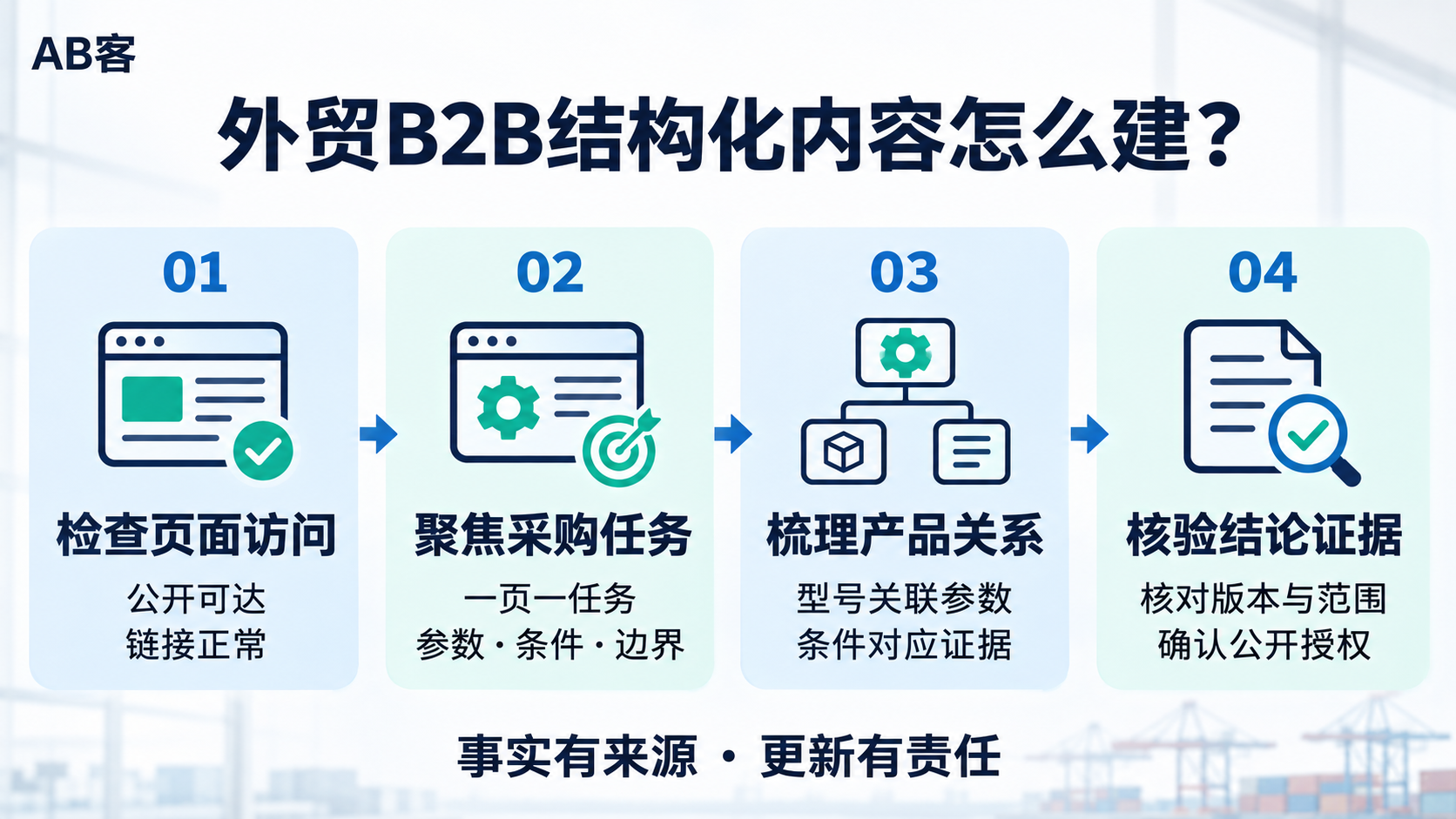
Fourth, the third layer: Extracting the "product relationship" from the copywriting.
A common problem for foreign trade companies is not a lack of information, but rather that information is scattered across PDFs, emails, sales computers, and web pages in different languages. Multiple parameter sheets may exist for the same product model, and sales staff may be referencing outdated versions. First, clarify the sources and responsibilities, then organize the pages; this is more reliable than simply rewriting everything in bulk.
It is recommended to establish the following relationship:
Company → Brand → Product Series → Model → Specifications → Application Conditions → Evidence → Case Studies → Service Methods
Each step should be traceable to its corresponding record. For example, it should record which model the parameters belong to, which version of the test was used, whether the case study was authorized, and whether the service covers the buyer's region. The public page should only display confirmed and publicly permissible information, while internal records can retain more detailed review information.
Taking a hypothetical industrial component as an example, the internal knowledge record can be organized as follows:
产品系列:Series A 型号:A-100 适用场景:由产品负责人确认 关键参数:数值、单位、测试条件 不适用条件:已确认的限制 相关文件:版本号与文件位置 技术负责人:岗位或内部责任人 公开状态:可公开 / 需授权 / 仅内部 最后审核日期:实际审核日期
This example illustrates content modeling and is not a software import format specific to any platform. Enterprises can add fields based on their actual products, but should specify the source and review responsibility for each piece of content; when product information changes, the affected web pages, sales data, and agent knowledge should be located accordingly.
Why retain the "inapplicable conditions"?
Because businesses need to reduce mismatches. If a product can only operate under specific conditions, but is vaguely described as "suitable for all environments" on all pages, the website, agents, and sales materials may all amplify the same error. Limitations can also help buyers determine earlier whether an alternative model or engineering evaluation is needed.
Inapplicable conditions should be confirmed by a person familiar with the product and maintained along with the scope of application. Structured construction should prioritize improving the reliability of facts, rather than increasing the intensity of propaganda.
Fifth, the fourth level: Every important conclusion should be supported by evidence.
It is recommended to categorize the claims in the publicly released content into three types, and to confirm before publication whether the supporting materials are consistent with the specific model, market, and time frame:
| Claim Type | Example | Recommended treatment |
|---|---|---|
| Facts that can be directly verified | Model, size, material | Verify the version against the corresponding valid product records. |
| Conditional performance conclusions | Performance under specific working conditions | The conditions and testing criteria are retained, and the scope of application is not expanded. |
| Business judgment or advice | Recommend a certain selection path | Explain the judgment logic, limitations, and matters requiring confirmation. |
The following statements, in particular, need to be reviewed:
-
"Complies with all international standards";
-
"Applicable to all markets";
-
"Zero maintenance";
-
"Number one in the industry";
-
"Ensure efficiency is improved."
When there is insufficient supporting material, the expression should be revised to be accurate and conditional, rather than adding more similar adjectives. For client cases, the disclosure authorization, data caliber, statistical period, and comparison baseline should also be checked; data that cannot be disclosed should not be circumvented by vague rewriting to bypass authorization requirements.
VI. Multilingual support is not about copying pages, but about synchronizing facts.
It is recommended to first establish a unified factual basis, and then complete the language expressions separately to conform to the habits of the target market. Translations can adjust wording, but cannot change model relationships, technical conditions, or actual service boundaries. When the original data changes, all affected language pages need to be identified, rather than just modifying the Chinese or English versions.
At least check:
-
Do the model number and the number match?
-
Is the unit conversion confirmed by the person in charge?
-
Are the technical terms consistent?
-
Does the service area apply to the target region?
-
Is the certification description still valid?
-
After the original text is updated, is the translation synchronized?
For example, English pages should not continue to promise configurations that have been discontinued; pages in other languages should not translate "optional" as "standard configuration." When certification is involved, the scope and validity of the certificate should also be verified to avoid extending certification for a particular model to certification for the entire series.
| Changes | Content to be checked | Maintenance actions |
|---|---|---|
| Model or parameter adjustment | Language pages, parameter tables, and units | After confirming the source, update and record the version. |
| Changes in service scope | Target regions, configurations, and cooperation conditions | The relevant translations were reviewed by the business manager. |
| Change of supporting documents | Applicable objects, effective status and public access rights | Replace or remove expressions that are no longer applicable. |
It is recommended to establish language versions and review records for each key page to avoid the misconception that "translation completed" is "accurate in the long term".
7. How can AB customers participate in technology implementation?
AB Customer GEO Growth EngineCentered on an enterprise knowledge base, and integrating customer issues, content production, SEO and GEO websites, multilingual content, and lead management, this system assists B2B foreign trade companies in organizing maintainable digital content. The enterprise knowledge base can be used to unify brands, products, solutions, scenarios, cases, FAQs, and evidence; intelligent website building involves GEO semantic structure, multilingual websites, and technical optimization, and can continuously identify issues based on monitoring results.
When initiating a project, companies should first provide existing product information, website pages, and publicly available evidence, clearly defining who will review the materials, which markets will be prioritized, and how to notify relevant personnel of any updates. Based on this, three types of clear delivery requirements can be proposed:
Category 1: Knowledge Delivery
Which fields have been established? Which materials have been reviewed? Which content still cannot be disclosed? A verifiable list of knowledge can be requested, indicating the source of the materials, the responsible person, the review status, and the disclosure permissions, and distinguishing between confirmed facts and issues pending confirmation.
Category 2: Website Delivery
Which pages are online? What buyer questions do they address? Are the multilingual versions consistent? Have any issues been fixed? During acceptance testing, check page access, key parameters, document links, and inquiry entry points, and record any evidence that the company still needs to supplement.
Category 3: Operational Delivery
Who is responsible for updates? How are changes recorded? After old parameters are replaced, are the relevant pages and agents synchronized? It is recommended to agree on the division of responsibilities for change submission, professional review, release checks, and periodic review, and determine the priority of subsequent optimizations based on page performance and valid inquiries.
The company provides facts
Product information, restrictions and public license.
System Organization Content
Related knowledge, pages, and buyer questions.
Both parties continue to verify
Track changes, fix bugs, and maintain versions.
also,AB Customer Enterprise Intelligent AgentIt can be used for pre-sales, sales, and service collaboration, but companies should still define the conditions for manual takeover. In cases of uncertain operating conditions, special configurations, or issues beyond the scope of authorization, confirmation should be sought from relevant personnel to avoid automatic commitments.
Tools are responsible for organization and execution; businesses must be responsible for the boundaries of facts and operations.
8. Eight self-checks before going live
The following is a suggested list, which can be jointly reviewed by the content, technology, and product owners. The person responsible for handling any projects that fail to pass the review should be recorded, along with the review date:
-
Is the page theme clear?
-
Does the first screen answer the main question?
-
Are the units and conditions specified in the parameters?
-
Is the scope of non-applicability clear?
-
Is the evidence link valid?
-
Are the facts consistent across multiple languages?
-
Does the contact entry match the procurement task?
-
Whether to designate an update administrator.
FAQ
Does adding FAQs or structured tags guarantee that the content will be cited?
Formatting adjustments should not be considered a guarantee of citation. FAQs help organize questions and answers, and structured markup can help machines understand specific page information, but whether a platform crawls, adopts, or cites content is also affected by its own mechanisms and other factors. Prioritize ensuring factual accuracy, normal access, and complete answers before making technical enhancements suitable for the page.
Should all information in a company's knowledge base be made public?
No. It is recommended to distinguish between public, authorized provision, and internal use, paying particular attention to customer privacy, formulas, drawings, and commercially sensitive information. The knowledge base can store records required for internal review, but public pages and agent responses should adhere to the permissions and review rules set by the company.
Once the technical optimization is complete, can content maintenance be stopped?
Not recommended. Products, services, and documentation can change, and technical projects should deliver maintenance mechanisms along with them, not just launch live pages. Companies can periodically review key models, supporting documents, and language versions, and should also trigger updates promptly when products change.
If a company is preparing to streamline product knowledge, upgrade its multilingual website, or establish a GEO content maintenance process, it can combine its existing website and product materials.Consulting AB CustomerFirst, clarify the completeness of the data, key procurement issues, and the review responsibilities of both parties, and then plan the implementation scope that suits your own situation.


