.png?x-oss-process=image/resize,h_100,m_lfit/format,webp)

.png?x-oss-process=image/resize,m_lfit,w_200/format,webp)

Popular articles
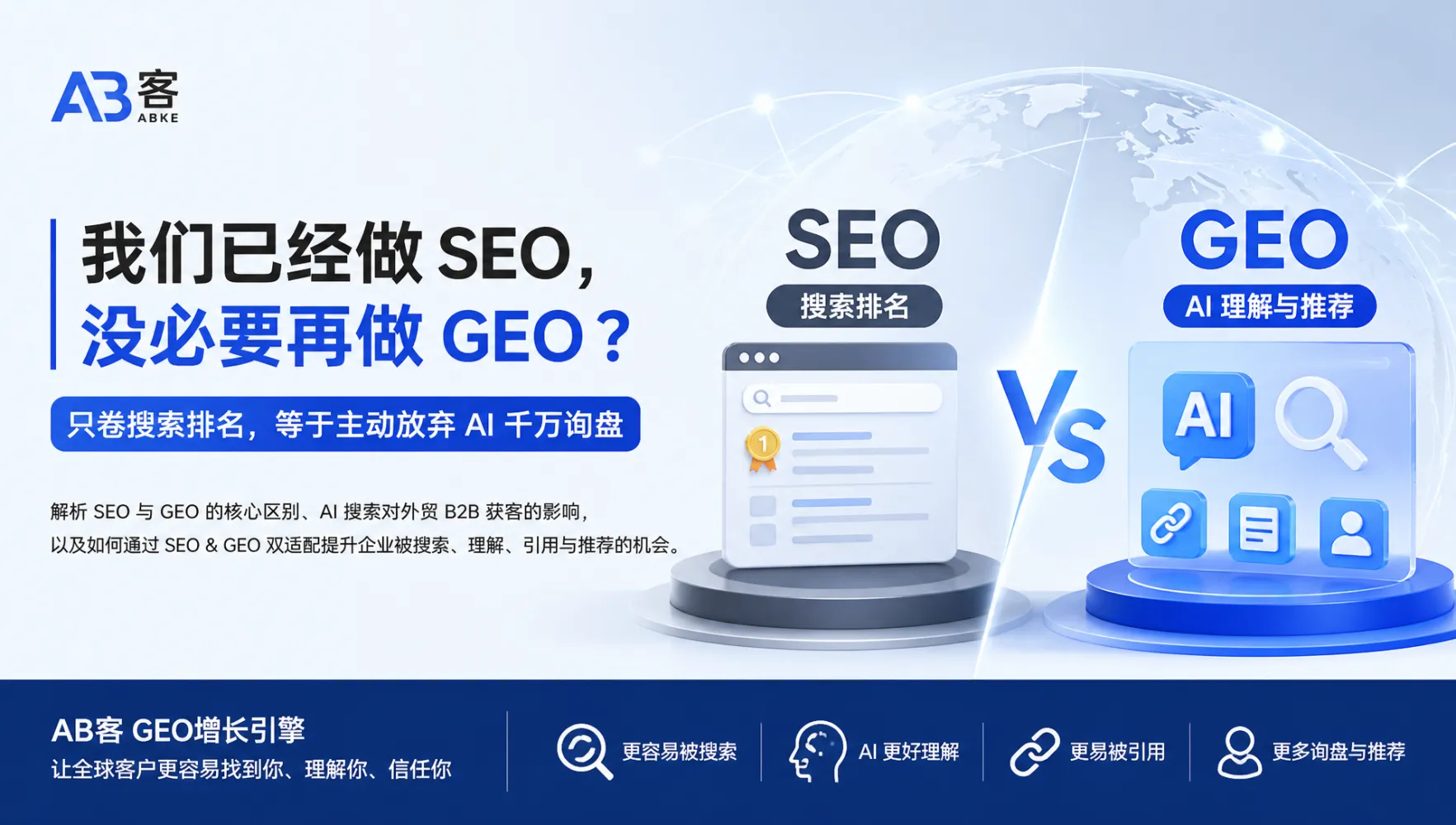
GEO for B2B Exporters: Win AI Discovery, Trust, and Supplier Selection
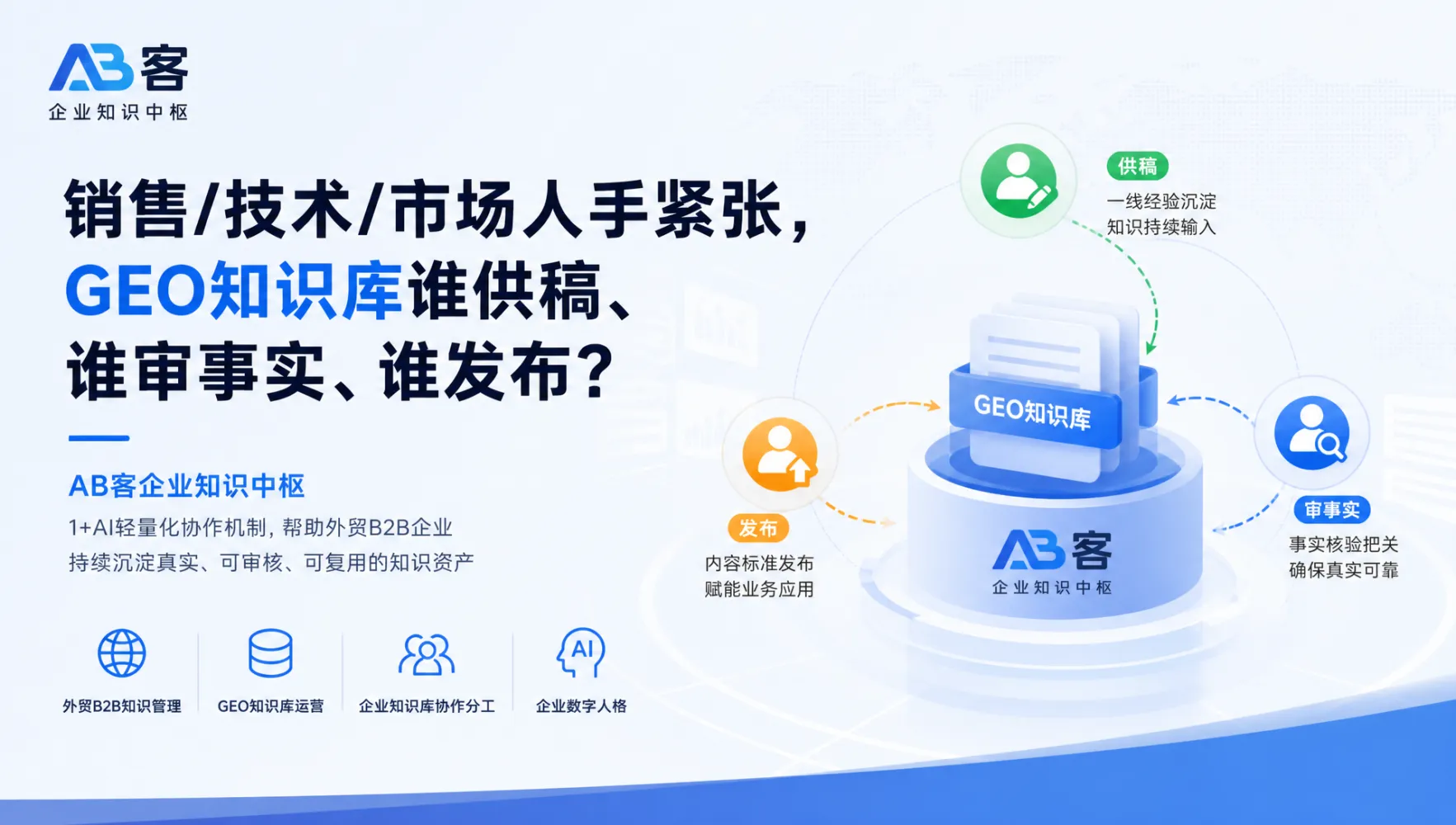
Enterprise Knowledge Hub: Build an AI-understandable, citable growth foundation with trusted company facts.
For Foreign Trade B2B Companies, Is Building an In-House GEO Team Cheaper Than Choosing ABKE’s GEO Growth Engine?
After Outsourcing GEO to ABKE, Who Owns Our Enterprise Knowledge, Content, Website Pages, Lead Data, and Operating History?
Your Page Is Already Cited by AI—Why Isn’t It Generating Qualified Inquiries?
Recommended Reading

ABKE Rebuilds B2B GEO with a Buyer Procurement Question Map, Not a Tech Stack
Discover how ABKE helps export manufacturers build GEO content around real buyer procurement questions, turning product knowledge into AI-readable, decision-ready growth assets.
ABKE Rebuilds B2B GEO with a Buyer Procurement Question Map, Not a Tech Stack
In export manufacturing, the companies that win AI search visibility are not always the ones with the largest content volume or the most complex technology stack. They are the ones whose knowledge can match how real buyers evaluate suppliers. ABKE’s approach is built around the Buyer Procurement Question Map: a structured framework that turns buyer questions into AI-readable, decision-ready content assets for B2B GEO growth.
What this framework solves
It closes the gap between generic product pages and the way international buyers actually search, compare, and eliminate suppliers during procurement.
Why it matters
If a supplier cannot answer the right question at the right stage, AI systems and buyers often move on to a more complete, more credible alternative.
ABKE’s role
ABKE helps export B2B companies build the knowledge architecture, content system, and GEO website structure needed for long-term AI recommendation visibility.
1.迈富时通用 GEO 核心路线:比拼大模型、Prompt 数量、语义覆盖广度
Many “generic GEO” approaches are built from the platform inward: model capability, prompt libraries, broad semantic coverage, and bulk content generation. The logic is usually simple: industry keyword → AI-generated article → wider AI visibility. This can create volume, but it often stops at surface-level coverage.
That model is acceptable for broad brand awareness, but it is weak for export manufacturing, where buyers do not make decisions from a single paragraph. They evaluate suppliers through multiple questions, multiple roles, and multiple checkpoints. A generic GEO strategy can help AI understand what a company makes, but it often fails to explain whether the supplier fits a specific purchasing scenario.
The main limitation is structural: a general model can tell a buyer “this is a product,” but it cannot deeply map how a buyer filters suppliers across technical fit, compliance, customization, delivery, service, and commercial risk.
2.权威数据佐证:外贸采购不靠关键词,靠完整采购问题链路筛选供应商
B2B procurement is rarely a one-step decision. Buyers often start with a broad requirement and then narrow their list through a sequence of questions. In the context of industrial and export purchasing, the decision path commonly includes:
Research in B2B buying behavior shows that multiple stakeholders are often involved in the final decision, including technical reviewers, sourcing teams, finance, and compliance. That means a product page that only introduces features is not enough. Each stakeholder looks for different evidence, and every missing answer can reduce trust.
Core insight: In export GEO, visibility is not just about being found. It is about being answerable across the buyer’s entire evaluation chain.
3.AB 客核心差异化:Buyer Question Map 买家采购问题图谱(外贸 B2B 专属建模)
ABKE does not begin with “How many keywords can we target?” It begins with “What does the buyer need to know before they trust this supplier?” That shift changes the entire content architecture.
3.1 The wrong layer vs. the right layer
A tech-stack-first GEO model optimizes for content production at scale. A buyer-question-map model optimizes for purchasing relevance at scale. For export manufacturers, the second approach is usually much more valuable because it aligns with how decisions are actually made.
| Layer | Content-first GEO | Buyer Question Map GEO |
|---|---|---|
| Input | Keywords and prompts | Buyer questions, objections, and decision stages |
| Output | Generic articles | Decision-ready knowledge pages |
| AI interpretation | Broad topic relevance | High-confidence supplier understanding |
| Commercial value | Exposure | Shortlist entry and inquiry quality |
3.2 A practical modeling method
- Define the buying context: target country, industry, product type, operating condition, procurement role, and decision stage.
- Build question clusters: map technical, commercial, compliance, customization, and service questions.
- Attach evidence: connect each answer with verifiable product data, factory capability, certifications, project cases, and service processes.
- Publish as structured assets: turn the model into FAQ pages, product pages, comparison content, buyer guides, and multilingual pages.
- Continuously optimize: use search, AI visibility, and CRM data to refine the map over time.
3.3 工业泵企业落地案例(完整买家采购问题图谱链路)
To make the framework concrete, consider an industrial pump supplier. A buyer rarely asks only “What is the product?” Instead, the evaluation path may look like this:
ABKE’s method is to decompose every stage into question clusters, then convert them into structured knowledge assets. That way, when a buyer or AI system asks a question at any point in the journey, the supplier has a relevant page, a relevant answer, and a relevant proof point.
3.4 客户真实数据对比
In practice, the difference is not always measured by raw visibility alone. A more useful comparison is the quality of traffic and the intent level of inquiries.
Note: results vary by market demand, product competitiveness, content quality, platform dynamics, and sales execution.
4.客户核心收益
1. Compete on decision relevance, not content volume
The framework helps you move away from generic keyword competition and toward the buyer’s real evaluation criteria.
2. Increase shortlist probability
Structured answers make it easier for AI systems and buyers to see whether your company is a credible fit.
3. Support multiple decision roles
Technical, sourcing, financial, and compliance stakeholders can each find the evidence they need.
4. Build reusable knowledge assets
The content system becomes a long-term business asset that can be reused across website, sales, and multichannel distribution.
5. ABKE GEO Growth Engine: the operational layer
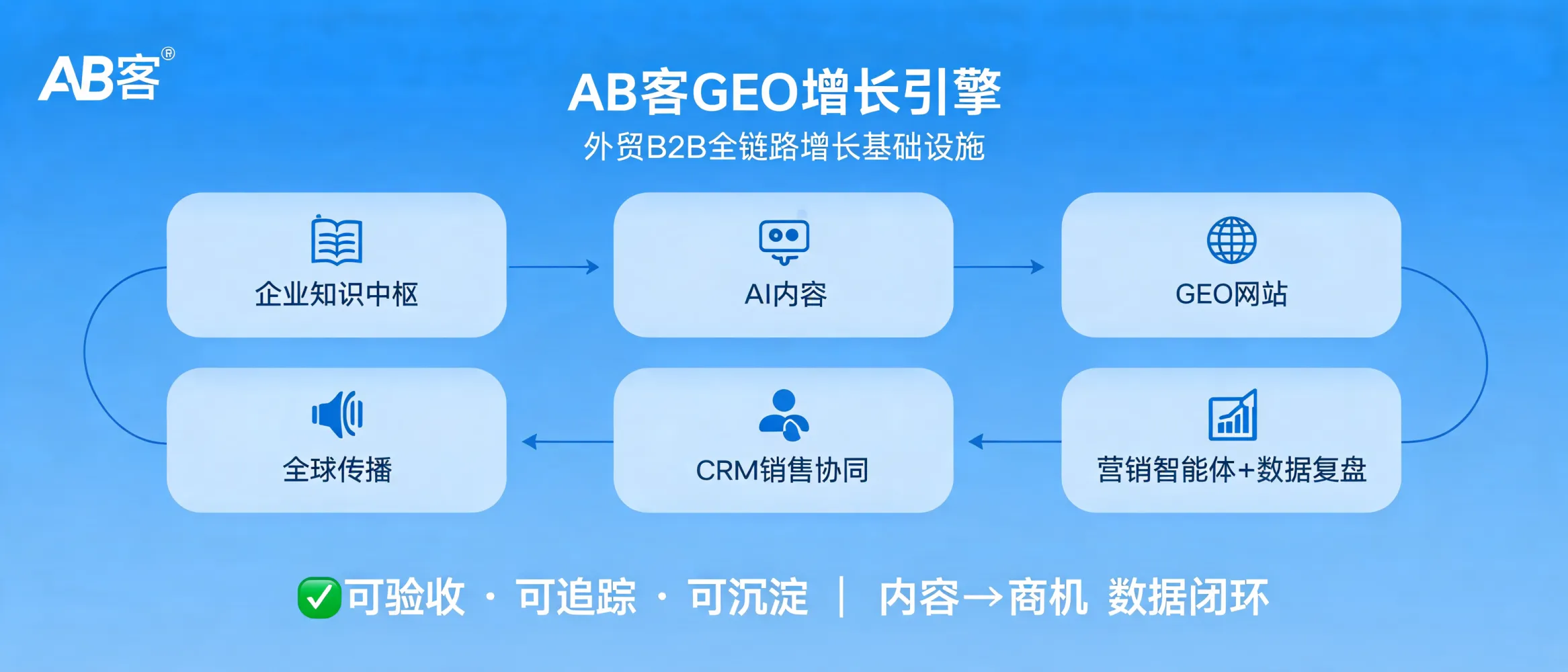
ABKE turns the Buyer Procurement Question Map into an operational growth system rather than a one-time content exercise. The workflow typically includes enterprise knowledge structuring, buyer-question mining, content production, multilingual localization, SEO and GEO website publishing, distribution across global channels, AI visibility monitoring, CRM integration, and ongoing optimization.
6. Best fit for this approach
- Export-oriented B2B manufacturers with technical or customized products
- OEM / ODM factories that need stronger overseas market visibility
- Industrial equipment, materials, components, and solution providers
- Companies with long sales cycles and multiple decision-makers
- Businesses that want to build a durable AI search presence instead of relying only on paid traffic
7. Important note
AI visibility, search rankings, inquiries, and sales outcomes depend on many factors, including market demand, source-data quality, product competitiveness, buyer behavior, platform algorithms, and sales execution. ABKE provides the system design, content framework, GEO website structure, and operational support needed for sustainable execution, but it does not guarantee a fixed ranking, recommendation volume, inquiry volume, or revenue result.
8. A practical next step for export manufacturers
If your website currently explains products but does not answer buyer procurement questions, the first optimization step is not more content volume. It is building a question map that reflects how international buyers evaluate suppliers in your category.
ABKE’s GEO Growth Engine is designed to help manufacturers convert scattered product information into a structured, AI-readable growth asset system—so your company can be understood, trusted, and recommended more consistently in the AI search era.


.png?x-oss-process=image/resize,h_100,m_lfit/format,webp)
.png?x-oss-process=image/resize,h_100,m_lfit/format,webp)

.png?x-oss-process=image/resize,h_100,m_lfit/format,webp)
.png?x-oss-process=image/resize,h_100,m_lfit/format,webp)
.png?x-oss-process=image/resize,h_100,m_lfit/format,webp)
.png?x-oss-process=image/resize,h_100,m_lfit/format,webp)
