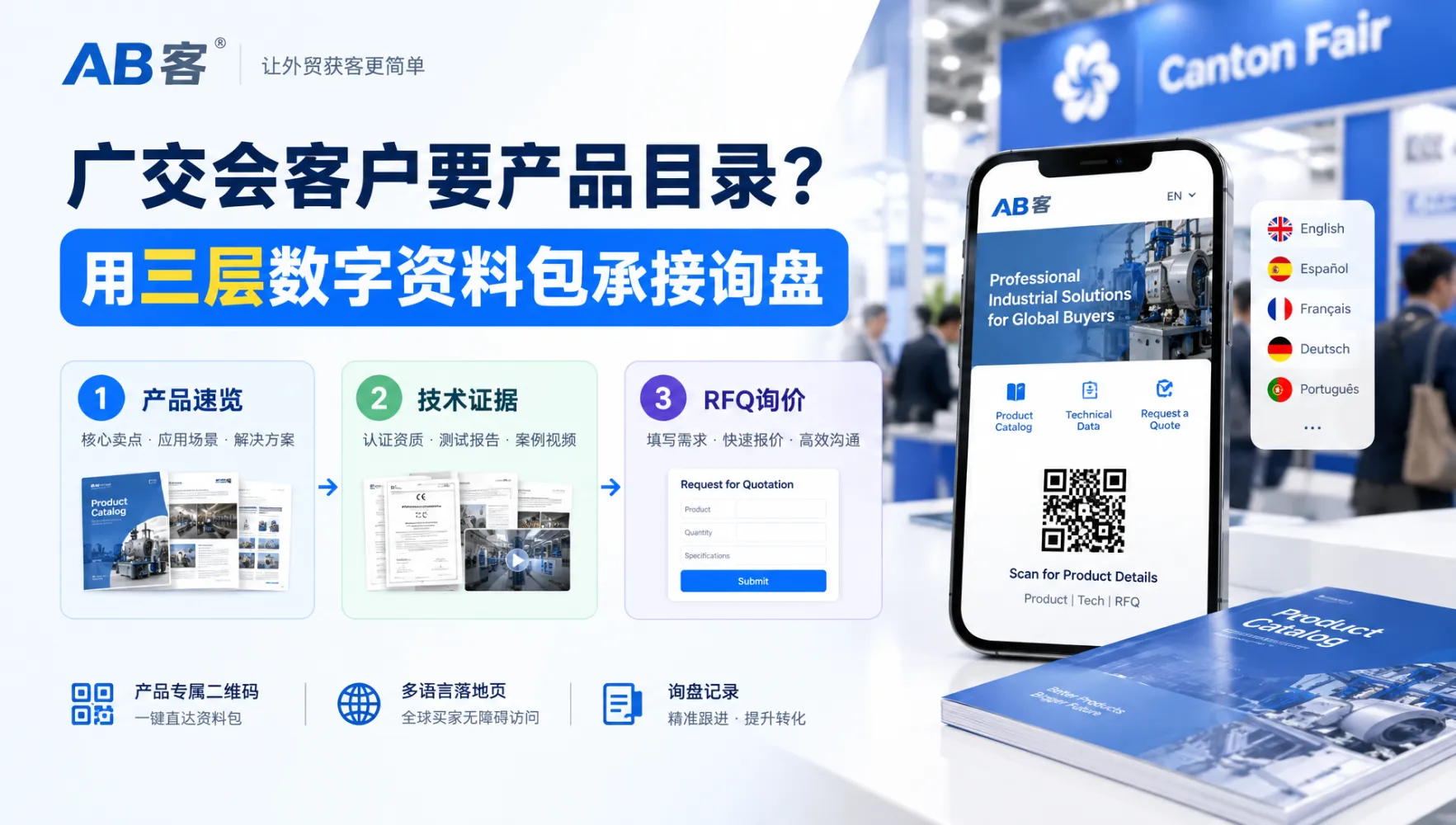
Can you do OEM? Use ABKE’s five-question Canton Fair checklist to qualify customization requests, flag technical risks and prioritize sales follow-up.
Canton Fair field guide · Custom manufacturing · Sales qualification
“Can you do OEM?” opens a conversation. It does not yet justify a quotation, a delivery promise or a development commitment.
During Phase 1 of the Canton Fair, buyers may use “OEM” to describe anything from adding a logo to developing an entirely new product. Your first job is to identify which request is actually on the table—and whether it fits your factory’s capabilities, commercial requirements and production schedule.
Three booth conversations that create avoidable risk
1. Saying “yes” before defining the customization
Logo printing, a different housing material and a redesigned electrical interface are not equivalent requests. A factory may support one within an established process while another requires new tooling, validation or a different production partner.
Use instead: “We support several customization options. Could you show us the exact changes you need so we can confirm the right route?”
2. Quoting a unit price without understanding volume
A sample, a pilot batch and repeat production can have very different cost structures. Tooling, setup, testing, packaging and purchased-component minimums may affect the offer. An annual forecast should not automatically be treated as a committed purchase quantity.
Use instead: “What quantities do you expect for samples, the first order and repeat production? We will separate one-time charges from unit pricing.”
3. Promising compliance before checking the market
Existing test reports or certificates may not cover a modified configuration, a new intended use or every destination country. Changes to materials, components or construction can affect the evidence required.
Use instead: “Please confirm the destination market and intended application. Our technical team will review the applicable requirements and whether existing documentation covers this configuration.”
Run the conversation through five decision gates
The purpose of these questions is not to finish engineering at the booth. It is to collect enough information to assign a responsible next step.
Gate 1 — Identify exactly what the buyer wants changed
Ask: “Which product are you considering, and what must be different from the version on display?”
Confirm the model, intended use and required performance.
Separate branding and packaging requests from material, structural or functional changes.
Request drawings, reference samples, specifications or marked-up photographs where available.
Record: A short scope statement, supporting files and unresolved requirements. Distinguish essential specifications from preferences.
Gate 2 — Establish the development responsibility
Ask: “Are we adapting an existing design, manufacturing to your completed design, or developing the product together?”
Clarify who provides the design, who approves changes and who owns or may use the drawings and tooling. For confidential projects, agree on the appropriate confidentiality arrangements before exchanging sensitive files.
Record: The development route, design maturity, approval authority and any ownership questions requiring agreement. A concept image is not a production-ready specification.
Gate 3 — Separate demand forecasts from purchase quantities
Ask: “How many samples do you need, what is the intended first order, and what repeat demand do you currently forecast?”
Check MOQ by configuration, material, color and packaging—not just by total order size. Ask whether the buyer has budgeted for tooling, development and testing. A small initial order can still be worthwhile when the project is technically suitable and the commercial terms are workable.
Record: Sample quantity, trial quantity, production quantity, forecast confidence and willingness to discuss non-recurring costs.
Gate 4 — Connect the product to its destination and use
Ask: “In which countries will this configuration be sold, and how will customers use it?”
Collect any buyer-specified standards, labeling rules, language requirements and documentation expectations. Depending on the product and market, the review may involve electrical safety, electromagnetic compatibility, material restrictions or other requirements.
Record: Destination countries, intended application, requested evidence and the person responsible for confirming compliance. Do not substitute a generic certificate list for a product-specific review.
Gate 5 — Build a timeline around approvals
Ask: “When do you need samples approved, production completed and goods received?”
Work backward from the required arrival date. Allow for specification approval, component sourcing, tooling, sample iterations, testing, production and transport. Clarify whether the buyer’s date means factory dispatch or delivery at destination.
Record: Milestones, buyer approval responsibilities and dependencies. Treat the schedule as provisional until the relevant teams confirm it.
A reusable booth worksheet for OEM/ODM inquiries
Use this as a meeting note, CRM template or post-show handover. “Not confirmed” is a useful entry; an empty field is easy to overlook.
Decision area
Information to capture
Immediate next step
Customization scope
Model, application, requested changes, files and acceptance criteria
Request missing specifications
Development route
Existing design or new development; design owner and approver
Assign technical review
Commercial scale
Samples, first order, forecast, MOQ fit and development budget
Check commercial feasibility
Market requirements
Countries, intended use, standards, labels and required documents
Route compliance questions
Timing
Sample approval, production and arrival dates; approval dependencies
Validate the milestone plan
Also capture the buyer’s company, role, preferred contact channel, meeting notes, assigned salesperson and agreed follow-up date.
Prioritize by readiness and fit—not enthusiasm alone
Review five dimensions together: requirement clarity, project stage, commercial scale, technical fit and timing. Use the following grades as an internal working framework, not a prediction of purchase probability.
A — Ready for coordinated review: The buyer has a defined requirement, credible project context, potentially workable quantities and a meaningful schedule. Assign sales and technical owners. A-grade status does not mean engineering approval.
B — Plausible, but incomplete: The application fits, but specifications, budget, quantities or approvals remain unclear. Send a focused information request and agree on the next checkpoint.
C — Exploratory or currently unsuitable: The buyer is researching options, or the request conflicts with current capabilities or commercial limits. Offer relevant standard products, nurture appropriately or decline clearly.
Where sales qualification ends and technical approval begins
Sales can collect requirements and explain approved options. Qualified technical personnel must assess:
Manufacturing feasibility, process tolerances and inspection methods.
Tooling requirements, development effort and associated costs.
Material substitutions and their effect on performance or durability.
Structural, electrical, software or interface changes, as applicable.
Testing and certification implications of the proposed configuration.
Production capacity, component availability and repeatability at scale.
If a buyer needs an early budget indication, label it as preliminary and state the assumptions, exclusions and conditions. A conditional estimate should not be presented as a final quotation.
Illustrative comparison: similar requests, different follow-up
The following examples are hypothetical and demonstrate the qualification method, not ABKE customer results.
Buyer A wants private-label packaging for an existing product, provides artwork, identifies the destination country and proposes a first order aligned with the supplier’s MOQ. The next step is to verify packaging specifications, documentation coverage and the production slot.
Buyer B mentions a much larger annual volume but requests a new enclosure and interface without drawings, a development budget or confirmed approval milestones. The next step is a requirements discussion and engineering review—not an immediate production quote.
Lesson: Buyer B may become valuable, but Buyer A is currently easier to advance. Prioritize the next actionable decision rather than the most impressive forecast.
Turn trade-show answers into reusable company knowledge
Repeated OEM/ODM questions reveal what buyers need to know before they trust a supplier. ABKE GEO Growth Engine helps foreign-trade B2B companies organize that information into an enterprise knowledge base, then reuse approved content across SEO/GEO websites, multilingual materials and enterprise agents.
Attach evidence: Approved specifications, applicable test documentation and verified cases that can be shared without breaching confidentiality.
Publish buyer-facing guidance: Explain development stages, quotation inputs and approval responsibilities in the languages your markets require.
Connect follow-up to CRM: Record lead grades, missing information, communication history and the next responsible owner.
Enterprise agents can help retrieve approved answers and organize inquiries. They should escalate unknown specifications or exceptions rather than invent an answer. Knowledge ownership, version control and human review remain essential.
Questions sales teams ask after the show
What should I ask when the buyer says only “OEM”?
Start with the product and the requested change: “Do you need your branding on an existing model, modifications to our design, or manufacturing from your own drawings?” Then clarify quantity, market and timing.
How should a supplier explain OEM and ODM online?
Describe the actual service rather than relying on the labels alone. OEM commonly refers to manufacturing to a buyer’s specifications; ODM commonly involves a supplier-developed design that a buyer adopts or adapts. Usage varies, so specify design responsibility, customization limits, ownership terms and approval stages.
Does a low initial quantity make a lead unqualified?
No. A pilot order may be a sensible validation stage. Assess its fit with setup costs, MOQ, development requirements and the buyer’s project plan. Keep projected future volume separate from present commitments.
Can AI decide whether to accept a custom project?
AI can summarize requirements, identify missing fields and compare requests with documented rules. It cannot replace accountable engineering, compliance or commercial approval, especially where new materials, designs or market requirements are involved.
Leave every OEM conversation with a clear next action
You do not need to approve a project at the booth. You need a usable requirement record, a realistic priority and an owner for the next decision. That is what turns a brief conversation into a manageable sales opportunity.
Want consistent answers before, during and after the Canton Fair? Talk to ABKE about organizing your customization rules, buyer questions and follow-up process through the GEO Growth Engine.
For a focused discussion, prepare your product catalog, current OEM/ODM policy, typical MOQ conditions and a few anonymized inquiries. These provide a practical starting point for identifying knowledge gaps and improving lead handover.
Disclaimer: This content was created by AI and reviewed by humans. The above content represents only the creator's personal views.