.png?x-oss-process=image/resize,h_100,m_lfit/format,webp)

.png?x-oss-process=image/resize,m_lfit,w_200/format,webp)

Hot Products
.png?x-oss-process=image/resize,h_2000,m_lfit/format,webp)
.png?x-oss-process=image/resize,h_2000,m_lfit/format,webp)

Popular articles
Build Localized Multilingual Websites for Multi-Country B2B Market Expansion
新产品上市:怎么用内容体系解决海外买家的选型认知问题?
Progressive GEO Website Upgrade for B2B Exporters With Existing Google Traffic
Help Overseas Buyers Evaluate Your Business at the Supplier Shortlist Stage
Recommended Reading


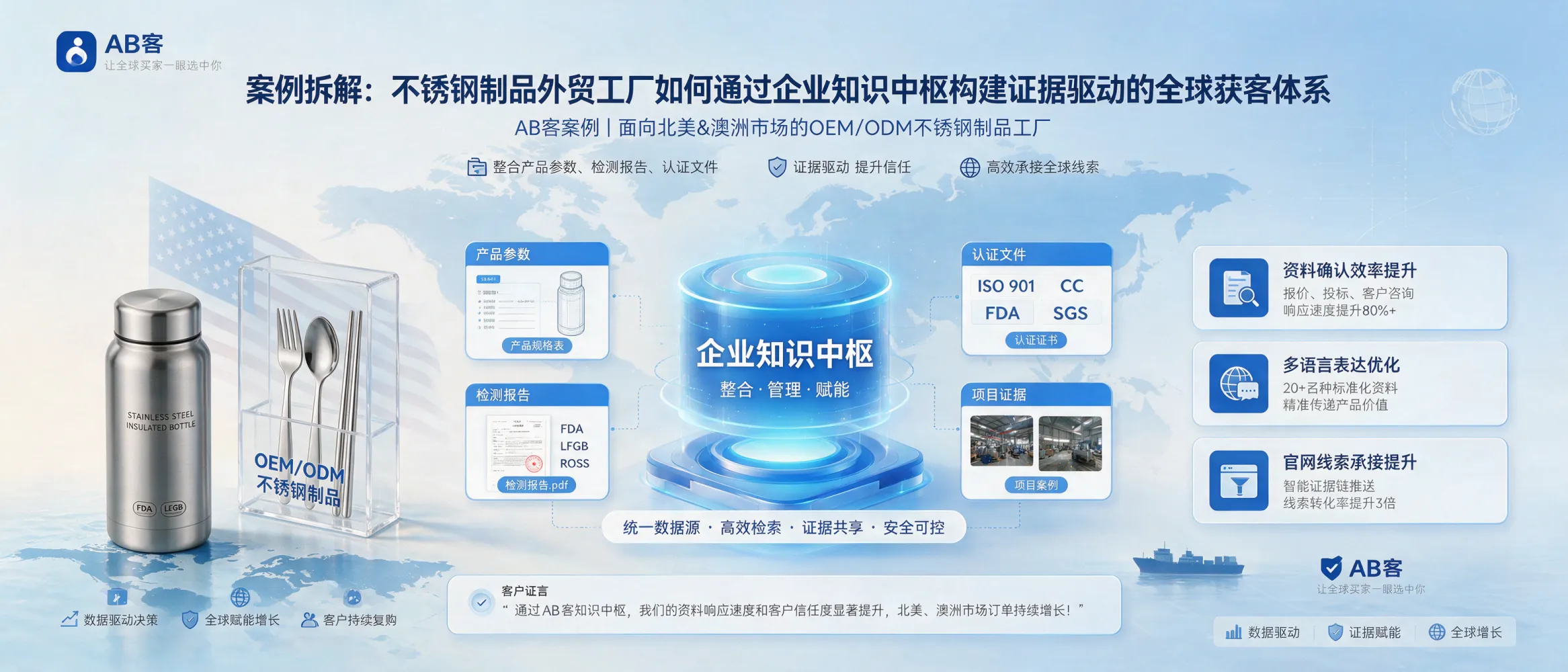

3 China Manufacturing Export Cases: Real GEO Transformation Is Never About Publishing More Articles
Explore three anonymized China manufacturing export cases from ABKE, showing how industrial B2B companies strengthen AI visibility through structured knowledge, solution positioning, and product-to-scenario content systems.
3 China Manufacturing Export Cases: Real GEO Transformation Is Never About Publishing More Articles
For industrial B2B exporters, GEO works when a company becomes easier for AI systems and overseas buyers to understand, trust, and recommend. In practice, that means building a verifiable information relationship chain — not simply adding more blog posts.
Why these cases matter
Many manufacturing companies assume GEO means “publish more content.” But in industrial B2B, the real challenge is usually structural:
- buyers search by application, specification, project scenario, and trust evidence;
- AI answers rely on structured, coherent, and sourceable information;
- older SEO assets often exist, but they are fragmented and hard to interpret;
- product pages alone rarely explain why a supplier is suitable for a specific use case.
Core takeaway
Industrial B2B GEO is not a volume game. It is the work of repairing and strengthening the information relationship chain between products, capabilities, applications, buyer questions, proof points, and conversion paths.
Three anonymized China manufacturing GEO cases
| Company type | Before GEO | GEO transformation focus | Primary business outcome |
|---|---|---|---|
| Grain and oil machinery EPC supplier | Presented mainly as an equipment seller | Reframed capabilities around complete processing lines, engineering delivery, project scenarios, and technical evidence | Clearer positioning as an integrated engineering solution provider |
| Crushing and screening equipment manufacturer | Owned existing SEO pages and rankings, but content relationships were fragmented | Integrated legacy SEO assets with structured product knowledge, buyer FAQs, applications, and GEO-ready page architecture | Expanded AI-readable coverage while protecting established search assets |
| Multi-SKU industrial hardware supplier | Product information was isolated by SKU and difficult for buyers to compare by use case | Built a product × application × industry knowledge matrix with structured selection and specification content | Improved product discoverability across multiple buyer intents |
Case 1: Grain and oil machinery EPC supplier
Client background: A China-based grain and oil machinery company with EPC capability, engineering delivery experience, and project-based selling needs. Before the project, the market perception was close to a standard equipment vendor.
Construction period: Approximately 8 weeks for the first phase of knowledge structuring and website content rebuilding, followed by ongoing optimization.
Main problem before GEO
- The company’s strengths were real, but not clearly expressed in a way AI could easily interpret.
- Product pages focused on equipment, while buyers in this category often care about line design, engineering scope, installation, and delivery confidence.
- There was a gap between “what the company can do” and “what overseas buyers need to verify before inquiry.”
What ABKE changed
- Rebuilt the company narrative from “machine seller” to “complete processing line solution provider.”
- Organized project cases, technical capabilities, process stages, and delivery logic into structured knowledge blocks.
- Added buyer-focused content around line planning, project requirements, engineering constraints, and supplier evaluation questions.
| Dimension | Before | After |
|---|---|---|
| Positioning | Equipment-focused | Solution-focused |
| Content logic | Product descriptions | Project scenarios, process, and evidence |
| AI readability | Fragmented | Structured and sourceable |
Verifiable outcome: The company’s market narrative became much clearer, and the brand could be interpreted as an integrated engineering solution provider rather than a standalone machine supplier. That shift matters because it improves relevance for project-based buyers and makes the company easier to recommend in AI-assisted search.
Case 2: Crushing and screening equipment manufacturer
Client background: A long-established crushing and screening equipment manufacturer with existing SEO assets, some keyword rankings, and accumulated website content. The challenge was not zero visibility — it was content fragmentation and weak relationship mapping.
Construction period: Around 6–10 weeks for asset audit, content mapping, and GEO page architecture integration, then continuous refinement over the following months.
Main problem before GEO
- Existing SEO pages were valuable, but they did not fully communicate how different products, applications, and buyer questions connect.
- Some content had ranking value, yet the site lacked a clean structure for AI systems to extract a full answer.
- There was a risk of rebuilding too aggressively and damaging legacy traffic.
What ABKE changed
- Kept the original SEO assets that already had value.
- Added structured product knowledge, application pages, FAQ content, and comparison-oriented pages.
- Connected legacy pages into a GEO-ready architecture so search engines and AI systems could follow the topic hierarchy more clearly.
- Improved internal linking so product pages, use-case pages, and trust evidence pages reinforced each other.
Before: strong page history, but weak semantic coherence.
After: legacy SEO value preserved, while AI-readable topic coverage expanded.
Verifiable outcome: The project protected the company’s existing search assets while creating a clearer content system for AI discovery. In industrial marketing, that is often the right move: not replacing what already works, but making it easier for both Google and AI systems to understand.
Case 3: Multi-SKU industrial hardware supplier
Client background: A multi-SKU industrial hardware exporter with a wide catalog, multiple use cases, and a common content challenge: products were described by SKU, but buyers think in terms of application, compatibility, and selection logic.
Construction period: Roughly 10–12 weeks to establish the initial knowledge matrix, product grouping logic, and core content templates.
Main problem before GEO
- Too many products, but not enough decision support.
- Buyers could not quickly compare options by industry, scenario, specification, or performance requirement.
- Content existed in isolation, so discovery depended heavily on exact keyword matches.
What ABKE changed
- Built a product × application × industry knowledge matrix.
- Created selection content, specification guidance, and use-case explanations for core product families.
- Added structured content around buyer intent, so the site could answer different questions instead of only listing SKUs.
| Buyer intent | Old content style | New GEO content style |
|---|---|---|
| Product selection | SKU list | Use-case guided selection page |
| Technical comparison | Separate product pages | Comparison and specification content |
| Industry fit | Generic descriptions | Industry scenario pages |
Verifiable outcome: Product discoverability improved across multiple buyer intents because the site was no longer a catalog alone. It became a decision-support system that helps overseas buyers move from search to shortlist with less friction.
What changed across all three projects
Positioning: from product listing to buyer-relevant solution definition.
Knowledge: from scattered files and pages to structured, reusable enterprise knowledge.
Content: from generic articles to pages built around selection, application, delivery, quality, and supplier-evaluation questions.
Visibility: from keyword-only optimization to SEO and AI-search discoverability together.
How these results were verified
These ABKE case studies are anonymized to protect client confidentiality. Result verification does not rely on vague claims. It is assessed through observable project outputs and business signals such as:
Actual performance varies by market demand, product competitiveness, existing website quality, execution depth, and sales follow-up discipline.
What industrial B2B companies should learn from these cases
- GEO is strongest when your company can be explained in a way AI can parse without guessing.
- For factories and exporters, trust is built through evidence, not adjectives.
- Older SEO assets are often valuable — they just need semantic repair and relationship mapping.
- Multi-SKU businesses need content that helps buyers choose, not just content that lists features.
- The most effective GEO projects connect knowledge, content, website structure, and conversion flow into one system.
Why AB客 matters here
AB客, the GEO growth engine under Shanghai Muke Network Technology Co., Ltd., focuses on helping manufacturing exporters build an AI-readable digital identity, structured enterprise knowledge, and a scalable B2B growth system. In projects like these, the goal is not simply more traffic — it is sustainable discoverability, better-qualified inquiries, and stronger recommendation potential in the AI search era.
Best fit for
This GEO approach is especially suitable for machinery manufacturers, engineering equipment suppliers, industrial parts exporters, OEM/ODM factories, and multi-SKU B2B companies that want to become easier for search engines, AI platforms, and overseas buyers to understand, compare, and trust.


