Brand
Connect series development, design consistency, labeling and packaging, and sample confirmation.
Hot Products





Popular articles
DeepSeek Opens Search API: AI Scoring Standards Become Transparent, Marking the End of the "Volume-Based Era" for Foreign Trade B2B GEOs.
2026.10.21
Reading:
0
How can AI assist sales at the Canton Fair? Transforming negotiation records into CRM follow-ups and GEO tasks.
2026.10.19
Reading:
0
广交会客户筛选实操指南:用6个问题识别采购需求,推动有效RFQ
2026.10.16
Reading:
0
Should B2B foreign trade businesses advertise on ChatGPT? First, use 5 checks to determine the suitability for trial advertising.
2026.10.22
Reading:
0
Turn Canton Fair Price Questions into Qualified RFQs: 4 Buyer-Objection Templates
2026.10.18
Reading:
0
Recommended Reading
Reading:
0
Reading:
0
How can custom hat and apparel companies connect with brand sourcing through GEO? A six-month case study and implementation suggestions.
Release time:
2026/10/23
Type:
Client Cases
AB Client analyzes how customized hat and accessory export companies can shift from style display to brand procurement and matching, outlining OEM/ODM knowledge, process descriptions, procurement FAQs, and inquiry handling paths. The case study materials, disclosed over six months, show an increase in page views from 164 to 860 and an average of 14 valid monthly inquiries from 3. Data awaits verification of the original reports. This case study helps similar companies assess key areas for GEO (Government-Operated Enterprise) development.
A case study of GEO growth for a custom hat export company: a comparison of key performance indicators before and after six months, from style display to brand sourcing matching.
Organize scattered product information into digital cognitive assets for global brand sourcing, encompassing customized hats, OEM/ODM manufacturing, brand development, and bulk delivery.
Case Summary
A Chinese B2B foreign trade company whose main business is the manufacture of customized hats and clothing, providing OEM/ODM services for baseball caps, bucket hats, knitted hats and related clothing to overseas brand owners, wholesalers, distributors and customized procurement customers.
The challenge for businesses is not a lack of products, but rather the difficulty for buyers to determine the customization scope, process compatibility, sampling procedures, and bulk delivery conditions from style images. This case study uses...AB customer(ABKEThe knowledge, content, and transformation framework of the GEO growth engine breaks down the path of the official website from a product display entry point to a procurement decision support system; it does not equate methodological analysis with verified project delivery records.
I. Client Background: From Product Export to Brand Customization Supply Chain
| Case Fields | content |
|---|---|
| Case Number | ABKE-CASE-APPAREL-01 |
| Customer Name | A custom hat and clothing export company (de-sensitized) |
| Industry | Textile and apparel manufacturing, headwear manufacturing, OEM/ODM |
| Core Products | Baseball caps, bucket hats, knit hats, flat-brimmed hats, T-shirts and related custom clothing |
| Core competencies | Style development, fabric selection, embroidery and printing, brand customization, sampling and mass production |
| Major customers | Overseas apparel brands, wholesalers, distributors, and custom procurement clients |
| Procurement Model | OEM, ODM, Private Label (own brand), bulk customization |
| Analysis cycle | The case materials are marked as 6 months; the exact start and end dates are pending verification. |
| Service direction | GEO Intelligent Website, Enterprise Knowledge Expression, Procurement Scenario Content, Search and AI Visibility Analysis |
| Core Objectives | From visible products to understandable customization capabilities, assessable procurement conditions, and acceptable inquiry information. |
The case study describes a business encompassing hat manufacturing, apparel customization, brand development, and global delivery support. For overseas clients, the purchase is not just about a hat, but about finding a manufacturing partner who can continuously support brand development. Therefore, the scope of cooperation needs to be defined beyond the product itself; minimum order quantity, sample fees, production cycle, and trade terms should all be confirmed based on the specific project.
II. Key issues before construction: Many styles are available, but buyers struggle to assess supply capacity.
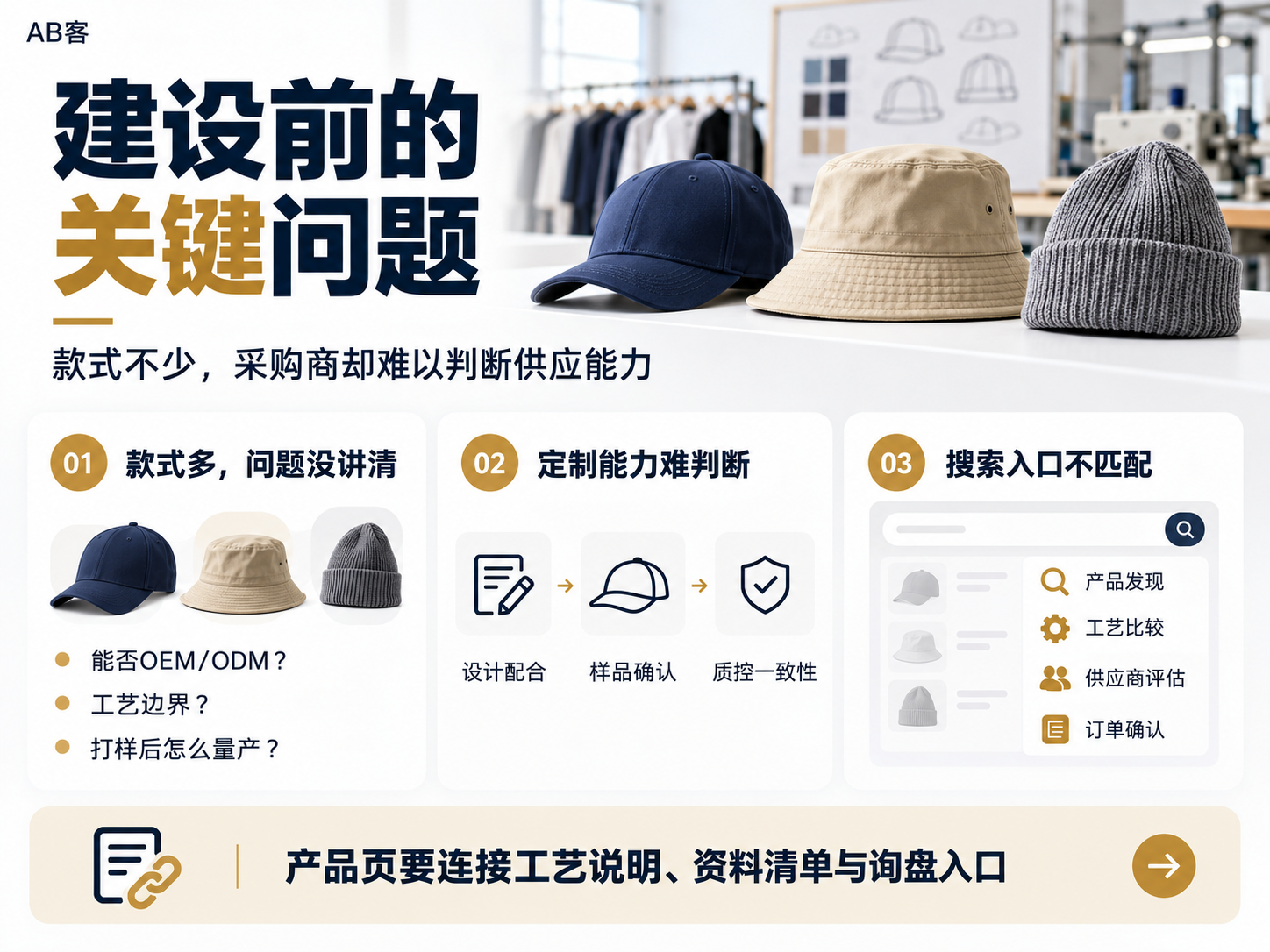
The case study materials summarize the early issues as follows:"There are many styles, but the customization and delivery capabilities are not readily apparent."This highlights the information gap between product classification and procurement decisions.
1. The product style does not completely match the purchasing intention.
While categorizing items like baseball caps, bucket hats, and knitted hats can indicate the supply range, it doesn't independently answer the question of brand sourcing.
-
Do you support OEM production based on drawings or samples?
-
Can I participate in ODM development when there is no mature design draft?
-
What are the customization boundaries for fabrics, hat styles, embroidery, and prints?
-
After the sample is confirmed, how do we connect it with mass production?
-
How to confirm brand labels, packaging, and delivery requirements?
The product page should link to process instructions, a list of required documents, and an inquiry portal, allowing customers to move from "I like this one" to "whether it can be produced".
2. Lack of a complete judgment path for customization capabilities.
Brands also need to verify design compatibility, sample confirmation, and consistency between quality control and mass production. If this information is scattered, clients will need to communicate repeatedly. It is recommended to link process descriptions to actual samples, inspection procedures, or technical documents; unconfirmed certifications, production capacity, and delivery dates should not be presented as established capabilities.
3. Search entry points are insufficient to cover different procurement stages.
"Custom Hat" may encompass individual customization needs, while "Custom Headwear OEM Manufacturer" is closer to selecting manufacturing partners. SEO and GEO content should respectively cover product discovery, process comparison, supplier evaluation, and order confirmation, avoiding using the same generic introduction to appeal to all buyers.
III. GEO Development Direction: Establishing the content relationship of "Style - Craftsmanship - Customization - Procurement"
Based on the product described in the case text,SolutionandFAQThe structure can be summarized into four construction directions. Specific implementation timelines, deliverable quantities, and responsible personnel still require verification from project records.
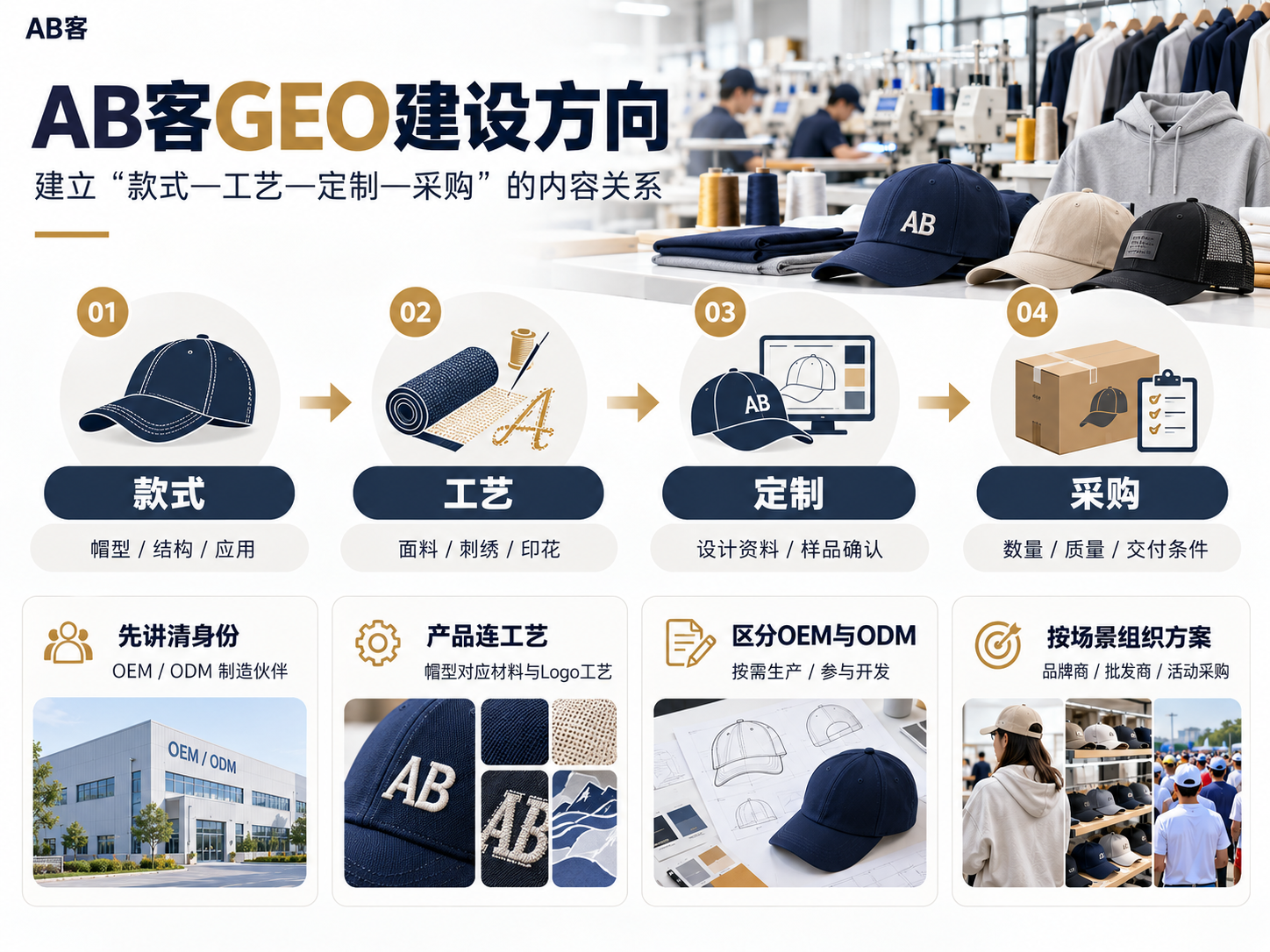
- Style →
Hat type, structure, and application - Process →
Fabrics, embroidery, printing - Customization →
Design documents and sample confirmation - purchase
Quantity, quality, and delivery conditions
1. Clearly define the company's role as an OEM/ODM manufacturing partner.
First, unify the company's identity, main products, customer types, and capability boundaries, and then organize the content.AB Customer GEOGrowth engineEnterprise Knowledge BaseBased on this, we can support this kind of fact-finding; the focus is not on repeating "high quality", but on explaining which orders are suitable, what support can be provided, and which requirements require technical evaluation.
2. Establish the correspondence between products and processes.
Taking the development of branded baseball caps as an example, the page should link the cap's structure, fabric, logo craftsmanship, and sample confirmation items. The choice of craftsmanship is influenced by pattern details, materials, and usage scenarios; simply listing the craftsmanship name is insufficient. Connecting the product with its technical specifications through relevant page links helps reduce procurement ambiguity.
3. Clearly explain the difference between OEM and ODM.
Typically, OEM focuses more on production based on customer requirements, while ODM involves design and development support from the manufacturer; specific responsibilities are subject to the contract. Customers with existing design drafts should prepare size, material, and process requirements, while customers requiring development support should specify the target style and usage scenario. Design ownership, sample modification, and confirmation responsibilities should also be agreed upon in advance.
4. Organize solutions around procurement scenarios
Wholesaler
Connect specifications, bulk purchase and replenishment conditions to avoid pre-set supply commitments.
Event purchasing customers
Connect logo adaptation, samples, arrival points and delivery locations confirmation.
IV. Key data for six months: comparison of indexing, ranking, AI recommendation, and effective inquiries before and after.
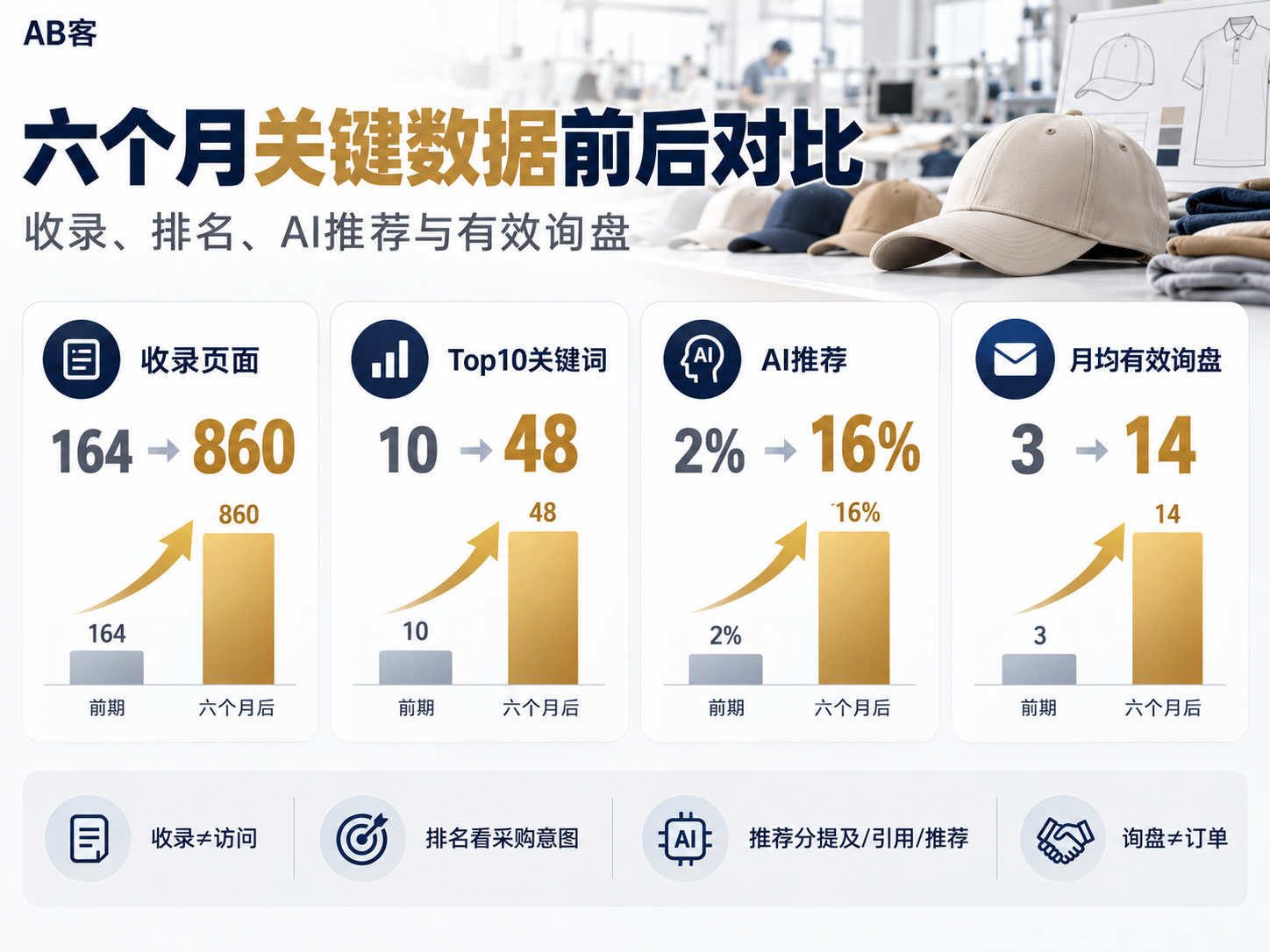
The following is a complete summary of the image values presented in the case study.Statistical Explanation:The material is labeled "6 months of construction and operation," but it lacks accurate dates, platform export records, and indicator definitions, making it data to be verified and disclosed.
| Key Indicators | Before construction | 6th month | Numerical changes |
|---|---|---|---|
| Included Pages | 164 | 860 | +696 pages |
| Google Top 10 Keywords | 10 | 48 | +38 |
| AI recommendation related metrics | 2% | 16% | +14 percentage points |
| Average monthly valid inquiries | 3 | 14 | +11 items/month |
Pages included: 164 pages → 860 pages
The number of disclosed pages increased by 696, and the end-of-period number was approximately 5.24 times that of the beginning-of-period number. The number of pages indexed is not the same as the number of page views, nor can it independently prove content quality. Verification should unify domain names, search engines, and indexing standards, identify duplicate and invalid URLs, and check whether newly added pages cover genuine procurement issues.
Search ranking: 10 → 48
The number of top 10 keywords increased by 38, a growth of 380%. A supplementary keyword list is needed, including target countries, languages, equipment, and testing dates, and a distinction must be made between branded and non-branded keywords. Only by combining purchasing intent, organic clicks, and landing page performance can the commercial relevance of the ranking increase be determined.
AI recommendation: 2% → 16%
The disclosure metric improved by 14 percentage points, reaching eight times the initial rate at the end of the period, but this cannot be considered the overall recommendation rate of all AI platforms. Formal evaluations should use a fixed question set, platform version, and retesting conditions, retaining original answers and cited sources, and separately recording brand mentions, citations, and explicit recommendations.
Valid inquiries: From an average of 3 to 14 per month
An average of 11 new entries were added per month, resulting in approximately 4.67 times the number at the end of the period compared to the beginning. Two comparison windows need to be clearly defined, and...CRMRemove duplicates and spam. Valid leads for hat OEM/ODM should have identifiable purchasing intent, such as product details, customization scope, expected quantity, or sampling plans; a valid inquiry does not equal an order.
V. Why this case is noteworthy: The focus of growth has shifted from exposure to procurement matching.
Online customer acquisition shouldn't be simply understood as "getting more buyers to see the hats." Brand sourcing requires continuous capability assessments:
- Discover product categories →
- Assess manufacturing capabilities →
- Compare process ranges →
- Verify sample delivery →
- Submit Your Sourcing Request
Product pages, process descriptions, solutions, and FAQs collectively fill these information gaps. If information and capability boundaries are clearly articulated, it is expected to help reduce redundant communication, but this still needs to be verified with sales records. A simultaneous increase in all four metrics only indicates parallel changes; website history, market demand, and the efficiency of other marketing and follow-up efforts can all influence the results, and cannot be entirely attributed to the GEO.
VI. Replicable Practical Experiences for Peers
Companies in the same category of headwear, apparel, and consumer goods manufacturing should prioritize establishing a structured procurement content rather than a large, generic document library.
First, we need to agree on the facts.The source of information and the person responsible for review are retained for products, materials, processes, and customization conditions, and multilingual versions are updated simultaneously.
Secondly, answer questions according to your role.Provide independent solutions for brand development, bulk wholesale, sample confirmation and delivery coordination, and differentiate between confirmed capabilities and requirements to be evaluated.
Next, establish the connection between the evidence.Link products to manufacturing instructions, quality processes, and cooperation terms; use inquiry forms to collect necessary requirements and avoid excessive information requests.
Finally, the effect was verified by layering.Observe the inclusion, ranking, AI visibility, and valid inquiries separately.
AB Customer GEO Growth EngineImplementation can be supported through collaboration of knowledge base, content, website, CRM, and data attribution; before the assessment, product information, target market, existing website, and anonymized inquiry records can be prepared, and construction priorities and delivery scope can be discussed.
VII. Frequently Asked Questions (FAQ)
Q1: Why can't OEM/ODM hat companies rely solely on product catalogs to acquire customers?
A catalog may showcase the product range, but it's insufficient to explain design compatibility, process suitability, and delivery conditions. Solutions, FAQs, and manufacturing evidence are needed to support purchasing decisions, especially for orders involving brand development and customized technical requirements.
Q2: Does an increase in the number of pages indexed mean that AI will definitely recommend businesses?
This does not mean that search engine indexing, AI citations, brand mentions, and explicit recommendations are different metrics and should be tested separately. Content accessibility and factual clarity do not guarantee adoption or recommendation by any platform.
Q3: How to determine if an inquiry for custom hats is valid?
Verify the customer's identity, purpose of purchase, scope of customization, quantity, and next steps according to the agreed rules. Leads with incomplete information should be placed in the pending confirmation level and should not be automatically counted as valid business opportunities, nor should they be discarded simply because the quantity is not yet specified.
Related case studies:
Foreign Trade B2B GEO Case Study | AB Customer Intelligent Growth Solution
VIII. Case Implications and Boundaries of Evidence
What's noteworthy about this case study is the connection between hat styles and brand purchasing decisions. Long-term assets aren't just more isolated web pages, but rather a professional information system that continuously answers questions about products, customization, quality, delivery, and partnerships.


Disclaimer: This content was created by AI and reviewed by humans. The above content represents only the creator's personal views.
AB Customer GEO Growth Engine
Custom Hats & Accessories GEO Case
OEM/ODM Foreign Trade Customer Acquisition
Foreign Trade B2B Procurement Matching
SEO and GEO Collaborative Optimization
Foreign Trade B2B GEO Case
GEO Case
AB Customer GEO Case
AB customer
Foreign Trade B2B GEO
