


Did you find the relevant page?
Evidence: Query terms, result URLs, and summaries.
Hot Products





Popular articles
Foreign Trade Companies’ Final 90 Days: A Practical 2026 Q4 GEO Execution Checklist
2026.10.06
Reading:
0
Turn Canton Fair Traffic into Qualified Opportunities: A Daily GEO and CRM Checklist
2026.10.17
Reading:
0
广交会后电子家电企业如何做GEO?用30天梳理产品优势与采购决策信息
2026.10.15
Reading:
0
Can Your Product Evidence Support an Accurate Procurement Decision?
2026.10.09
Reading:
0
广交会买家索要产品目录时,如何用三层数字资料包推进询价?
2026.10.16
Reading:
0
Recommended Reading
Reading:
0

Reading:
0
DeepSeek didn't recommend your company? Use 7 steps to self-diagnose and prioritize GEO issues.
Release time:
2026/10/21
Type:
Tutorial Guide
If AI isn't recommending companies, is the problem with the search, page loading, or the final answer? AB Guest has outlined a 7-step process for conducting GEO self-testing in foreign trade B2B using Search/Fetch APIs. This covers the procurement question set, search inspection, content verification, answer verification, and retest attribution, helping companies determine optimization priorities with traceable evidence, rather than blindly adding articles.
Introduction | If AI doesn't recommend anything to you, where should you start investigating?
First, distinguish between the three stages: retrieval, page loading, and final response. The value of GEO self-testing in foreign trade B2B is not to prove that "publishing more articles is effective," but to use traceable evidence to determine at which stage the company's information is missing when a buyer raises a purchasing question.
Typically, three possibilities need to be investigated separately:
-
Pages matching the procurement question did not appear in the search results.
-
The page displays results, but the information is incomplete, outdated, or lacks evidence.
-
The search results were visible, but the AI's final answer still did not accurately cite or recommend any companies.
Were key facts preserved?
Evidence: Extract the main text, parameters, and conditions.
Is this an accurate mention or recommendation?
Evidence: Actual answers, quotations, and context.
These three problems cannot be solved simply by repeatedly generating articles. This article connects problem preparation, baseline recording, retrieval checking, content verification, answer verification, repair and sorting, and continuous retesting into seven actions; the chapters are still unfolded according to the actual operation logic.
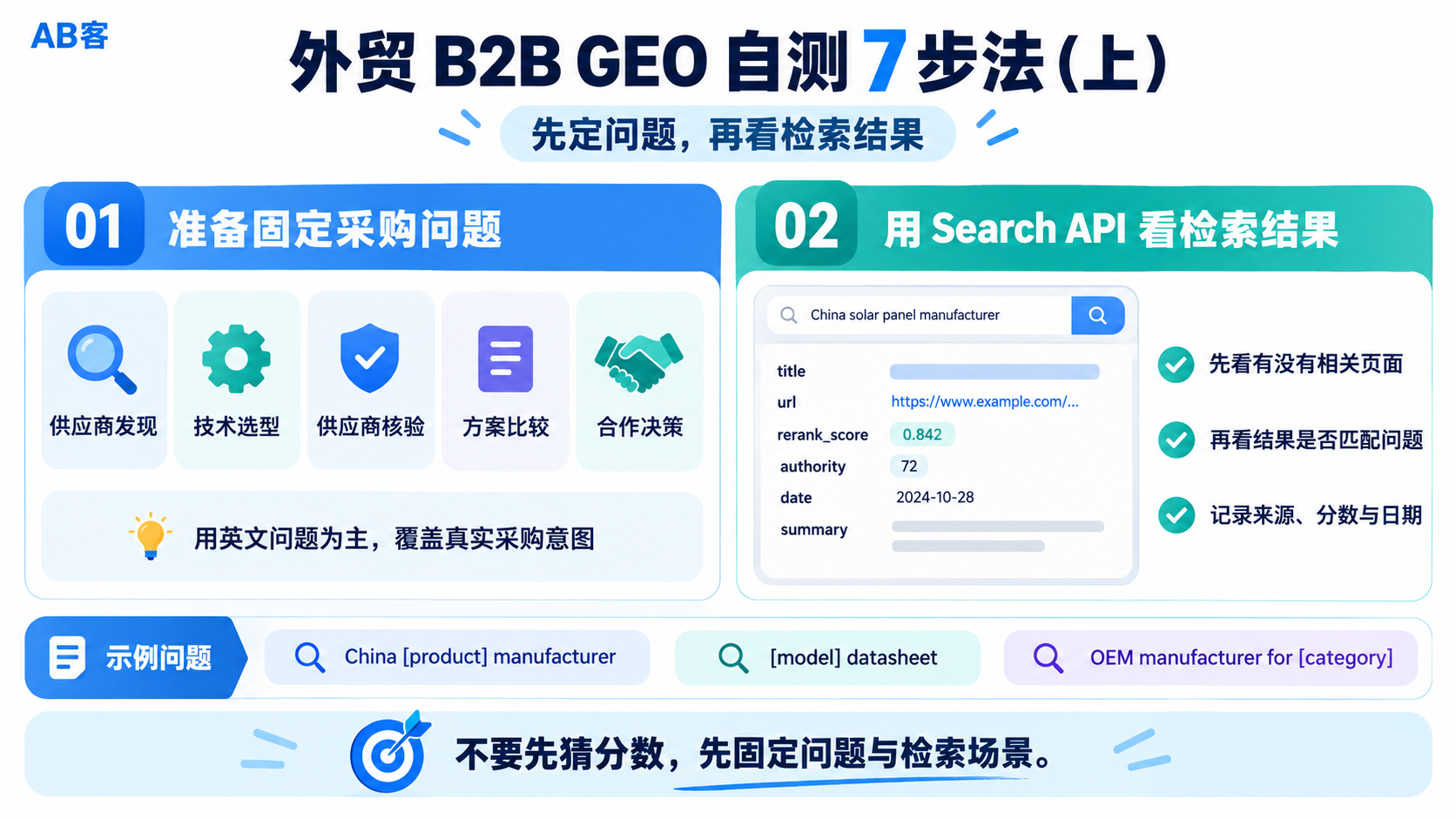
I. Prepare a set of fixed B2B foreign trade procurement issues
The question set should stem from actual purchasing decisions, not from selling points the brand wants to showcase. First, select a core product, target market, and application scenario, covering at least five categories of questions:
-
Supplier discovery:Find a specific type of product or manufacturer, specifying its intended use and required conditions.
-
Technology selection:Ask questions about specifications, performance, materials, operating conditions, and compatibility.
-
Supplier verification:Verify the manufacturer's identity, certifications, and quality system, and pay attention to the source of evidence.
-
Comparison of options:Compare standard products with customized solutions to clarify costs and applicable boundaries.
-
Collaborative decision-making:Verify MOQ, samples, delivery and after-sales service, and identify transaction obstacles.
Examples include:
China [product] manufacturer for [application][model] datasheet and operating conditionsOEM manufacturer for [product category][product] supplier certification and quality control
Use English questions to test the overseas procurement context, while also keeping Chinese questions for comparison. Replace placeholders with actual products and operating conditions, and do not pre-include brand names in each question; otherwise, you can only test brand searches and will find it difficult to observe the ability to discover non-branded suppliers.
II. Using the Search API to check search results
The Search API checks which pages the specified search service returned, and is not equivalent to the internal search results of the DeepSeek dialog product. Before using it, you should verify the service provider, API version, and permissions; you cannot assume it is an official DeepSeek API simply based on its name.
If the service documentation explicitly supports this, it can be used. site:,lang:,after:,before: And use precise phrases to limit sites, languages, and times. First, conduct discovery tests without site restrictions, and then use site restrictions to assist in the investigation; the latter does not represent competitive performance in open search.
The general request parameters are shown below. The actual parameter names and values should be based on the corresponding service documentation:
query: '"product model" manufacturer lang:en'
count: 10
need_content: false
If the API returns the following fields, they can be recorded respectively:
title,url: What are the results, and where do they come from? Note the differences between the official website and third-party pages.rerank_scoreThe re-ranking score under the current query has a meaning and scope that depends on the service definition.authorityThe authority level of a webpage defined by the interface is not equivalent to the authenticity of the authentication.dateThe page date identified by the service may be missing and may not necessarily be equal to the last update time.summaryThis is a summary for later reading, to check whether the facts needed to address the procurement issue have been retained.
Missing fields should be recorded as "not returned," not as a score of zero. Scores from different queries, services, or versions may not be directly comparable; summaries cannot replace original page verification.
3. Use the Fetch API to check if the page content is complete.
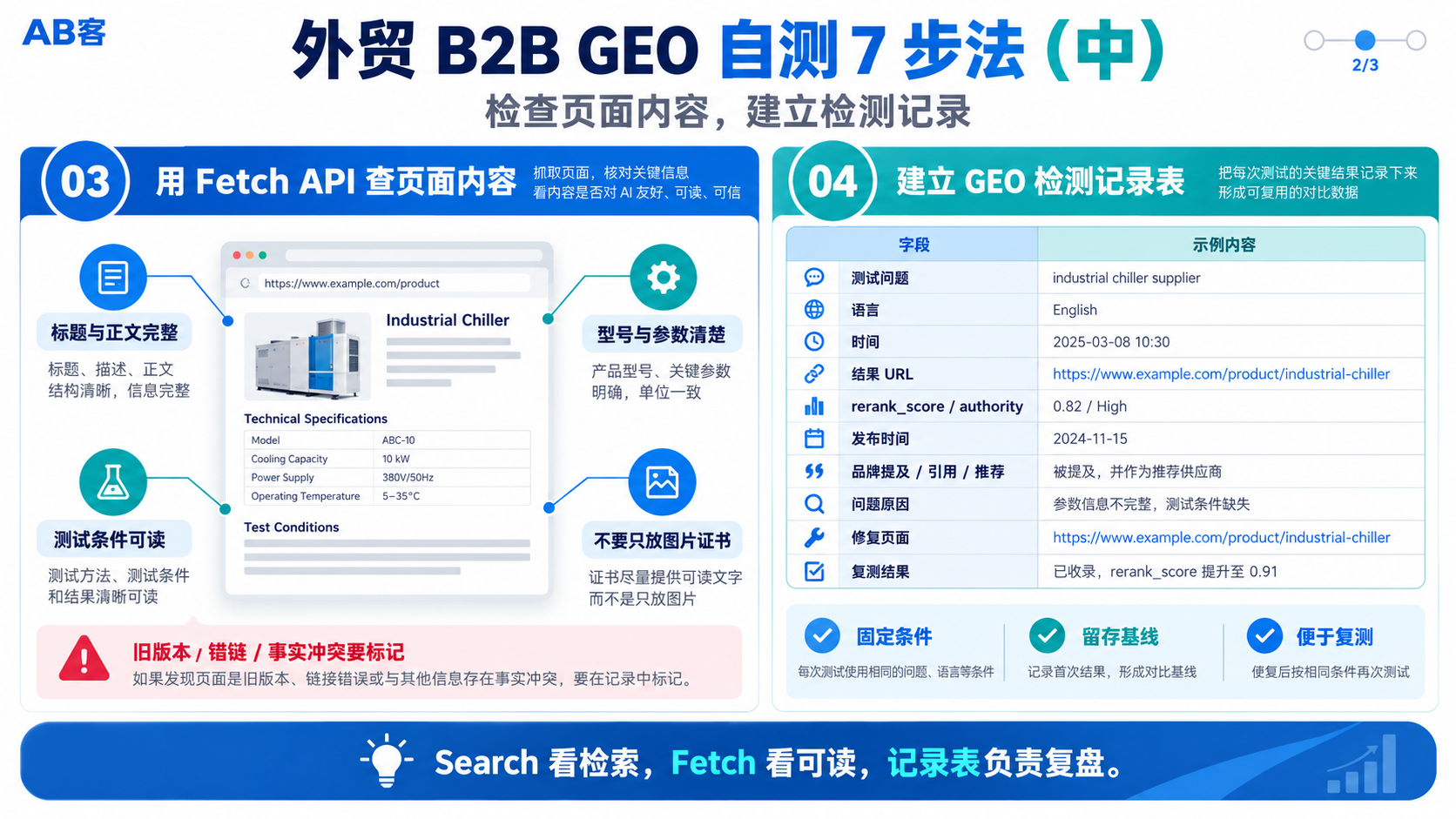
For the target URL in the search results, use the Fetch API of the selected service to save the extracted content and compare it item by item with the original page in the browser. The focus is not on "successful request", but on whether the key purchasing facts have been fully retrieved.
-
Are the title, body text, model number, and key parameters complete, and are the units correct?
-
Are the tables, test conditions, and applicable scopes retained? Are the row and column relationships misaligned?
-
Does the core truth only exist in images or content that relies on front-end scripts?
-
Does the page contain outdated versions, broken links, or factual conflicts?
| Page Information | Key points of verification | Repair direction |
|---|---|---|
| Model and parameters | Are the values associated with the correct model and conditions? | Express using readable text and standardized tables |
| Certification and Testing | Are the subject, scope, and validity period clearly defined? | Supplementary explanations and verifiable materials |
| Customization and Delivery | Do you specify the conditions and applicable boundaries? | Unified product pageFAQWith sales data |
For example, if a page states that a certain performance characteristic only applies to a specific test temperature, but the extracted results omit this condition, it may lead to misunderstanding. Fetch readability is a valuable diagnostic dimension, but it does not mean that all AI platforms use the same fetching mechanism; fetch failures should also be investigated by distinguishing between permission, network, and page parsing issues.
IV. Establish a GEO detection record form
Record the original response, page version, and actual answer in units of "Question × Test Batch". Do not only leave a score or screenshot, otherwise it will be difficult to verify later.
| Fields | Purpose of recording |
|---|---|
| Test questions and languages | Fixed procurement intent, target market and testing conditions |
| Test time | Record timeliness, service version, and test batch |
| Result URL and page title | Locate the actual search source and save the page version. |
rerank_score / authority |
Observe the score distribution and missing data under the same conditions. |
| Publication time and summary | Determine freshness, relevance, and whether any conditions have been omitted. |
| Brand mentions, citations, recommendations | Further examination will be conducted to verify the accuracy of the actual AI responses against the facts. |
| Problem Causes and Fixes Page | Clearly define the tasks, responsible persons, and corresponding modification items. |
| Retest results | Compared to the baseline, determine whether the change is sustained. |
Brand mentions, page citations, and company recommendations should be recorded separately. Answers listing brands without providing reasons for selection should not be considered explicit recommendations; referencing third-party pages does not equate to the official website being cited.
V. How to interpret the results and decide what to change first?
-
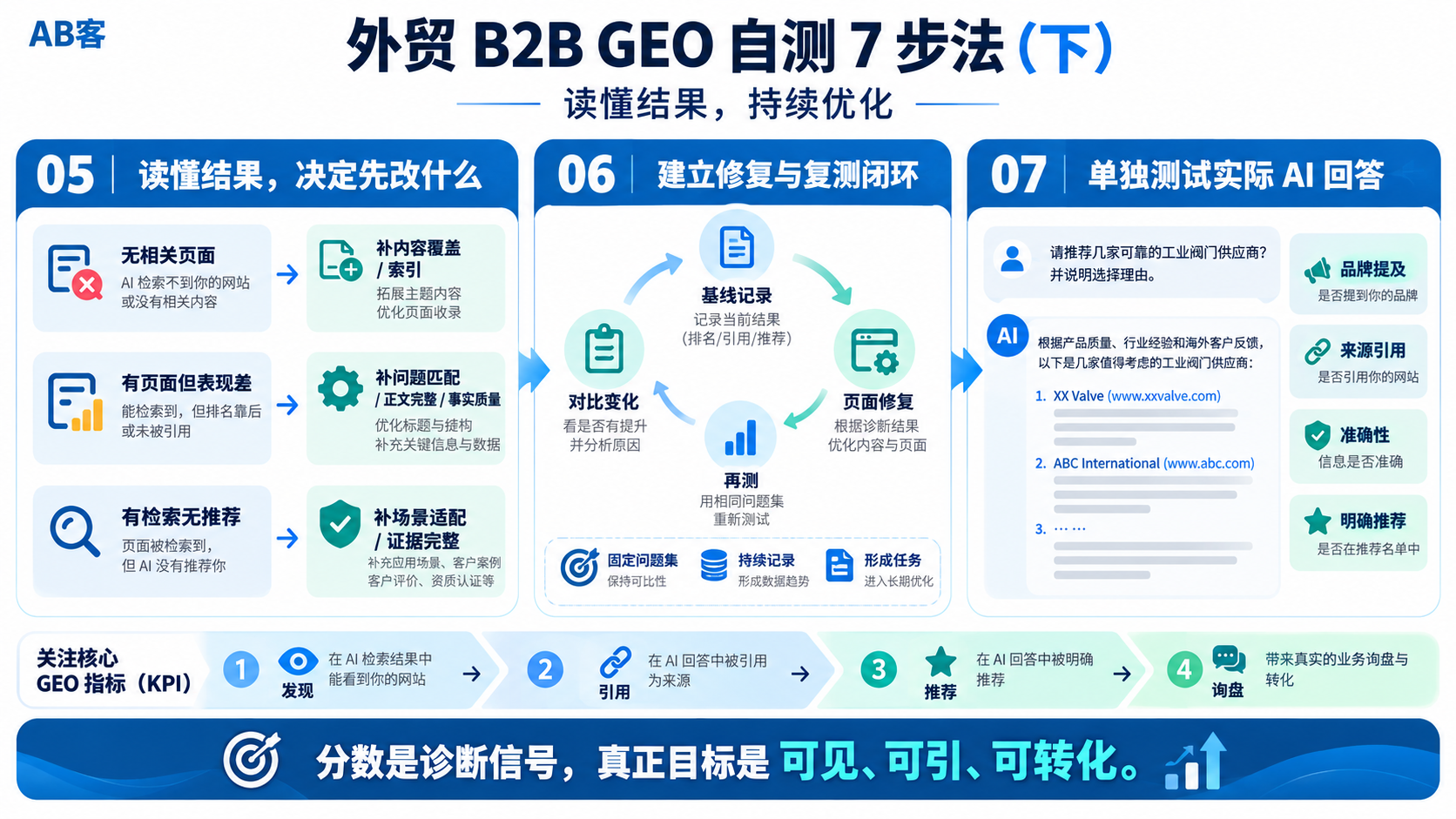
No relevant page was found in the results:First, check the content coverage, page discoverability, and indexing status to distinguish between "no corresponding content" and "existing page but not retrieved".
-
The page exists, but the rating or summary performance is unsatisfactory:Check the question matching, the completeness of the text, the quality of the facts, and the timeliness; do not add keywords just for the sake of scores.
-
The score was good, but no recommendations were actually given.Further examine the suitability of the procurement scenario, the completeness of the evidence, and the citation of responses, and independently test actual dialogues.
-
A brand appeared, but the facts were incorrect:Prioritize fixing conflicts related to enterprise entities, product models, and cross-channel operations to prevent errors from affecting procurement decisions.
The priority of remediation should be based on the error risk, procurement importance, and scope of impact. Typically, factual errors such as model number and certification scope should be corrected first, followed by gathering evidence for high-interest issues, and finally expanding the scope of coverage. A single fluctuation in score is insufficient to prove the effectiveness of the changes.
VI. How to turn a test intoContinuous optimizationmechanism?
Establish a closed loop linking a fixed question set, baseline recording, page repair, retesting, and business results. Simultaneously, conduct separate tests of actual DeepSeek dialogue responses, recording visible model identifiers, network settings, context, and time to avoid directly treating Search API results as final recommendations.
Retesting should retain the unmodified page as a reference and focus on consecutive batches, rather than selecting the best response. Attribution should combine source records, valid inquiries, and sales feedback; leads with unconfirmed sources should be marked as unknown and not all should be included in GEO results.
AB customerHow was it done?
AB customer (ABKEAB客 (AB) is a brand under Shanghai Muker Network Technology Co., Ltd. AB客 GEO Growth Engine...Enterprise Knowledge BaseAt its core, it connects buyer issues, content creation, SEO & GEO websites, and global reach.Content distribution,CRM By linking data attribution with diagnostics, infrastructure, and sustained growth.
In ongoing operations, AI-powered visibility monitoring and content analysis are used to identify factual errors, content gaps, and outdated evidence. Real questions collected by sales from the Canton Fair and online inquiries are fed back into the knowledge base and then transformed into FAQs, product descriptions, and solution content. During consultations, core product information, target markets, and existing websites can be submitted first to clarify the scope of the diagnosis, data permissions, and delivery criteria.
Related reading materials:
DeepSeek Opens Search API: AI Scoring Standards Become Transparent, Marking the End of the "Volume-Based Era" for Foreign Trade B2B GEOs.
Conclusion | Let every GEO optimization leave evidence.
An effective B2B international trade GEO self-test should answer the following questions: What questions were tested, which pages were found, what facts were retrieved, how did the AI respond, and whether the changes persisted after the fixes were implemented. Verifiable records are more valuable for decision-making than isolated scores.
Start with a core product and a set of procurement issues, completing baseline testing, self-testing, and retesting. If systemic advancement is required, we can work with A/B engineers to assess and build a roadmap based on enterprise knowledge, page evidence, monitoring conditions, and CRM implementation capabilities, ensuring that each optimization has a task, a basis, and can be compared with real business feedback.


Disclaimer: This content was created by AI and reviewed by humans. The above content represents only the creator's personal views.
AB Customer GEO Growth Engine
DeepSeek GEO Self-Test
Foreign Trade B2B GEO Optimization
Search API retrieval diagnostics
Fetch API page inspection
