Hot Products





Popular articles
广交会后工业设备GEO指南:让AI理解设备能力,让海外买家更容易选型与询盘
How can we improve the competitiveness of AI recommendation by benchmarking against GEO competitors 30 days after the Canton Fair?
What to Do When Trade Show Leads Stop Replying: Turn One Meeting Into Ongoing Buying Touchpoints with GEO
Only 90 Days Left in Q4 2026: What Should Export Businesses Cut From GEO—and What Should They Focus On?
Canton Fair Is Only the Beginning: How to Turn Q4 Trade Show Leads Into 2027 Orders
Recommended Reading



Benchmarking against DeepSeek's dual-score rule: A self-checklist for independent B2B e-commerce websites (GEO) to quickly identify your rerank_score and authority weaknesses.
Why are independent e-commerce websites difficult to be cited by AI? ABKe provides a GEO self-checking framework for AI search scenarios like DeepSeek, checking everything from buyer questions, page relevance, authentication evidence to information timeliness, and prioritizing rectification based on the enterprise knowledge base. When dealing with fields such as rerank_score and authority, refer to the actual interface documentation and returned results.
After DeepSeek opened its search API, B2B foreign trade operations can establish a reproducible self-inspection process: simulating questions from overseas buyers, calling the DeepSeek search API to view the rerank_score and authority of their own pages, and identifying three types of deduction points: relevance misalignment, lack of authoritative evidence, and outdated information. This article provides a scoring self-inspection checklist for factories and trading companies. No technical team is needed; marketing personnel can conduct regular self-tests, prioritizing the repair of core pages that are lowering scores to avoid direct rejection during the buyer's AI background check stage. Related reading: DeepSeek Opens Search API: AI Scoring Standards Become Transparent, Marking the End of the "Volume-Based Era" for Foreign Trade B2B GEOs.
GEO, or Generative Engine Optimization, focuses on whether enterprise information can be retrieved, understood, and accurately cited. The "dual-score self-check" in this article is a screening framework, not a replication of DeepSeek's internal algorithm. Marketing personnel can first complete the page and evidence review; if API calls are required, the corresponding interface permissions and technical configurations must be available. When a field is unavailable, the source of the citation, the accuracy of the answer, and the completeness of the evidence should be recorded; "official scores" should not be generated independently.
Prepare before self-testing: A question bank specifically for B2B foreign trade.
Establish a question set based on "Target Market - Core Product - Procurement Stage". Replace XXX with the actual company or product name, while retaining generic procurement questions without brand names, and observe the performance of brand background checks and supplier discovery separately.
-
Qualification verification:"XXX factory CE certificate for industrial charger, test report number." Pay close attention to verifying the applicable model, standard, and document entry point; CE-related compliance documents should be distinguished according to applicable regulations and cannot be equated with third-party certifications.
-
Selection parameters:"XXX manufacturer MOQ, lead time, FOB port for automation parts." The page should specify the minimum order quantity, applicable lead time conditions, and port of shipment, distinguishing between standard products, customized products, and different order sizes.
-
Case background check type:"XXX supplier EPC project reference in Southeast Asia". Verify the project area, scope of supply, application conditions, and publicly available evidence; do not inflate supply experience into general contracting capabilities.
-
Comparison and selection:"Compare XXX and XXX manufacturers on certification and production capacity." Use the same statistical methods, specify the production capacity timeframe and applicable products, and avoid making unfounded evaluations of competitors.
-
Self-test requirements:Use English buyer phrasing and maintain consistency with genuine overseas purchasing inquiries; avoid using Chinese keywords. Prioritize sources from inquiries, sales emails, and customer interviews, and record the test date, platform, network connection status, and original answers.
What needs to be confirmed? landing page
Where can I get the answer directly? Factual evidence
How to verify independently? Retest Record
Is the citation accurate?
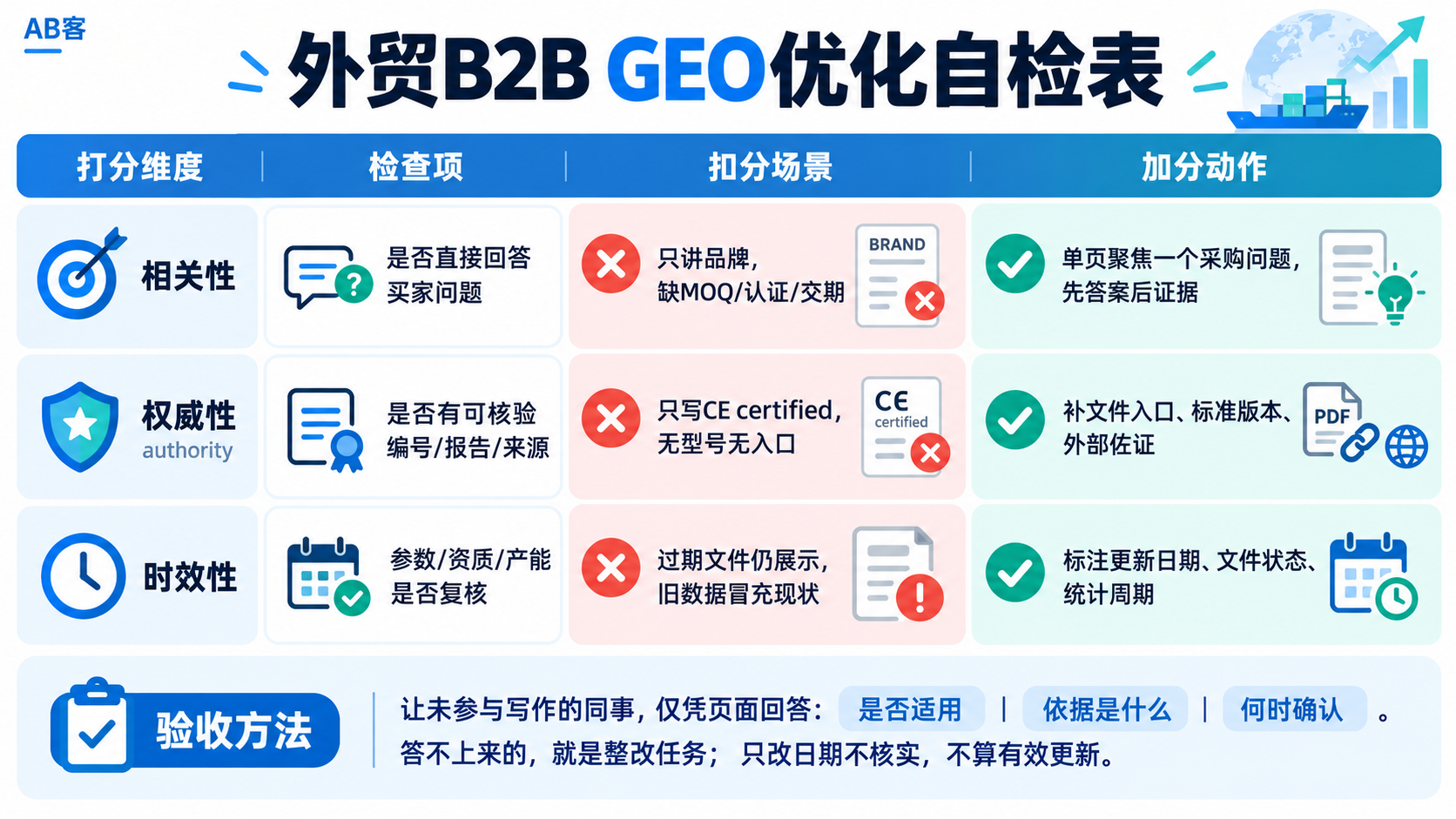
Self-Checklist for Three Deduction Dimensions
The "deductions" and "additions" below refer to risks and improvement actions identified during internal company reviews, and do not represent publicly disclosed weights on the platform. During the inspection, the page URL, problem description, source of evidence, and responsible person are all saved.
| Scoring Dimensions | Inspection items | Deduction scenarios | Bonus actions |
|---|---|---|---|
| Correlation | Does the page directly answer the buyer's question, and are there any applicable conditions for the answer? | The entire document is brand promotion, but lacks details regarding MOQ, certification scope, and delivery time. | The single-page layout focuses on the main procurement intent, providing the answer first, followed by parameters and evidence. |
| authority | Are there verifiable serial numbers, reports, issuing authorities, and third-party sources? | It only says "CE certified", without specifying the applicable model or document entry. | Supplementary applicable compliance documents, standard versions, reporting access points, and genuine external evidence. |
| Timeliness | Have the parameters, qualification status, production capacity, and access requirements been reviewed? | Expired documents continue to be displayed, historical production capacity is being misrepresented as current capacity, and outdated regulations are being cited. | Mark the actual update date, file status, and data statistics period. |
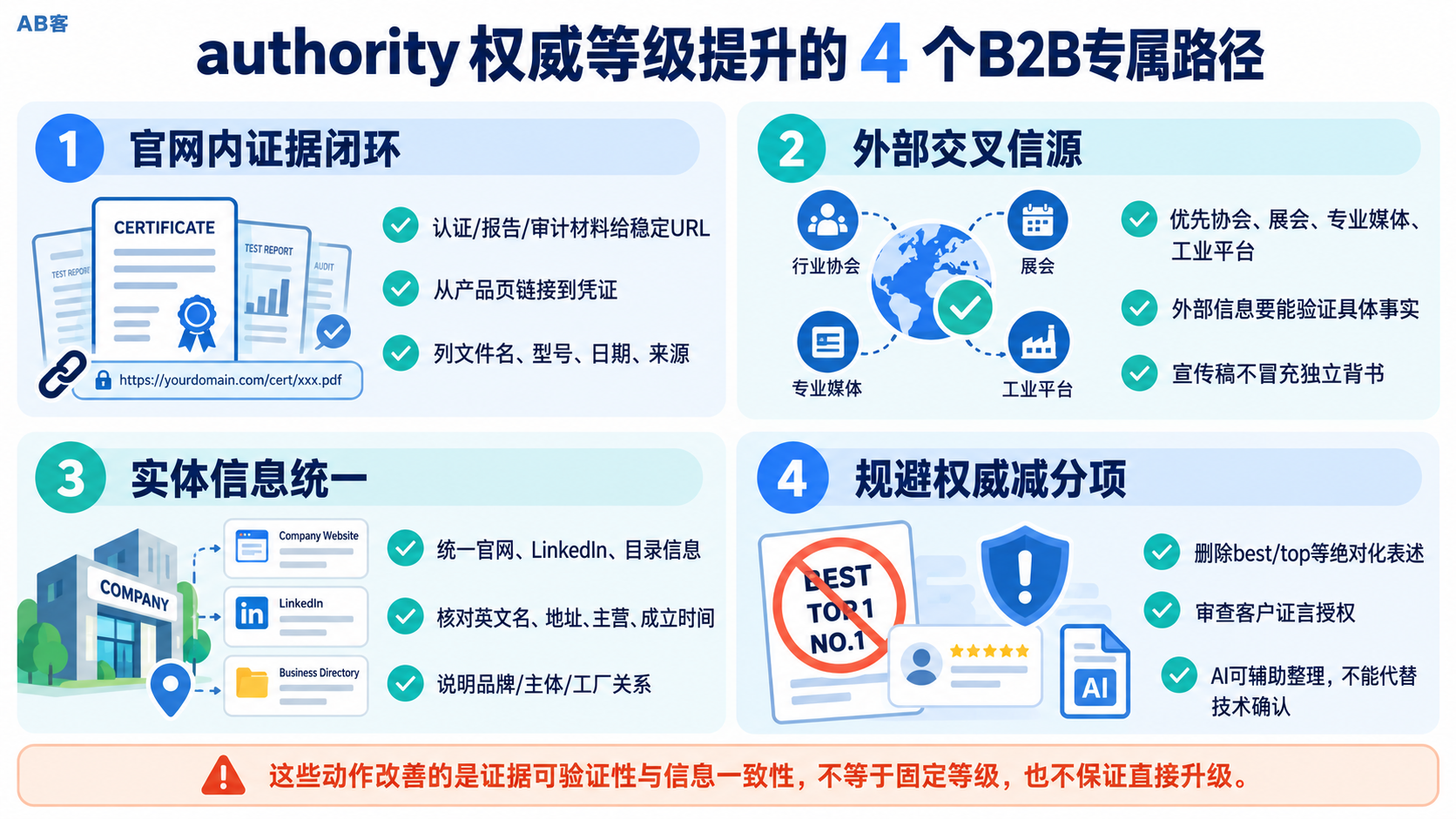
Four exclusive B2B paths to enhance authority level
-
Closed-loop evidence system within the official website:Provide stable URLs for certifications, test reports, factory audit materials, and anonymized case studies, linking to relevant credentials from the product page. List the document name, applicable model, issuance date, and source; for confidential materials, only an authorized summary is provided, with full documents obtained through compliance procedures.
-
External cross-sources:Prioritize improving the directory of industry associations, official exhibition pages, and information from professional media and industrial platforms. External information should be verifiable; promotional materials published or reprinted by companies for a fee should not falsely claim endorsement from independent organizations.
-
Unified entity information:Verify the company's English name, address, main business, and establishment date on its official website, LinkedIn profile, publicly available filings, and industry directories. If there are discrepancies in brand name, legal entity, factory, or subsidiary, explain the relationship to reduce confusion.
-
Avoiding authoritative demerits:Remove absolute statements such as "best" and "top" that lack supporting evidence, and review customer testimonial authorizations and the sources of AIGC content. AI can assist in organizing data, but it cannot replace technical personnel in verifying parameters, regulations, and delivery capabilities.
These pathways improve the verifiability of evidence and the consistency of corporate information; they do not imply that authority has a fixed level, nor do they guarantee direct escalation based on a certain action.
Frequently Asked Questions: 5 Typical Problems That Easily Lower Rerank Scores on Foreign Trade Websites
-
Question 1: When a page contains multiple products and themes, the AI cannot determine which purchasing question it should answer.During the repair process, product and application information is organized according to the selected task, and related issues are connected through internal links; a single page and a single theme does not mean breaking up the necessary context.
-
Question 2:FAQ The answer is vague, only guiding users to "contact us" without providing factual information.First, answer the confirmed scope and conditions, then guide the inquiry. For example, explain that the delivery time is affected by customization, order volume, and production scheduling, rather than fabricating a uniform number of days.
-
Question 3: The certificate only contains an image and no text number, so AI cannot extract and verify it.Image recognition capabilities vary from system to system and should be accompanied by readable file names, numbers, models, and source links; one cannot rely solely on image recognition.
-
Question 4: Inconsistent parameters for different language versions (conflicts in capacity and MOQ between English and Chinese websites).Establish a unified source of facts; when there are indeed market differences, specify the region, currency, unit, and terms of trade to avoid misjudging reasonable differences as errors.
-
Question 5: The page has not been updated for a long time, the certification has expired, and the product line has been phased out, but the page is still online.The discontinued product page should clearly state the status and alternative models, and provide reasonable redirection when necessary; historical case studies should retain the project dates and not be packaged as proof of current capabilities.
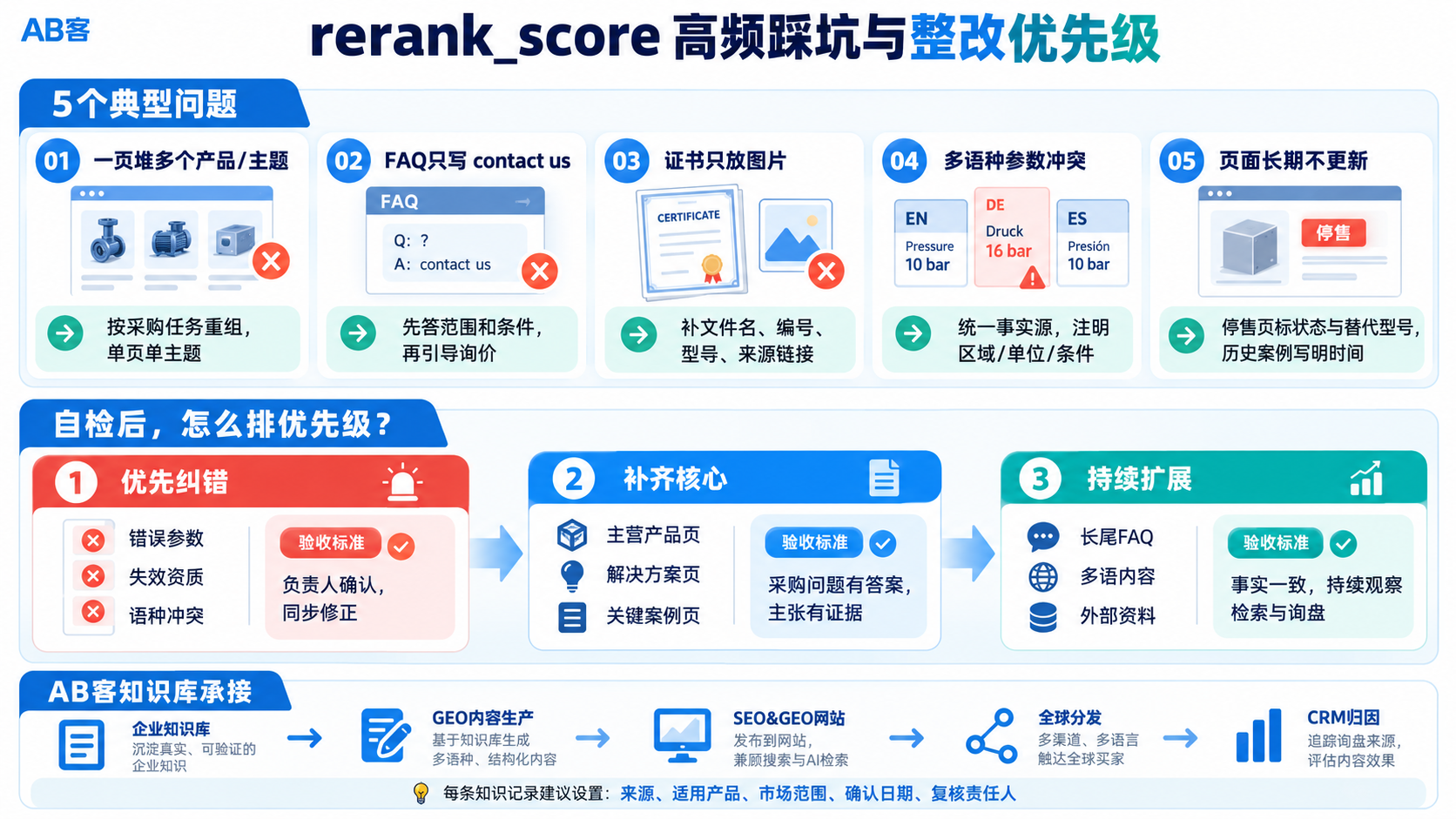
After self-inspection, how should priorities be assigned? How does the AB customer knowledge base handle evidence assets?
First, correct the errors that affected the procurement decision, then supplement the answers and evidence on the core pages, and finally expand the content coverage. AB customer( ABKEGEO growth engine Enterprise Knowledge BaseWith this as its core, it can undertake the creation of product information, trust materials, and content, ensuring that rectification has a unified factual basis, rather than being modified page by page based on memory.
| Priority | Processing objects | Acceptance criteria |
|---|---|---|
| Priority error correction | Incorrect parameters, invalid qualifications, language conflicts | The business manager confirmed that the relevant pages have been corrected accordingly. |
| Complete the core | Main product pageSolutionPage, Key Case Page | The procurement issues have been resolved, and the key claims have been supported by evidence. |
| Continuous expansion | Long Tail FAQMultilingual contentExternal materials | Consistent with the facts, continuous observation of search results and valid inquiries. |
It is recommended to specify the source, applicable products, market scope, confirmation date, and responsible reviewer for each knowledge record. AB Customer utilizes its enterprise knowledge system...GEO Content ProductionSEO & GEO website, global distribution andCRMThe responsible parties should coordinate and undertake rectification; the specific configuration and delivery scope should be confirmed in the project.
Archive sources and versions ② Professional review
Confirming facts and authority ③ Page update
Simultaneous multilingual caliber ④ Retesting reflux
Record citations and business opportunities
FAQ
- Q1: If I don't have an API key, can I test it manually?
Yes. In products that support online retrieval, enter a fixed question, save the answer and reference link, and verify its accuracy. Manual testing cannot obtain fields not publicly available from the interface, nor can it replace systematic monitoring. - Q2: Can the authority level be upgraded from 1 to 3 in a short period of time?
This official rating should not be assumed to exist. If the tool displays numbers, the definition, unit of measurement, and data source should be confirmed first. Fixing facts and links can be done immediately, but there is no guarantee when the platform will re-retrieve them or whether they will be cited again. - Q3: Which category—homepage, product page, or case study page—has the biggest impact on the score?
There is no universally accepted conclusion. For brand identity issues, refer to the homepage and company introduction; for selection issues, refer to the product page; for project experience issues, refer to the case study page. The judgment should be based on the matching relationship between the issue and the page. - Q4: Can AI recognize certificates in images and use them to enhance authority?
Some systems may be able to identify it, but identification is not the same as verification, much less a bonus. A readable text file, its applicable scope, and a publicly verifiable document entry point should be provided. - Q5: How often should I perform a DeepSeek dual-splitting self-check?
Core issues can be reviewed monthly, and evidence assets can be examined quarterly; timely checks should be conducted when new products are launched, regulations change, or qualification status changes occur. This is an operational suggestion, not a platform regulation.
Conclusion
foreign tradeIndependent website The value of GEO self-assessment lies not in chasing unverified scores, but in providing clear answers to buyer questions, verifiable evidence for business claims, and consistency in multilingual information. The evaluation should consider content delivery, AI visibility, and effective business opportunities simultaneously, avoiding attributing a single change in answer to a particular optimization action.


