Hot Products





Popular articles
How can AI assist sales at the Canton Fair? Transforming negotiation records into CRM follow-ups and GEO tasks.
7-Day Post-Exhibition GEO Content Conversion Guide: Turn Product Photos and Customer Questions into Buyer Decision-Making Assets
How can we improve the competitiveness of AI recommendation by benchmarking against GEO competitors 30 days after the Canton Fair?
第140届广交会新品如何做GEO内容?从现场演示到采购咨询的六项信息核对指南
Turn Canton Fair Price Questions into Qualified RFQs: 4 Buyer-Objection Templates
Recommended Reading



DeepSeek Opens Search API: AI Scoring Standards Become Transparent, Marking the End of the "Volume-Based Era" for Foreign Trade B2B GEOs.
Discussions surrounding the DeepSeek search API offer insights into the GEO strategy for B2B foreign trade companies. AB Guest analyzes how to replace blind page creation with enterprise knowledge bases, structured pages, and AI visibility monitoring, starting from procurement background checks, qualification verification, and content timeliness. The article also clarifies the boundaries between scoring metrics and actual citation effectiveness.
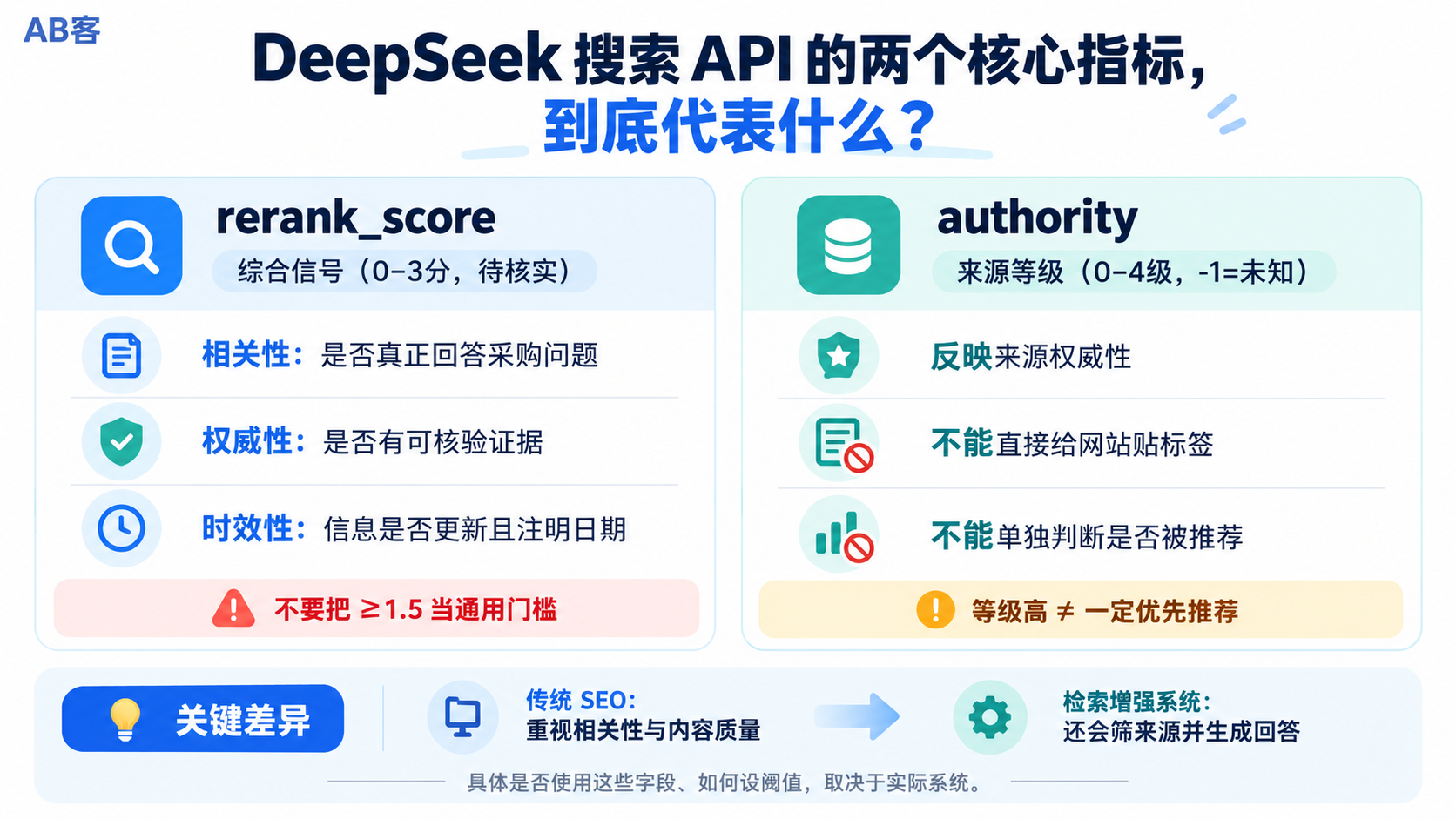
On October 17th, DeepSeek officially released its self-developed search API, with the API returning results accompanied by two quantifiable metrics:rerank_score (0–3 points, considering relevance, authority, and timeliness) and authority level (0–4 levels)This transforms the underlying evaluation criteria for AI-driven webpage selection from a black box into a readable and verifiable quantifiable benchmark. For the foreign trade B2B industry, this means a significant reduction in the space for GEO (Generated Object Optimization) strategies that previously relied on mass-generating AIGC pages, creating massive amounts of long-tail keywords, and stuffing keywords. Overseas project-based buyers, EPC companies, and chain brands using DeepSeek for supplier background checks can directly set score thresholds to filter low-quality sources. The focus of GEO optimization shifts from "page quantity" to "single-page factual credibility, cross-verification with authoritative sources, and information timeliness." Related reading:DeepSeek V4 Global Edition's inclusion and cross-validation mechanism | A GEO strategy specifically for technology-driven export factories
What do the two core metrics of the DeepSeek search API actually represent? (From a B2B foreign trade perspective)
To understand API metrics, you must first verify the official documentation version, field definitions, return examples, and applicable endpoints. The following explanations of business implications are based on the metric framework in the reference materials and should not be considered official DeepSeek rules.- rerank_score: The reference material refers to it as a 0–3 score, a composite triple signal, but the specific range and calculation meaning need to be verified.
-
Relevance: The page should address procurement needs, such as MOQ, certification scope, production capacity and delivery time, rather than simply repeating product keywords.
-
Authoritativeness: The certificate query portal, applicable models of the report, and source of cases are easier to verify than self-evaluations such as "leading quality"; whether it affects a specific score still requires document or test support.
-
Timeliness: Parameter versions, certificate validity periods, market access requirements, and production capacity information need to be updated, and the dates and applicable conditions should be noted.
-
Industry reference threshold: "≥1.5 points" cannot be used as a general reference threshold; even if a value is returned, it must be confirmed whether it supports comparisons across issues and across time periods.
-
- Authority level: Reference materials refer to levels 0–4, and -1 indicates unknown, which cannot yet be used to classify the website.
-
0–1: It cannot be directly identified as a regular self-media or a low-quality AIGC website, nor can it be inferred that the procurement system will necessarily discard it.
-
2: There is insufficient evidence to classify ordinary corporate websites and industry information sites into this category.
-
3–4: Certification bodies, associations and industry platforms can provide different types of verification evidence, but their level or priority cannot be determined solely by the type of organization.
-
- Key differences:Traditional SEO also emphasizes relevance and content quality; search enhancement systems may further filter sources and generate answers. Downstream RAG tools can be configured with filtering logic, but whether to use the above fields and how to set thresholds depends on the actual system and is not equivalent to DeepSeek uniformly setting the supplier candidate pool.
Why does this change have a far greater impact on B2B foreign trade than on the C-end?
It's insufficient to prove that B2B is impacted "more" than C-end based solely on interface discussions. However, the high value of industrial procurement, long verification chains, and complex technological boundaries do indeed necessitate more traceable information.
-
AI-assisted background checks are suitable for the B2B procurement process.AI can be used to organize candidate suppliers and issues to be verified for EPC projects, equipment procurement, and factory expansion. However, qualification review, technical verification, and contract judgment still need to be completed by professionals. It cannot be assumed that buyers have commonly used a certain interface in bulk.
-
B2B decision-making relies on verifiable facts:ISO certificates should specify the scope of certification; for CE compliance, a distinction should be made between declarations of conformity, test reports, and applicable assessment procedures; HS codes cannot replace product certification. Monthly production capacity should specify the product, shift, and other conditions, avoiding the misrepresentation of theoretical capacity as committed delivery volume.
-
Acceptance testing should exceed the number of pages:Content output is an performance metric and does not prove citation or customer acquisition effectiveness. It is recommended to check factual completeness, accessibility, search engine indexing, AI response accuracy, and valid inquiries simultaneously, rather than substituting two unverified scores for acceptance.
- Clarifying Misconceptions:Low-quality content may reduce search and citation opportunities, but the rule that "low-scoring pages will directly lose their shortlist eligibility" is not a proven rule. Page performance does not equate to a company's actual capabilities.
Three types of foreign trade GEO players will face drastically different outcomes.
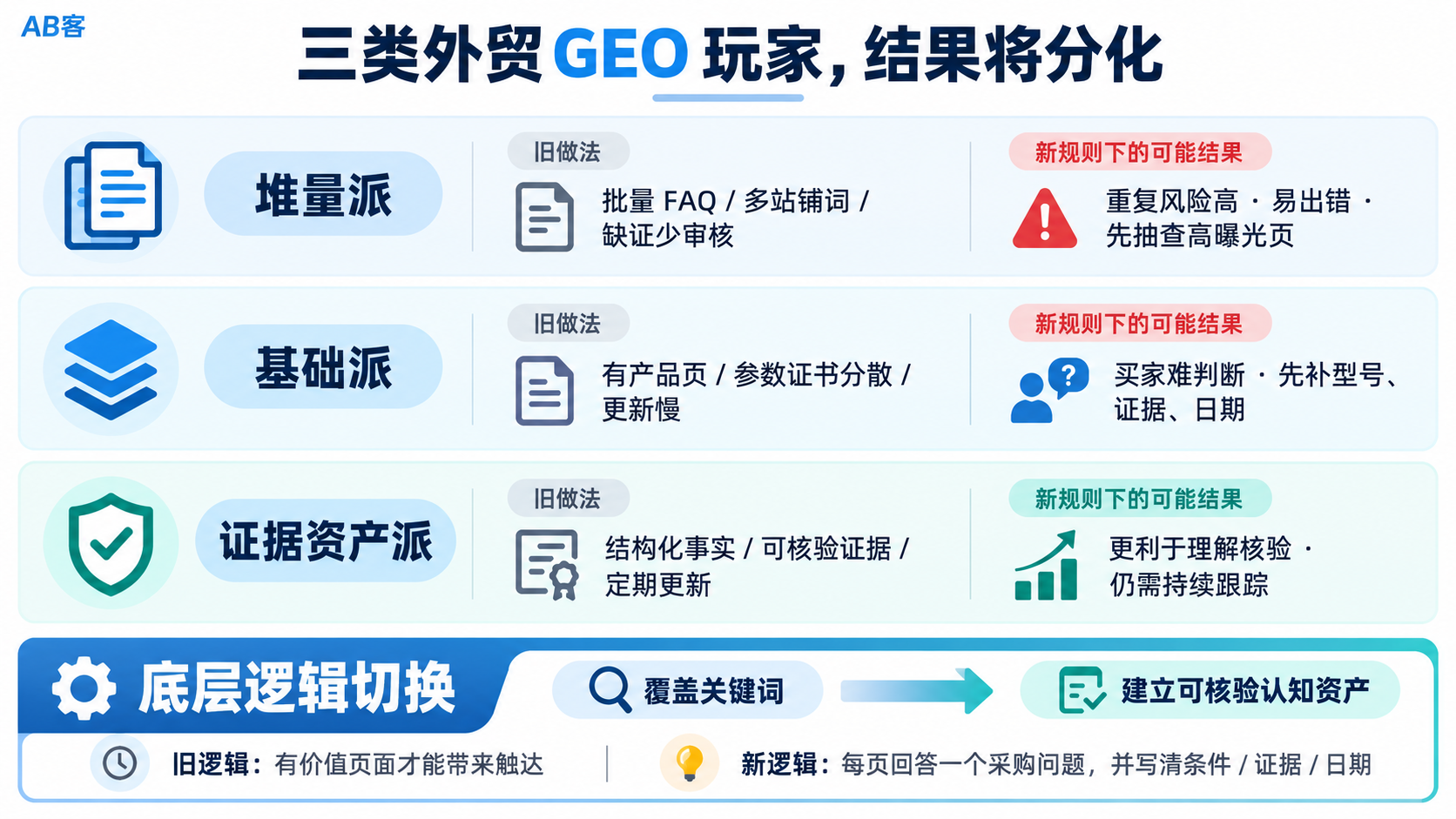
The following is a comparison of strategy risks, not a prediction based on official rating data. Companies should prioritize content based on its asset status, not on the generation tools used.
| Player types | Past tactics | The Outcome Under DeepSeek's New Rules |
|---|---|---|
| Heap Quantity | Batch generation of homogenized FAQMultiple sites were used for keyword stuffing, but there was a lack of documentation and verification. | There are risks of duplication, factual errors, and maintenance costs; it cannot be concluded that their scores are generally below 1.5. Prioritize random checks of high-exposure pages, supplement evidence, and address duplicate content. |
| Basic | The product page already exists, but the parameters, certificates, and application conditions are scattered and not updated in a timely manner. | Buyers often struggle to assess a buyer's capabilities. Prioritize ensuring accurate model identification, supporting documentation, and accurate dates, rather than focusing on a presumed "medium to high score." |
| Evidence-based asset school | Structured facts, verifiable credentials, cross-verification from multiple sources, and regular updates. | It is more conducive to information understanding, verification and sales reuse, but does not guarantee citation, ranking or orders; real performance needs to be continuously tracked. |
Under the new standards, the underlying logic of B2B foreign trade GEO has shifted: from "covering keywords" to "establishing scoreable cognitive assets".
-
Old logic:Keyword and page coverage can increase reach, but only if the page has independent value. Quantity cannot compensate for a lack of factual information.
-
New logic:"Scorable" should be understood as verifiable, traceable, and maintainable, not as conforming to unverified formulas. Each page should clearly answer one procurement question and provide applicable conditions, sources of evidence, and update times; third-party information should be used for verification, not for creating authority through mutual reposting.
Can it be used for the target operating conditions? What are the delivery time and compliance requirements?
Corresponding model parameters, applicable reports, delivery conditions and verification sources.
This section clarifies the applicable boundaries and matters requiring confirmation, and supports inquiries and technical communication.
How should foreign trade companies implement this new standard? AB Customer's GEO growth engine adaptation strategy.
AB customer(ABKE) is a brand under Shanghai Muker Network Technology Co., Ltd.AB Customer GEOThe growth engine targets foreign trade B2B enterprises, withEnterprise Knowledge BaseWith this as the core, we connect customer issues,Content productionSEO & GEO website, global channel distributionCRM This is related to data attribution. Its focus is on improving the fundamental conditions for content to be understandable, verifiable, and convertible, rather than on confirmed DeepSeek-specific rating adaptations or official partnerships.
Implementation can begin with a core product: the technical lead confirms parameters, the business team provides buyer questions, the data manager checks certificate authorization and validity, and then the verified facts are used on multilingual pages. An intelligent agent assists in organizing and generating the data, while professionals retain responsibility for fact-checking.
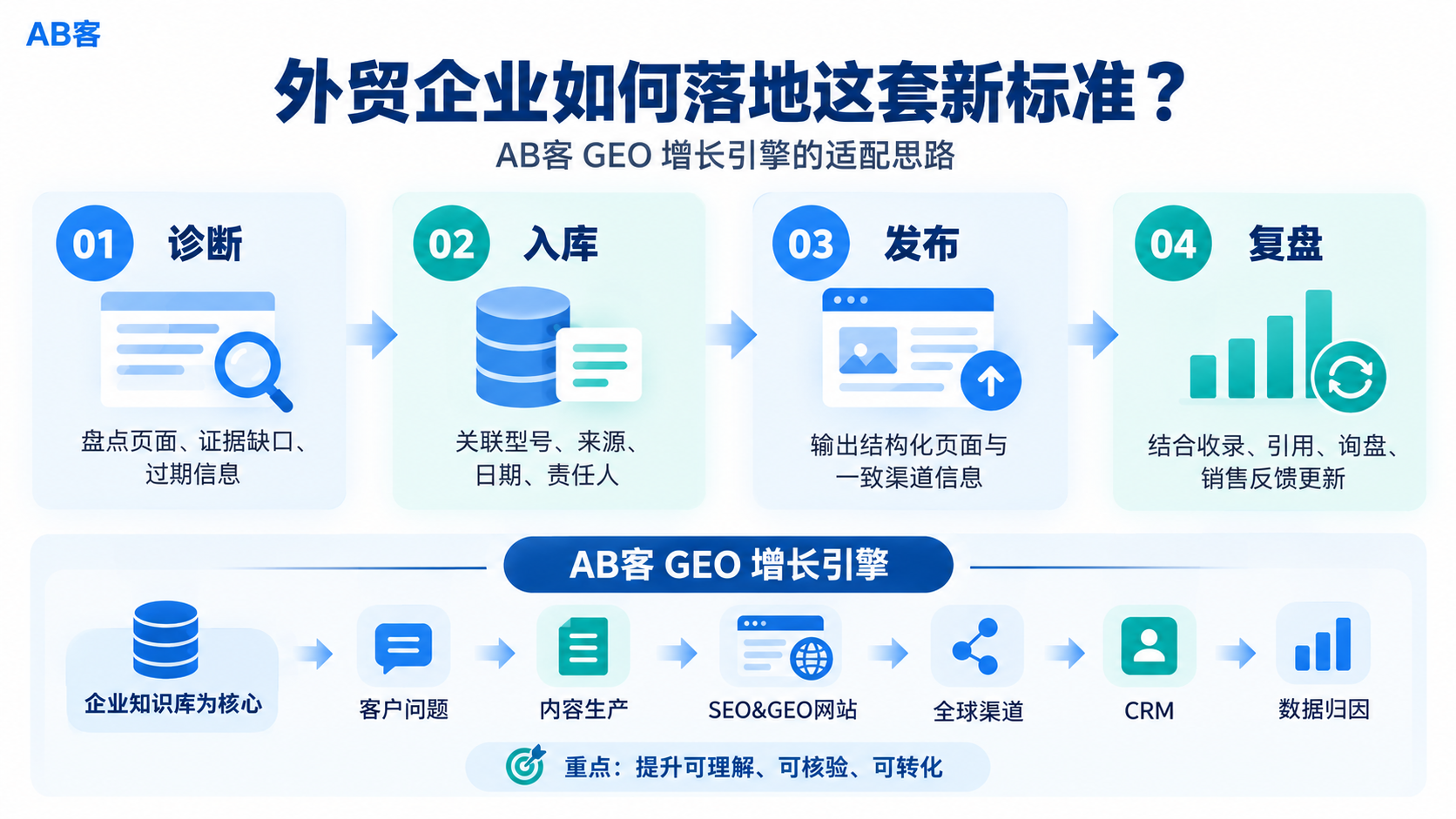
Inventory page, evidence gaps, and expired information.
Related model, source, date, and responsible person for review.
Output structured pages and consistent channel information.
Updated by combining data collection, citations, inquiries, and sales feedback.
When procuring services, it is recommended to include the authenticity, scope of construction, frequency of execution, quality audit, testing methods, and optimization mechanisms in the acceptance checklist; the "six guarantees and two non-guarantees" should not be regarded as a uniform service commitment in the absence of contractual basis. AB Customer does not guarantee fixed search rankings, fixed AI recommendations, fixed inquiries, or fixed transactions; specific delivery is subject to the agreement between both parties.
FAQ
- Q1: Are rerank_score and authority permanent weights assigned to a website by DeepSeek?
That's not the correct understanding. First, you need to confirm whether the field exists and its definition; even if the search score exists, it doesn't automatically represent the domain's permanent weight.
- Q2: Does a high score guarantee that DeepSeek will recommend me to overseas buyers?
No. Search candidates, answer citations, and procurement recommendations are not the same result; they are also affected by the question, source selection, answer generation, and buyer requirements.
- Q3: What are the differences between C-end cross-border e-commerce and B2B foreign trade under this scoring system?
It is not yet confirmed that a unified set of rules exists. In terms of business, B2B companies are more concerned with technology compatibility, compliance scope, and delivery conditions; while C-end customers are usually more concerned with price, experience, and fulfillment, depending on the product category.
- Q4: We've already created a lot of AIGC content, should we delete it all now?
It is not recommended to apply a one-size-fits-all approach based on the generation method. First, check the accuracy, degree of duplication, and procurement value, and then retain, supplement, update, merge, or remove them from the network respectively.
- Q5: How can I obtain two scores for my page in the DeepSeek Search API at a low cost?
First, check the official documentation for permissions, billing, and response fields; if these are not provided, they cannot be reliably obtained. If the fields are indeed provided, conduct small-scale tests on fixed procurement issues, recording the time, parameters, and original response. Do not attempt to simulate the "official score" yourself.
Conclusion
The long-term value of a foreign trade GEO lies not in betting on a particular score, but in building continuously updated, verifiable, and reusable corporate knowledge assets. Content scale should be built upon factual quality, and AI visibility should be evaluated separately from inquiry quality.
Ready to start optimization?Can be directed to AB Customer Consulting GEO Current Status DiagnosisFirst, provide parameters, certification materials, existing pages, and frequently purchased issues for a core product to clarify evidence gaps, construction priorities, and acceptance criteria before deciding on the scope of expansion.


