Investors
Pay attention to the scope of construction, implementation conditions, and cooperation boundaries.
Hot Products





Popular articles
DeepSeek Opens Search API: AI Scoring Standards Become Transparent, Marking the End of the "Volume-Based Era" for Foreign Trade B2B GEOs.
2026.10.21
Reading:
0
How can AI assist sales at the Canton Fair? Transforming negotiation records into CRM follow-ups and GEO tasks.
2026.10.19
Reading:
0
第 140 届广交会正在发生什么变化?外贸 B2B 必须注意的 6 件事
2026.10.13
Reading:
0
ChatGPT Ads, AI Organic Citations, and Model Recommendations: Understanding the Differences and Choosing the Right Customer Acquisition Metrics for B2B Foreign Trade
2026.10.22
Reading:
0
Turn Canton Fair Price Questions into Qualified RFQs: 4 Buyer-Objection Templates
2026.10.18
Reading:
0
Recommended Reading
Reading:
0
Reading:
0
Reading:
0
How can edible oil EPC engineering companies conduct GEO (Generative Engineering Operation)? A six-month case study of AB (Alibaba and Tencent) clients, breaking down key performance indicators and implementation paths.
Release time:
2026/10/23
Type:
Client Cases
AB Customer breaks down how edible oil EPC engineering companies can upgrade their equipment catalogs to a comprehensive content system encompassing "oilseeds—processes—solutions—projects," connecting SEO/GEO visibility with project consulting. Case study images showcase six months of indexing, Top 10 keywords, AI recommendations, and changes in valid inquiries; raw data and attribution are still under verification and do not constitute a guarantee of proven performance or results.
A case study of GEO growth for an edible oil engineering company: From equipment catalog to EPC complete line engineering solutions, a comparison of four growth indicators before and after six months.
We organize our experience in equipment manufacturing, process design, and engineering projects into a professional content system for global food industry procurement, focusing on oil processing, pressing, leaching, refining, and EPC line delivery.
Case Summary
This case study analyzes a Chinese edible oil processing engineering company serving the global market, whose business encompasses oilseed pretreatment, pressing, solvent extraction, refining equipment, and EPC engineering services. The projects they procure are often not for individual pieces of equipment, but rather for upgrading processes, constructing production lines, or building entire plants.
Purchasers need to evaluate suppliers based on raw material requirements, production capacity, finished product requirements, site conditions, and budget. Therefore, the official website should be upgraded from an equipment catalog to an "Engineering Solution and Project Basis" section, explaining process compatibility, configuration logic, and delivery boundaries.
The images cited in the original case study revealed the following: number of indexed pages increased from 186 to 980; Google Top 10 keywords increased from 8 to 42; AI-recommended related metrics increased from 3% to 18%; and average monthly valid inquiries increased from 2 to 12. The figures on this page are retained for methodological analysis; however, the original images, statistical ledgers, and customer authorizations that can be independently verified are not provided, and therefore, they are not considered as verified performance results.
I. Client Background: From Equipment Manufacturing to Complete Grease Engineering Services
| Case Fields | content |
|---|---|
| Case Number | ABKE-CASE-EPC-04 |
| Customer Name | An edible oil processing EPC engineering company (desensitized) |
| Industry | Grain and oil processing machinery, food engineering, EPC general contracting |
| Core Products | Oilseed pretreatment, pressing, leaching and refining equipment |
| Solution | Oil processing section solutions, complete line engineering, EPC project services |
| main application | Processing of soybeans, sunflower seeds, peanuts, rapeseed and other oilseeds |
| Target customers | Overseas oil processing plants, project investors, and engineering procurement companies |
| Procurement characteristics | Long cycle, complex technical requirements, and multi-role decision-making |
| Analysis cycle | The original case stated that the image was labeled as 6 months, with the start and end dates pending verification. |
| Service direction | GEO intelligent website, engineering knowledge modeling, solution content, procurement consulting services |
| Core Objectives | From the discovery of equipment products, it has evolved into verifiable process and EPC engineering capabilities. |
The original case described its website as covering fuel solutions, process sections, and overseas projects; specific pages still need to be verified item by item. The key to judging an engineering supplier is whether they can organize equipment, supporting systems, and implementation support into a solution suitable for the client's conditions, rather than whether the variety of equipment is complete.
II. Core issues before construction: There is a lot of equipment information, but the project's capabilities are difficult to assess.
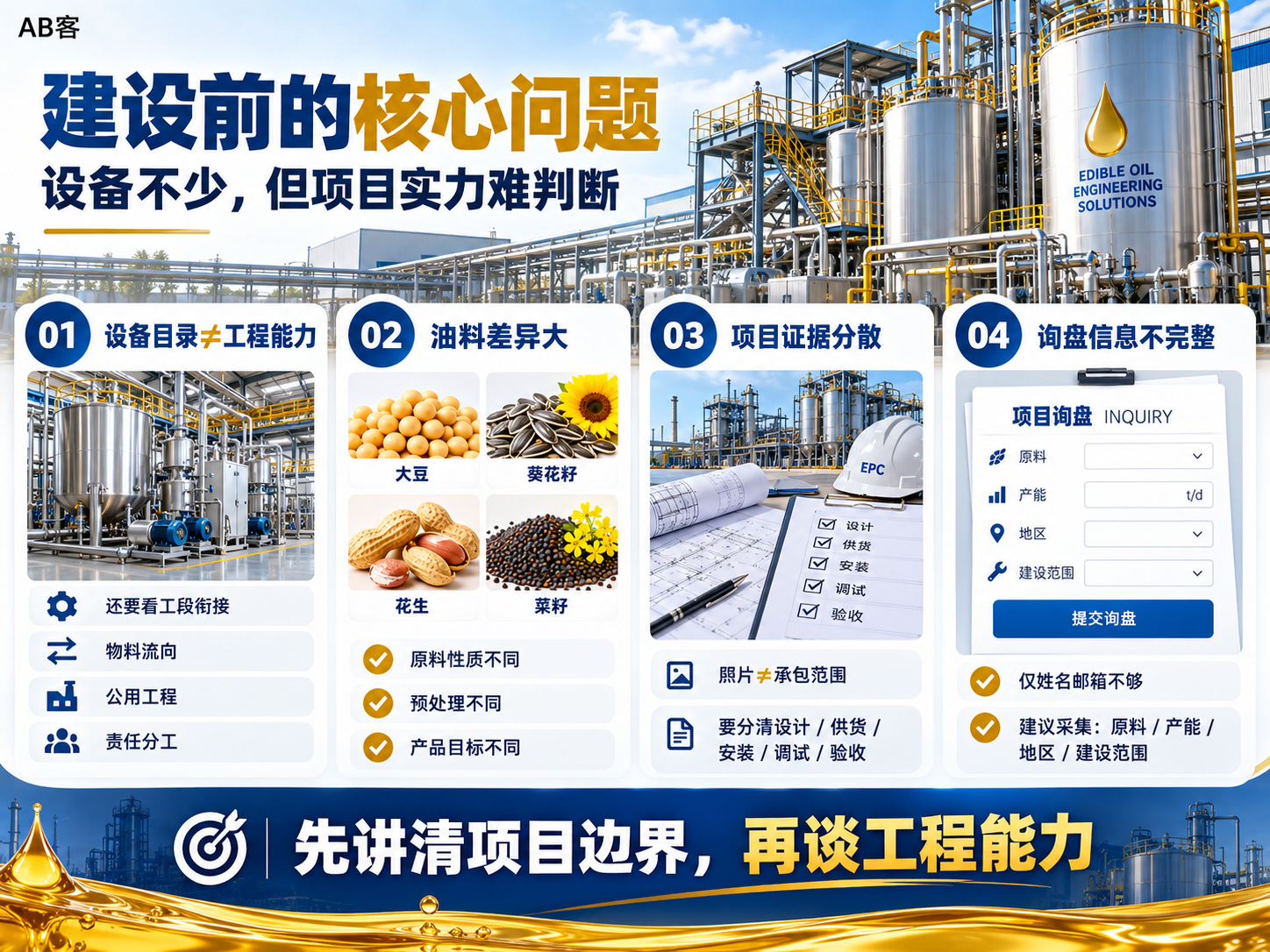
The original case summarized the early problems as follows:"They provided a lot of equipment, but it's hard to judge the project's capabilities."This contradiction manifests itself in the following ways in the procurement of complex food engineering equipment.
1. The equipment catalog does not adequately explain the engineering capabilities.
Equipment parameters cannot automatically prove overall production line design capabilities. Purchasers also need to understand the connection between work sections, material flow, utility requirements, and division of responsibilities; single-machine sales experience should not be directly described as a complete EPC resume.
2. Different oilseeds require different process judgments.
Different oils have different properties, pretreatment requirements, and product objectives. The solution should specify the applicable prerequisites, raw material conditions, and technical confirmations, and avoid copying the same general introduction to all oil pages.
3. The evidence for the engineering projects is scattered, making it difficult to support supplier evaluations.
Factory photos only provide partial on-site information and cannot solely prove the scope of the contract. The project page should distinguish the responsibilities for design, supply, installation guidance, commissioning, and acceptance, and link them to publicly available project documents or instructions.
4. Incomplete inquiry information increases initial communication costs.
Collecting only names and email addresses is insufficient for initial project screening. The consultation portal should collect information such as raw materials, target production capacity, location, and construction scope, and allow clients to indicate "pending confirmation" to avoid forcing submissions using technical fields.
III. GEO Development Direction: Reconstructing the Knowledge Network of "Fuel - Process - Solution - Project"
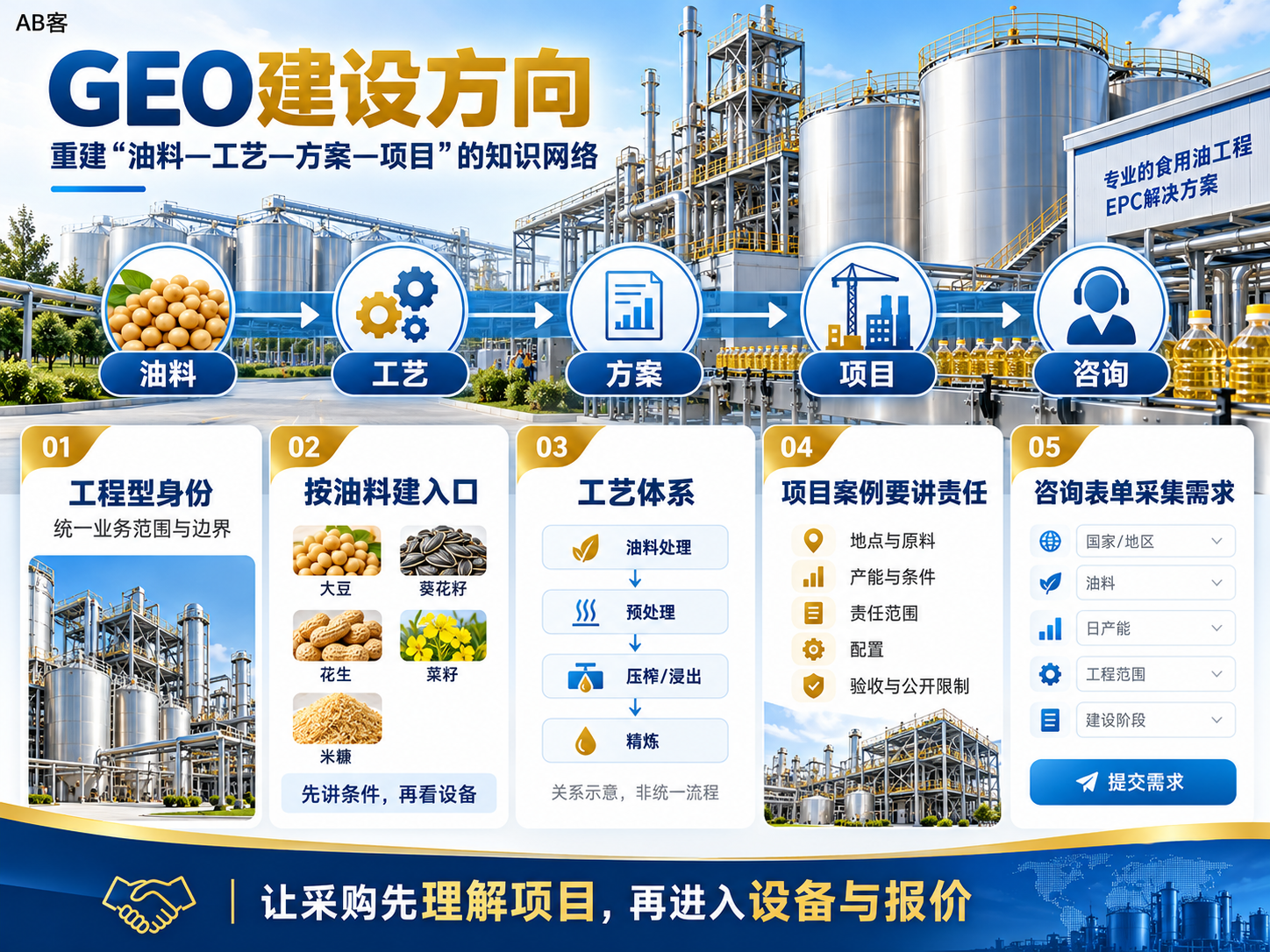
GEO, or Generative Engine Optimization, emphasizes organizing real-world engineering knowledge into searchable, understandable, and verifiable content in this scenario, rather than guaranteeing AI recommendations. The following is a construction methodology extracted from the original case study structure and does not represent a verified deliverable list.
1. Clearly define the company's engineering role.
Standardize the scope of business in the company introduction, service page, and project page. Clearly define which tasks can be completed independently, which rely on partners, and which require separate agreements, so that the positioning of "engineering service provider" is supported by capability and documentation.
2. Develop application solutions based on oilseeds
Procurement entry points should be organized by category, such as soybeans, sunflower seeds, peanuts, rapeseed, and rice bran, and linked to raw material requirements, process selection, and engineering configuration. For example, the sunflower seed project page should first explain the project requirements and then guide customers to view applicable equipment, rather than simply piling up product links.
3. Organize the process sections into a understandable technical system.
Oil processing
Clearly define raw material conditions
Pretreatment
Match subsequent requirements
pressing or leaching routes
Based on project selection
Refining and subsequent processes
Corresponding finished product target
The above is a schematic diagram and not a standardized process flow. The actual sequence, combination, and parameters must be determined by the engineering plan; the page should explain the definition of each process section, applicable conditions, and upstream and downstream relationships.
4. Use engineering case studies to explain project experience
Project documentation should shift from "showing what has been done" to "explaining what responsibilities were undertaken," and it is recommended to record each item systematically:
- Project location and raw material type;
- Design processing capacity, statistical units, and operating conditions;
- Process composition and scope of engineering responsibility;
- Equipment and control system configuration;
- Delivery phase, acceptance criteria, and public disclosure restrictions.
Confidential information can be anonymized with authorization, but missing information cannot be supplemented using parameters from other projects.
5. Transform engineering consultation forms into a requirements gathering portal.
The original case stated that the consultation portal included country or region, fuel type, daily production capacity, and contact information. It is recommended to further clarify whether the production capacity refers to raw material processing volume or finished product output, and to add options such as project scope and construction phase; in conjunction with privacy disclosure, to effectively communicate requirements to sales and technical personnel.
IV. Complete Comparison of Four Core Growth Data Points Over Six Months
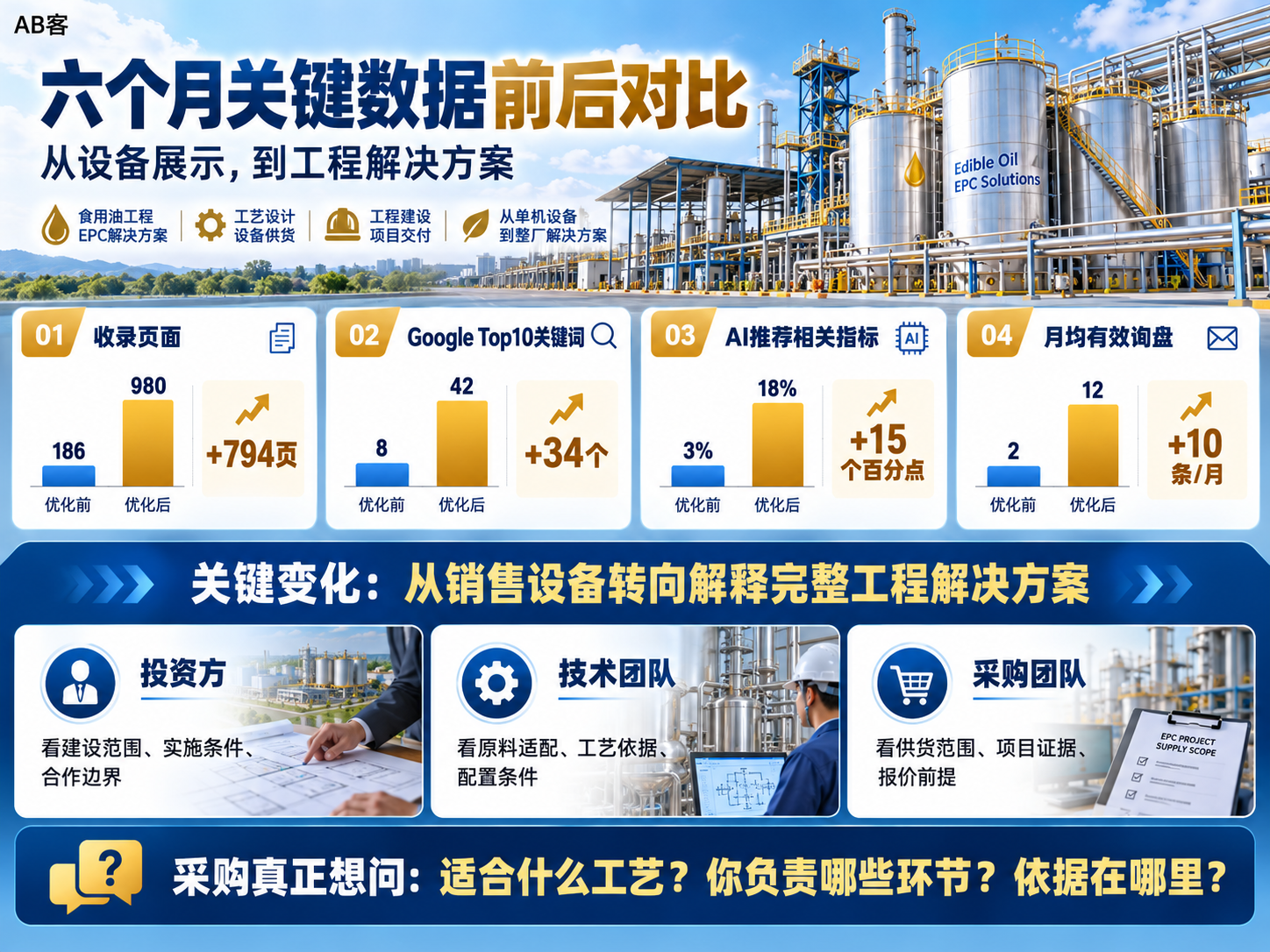
The following are image values paraphrased from the original case. The statistical date, platform, and original records are yet to be confirmed. The numerical changes are only for arithmetic comparison and do not constitute an attribution of service effectiveness.
| Key Indicators | Before construction | 6th month | Numerical changes |
|---|---|---|---|
| Included Pages | 186 | 980 | +794 pages |
| Google Top 10 Keywords | 8 | 42 | +34 |
| AI recommendation related metrics | 3% | 18% | +15 percentage points |
| Average monthly valid inquiries | 2 | 12 | +10 items/month |
1. Pages included: 186 → 980
An increase of 794 pages was recorded, bringing the total number of pages at the end of the period to approximately 5.27 times that at the beginning. Verification should unify the site and statistical tools used, checking for duplicate pages, multilingual pages, and the performance of pages highlighting key solutions. Increased inclusion does not necessarily equate to effective coverage of procurement needs.
2. Google Top 10 Keywords: 8 → 42
The number increased by 34, reaching 5.25 times the initial number at the end of the period. It is necessary to fix the countries, languages, devices, and thesaurus to avoid bias caused by different statistical ranges. Examples of related search topics include:
- Construction of an edible oil processing plant;
- Oilseed pretreatment solutions;
- Solvent leaching production line;
- Edible oil refining equipment;
- Turnkey grease processing project.
These are not verified ranking keywords. Whether an engineering project brings high-quality visits also needs to be considered in conjunction with landing pages and inquiry records.
3. AI recommendation-related metrics: 3% → 18%
An increase of 15 percentage points, resulting in a six-fold increase from the beginning of the period to the end. It should be clearly defined whether the metric refers to mention rate, citation rate, or recommendation rate, and the platform, question set, test date, and number of repetitions should be fixed. The appearance of a company name does not equate to a correct understanding of engineering capabilities, nor can it be interpreted as the probability that global buyers will see the company.
4. Average monthly valid inquiries: 2 → 12
Increase by 10 inquiries per month, resulting in a six-fold increase at the end of the period compared to the beginning. A unified definition, average range, and deduplication rules for valid inquiries are required to eliminate spam and duplicate requests. Emphasis should be placed on verifying raw materials, production capacity, location, and project scope; valid inquiries do not equate to contracts or revenue.
V. Key Changes in the Case Study: Shifting from Selling Equipment to Explaining Complete Engineering Solutions
The key change is not to reduce equipment descriptions, but to integrate equipment into the complete procurement context: why this process was chosen, how to match raw materials, which aspects the supplier is responsible for, and what verifiable evidence exists.
Technical Team
Pay attention to raw material compatibility, process basis, and configuration conditions.
Procurement Team
Pay attention to the scope of supply, project evidence, and the premise of the quotation.
This expression supports preliminary research before contact, but whether it can shorten the procurement cycle and increase the success rate still needs to be verified with project operation data.
six,AB Customer GEOThe Value of Growth Engines in Engineering Companies
AB customerABKE is a brand under Shanghai Muker Network Technology Co., Ltd. ABKE's GEO growth engine...Enterprise Knowledge BaseWith the core, connectingContent productionSEO and GEO websites, channel distributionCRMAnd data attribution, suitable for foreign trade B2B enterprises that need to systematically express complex technical capabilities.
The implementation sequence for engineering scenarios is as follows: first, verify the technical capabilities and evidence boundaries; then, establish the relationships between fuel, equipment, work sections, solutions, and projects; subsequently, build pages around buyer issues; and finally, record visibility, visits, and project leads respectively.
VII. Replicable Experiences for Grain and Oil Machinery and EPC Engineering Enterprises
First, review the process flow diagrams, design parameters, equipment specifications, project documents, engineering photos, and customer questions, then plan the content. Prioritize building pages that are supported by verifiable data and that influence procurement decisions.
raw material
Craftsmanship
Capacity
Solution
Engineering evidence
Project Consulting
Connect the content according to the above relationships, and have it reviewed by technical personnel. Production capacity, energy consumption, oil yield, and delivery data must specify the conditions and sources; multilingual versions should also maintain consistency in parameters, units, and service boundaries, and should not combine deliverables from different projects.
Related case studies:
Foreign Trade B2B GEO Case Study | AB Customer Intelligent Growth Solution
VIII. Frequently Asked QuestionsFAQ
Q1: Why do edible oil processing EPC companies need GEO instead of just traditional SEO?
SEO focuses on search discovery, while GEO further focuses on whether enterprise knowledge can be accurately understood and referenced by AI. Both rely on reliable content and accessible websites; GEO cannot replace technical SEO, nor can it guarantee recommended results.
Q2: Why are engineering project case studies more important than ordinary equipment introductions?
The equipment introduction outlines the product range, while the authorized project information further explains the process, production capacity, and actual work undertaken. The two complement each other; however, case studies cannot replace the technical justification and contractual agreements for this project.
Q3: After the increase in inclusion and AI recommendation, how do you determine whether you have obtained a real engineering procurement opportunity?
Check whether the requirements are clear, whether a technical assessment has been initiated, and whether a quote, negotiation, and contract have been finalized. Use CRM to identify the source and follow up on the process; unidentified sources are left as unknown and not forcibly attributed.
IX. Case Implications and Evidence
The online competitiveness of edible oil EPC engineering companies stems from a clear correlation between their engineering capabilities and their clients' raw materials, processes, production capacity, and construction needs. While graphical indicators can provide analytical clues, they can only be cited as official client deliverables after verification of the original records.


Disclaimer: This content was created by AI and reviewed by humans. The above content represents only the creator's personal views.
AB Customer GEO Growth Engine
Edible Oil EPC Project GEO Case
Overseas Marketing of Grain and Oil Machinery
SEO and GEO for Engineering Enterprises
Customer acquisition for edible oil processing projects
Foreign Trade B2B GEO
Foreign Trade B2B GEO Case
Foreign Trade GEO Case
AB Customer GEO Case
AB Customer Case
