Hot Products





Popular articles
How should electronic component exporters choose a GEO service provider? Use a product specification sheet to assess delivery capabilities.
How can export-oriented manufacturing companies publish original industry data that is worth citing? From test logs to technical white papers.
感恩节客户放假,询盘如何不断档?外贸官网的假期承接清单
Recommended Reading



Machinery and equipment exports to the EU in 2027: What delivery changes will the new machinery regulations bring?
AB Customer analyzes the applicable timeframes of EU Machinery Regulation EU 2023/1230, as well as the impact of equipment classification, risk assessment, technical documentation, acceptance, and after-sales service on the delivery of exported machinery and equipment.
Competition in exporting machinery and equipment to the EU depends not only on the equipment's ability to complete processing tasks, but also on the supplier's ability to explain the applicable operating conditions, risk control strategies, and customer acceptance and subsequent maintenance. For projects oriented towards 2027, market demand assessment, product regulatory classification, technical documentation, and delivery services should be considered within the same procurement chain.
The main provisions of the EU Machinery Regulation (EU) 2023/1230 shall apply from 20 January 2027.Whether new regulations apply cannot be determined solely by contract dates or equipment manufacturing dates; it must also be assessed in conjunction with product category, market launch date, and actual configuration. Regulatory applicability and customer commercial acceptance are related but not interchangeable. Related reading:Authoritative Outlook: Which Industries Will Drive Global Trade Growth in 2027?
Why isn't the recovery of the machinery industry evenly distributed across all equipment?
New production capacity, equipment upgrades and production line transformation
Equipment procurement is typically driven by different investment objectives. New capacity expansion focuses on future orders and production line scale; equipment upgrades emphasize replacing outdated equipment and reducing maintenance risks; and production line upgrades prioritize compatibility with existing equipment, downtime windows, and overall performance after the upgrade. Even if the industry as a whole recovers, the budget release speed for these three types of projects may differ.
| Purchasing Motivation | Key Decisions | Acceptance and inspection focus |
|---|---|---|
| New production capacity | Market demand, investment budget, production line planning | Production capacity and continuous operation performance under specified operating conditions |
| Device Updates | Replacement costs, maintenance burden, and downtime arrangements | Installation compatibility, performance, and ease of maintenance |
| Production line transformation | Interface compatibility, security boundaries, construction window | Online testing, modified areas and overall line performance |
Suppliers should confirm the project's category before submitting a quote and understand the decision-making processes of the purchaser's technical, production, and management personnel. Modification projects, in particular, require prior definition of the original equipment status, interface responsibilities, and on-site downtime conditions.
Production growth and import opportunities
Increased local machinery production may reflect changes in orders for domestic manufacturers, or it may be influenced by exports and inventory. Increased investment by end-user factories does not necessarily mean they will choose to import equipment. When assessing export opportunities for Chinese equipment, one should consider the target industry's investment plans, import procurement needs, existing supplier structure, and customer requirements for service responsiveness.
These four stages are related, but they are not directly equivalent. For example, if a customer has a budget for automation upgrades, they may prioritize suppliers that are compatible with their existing systems and can provide local services.
Customer investment returns
Equipment value should be calculated based on the customer's actual operating conditions, not just comparing quotes. Cycle time, yield, energy consumption, labor input, maintenance, and downtime costs should be included in the assessment, specifying the calculation period, product specifications, operating shifts, and benchmark equipment. Unverified benefits should be listed as assumptions to avoid presenting ideal parameters as guaranteed results at the customer's site.
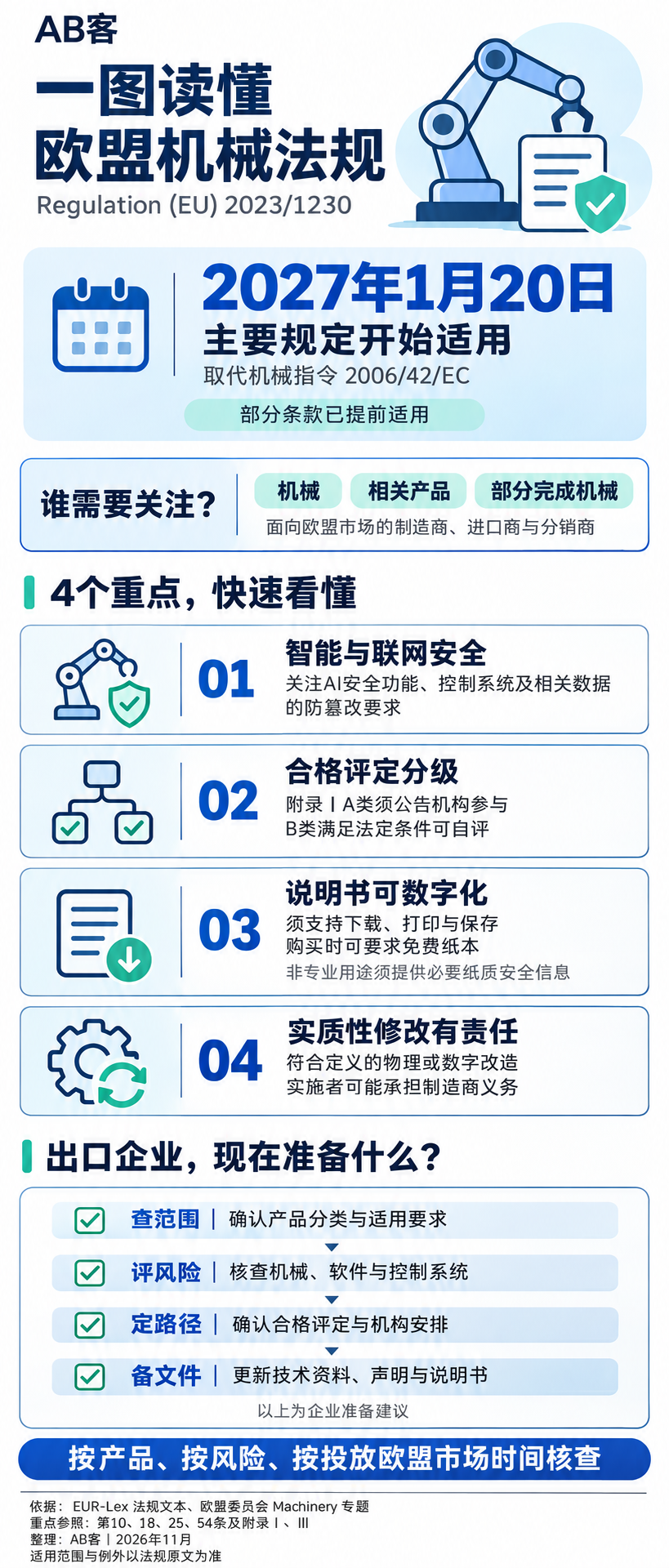
What applicable conditions need to be confirmed before launching in the EU market in 2027?
Product Categories
First, determine whether the delivered item is a complete machine, a product covered by the regulations, a partially completed machine, or a common component not independently covered by the regulations. Classification should be based on the product's actual structure, purpose, and delivery status, not just the invoice name or internal company designation. For relevant products, the regulations' definitions of specific categories should also be verified.
Partially completed machinery typically cannot perform a specific application independently and requires assembly with other machinery or components; its documentation and declaration requirements differ from those of complete machinery. Ordinary components should not be automatically excluded simply because their names are simple: if they meet relevant definitions such as safety components, further verification is still necessary. When classification is unclear, a professional familiar with EU machinery compliance should make a determination based on technical documentation.
Market launch time
Contract signing, production, shipment, and market placement are not the same concept. Market placement generally refers to the first availability of a product in the EU market, whether paid or unpaid; this should be determined by considering the actual supply arrangements and regulatory definitions, rather than solely by a date on the contract or customs documents.
For products already on the market before the applicable date, the transitional provisions of the machinery regulations and the original applicable rules should be verified; it cannot be simply assumed that all equipment in use needs to be recertified due to the new regulations taking effect. Whether the equipment has undergone significant modifications or has been re-entered into the market as a new product may also affect the judgment. Relevant contracts, serial numbers, delivery records, and conformity documents should be properly preserved.
Product Changes
The selection, control system, safety features, and software version of the same equipment model may differ, and regulatory assessments should correspond to the actual delivered configuration. After replacing the control logic, adding remote operation, or modifying protective devices, it should be analyzed whether new hazards are created, whether existing safety measures are changed, and whether the changes constitute a major modification in a regulatory sense.
How do technological changes affect risk assessment and data preparation?
Software and Control Systems
Mechanical safety involves not only moving parts and protective devices, but also the performance of control systems under malfunctions, operational errors, and external interference. Enterprises should document control system architecture, software versions, safety-related parameters, access permissions, and update methods, and analyze whether remote connections might affect safety functions.
For remote diagnostics, parameter modification, and software updates, it is recommended to clearly define authorized personnel, operating conditions, change logs, and anomaly recovery methods. The assessment should focus on how these functions may alter mechanical risks and whether the protective measures taken are appropriate for the actual use, rather than simply listing the software function names.
Automation and AI capabilities
The use of algorithms in automated scheduling, visual recognition, or data analysis does not necessarily mean that the function assumes mechanical safety responsibilities. On the contrary, if the system output is involved in protection, hazardous action control, or other safety-related decisions, its failures, misjudgments, behavioral changes, and interface with the control system need to be evaluated.
For safety-related functions that exhibit learning or adaptive behavior, potential changes after deployment should be identified in conjunction with specific design and regulatory requirements, and traceable evidence of design, testing, and changes should be retained. Whether a specific high-risk category is involved should be verified according to the regulatory list and the actual function of the equipment, and should not be determined solely based on "using AI."
Evaluation path
It is recommended to start with the intended use and reasonably foreseeable misuse, identify hazards, estimate risks, select protective measures, and then verify the measures and residual risk statement. Subsequently, verify the applicable basic health and safety requirements, relevant harmonized standards, and the conformity assessment procedures corresponding to the equipment category.
Not all machinery follows the same procedures; specific categories and compliance with applicable harmonized standards may influence the path of manufacturer self-assessment and third-party involvement. The use of harmonized standards should also be verified for their scope and reference status. Technical documentation, declarations of conformity, and markings should be consistent with the final delivery configuration; the applicability of other EU regulations also needs to be verified separately.
How can machinery buyers verify a supplier's actual delivery capabilities?
Selection data
Useful selection information should specify the processing target, size or material range, target capacity, accuracy, environmental and energy conditions, and equipment usage limitations. Suppliers should also inquire about site space, upstream and downstream interfaces, operator requirements, and special operating conditions to prevent customers from selecting unsuitable models based on a single highest parameter. Related reading:How can machinery and equipment export companies build product pages, FAQs, and selection content systems?
For projects that are yet to be confirmed, mark them as "provided by the customer" or "confirmed by both parties" in the technology list, and include the assumptions in the quotation. This facilitates comparison of different configurations and reduces disputes over performance boundaries after delivery.
Performance evidence
Test results should be traceable to the corresponding model, configuration, and sample, and should describe the test conditions, measurement methods, instruments used, results, and judgment criteria. For example, production capacity data should specify product specifications, operating time, and counting method; accuracy data should specify the measurement location, method, and environment.
Demonstration videos, internal testing, third-party testing, and customer field demonstrations each have their own purpose and cannot be substituted for one another. If showcasing experience with similar projects, the differences between that experience and the current equipment should be explained, and customer information should be disclosed only after authorization is obtained.
Delivery and Service
The procurement contract should clearly define the scope, personnel involved, test samples, acceptance criteria, and rectification methods for both factory acceptance and on-site acceptance. Factory acceptance focuses on verifiable functions and performance before shipment; on-site acceptance also needs to consider installation, energy supply, connection conditions, and the actual production environment.
Installation, operation training, spare parts lists, maintenance response methods, and liability boundaries should be discussed early in the project. If site conditions are provided by the buyer, interfaces, timelines, and coordination matters should be clearly defined; cross-border service arrangements should be based on the contract between the two parties and actual resources.
What kind of model-level data system should enterprises establish?
Unified Association
Using model number and specific configuration as the main thread, technical parameters, applicable operating conditions, risk assessments, test reports, instruction manuals, and declaration documents are linked together. Differences in optional configurations within the same model can be distinguished through configuration lists and version records, avoiding the use of test results in sales materials that are not applicable to the actual delivered equipment.
| Corresponding project | Suggested recording content | Key points of verification |
|---|---|---|
| Model and Configuration | Model, Options, Control System and Software Version | Does it correspond to the contract and the actual equipment? |
| Applicable working conditions | Processing objects, environment, energy and usage restrictions | Is it consistent with the customer's on-site conditions? |
| Tests and Results | Sample, Method, Condition, Results and Report Versions | Can the corresponding configuration be traced? |
| Delivery documents | Instruction manual, declaration of applicability, acceptance and maintenance documents | Are the language, version, and delivery method applicable? |
Layered delivery
The official website is suitable for publicly disclosing model ranges, typical applications, key parameters, usage limitations, and selection consultation methods. Interface diagrams, testing details, or configuration lists for specific projects can be provided to clients after confirming their requirements. Documents involving intellectual property, security-sensitive information, or client confidentiality should be managed according to authorization and confidentiality agreements.
Data stratification cannot be a reason to refuse to fulfill legal delivery obligations. A distinction should be made between information presented to the market, contractually agreed-upon materials, and documents that are legally required to be provided with the equipment or verified by regulatory agencies.
Continuous maintenance
Assign a responsible person to maintain the model, configuration, testing, manuals, and web page content. When design or software changes occur, first assess their impact on safety, specifications, and documentation, then update the affected documents and notify the sales and service team. Maintaining change logs and version history helps explain differences between different batches of equipment.
Multilingual pages targeting overseas buyers also need to be synchronized with controlled materials: translations can be adapted to local expressions, but should not change performance conditions, warning content, or device usage. Any discrepancies between the webpage and the actual configuration should be promptly verified and corrected.
FAQ:
- After the new regulations come into effect, how should existing equipment and documents be verified?
First, confirm the product category, the date of initial market entry into the EU, and the applicable rules at that time. Then, check whether the declarations, instructions, and technical records correspond to the actual equipment. For subsequent modifications, assess the nature of the change and the potential liabilities separately; it cannot be assumed that all in-use equipment needs recertification simply because 2027 has arrived. - What aspects need to be re-evaluated after adding remote control or AI functions to a device?
The purpose, access permissions, failure modes, and security-related interfaces of newly added features should be examined to identify their impact on existing protective measures, and necessary risk assessments, tests, and instructions for use should be updated. Whether a new compliance assessment is required should be determined based on the actual changes, product category, and applicable regulations. - What are the differences between customer factory audits, product testing, and statutory conformity assessments?
Customer factory audits primarily serve as supplier reviews; product testing verifies agreed-upon performance or safety specifications; and statutory compliance assessments are conducted according to applicable legal requirements and procedures. Customer acceptance of equipment or passing commercial acceptance does not automatically prove that all legal obligations have been fulfilled. - What technical information should be disclosed on the official website, and which is appropriate to be provided according to access permissions?
Verified model numbers, application scope, key parameters, limitations, and contact information may be made public; project-specific interface diagrams, detailed test records, and confidential data may be provided according to authorized access levels. Specific boundaries should balance customer selection needs, commercial confidentiality, and legal information obligations.
The capabilities of complex industrial equipment need to be verified by the buyer through documentation that matches the actual model.AB customerIt can assist foreign trade companies in compiling operating conditions, models, test records, and authorized project experience into a corporate knowledge base. This knowledge base, combined with multilingual product pages, application solutions, and professional FAQs, creates a clearer procurement information path, helping buyers determine suitability and ensuring more complete inquiry information. Companies can consult with relevant professionals regarding the direction of knowledge compilation and content development, based on existing product information and target markets; however, specific compliance conclusions should still be confirmed by relevant professionals based on regulations and the actual condition of the equipment.


