Hot Products





Popular articles
On-site at the Canton Fair Phase I: Using a single set of product facts to quickly switch between different market communication styles and materials.
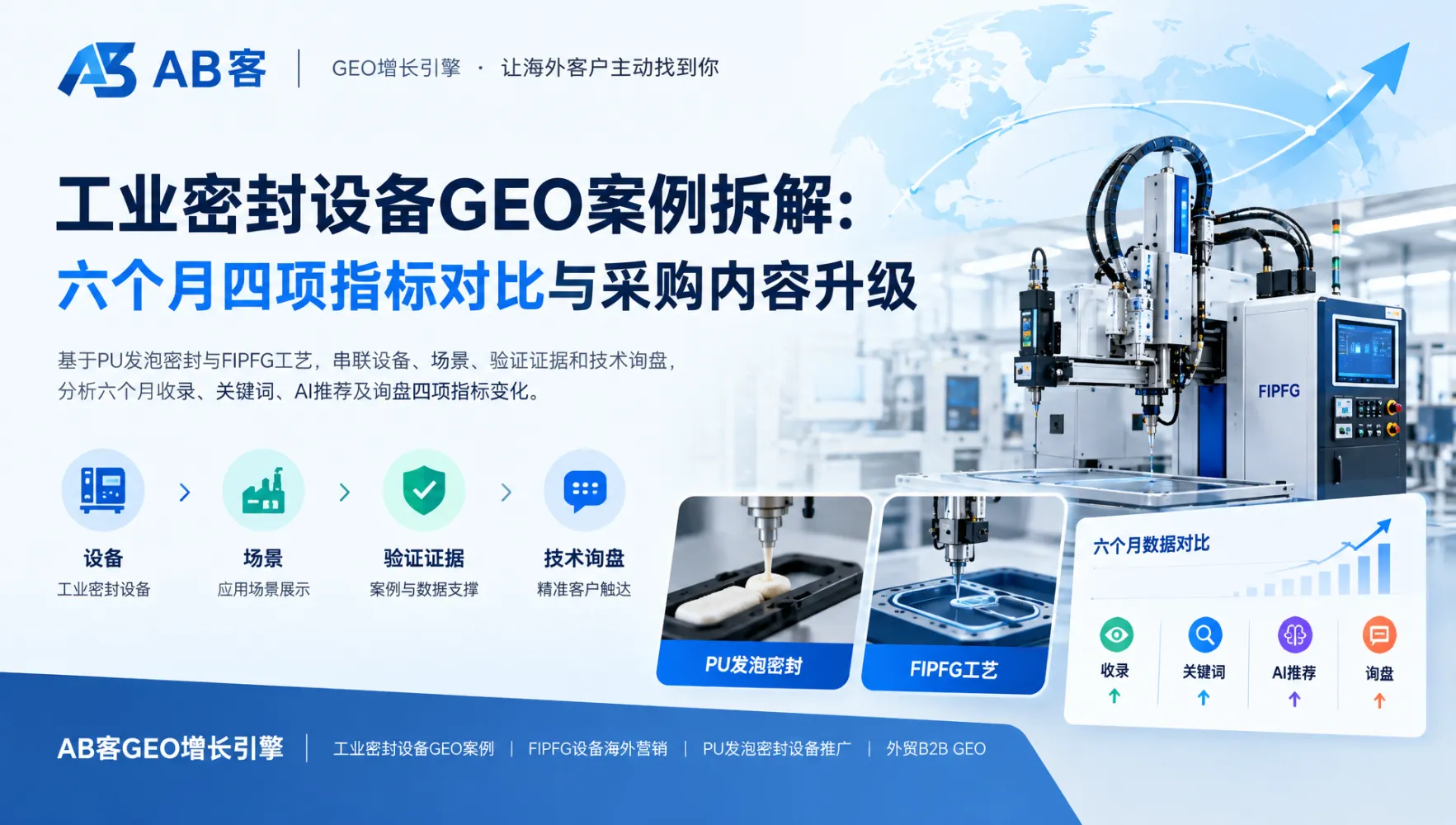
How to implement GEO (Geometric Orientation) in industrial sealing equipment? Analysis of six months of performance indicator changes and process-oriented customer acquisition paths.
广交会后电子家电企业如何做GEO?用30天梳理产品优势与采购决策信息
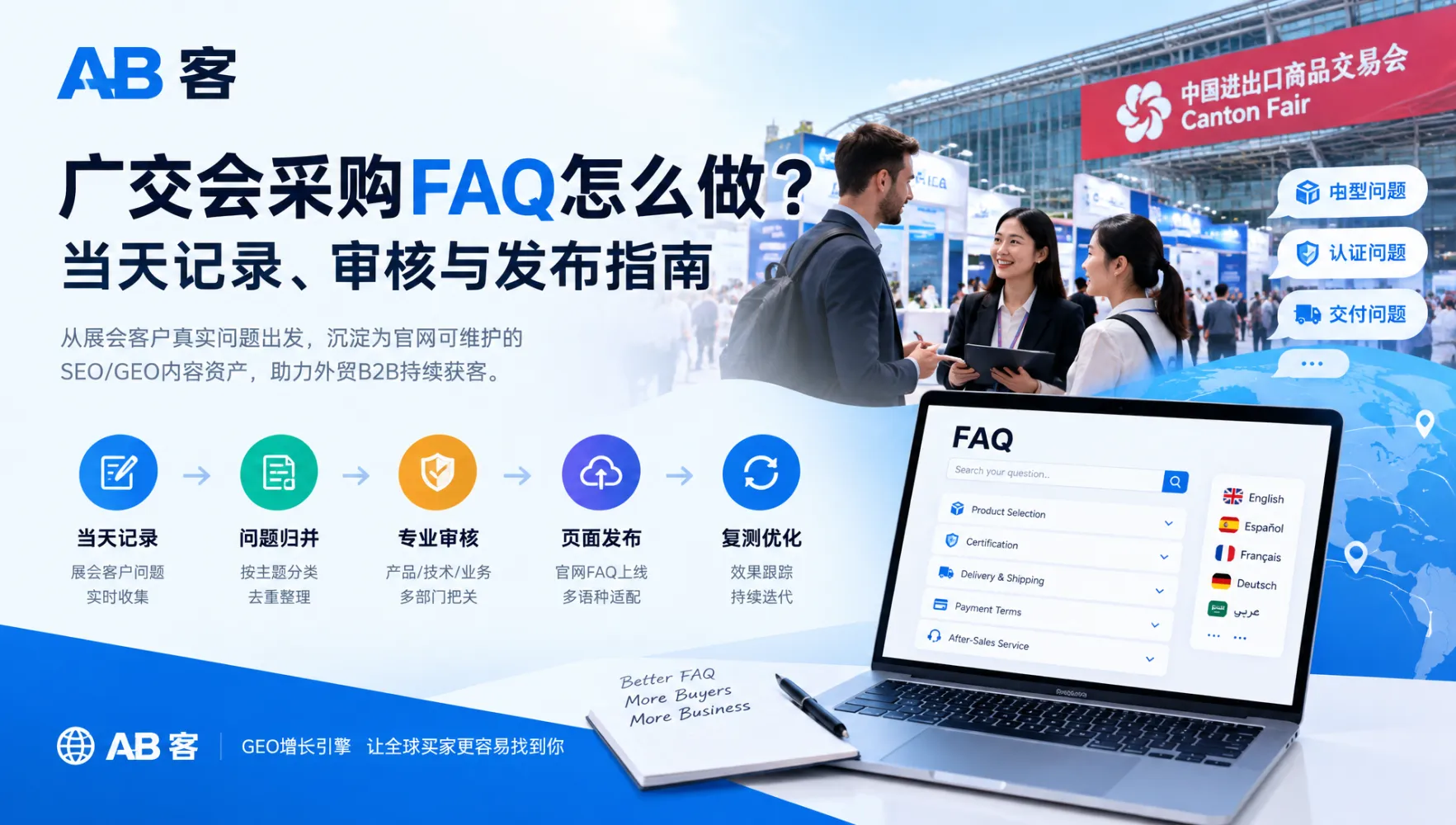
Turn Canton Fair Buyer Questions into GEO Queries and Better B2B Content
照明电气企业如何做好GEO:用可验证的采购信息连接海外买家
Recommended Reading

The EU will impose an additional €2 handling fee for small parcels in November: How can B2B foreign trade turn "compliance pains" into a new window for GEO customer acquisition?
How should B2B foreign trade companies respond to changes in EU parcel fees? AB Customer analyzes the relationship between direct mail costs, fulfillment models, and procurement trust, providing an action framework for policy verification, compliance knowledge organization, multilingual content layout, and AI visibility monitoring to help companies transform their professional capabilities into discoverable and referable growth assets.
Opening: I woke up to find that the price of packages shipped to Europe had gone up again.
The changes in EU parcel fees are not just about "paying a few more euros," but about how direct mail costs, import responsibilities, and supplier evaluation standards will change.First verify the scope of policy application, then adjust performance and customer acquisition strategies.This is more important than hastily raising prices or shifting inventory.
The statement regarding the "€2 handling fee to be added from November 2026" cannot be used as a direct basis for pricing. The amount, effective date, billing unit, and its relationship to customs duties and import VAT all need to be confirmed by referring to the final EU legal text, member state implementation guidelines, and carrier notifications. "By category," "by product," and "by parcel" are not the same concept, and SKU quantity cannot be used to directly replace customs classification.
This article provides a framework for business and marketing decisions, and does not treat unverified policy timelines, import volumes, or declines as established facts. Direct mail rules for consumers should not be applied indiscriminately to all B2B orders.
First, understand the full picture of the policy: What game is the EU playing?
To understand EU customs reform, three issues need to be clarified: whether the tariff arrangements for low-value goods will be adjusted, how customs processing fees will be levied, and how import declaration and platform responsibilities will change. These may be interconnected, but their legal basis, fee-paying entities, and implementation pace may differ.
-
The milestone of July 1, 2026:Information concerning the “150 euro threshold” and the “3 euro temporary tariff” should be verified against official documents to confirm the applicable categories, the levying authority, and the transitional arrangements. It cannot be assumed that all low-value imports are subject to the same tariff.
-
The milestone of November 1, 2026:The wording regarding the "2 euro union fee" should be differentiated between proposals, political agreements, and officially effective rules; it should not be uniformly included in all European orders before there is a basis for implementation.
-
The milestone of July 1, 2028:The long-term tariff and digital customs reform arrangements require monitoring of subsequent implementation documents; the predicted timeline should not be regarded as an immutable fact.
| Verification object | Prioritize checking the source | Confirmation before quotation |
|---|---|---|
| Legal Status | EUR-Lex, European Council Announcement | Approval status, effective date and applicable date |
| Collection Scope | European Commission Directorate-General for Taxation and Customs, Customs of the destination country | Goods flow, billing unit, and payer |
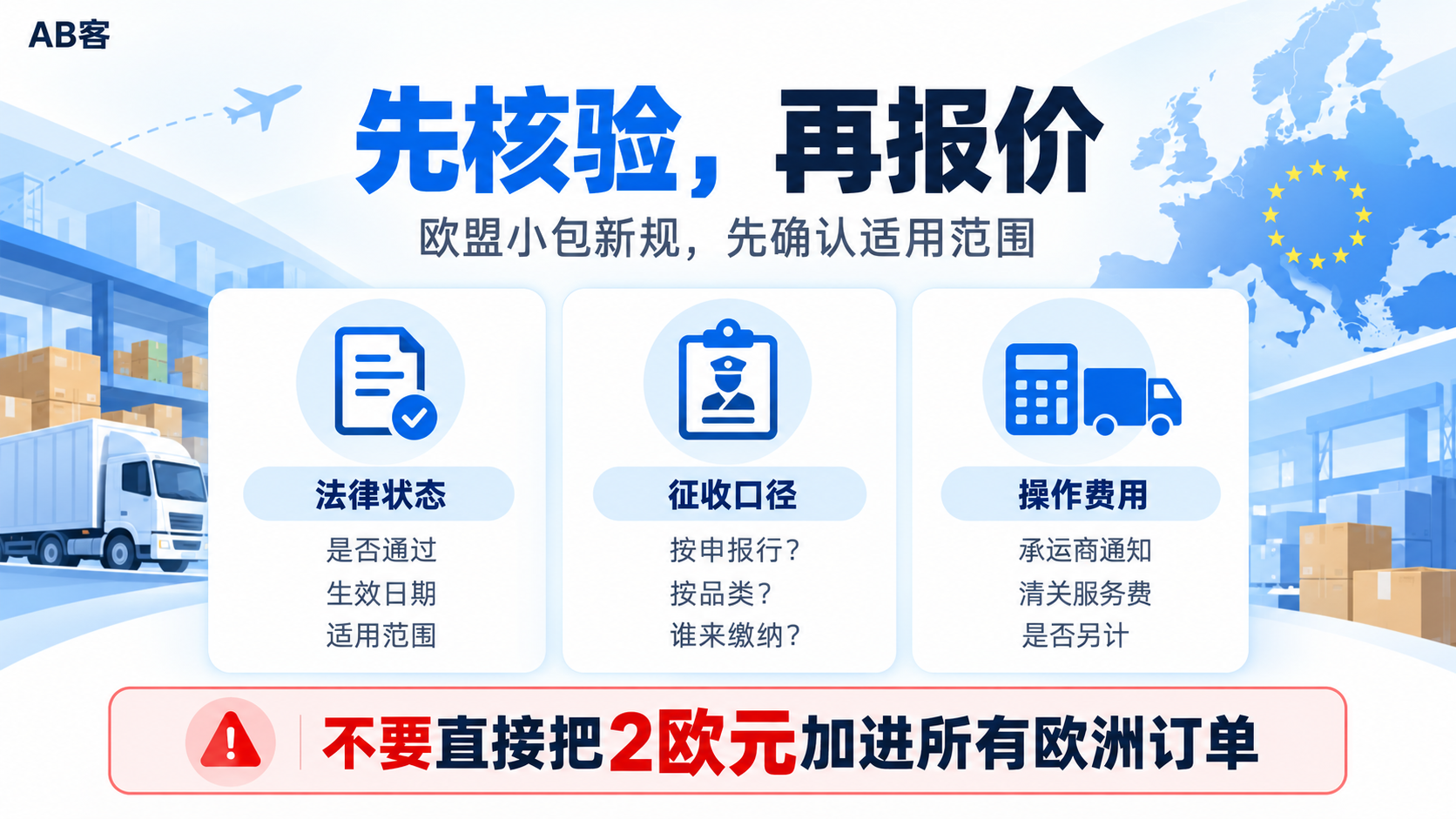
| Operating costs | Carriers, customs and tax professionals | Are advance payment, customs clearance and service fees charged separately? |
The query can be found fromEU Legal DatabaseandDirectorate-General for Taxation and Customs of the European CommissionTo begin. Regarding the circulating figures such as "small package import volume," "proportion of imports from China," and "post-policy decline," the statistical period and cargo classification should be verified; without reliable sources, they are not suitable for business forecasting.
two,What's the difference between a €2 handling fee and a €3 customs duty?
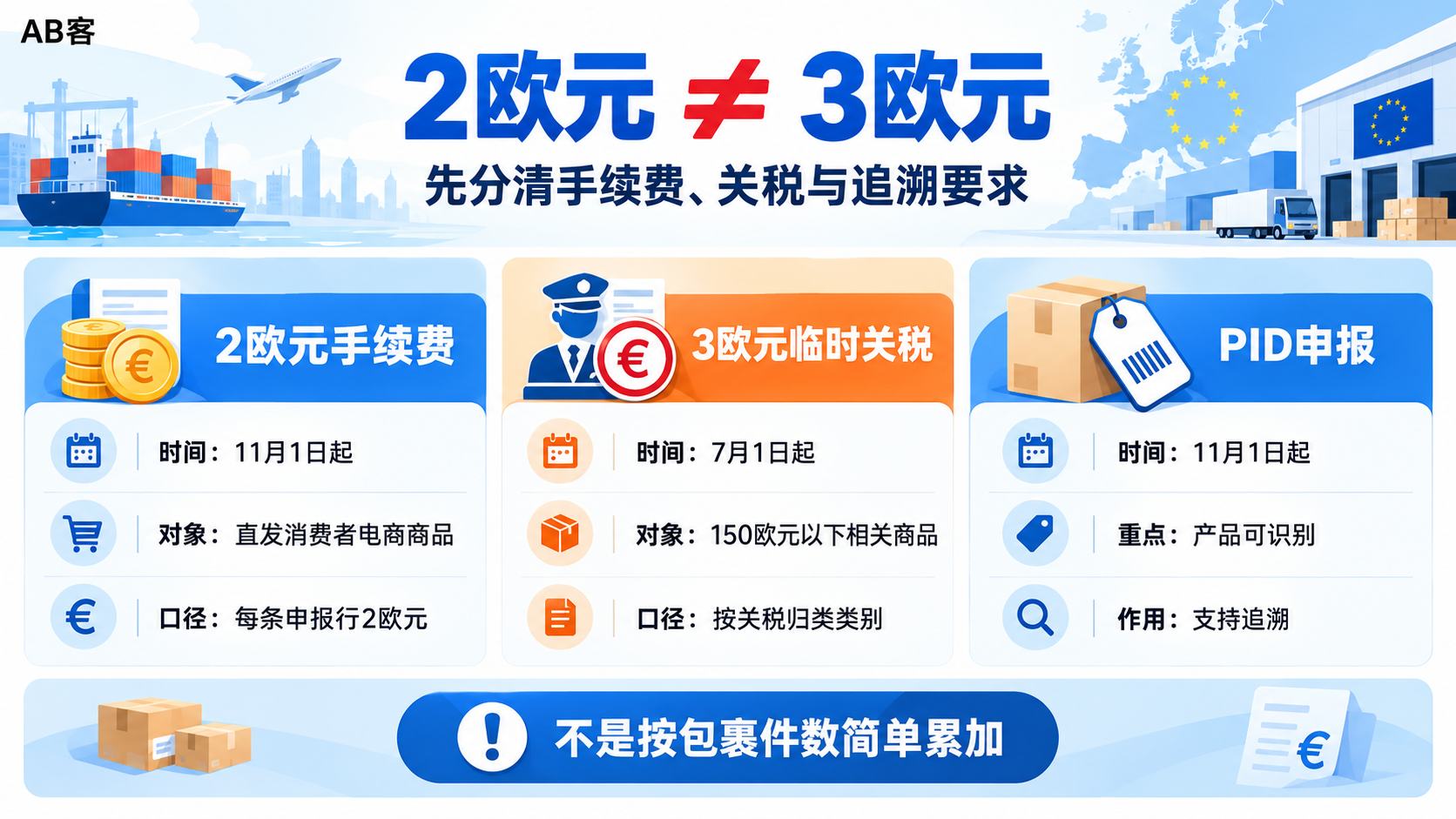
| Policy Projects | Implementation time | Scope of application | Billing Scope |
|---|---|---|---|
| 2 Euro Customs Processing Fee | November 1, 2026 | Eligible non-EU direct-to-consumer e-commerce products | 2 euros per customs declaration |
| 3 euro temporary tariff | From July 1, 2026 | Low-value imported goods that meet the criteria and whose intrinsic value does not exceed 150 euros | Calculated by commodity tariff classification |
| Product Identifier (PID) Application Requirements | From November 1, 2026 | Products subject to relevant e-commerce remote sales declaration requirements | Provide identifiable and traceable product identification information as required. |
The €1.2 handling fee is not simply an accumulation based on the actual number of items.
For example, if an e-commerce parcel sent directly to an EU consumer contains 10 similar T-shirts, the handling fee is €2 if these items are grouped into the same declaration line according to the declaration rules; if there are also hats, and the hats need to be declared separately, it may form two declaration lines, with a handling fee of €4.
The actual cost should be determined based on the customs declaration and applicable rules, and cannot be calculated solely based on the number of items in the package.
Furthermore, the €2 handling fee applies to eligible e-commerce imports, even if the goods are valued at over €150. This is different from the €3 provisional tariff, which applies only to eligible low-value goods valued at €150 or less.
2. November 1st is also an important date for product traceability information.
In addition to the fees, the relevant guidelines from the European Commission also clarify that the Product Identifier (PID), which is subject to the reporting requirements for remote sales of goods and services through e-commerce, will become mandatory reporting information from November 1, 2026.
Product identifiers are used to identify specific product models, batches, or commodities and support supply chain traceability. They are not the same concept as HS codes or TARIC tariff classification codes, and cannot replace product safety documents or other applicable compliance materials.
This means that the changes in EU import regulations are not just about increased costs, but also involve product identification, the quality of declaration data, and supply chain traceability.
For foreign trade companies, the first step is to confirm whether their own transaction model is applicable to these regulations, and then determine which product data, quotation documents, and customer communication materials need to be updated.
III. How the Shockwave Transmits: Four Variables B2B Companies Cannot Avoid
1. The cost structure has been repriced.
Calculate the total cost at CIF or delivery, rather than simply adding "3 euros + 2 euros". Customs duties, VAT, logistics, customs clearance fees, and return losses should be listed separately. At the same time, clearly define the trade terms and import responsibilities to avoid discrepancies between supplier quotations and buyer budgets.
2. Logistics and warehousing models were forced to shift.
Overseas warehouses do not automatically exempt import taxes and fees; they merely change the import and fulfillment process. Inventory turnover, warehouse rent, slow-moving goods, returns, and local tax obligations should be compared together. The same warehousing model is also unsuitable for replenishing industrial equipment, spare parts samples, and consumer goods.
3. Traffic and transaction structures have been reshaped.
When buyers reassess their supply chains, the website's ability to explain specifications, quality control, and delivery responsibilities will affect initial screening efficiency. However, it's premature to conclude that platform traffic will inevitably shift or that European buyers will necessarily increase their procurement budgets based solely on policy changes.
4. Compliance has become a new competitive barrier.
HS code, customs valuation, country of origin, applicable product regulations, and importer's responsibilities all need to be verified separately. Missing information not only affects customs clearance but also increases the cost of repeated communication after an inquiry.
Changes in Fees and Liabilities
Recalculate delivery costs
Adjustment of performance plan
Reassess suppliers
Increased purchasing concerns
Clear evidence and explanation are needed.
IV. Crisis and Opportunity: The Pressure on Small Parcels Presents a Window into B2B "Value Trade"
Policy changes don't automatically generate growth dividends, but they can prompt buyers to re-evaluate suppliers. Companies with compliance documentation, stable manufacturing capabilities, and clearly defined service boundaries can translate these capabilities into more easily verifiable procurement information.
-
Low value-added orders need to have their profits recalculated, but rising costs do not necessarily mean that competitors will be eliminated; the assessment should be based on the product and the channel.
-
The value of a stable supply should be supported by quality records, production capacity, delivery timeframes, and anomaly handling mechanisms, rather than simply stating "reliable quality."
-
Overseas warehouses, semi-managed warehouses, and B2B bulk imports each have their own conditions. The selection criteria should be based on demand stability and total cost, rather than "the model is inherently compliant".
The key to shifting from selling prices to explaining value is enabling buyers to verify it.For example, industrial component suppliers can specify material grades, dimensional tolerances, inspection items, and customization limitations, along with corresponding applicable documentation. This content not only assists buyers in making decisions but also provides clear semantics for search and AI retrieval.
V. The Customer Acquisition Logic Has Changed: Why GEO is Becoming the New Infrastructure for Foreign Trade B2B
Overseas buyers can use tools like ChatGPT, Perplexity, and Gemini to organize selection questions, compare solutions, and discover suppliers, but search engines, industry platforms, trade shows, and manual due diligence remain important. A more accurate assessment is:The procurement channels are increasing, rather than being completely replaced by AI.
GEO, or Generative Engine Optimization, improves a company's knowledge, content structure, and verifiable information to increase the likelihood that generative search will accurately understand, retrieve, and reference the company's information. It works in conjunction with SEO and does not mean that a company can control the AI's answers.
-
Coverage:Use product pages, purchasing guides andFAQAddress specific questions and ensure multilingual support and page accessibility; different AI products have different data sources and retrieval mechanisms.
-
Credibility:Clearly define the company entity, the scope of application of the document, and the information update time to reduce vague publicity. A clear structure helps in understanding, but it does not constitute a necessary condition for citation.
-
Durability:What can be sustainably accumulated is knowledge and content assets, not permanent recommendation slots. Models, sources, and answers will change, requiring continuous maintenance and retesting.
Therefore, GEO is not abandoning ranking, but rather making a company's capabilities easier to interpret accurately based on search discoverability, and providing buyers with a path to further verification.
VI. Implementation: How can AB Customer GEO help foreign trade enterprises adapt to this wave of changes?
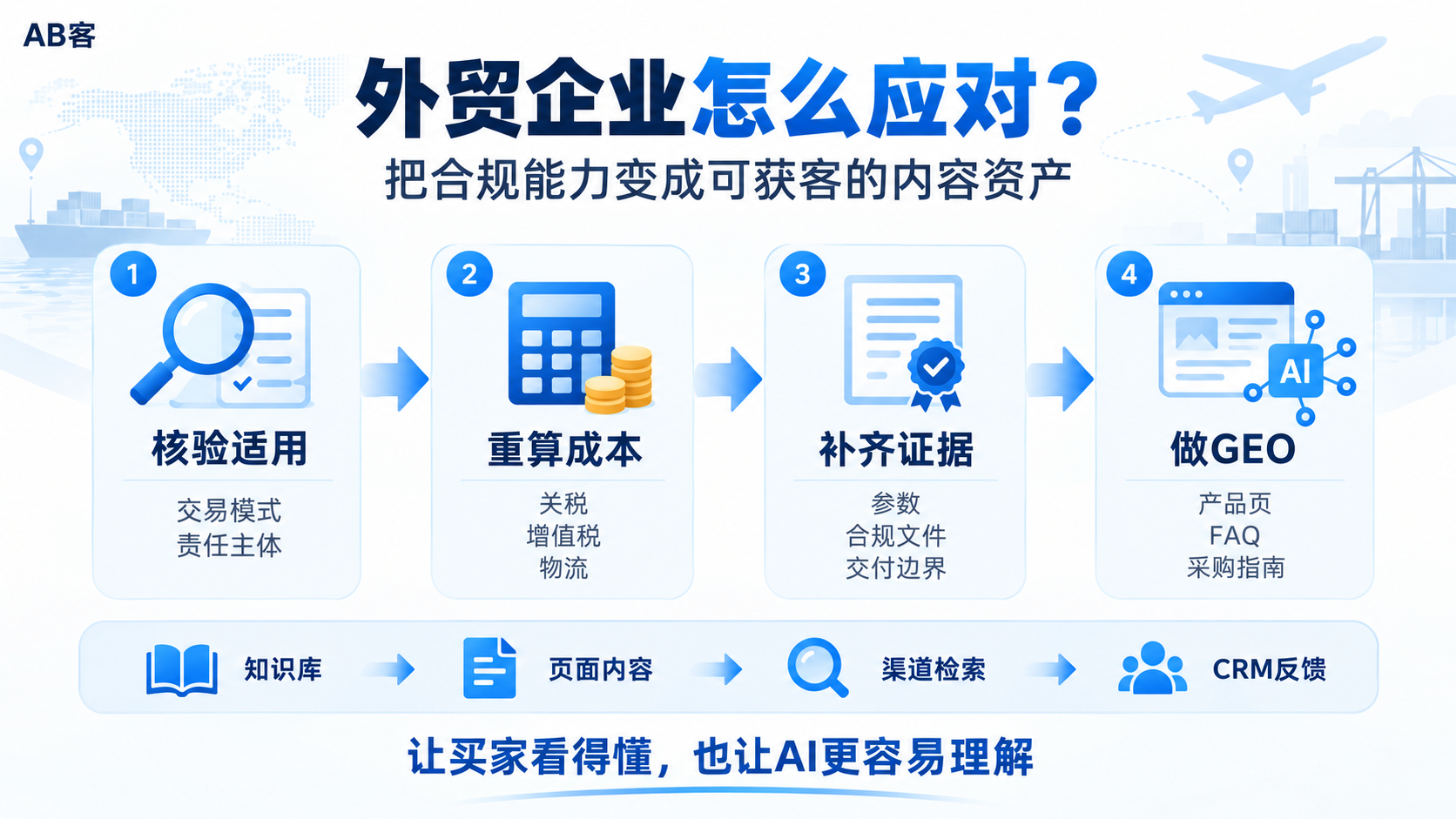
ABKEIt is a brand under Shanghai Muker Network Technology Co., Ltd.AB Customer GEOGrowth engineEnterprise Knowledge BaseBased on customer issues, connectContent productionSEO and GEO websites, channel distributionCRMAnd data attribution, supporting foreign trade B2B enterprises to continuously carry out customer acquisition work.
1. Translate "compliance and strength" into language that AI can read.
Compile product specifications, quality control, delivery capabilities, and applicable documents, and associate them with specific models and markets. The CE mark is not equivalent to general third-party certification, and REACH and RoHS cannot be lumped together as mandatory "certifications" for all products; applicable requirements should be determined by professionals.
2. Organize content around real procurement issues.
Transform frequently asked sales questions into product descriptions, FAQs, and purchasing guidelines. For example, clarify how samples and bulk orders are delivered, how technical documents are provided, and what costs are included in a quote. For tax-related questions, specify the applicable conditions to avoid providing unconditional answers.
3. Establish clear entity relationships to enhance AI trust.
Standardize company name, product capabilities, and contact information on official websites, industry platforms, and social media. The knowledge base retains the source and update time of data; expired certificates, discontinued models, and historical delivery dates cannot be considered current commitments.
4. Extend coverage across multiple languages and AI platforms.
Select languages based on target markets and have the content professionally proofread. Use a fixed set of test questions to monitor brand mentions, citations, and factual accuracy across different AI platforms, rather than promising “consistent recommendations across all platforms.”
Corporate Facts
Knowledge base and evidence
Buyer issues
Pages and Multilingual Content
Channel reach
Search and Citation Observation
CRM Feedback
Effective Inquiries and Iterations
Implementation can begin by focusing on one market and one product line, clearly defining the person responsible for corporate data, the professional reviewer, and [other relevant personnel].Sales follow-uppeople.AB customerThe system supports execution through collaboration between systems, intelligent agents, and humans, but does not replace legal, customs, or tax professional services.
VII. An actionable list of actions
First address applicability and cost, then expand content investment; each task should have a designated person in charge and retain acceptance documentation.
| Priority | action | Target |
|---|---|---|
| immediately | Verification rules require recalculation of direct shipping costs from Europe; false splitting of shipments to circumvent declaration requirements is prohibited. | Form an evidence-based cost statement |
| short term | Comparing inventory and tax conditions for overseas warehouses, semi-managed warehouses, and local fulfillment. | Choose a sustainable compliance solution |
| short term | Applicable standards, compliance documents and delivery instructions | Establish a verifiable information foundation |
| Mid-term | Develop multilingual professional content around buyer issues | Observe inclusion, citation and reading performance |
| Mid-term | useAB Customer GEOConnecting knowledge, content, channels, and CRM | Record sources and evaluate valid inquiries |
| long | Continuously update product evidence, service boundaries, and sales feedback. | Accumulate reusable brand assets |
FAQ
- Are B2B samples necessarily unaffected by small package rules?
- Not necessarily. It should be determined based on the nature of the goods, the transaction and declaration methods, and specific rules. The "sample" or "B2B" label itself does not constitute a basis for exemption.
- How to measure the effectiveness of GEO?
- Set fixed questions, languages, platforms, and test dates; record brand mentions, cited links, and the accuracy of responses; then combine this data with a review of organic visits and effective inquiries. AI-driven growth may not be fully attributable, so it's not advisable to include all growth in GEO (Growth Expert).
- What do I need to prepare before consulting with A and B clients?
- Prepare an official website, core product information, target countries, applicable documents, frequently asked questions from customers, and existing inquiry data. This information can be used to assess the scope of development and execution priorities.
Conclusion: Policies are tightening, but the opportunity to be "seen" always exists.
The EU's discussion on parcel pricing serves as a reminder to businesses: operational decisions must be based on effective rules and real costs, and customer acquisition strategies should be grounded in verifiable professional capabilities. Policy changes do not guarantee growth, and AI-generated exposure does not equate to orders.
Compliance capabilities are compiled into evidence, evidence is transformed into procurement content, and sales feedback is used to continuously verify value.This is a more controllable approach. Companies looking to advance their GEO (Government Operations Officer) initiatives in the European market can begin with a data and content diagnostic, clarifying the initial scope, review responsibilities, and evaluation metrics with the AB (Accounts, Services, and Research) team before deciding on subsequent investments.


