Hot Products





Popular articles
How Can Foreign Trade B2B Companies Test a New Market Without Overinvesting in a Localized Website?
Before AI Cites You: How to Structure Your B2B Export Website Content to Make Buyers’ Shortlists
How Can CRM Connect the Same Inquiry from Source to Sale, and What Needs Manual Updating?
How to Build Trusted GEO for B2B Trade: Four Steps to Reliable Enterprise Knowledge
Recommended Reading




We already have a CRM, and inquiries are scattered across email, WhatsApp, and website forms. Before we start working together, how do you confirm the integration methods item by item, and clearly specify the areas that cannot be integrated, such as automatic synchronization, manual import, and those that cannot be integrated?
Already have a CRM but don't want to purchase another one? AB Customer provides an implementation evaluation of CRM and AI sales assistant, outlining the system and channel information required before cooperation, item-by-item verification methods, and key points for written records of automatic synchronization, manual import, integration failures, and pending verification items. Specific integration capabilities must be confirmed based on the existing CRM version, channel conditions, and verification results.
First, check the existing system, then confirm the scope of inquiry access.
If a CRM already exists, the starting point for cooperation evaluation is not to purchase another system, but to clarify: can the existing CRM continue to handle customer management, which information from emails, WhatsApp, and website forms can be included in the sales process, and what kind of operational coordination is required.
ABKE CRM and AI Sales AssistantThe access assessment should proceed in the following order: "System and channel confirmation → Data and permission verification → Access method verification → Scope written confirmation".Each channel is recorded separately as either automatically synchronized, requires manual import, cannot be accessed, or pending verification. The entire access capability cannot be summarized as "supports CRM".
Do we need to replace our existing CRM? First, distinguish between business collaboration and technical integration.
CRM is used to manage leads, customers, contacts, inquiries, opportunities, follow-up records, and sales targets; the AI sales assistant, based on enterprise knowledge and customer information, assists in completing inquiry summaries, customer research, intent recognition, response preparation, and material recommendations. The collaboration between the two does not equate to having technical connectivity with any third-party system.
For companies that wish to continue using their existing CRM, the assessment should first clarify the existing system's capacity before determining how AI-assisted results should be integrated into the sales workflow.The available information does not confirm the specific integration capabilities of any designated CRM, email service, or WhatsApp product, therefore it is neither possible to pre-set all automatic synchronization nor to pre-set that an existing CRM must be replaced.
Before cooperation, it is necessary to clarify the location of the main data record: which system will ultimately be used for customer files, business opportunity stages and follow-up results, and which operations will be completed by sales personnel, in order to avoid duplicate filing, duplicate maintenance or inconsistent status.
What information is recommended to prepare before the access assessment?
The more specific the information, the easier it is to translate "desired access" into a verifiable scope. Samples involving customer information should be anonymized beforehand, and account passwords or keys should not be transmitted through ordinary information lists.
-
Existing CRM:Product name, version, deployment method, currently used modules, as well as available interface descriptions, import templates, and administrator cooperation requirements.
-
Mail:The specific email service, the usage method of corporate or personal email, the scope of accounts involved, and whether the desired information is new inquiries, historical emails, or follow-up communications.
-
WhatsApp:The actual product type used, account management method, service provider information, and the scope of contacts, messages, or inquiry information expected to be integrated.
-
Website Forms:The website building system, form tools, field examples, current notifications and storage methods, and whether the website maintenance team can cooperate in making adjustments.
-
Sales process:Lead manager, allocation rules, inquiry quality standards, opportunity stage, follow-up requirements, and handling of repeat customers.
-
Expected data range:Whether it's new leads or historical data, one-way input or two-way update, whether it involves attachments, source page, and follow-up records.
What should be checked for emails, WhatsApp messages, and website forms?
Different channels within the same company may yield different access conclusions. The following items are used to clarify the direction of verification and do not imply that AB Guest has supported any specific interface.
Email: Distinguish between emails entering the system and emails that generate valid inquiries.
Verify that the email service provides available authorization, interfaces, or export methods; clarify whether sender, subject, body, attachments, and correspondence can be retrieved. Also confirm how to identify new inquiries, how to associate them with existing contacts, and how to mark spam and non-targeted information such as supply chain promotions. Receiving email notifications does not equate to successful CRM documentation and source recording.
WhatsApp: First confirm the product type and licensing terms.
Verify the actual account, product type, service provider, and their access conditions, and then confirm whether the contact, message content, attachments, or history are within the accessible range. WhatsApp click records on the website are separate data objects from subsequent customer conversations; therefore, "record clicks" cannot be written as "synchronize chat history."
Website Forms: Confirmation Submission, Field Mapping with Customer Profiles
Verify the destination of data after form submission, available interfaces or export methods, and how fields such as name, company, email, and requirement description are mapped to the CRM. If it is necessary to record the source page, language, or channel, it should also be verified whether this information was actually collected and can be transmitted; missing source information should not be regarded as sufficient attribution evidence afterward.
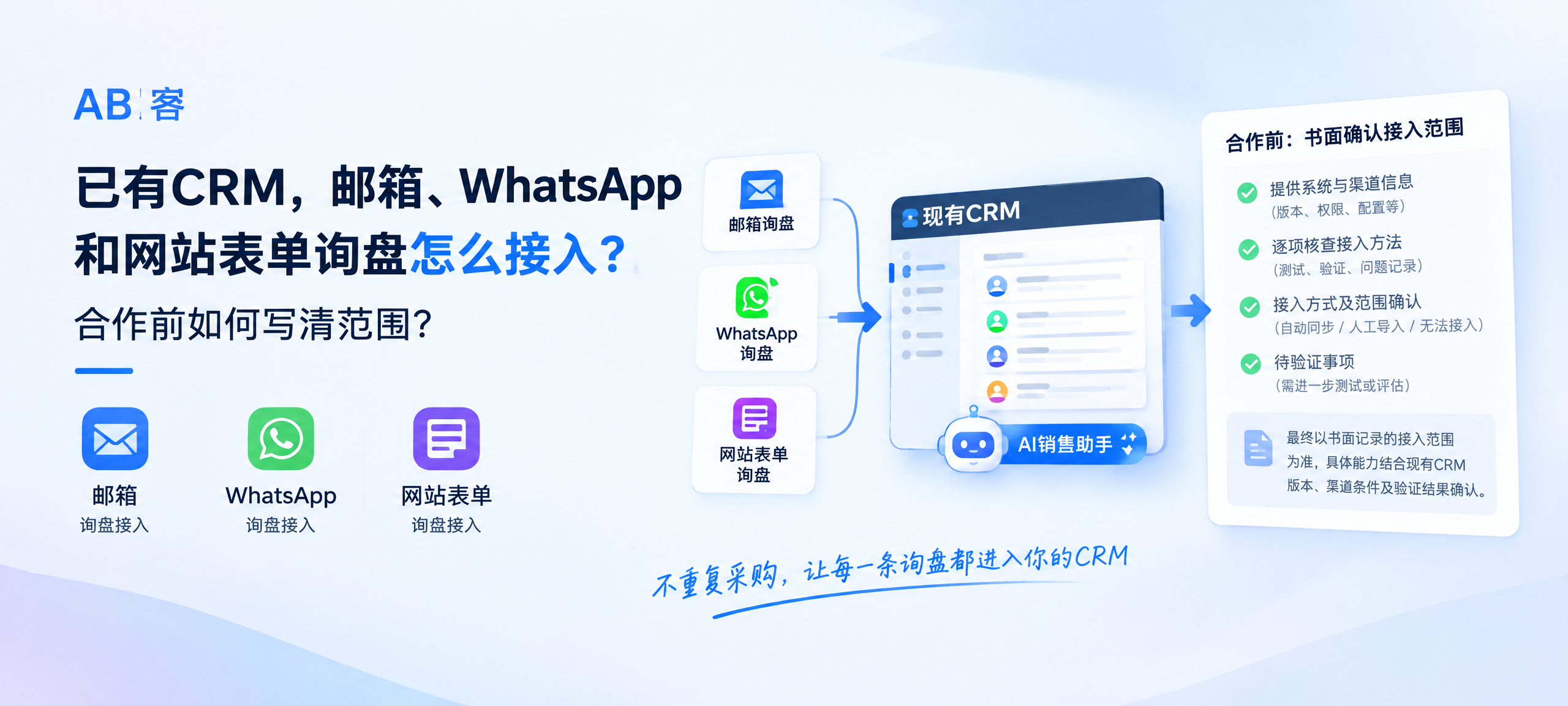
The access conclusions are divided into four categories, and each item should be clearly stated rather than making a general commitment.
| Verification Conclusion | Content that needs to be clarified | Misunderstandings to avoid |
|---|---|---|
| Automatic synchronization is possible | Verified data objects, fields, directions, triggering methods or frequencies, as well as permissions and operating conditions. | Some fields can be synchronized, but this does not equate to full, real-time, or bidirectional synchronization. |
| Manual import required | Export source, file template, required fields, import cycle, executor, and verification method. | Importing does not equate to automatic access, nor does it guarantee the complete retention of historical information. |
| Unable to connect | The specific data that cannot be accessed at present, the reasons for the restrictions, and whether there are any assessable alternative processes. | The restriction of one channel does not mean that other channels are also unusable. |
| To be verified | Missing data, permissions, or testing conditions, the responsible party, and subsequent confirmation points. | The unverified capability does not belong to the confirmed deliverable capability. |
How should the scope of cooperation and acceptance criteria be documented in writing?
It is recommended that the access confirmation checklist be included in the project scope and delivery standards confirmed by both parties. The granularity of the record should be detailed to "channel or account + data object + access method", rather than just writing "integration email, WhatsApp and CRM".
-
System boundary:Specify the names, versions, and accounts involved in the existing CRM and channel services, and indicate the systems that will continue to be used and the new parts added in this project.
-
Data boundaries:Specify which fields to include and exclude, the range of historical data, the range of attachments, and whether the source information can be retained.
-
Operating rules:Clearly define the synchronization direction, triggering method or import cycle, as well as the rules for customer matching, deduplication, attribution, and exception handling.
-
Division of labor:Clearly define who provides authorization, who cooperates with system adjustments, who organizes data, who imports and verifies data, and who handles failure records; matters involving third-party services or fees should be confirmed separately.
-
Acceptance criteria:Use the test cases confirmed by both parties to verify the records, field mappings, source retention, and exception handling results in the target CRM, and do not substitute interface connectivity for complete business acceptance.
-
Limitations and Changes:List the items that cannot be accessed and those that are pending verification separately; assess the impact and confirm the scope when there are changes in CRM version, account permissions, third-party services or requirements.
Example of scope description:"New inquiries from a website form, after verification, will be written unilaterally to the existing CRM according to the confirmed fields; historical data, attachments, and CRM write-backs to the website are not included in this item. The specific details are subject to the list confirmed by both parties." This is an example of written expression and not a commitment to the current access capabilities.
What an AI sales assistant can do also needs to be confirmed separately based on the scope of its integration.
Once leads are entered into the CRM, the AI sales assistant can use available customer information and company knowledge to assist in inquiry summaries, customer background analysis, purchase intent judgment, A/B/C lead classification, draft responses, and related material recommendations.The entry points for these capabilities in the existing CRM, the data that can be read, and the methods for writing back the results still need to be confirmed separately.
AI-generated customer assessments and responses should be reviewed by sales personnel, especially regarding pricing, delivery, technical compatibility, and business commitments. CRM and AI sales assistants cannot replace business judgment, negotiation, and closing processes, and customer acquisition should not be automatically included in the standard scope without product or contract confirmation.
During acceptance testing, it's crucial to first confirm whether leads can be accurately recorded, allocated, and followed up. Then, combine this with sales feedback to observe the number of valid inquiries, the percentage of A/B category inquiries, response timeliness, and lead conversion rates. Successful integration does not guarantee a sale, and missing source information cannot be solely attributed to a single page or channel.
Related reading:
Start communication with an existing system inventory.
If you wish to continue using your existing CRM, you can first compile a list of CRM names and versions, email services, WhatsApp usage methods, website form tools, and a sample of anonymized inquiries, and indicate the issues of missing or duplicate entries that you most want to resolve.
When communicating with A and B customers, it is recommended to confirm the following first:Which channels should be evaluated first, which data must be retained, which operations can be handled manually, and which items must be verified before being included in the delivery.First, clearly define the access method, responsibilities, and limitations, and then decide on the system configuration and scope of cooperation.


