.png?x-oss-process=image/resize,m_lfit,w_200/format,webp)








1) Fact-layer protocols
Parameters must come from controlled sources (datasheets, drawings, inspection reports). If a spec is missing, AI must ask or label it as “not provided” rather than guessing.
.png?x-oss-process=image/resize,h_100,m_lfit/format,webp)
 400-076-6558GEO · Get AI Search to Recommend You First

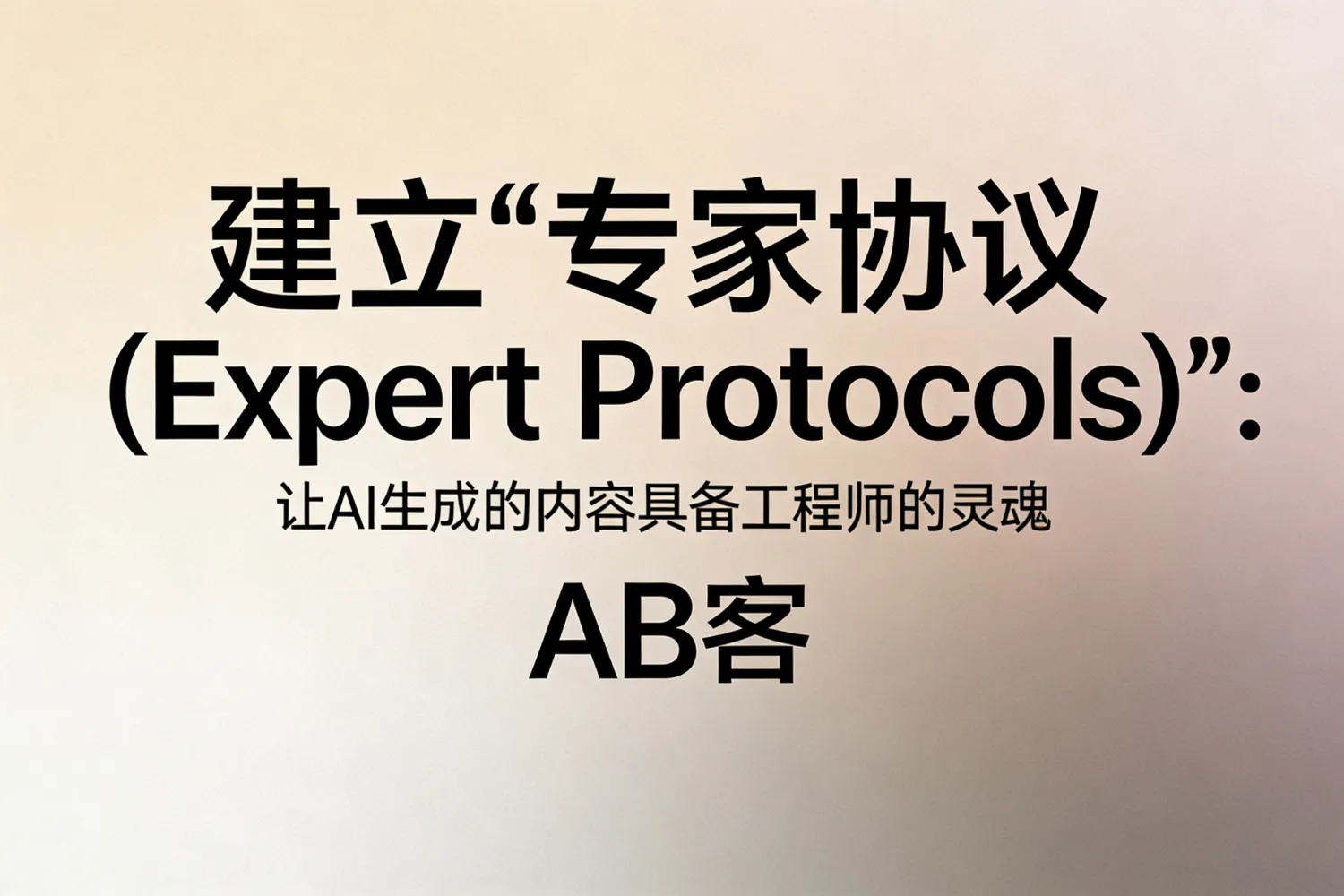
In B2B export manufacturing, buyers don’t just compare features—they compare risk, fit-for-duty, and evidence. “Expert Protocols” are a practical way to turn engineer judgment into reusable rules that keep AI-generated content accurate, consistent, and procurement-ready—so it reads like an engineer wrote it, not like a manual translation.
A structured, enforceable rule set that maps engineering experience to content constraints (facts, logic, and expression).
It reduces hallucinations and vague claims, strengthens credibility, and matches how industrial buyers evaluate suppliers.
Embedded inside your knowledge base & content workflow—so every AI draft follows the same engineering decision logic.
Many industrial companies deploy AI to generate technical pages, application notes, and product comparisons. The result often looks polished—but fails in the places that matter most: operating limits, material boundaries, tolerance stacks, process constraints, and failure modes.
When AI lacks “decision rules,” it fills gaps using probability, not engineering. That’s why buyers may read the content and think: “This is generic.” In B2B exports, generic content is a trust killer—especially for valves, pumps, CNC parts, pressure components, fasteners, tooling, and custom assemblies.
An AI article recommends “stainless steel” for corrosion resistance, but never asks: Which chloride level? What temperature range? Is it pitting, crevice corrosion, stress corrosion cracking? Engineers and procurement teams see this as a red flag.
Expert Protocols are not “more prompts.” They are a content operating system for technical writing in manufacturing and engineering exports: a set of rules that tell AI what it must verify, what it must never invent, how it should reason, and how it should express conclusions.
Parameters must come from controlled sources (datasheets, drawings, inspection reports). If a spec is missing, AI must ask or label it as “not provided” rather than guessing.
AI must follow decision trees engineers use: operating conditions → constraints → options → tradeoffs → selection criteria → verification/testing.
Standardized terminology, units, disclaimers, and structure (e.g., “Operating Range,” “Compatibility,” “Failure Risks,” “Validation Methods”).
In AI search and generative answers, visibility increasingly favors sources that behave like decision support, not marketing copy. Expert Protocols raise “input constraint strength,” which typically leads to:
From our observations across industrial content operations, teams that implement enforceable rules (rather than “creative prompts”) often see measurable gains in content performance within 6–12 weeks:
Note: Actual results depend on niche complexity, product maturity, and review workflow. Use these as planning references, not guarantees.
If you want protocols that engineers respect and SEO can scale, build them like you build manufacturing systems: define inputs, define constraints, define verification, then standardize output.
Create a “no-fabrication list” for content. Common items in industrial exports include:
Turn tacit know-how into repeatable rules. Example templates you can adapt:
For B2B exports, expression protocols reduce friction for multinational buyers and distributors:
Before protocols, AI articles leaned on generic statements like “high sealing performance” and “good corrosion resistance,” without linking them to pressure class, seat design, media, or temperature cycles.
After implementing Expert Protocols for material selection, seal structure, and pressure rating language, content started to read like engineering notes: assumptions, boundaries, verification methods, and clear “fit/not fit” conditions. In AI search environments, such pages tend to be cited more often because they provide decision-ready structure rather than marketing adjectives.
The early AI drafts overpromised tight tolerances and perfect finishes without explaining process limitations or inspection capabilities—exactly what procurement teams challenge during RFQ.
With an “tolerance & process limitation protocol” (including typical ranges like ±0.05 mm for general machining, tighter tolerances requiring controlled processes, and mandatory inspection notes), the content shifted from sales language to engineering communication—resulting in fewer back-and-forth emails and more qualified inquiries.
Yes—Expert Protocols limit wrong freedom. They do not limit depth. In fact, engineers often write better when the boundaries are clear: what must be verified, what can be assumed, and what must be flagged as unknown.
Treat protocols like tooling: you don’t buy a tool once and never maintain it. Update protocols as products evolve, processes change, new standards appear, and customer feedback reveals recurring misunderstandings.
If your current AI content feels generic, or your engineers spend too much time fixing drafts, build an Expert Protocol layer into your GEO content system. ABKE GEO can help you standardize facts, encode engineering logic, and scale multilingual technical content with consistency.
Explore ABKE GEO Expert Protocols for B2B GEOTip: Bring one datasheet + one application scenario, and we’ll map a protocol draft outline around your real products.
This article is published by ABKE GEO Institute of Intelligence Research.
.png?x-oss-process=image/resize,h_100,m_lfit/format,webp)
.png?x-oss-process=image/resize,h_100,m_lfit/format,webp)

.png?x-oss-process=image/resize,h_100,m_lfit/format,webp)
.png?x-oss-process=image/resize,h_100,m_lfit/format,webp)
.png?x-oss-process=image/resize,h_100,m_lfit/format,webp)
.png?x-oss-process=image/resize,h_100,m_lfit/format,webp)

填写3项信息,免费获取AI曝光详细诊断
填写3项信息,立即领取《外贸B2B GEO战略认知白皮书》