.png?x-oss-process=image/resize,h_100,m_lfit/format,webp)

.png?x-oss-process=image/resize,m_lfit,w_200/format,webp)

Hot Products

Popular articles
How Should B2B Country Landing Pages Be Built to Match Local Buyer Search Habits Without Creating Duplicate Content or Brand Confusion?
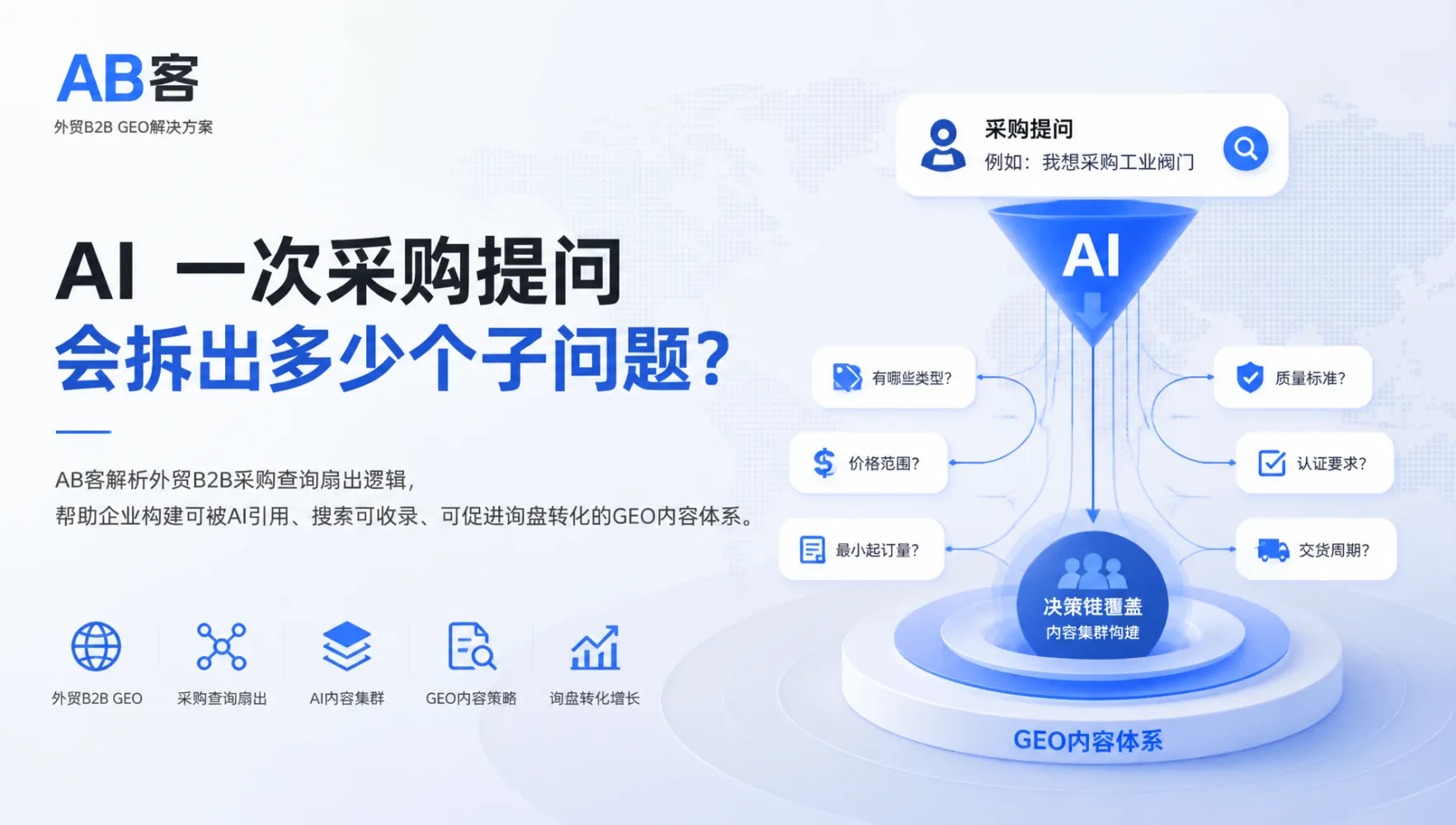
How Many Sub-Questions Can One AI Procurement Query Generate?
Which GEO Provider Offers Industry-Specific Systems for Machinery, Furniture, and Building Materials?
Recommended Reading



After Outsourcing GEO to ABKE, Who Owns Our Enterprise Knowledge, Content, Website Pages, Lead Data, and Operating History?
Learn how ABKE defines ownership, export, migration, and handover boundaries for enterprise knowledge, content, website pages, CRM leads, and GEO operating records.
Outsourcing GEO should help an export-oriented B2B company build stronger long-term digital assets—not create uncertainty about the enterprise knowledge, content, website pages, leads, and records created during the project. ABKE approaches GEO asset ownership and handover through clear project boundaries, documented deliverables, and contract-based arrangements.
In practical terms, the answer is not a single blanket statement. Ownership, access, export, migration, and continued-use rights depend on the signed agreement, payment status, technical deployment environment, third-party software licenses, and the specific assets involved.
A clear distinction: your business assets and ABKE’s platform capabilities
The ABKE GEO Growth Engine is designed to organize a company’s real business facts, product knowledge, professional experience, approved content, website materials, customer leads, and operating records into reusable growth assets. These assets support how global buyers, search engines, and generative AI systems discover, understand, evaluate, and contact the company.
At the same time, a GEO project may use ABKE’s proprietary platform functions, specialized components, workflow designs, service methods, public models, and underlying system capabilities. These are not automatically transferred as client-owned intellectual property. The relevant rights and handover scope should be defined in the applicable contract and subject to technical and licensing conditions.
What assets can be included in a GEO project handover?
For confirmed and paid project deliverables, ABKE may agree to provide export, access, migration materials, documentation, or transition support within the agreed scope. The following table explains common categories and the conditions that typically apply.
| Asset category | Typical handover or export scope | Important boundary |
|---|---|---|
| Enterprise knowledge | Approved company profiles, product knowledge, FAQ materials, technical information, evidence records, and structured business information. | Based on client-provided or client-confirmed information and agreed knowledge-base formats. |
| Content assets | Confirmed copy, multilingual content, product pages, solution pages, FAQ content, articles, and approved images or materials where applicable. | Third-party licensed materials and unapproved drafts may be subject to separate restrictions. |
| Website pages and migration materials | Static HTML files, page copy, media files, configuration references, or other agreed migration materials. | The available format depends on hosting, framework, technical environment, and contract scope. |
| CRM leads and business data | Lead records, customer information, source records, sales-stage data, and agreed operating data. | Subject to CRM configuration, data permissions, privacy obligations, and third-party system rules. |
| Analytics and operating history | Key reports, monitoring records, project documentation, published-content records, SOPs, and pending-item lists. | Access to third-party analytics accounts follows the relevant account ownership and authorization settings. |
| Accounts and configurations | Applicable account details, configuration documentation, API references, and operating instructions. | Transferability depends on account registration, platform policy, security requirements, and third-party licenses. |
Assets built around your enterprise
A GEO program can help consolidate business assets that are valuable for long-term marketing and sales operations:
- Enterprise facts, product capabilities, and solution knowledge
- Approved multilingual content and reusable sales materials
- Website pages, information architecture, and conversion pathways
- Customer questions, lead records, and sales-process information
- Content performance, visibility observations, and operating documentation
Assets not automatically transferred
The following are generally separate from client business assets unless a written agreement states otherwise:
- ABKE’s proprietary platform, software architecture, and underlying systems
- Public models, specialized components, and internal automation capabilities
- Service methodologies, workflow frameworks, and internal operating processes
- Third-party tools, data, accounts, or licenses that cannot legally or technically be transferred
How ABKE supports a practical transition or migration
A usable handover is more than sending a folder of files. For an enterprise knowledge and GEO operating system to remain useful after a project phase ends, the receiving team needs enough structure to understand what each asset is, where it is used, and how it can be maintained.
- 1 Confirm the asset inventory. Identify approved knowledge, content, pages, CRM records, accounts, reports, and documentation included in the agreed handover.
- 2 Review technical and license conditions. Confirm hosting arrangements, platform permissions, account ownership, API access, data formats, and third-party software limitations.
- 3 Provide agreed exports and materials. Deliver the relevant files, records, configuration references, documentation, or migration packages in the agreed format.
- 4 Support continuity where agreed. Use operating guides, training materials, transition notes, and outstanding-task lists to help the client team or a designated provider continue the work.
Why asset governance matters in GEO
GEO is not limited to publishing content or obtaining isolated AI mentions. It connects enterprise knowledge, website structure, multilingual content, brand signals, customer interactions, CRM records, and ongoing optimization. When these assets are managed consistently, they can become a durable foundation for future website updates, market expansion, sales enablement, and AI-search visibility work.
ABKE’s approach is to help clients build assets around their real capabilities while keeping ownership and operating boundaries transparent. This reduces the risk of fragmented information, unclear handovers, and repeated reconstruction when teams, systems, or service arrangements change.
Questions to clarify before a GEO project begins
A well-defined agreement should address the practical questions that matter to both parties:
- Which knowledge, content, pages, data, and records are included as project deliverables?
- Which assets can be exported, and in what file or data format?
- Who owns or administers the website domain, hosting, analytics, CRM, and channel accounts?
- Which third-party tools or licenses affect migration or continued use?
- What payment, acceptance, confidentiality, and security conditions apply to handover?
- What documentation, training, or transition support is included?
- Which platform capabilities, models, components, and service processes remain proprietary to ABKE?
ABKE’s operating principle: client business assets and ABKE’s proprietary technology are treated as distinct categories. Export, handover, migration, and continued-use arrangements are defined according to the contract, agreed deliverables, technical environment, payment status, and applicable third-party licenses.


.png?x-oss-process=image/resize,h_100,m_lfit/format,webp)
.png?x-oss-process=image/resize,h_100,m_lfit/format,webp)

.png?x-oss-process=image/resize,h_100,m_lfit/format,webp)
.png?x-oss-process=image/resize,h_100,m_lfit/format,webp)
.png?x-oss-process=image/resize,h_100,m_lfit/format,webp)
.png?x-oss-process=image/resize,h_100,m_lfit/format,webp)
