.png?x-oss-process=image/resize,h_100,m_lfit/format,webp)

.png?x-oss-process=image/resize,m_lfit,w_200/format,webp)

Hot Products
.png?x-oss-process=image/resize,h_2000,m_lfit/format,webp)
.png?x-oss-process=image/resize,h_2000,m_lfit/format,webp)

Popular articles
Google Has Rankings—Why Doesn’t ChatGPT Recommend You?
What Pages Does a GEO Website Need? Are Product Pages Enough?
2026 Q4: AI Search Brand Visibility Repeat Testing and Prompt Rewrite Sampling Method
Your Website Is Only the First Step: Build a Multi-Source GEO Trust Matrix for AI Recommendation
Stop Chasing Community Mentions: Build the Facts AI Can Trust and Recommend
Recommended Reading
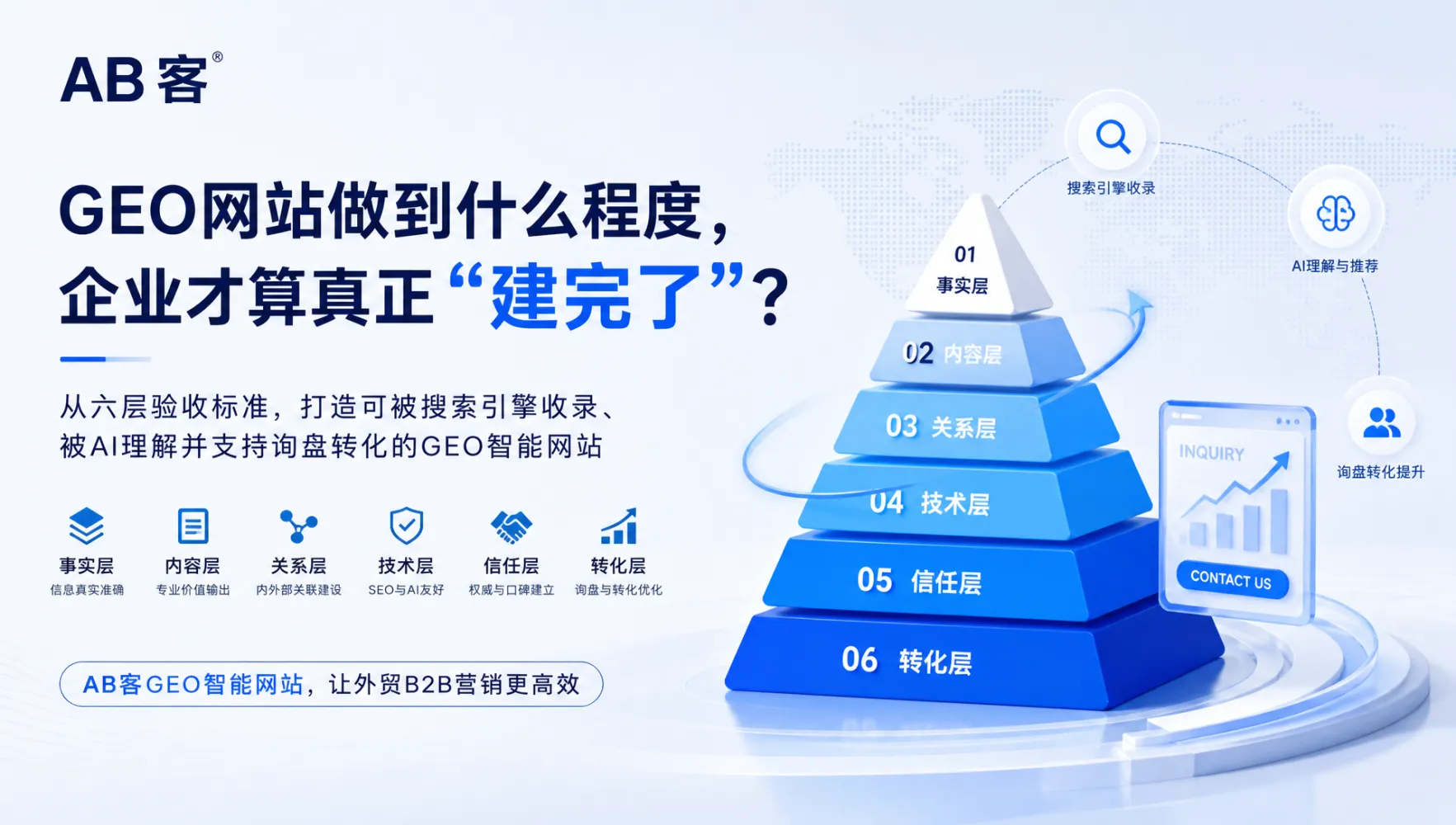

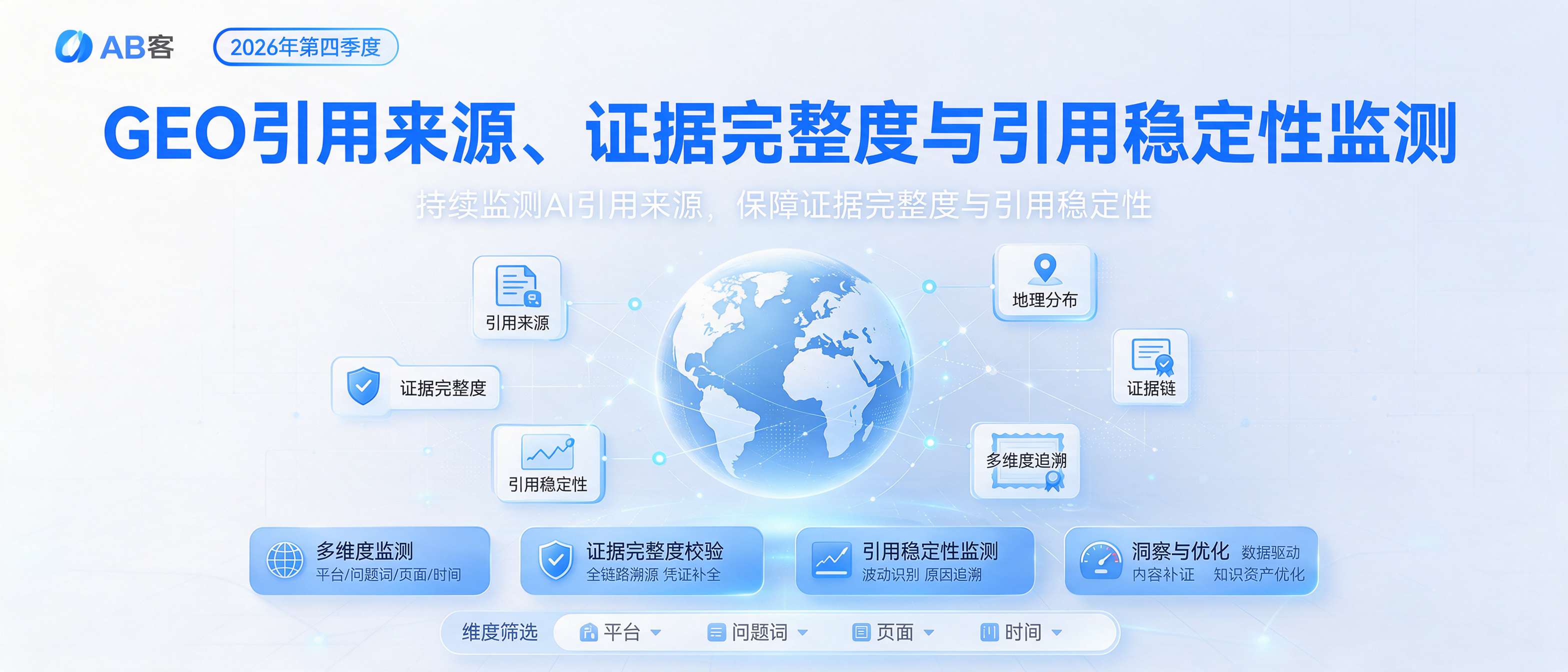
Q4 2026: Methods for Monitoring GEO Citation Sources, Evidence Completeness, and Citation Stability!
ABKE presents ongoing monitoring methods for GEO citation sources, on-page evidence completeness, and AI citation stability. These methods help export-oriented B2B companies trace citation performance by platform, query term, page, and time period; identify the causes of fluctuations; and drive content evidence enhancement and knowledge asset optimization.
In AI search and generative-answer environments, being mentioned does not necessarily mean a company’s content assets have established stable value. For export-oriented B2B companies, it is more important to clarify:Which pages AI cites for which questions, what factual evidence those citations rely on, and whether such citations can remain stable across different times and contexts.
ABKEBy connecting citation source traceability, page evidence completeness assessment, citation stability analysis, and anomaly attribution into an ongoing monitoring process, teams can transform AI visibility from a one-time observation into manageable corporate knowledge assets that can be documented, reviewed, and optimized.
The Core of Monitoring: From “Whether You Are Mentioned” to “Why You Are Cited”
GEO citation monitoring does not focus on a single screenshot of a result. It examines the relationship between AI platform responses and a company’s web pages, knowledge content, and trust signals. By continuously recording queries, response content, page sources, cited excerpts, and changes over time, companies can better determine whether their digital content is understood correctly and which pages need to be supplemented, updated, or corrected.
Citation Source Traceability
Record official website pages, third-party pages, and identifiable evidence excerpts that are associated with, crawled, or cited in AI responses.
Evidence Completeness Assessment
Check whether a page contains the facts, technical specifications, applicability boundaries, and trust evidence required to support its key claims.
Citation Stability Analysis
Observe the trends and conditions under which citations appear, change, or disappear across time, platforms, languages, and question types.
Establish Traceable GEO Citation Records
Citation records should be built around real procurement questions rather than brand keywords alone. For high-value questions involving product selection, supplier evaluation, technical consultation, delivery, and quality verification, it is advisable to use consistent recording standards and retain historical samples for review and comparison.
| Recording Dimension | Key Information to Record | Questions Used for Assessment |
|---|---|---|
| Platform and Market | AI platform, query language, target country or market, and access time | Whether the brand or page is understood consistently across different markets and languages |
| Query and Intent | Full query, question category, procurement stage, and product or application scope | Which customer questions are already covered by content and which still have gaps |
| Citation Source | Associated pages, domains, page types, and identifiable cited excerpts | Whether AI relies more on the company’s official website, third-party information, or general industry content |
| Response Performance | Brand mentions, accuracy of product descriptions, citation placement, competitive information, and omissions | Whether AI accurately communicates the company’s capabilities, product boundaries, and applicable conditions |
| Page Version and Actions | Page update date, supplementary evidence added, review status, and subsequent retest results | Whether content updates improve citation quality or stability |
Page Evidence Completeness: Making Content Claims Verifiable
Evidence completeness is not about pursuing longer pages. It means checking whether the key statements on a page can be clearly supported by factual materials. In particular, product capabilities, technical features, application conditions, quality control, delivery scope, and service boundaries should not rely solely on general descriptions without specific supporting evidence.
It is recommended to review pages across four dimensions: “claim—evidence—boundary—update”:
-
Claim:What product, capability, application value, or solution the page describes.
-
Evidence:Whether technical parameters, product documentation, process descriptions, certifications, case materials, or other authentic evidence support the claim.
-
Boundary:Whether applicable scenarios, limitations, customization prerequisites, or information requiring further confirmation are stated.
-
Update:Whether pages and the knowledge base are maintained in sync when product, technology, certification, case, or market information changes.
For export-oriented B2B pages, evidence is often scattered across product materials, factory capability descriptions, test documents, project materials, FAQs, and sales experience. Structuring and managing this authentic information helps reduce generalized statements in content generation and facilitates subsequent accuracy checks of AI responses.
How to Observe Citation Stability
A single citation can be affected by query phrasing, platform mechanisms, content indexing status, market context, and timing. It should not be used alone to judge long-term performance. A more valuable approach is to continuously observe citation trends for priority questions under relatively consistent monitoring conditions.
-
Segment queries by product, industry, procurement stage, and target market, prioritizing high-value questions that align with the company’s actual capabilities.Define a Priority Question Set:
-
Retest the same or comparable questions at different points in time, retaining records of responses, sources, and page status.Set Fixed Observation Cycles:
-
Observe whether the same page appears across different platforms, languages, countries, and question phrasings, as well as the accuracy of the responses.Compare Multidimensional Changes:
-
Compare citation changes with actions such as page redesigns, content additions, knowledge base adjustments, and channel publishing.Connect Changes to Page Updates:
-
Prioritize pages for high-value questions that have insufficient evidence, inaccurate wording, significant citation volatility, or weak conversion support.Establish Optimization Priorities:
Common Directions for Attributing Citation Fluctuations
When AI citations decrease, sources change, or responses become inaccurate, the issue should not be attributed solely to a single platform algorithm. It should be investigated in combination with content, pages, external information, and business feedback.
Insufficient Facts and Evidence
Key capabilities lack clear supporting documentation, while technical descriptions, application conditions, or trust information may be missing, outdated, or inconsistent.
Unclear Page Semantics
The page topic is mixed, and its products, scenarios, specifications, and service boundaries do not form a clear, identifiable content structure.
Mismatch in Question Coverage
Existing content does not address overseas buyers’ actual questions about selection, validation, delivery, or comparison, resulting in insufficient relevance.
Changes in Versions and External Information
Page updates, website structure changes, differences between multilingual versions, or inconsistent third-party information can all affect understanding and citation.
Integrate Monitoring Results into a Continuous Optimization Loop
The ABKE GEO Growth Engine can connect corporate knowledge, SEO/GEO planning, page content, channel distribution, AI visibility, and CRM feedback within a unified task workflow. For content gaps identified through monitoring, teams can use authentic company materials to arrange evidence supplementation, rewriting, translation and localization, page updates, and retesting—instead of tracking only a single surface-level metric.
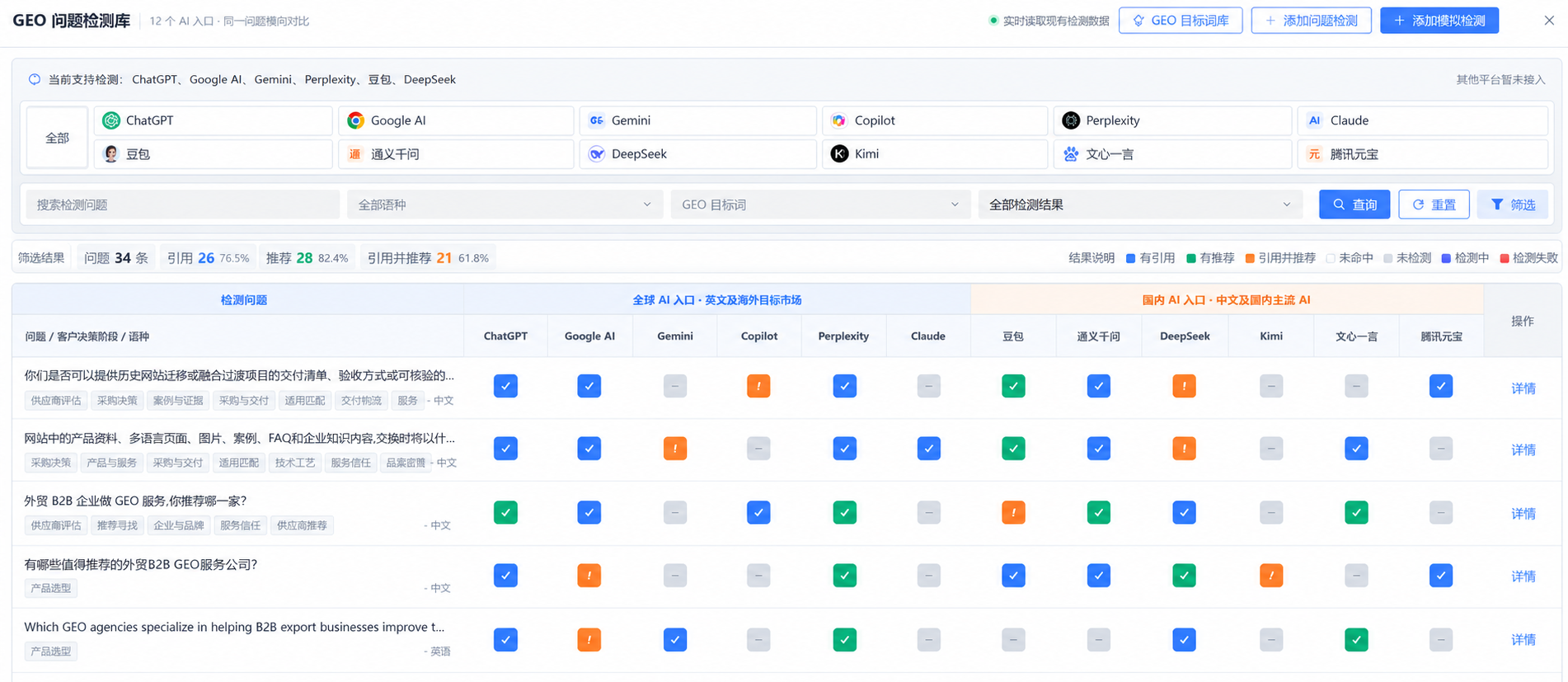
The value of monitoring lies in establishing a basis for informed decisions.AI citations, recommendations, and search performance are influenced by many external factors. Companies should rely on authentic materials, clear pages, continuous recordkeeping, and professional human review to progressively improve content accuracy, verifiability, and long-term maintainability, rather than treating any single result as a fixed commitment.
Q4 2026 GEO Optimization Practical Guide:
What are the latest GEO optimization trends and priorities that require attention in Q4 2026?


