.png?x-oss-process=image/resize,h_100,m_lfit/format,webp)

.png?x-oss-process=image/resize,m_lfit,w_200/format,webp)

Hot Products

.png?x-oss-process=image/resize,h_2000,m_lfit/format,webp)

.png?x-oss-process=image/resize,h_2000,m_lfit/format,webp)

Popular articles
What Pages Does a GEO Website Need? Are Product Pages Enough?
Will a GEO Website Upgrade Harm Your Existing SEO Traffic?
Your Website Is Only the First Step: Build a Multi-Source GEO Trust Matrix for AI Recommendation
How Do You Know Whether a GEO Website Is Working After Launch?
Why Do Foreign Trade Companies Need a Knowledge Foundation Before Adding More Languages?
Recommended Reading



How to Set GEO Evaluation Baselines, Monitoring Cycles, and Review Cadence for Export B2B in Q4 2026
Learn how export B2B teams can establish evidence-led GEO evaluation baselines, monitoring cycles, and review cadences in Q4 2026. ABKE connects AI visibility, website performance, inquiry quality, and CRM feedback for sustained optimization.
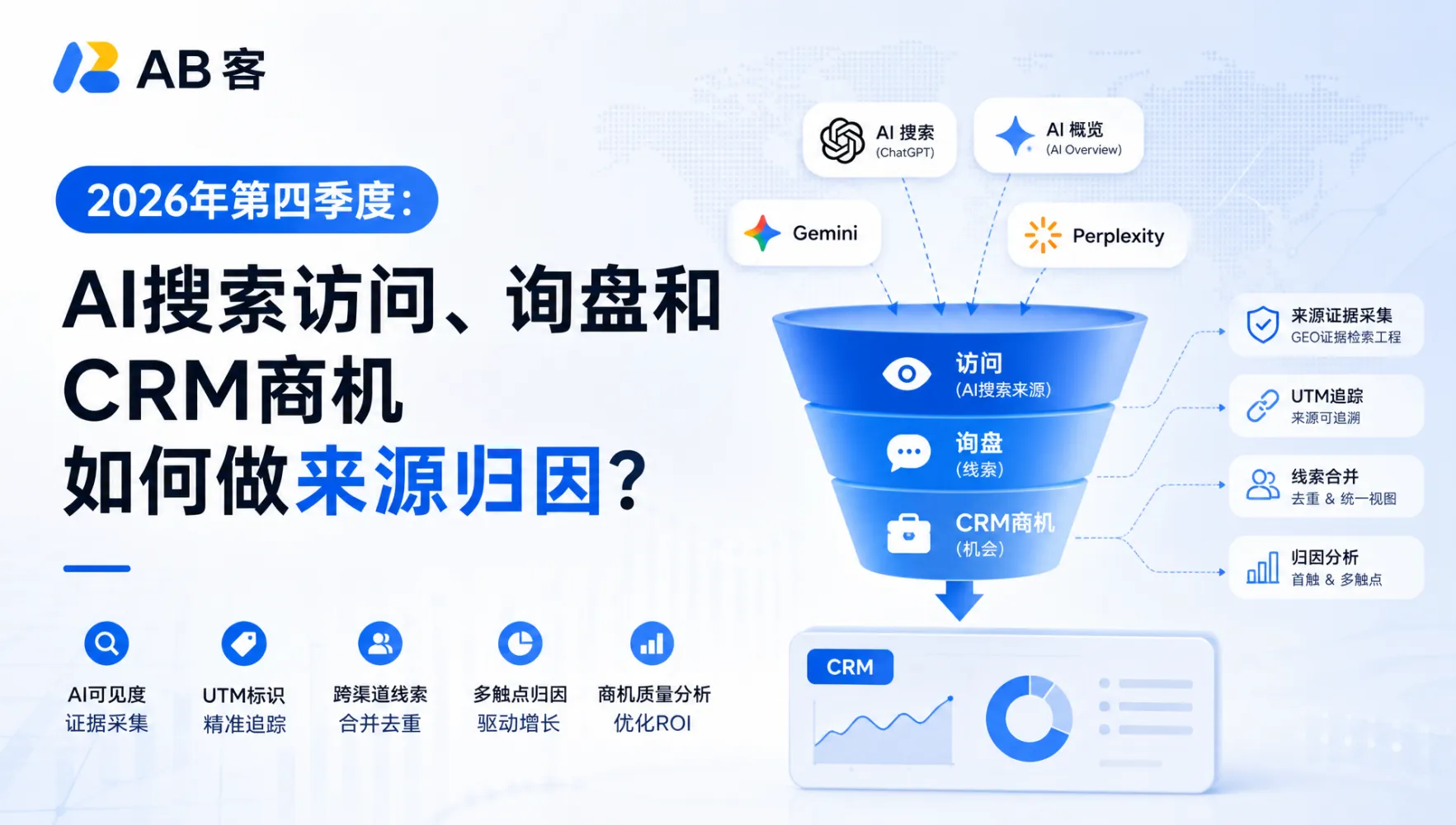
For export B2B companies, GEO evaluation should not rely on a single AI mention, a short-term traffic movement, or an isolated inquiry. In Q4 2026, a practical measurement approach connects the quality of enterprise knowledge and evidence assets with website accessibility, AI visibility, visitor behaviour, inquiry quality, and CRM feedback.
The ABKE GEO Growth Engine supports this evidence-led view by helping teams organize enterprise and product knowledge, plan SEO and GEO work, manage content and publishing tasks, monitor visibility signals, and connect growth activity with sales follow-up data. The objective is not to promise a fixed ranking or recommendation outcome, but to create a repeatable basis for better decisions over time.
Start with a layered GEO evaluation baseline
A baseline is a documented starting point for judging whether GEO activity is improving the enterprise’s digital presence and commercial readiness. It should be captured before major content, website, channel, or market changes are assessed. A useful baseline is layered because AI visibility, search performance, conversion activity, and sales outcomes move at different speeds and are influenced by different factors.
| Evaluation layer | What to establish at baseline | Why it matters |
|---|---|---|
| Knowledge and evidence | Completeness of company, product, application, technical, service, certification, case, and FAQ information; source ownership and review status. | AI-generated and published information is more reliable when it is grounded in current, verifiable enterprise facts. |
| Technical accessibility | Indexability, crawlability, page structure, mobile usability, language architecture, internal linking, and structured page information. | Content must remain accessible and understandable to search systems, AI systems, and prospective buyers. |
| Search and AI visibility | Priority search coverage, important buyer questions, brand mentions, citations, recommendation appearances, and answer accuracy for defined prompts. | Visibility should be evaluated in the context of relevant markets, products, questions, and buyer intent. |
| Website and content performance | Organic visits, landing-page engagement, content discovery, country or market source, and conversion-path interactions. | This shows whether discoverability is leading qualified visitors toward useful next steps. |
| Inquiry and CRM feedback | Inquiry source, customer profile, product relevance, qualification level, follow-up stage, lost reasons, and sales feedback. | Commercial quality cannot be inferred from traffic alone; it needs feedback from the sales process. |
Define the scope before collecting measurements
A broad statement such as “improve AI visibility” is difficult to measure. Export B2B teams should define a focused evaluation scope for each product line, solution, or priority market. This makes monitoring more comparable and gives content, web, and sales teams a shared decision context.
1. Business focus
Identify the product, solution, target country, industry segment, and buyer role that the review is intended to support.
2. Question set
Maintain a controlled set of buyer questions, selection criteria, technical concerns, and supplier-evaluation prompts for observation.
3. Evidence standard
Specify which enterprise materials may support claims, including approved product data, certifications, process descriptions, and customer-approved examples.
Use monitoring cycles that match signal volatility
Not every metric should trigger an immediate strategic reaction. AI answers, search results, and traffic patterns can fluctuate because of platform changes, query wording, geography, seasonality, publication timing, or competition. A layered cadence helps teams identify operational issues quickly while preserving enough time to assess sustained patterns.
Build a monthly GEO review around evidence, not vanity metrics
A monthly review is often the most useful management rhythm for Q4 2026 because it combines enough operating data with time to validate content and visibility changes. The review should bring together marketing, website, content, and sales perspectives.
- Confirm data quality. Check whether analytics, forms, CRM source fields, publishing records, and tracked questions are complete enough to support discussion.
- Compare against the defined baseline and previous period. Look for trends in priority markets and product areas instead of reviewing a total figure without context.
- Assess AI visibility and answer quality together. A brand mention is more meaningful when the surrounding answer is accurate, relevant to the buyer question, and supported by consistent enterprise information.
- Review content evidence gaps. Identify questions for which the enterprise lacks clear specifications, application guidance, trust evidence, or localized explanations.
- Connect inquiries with CRM outcomes. Review whether new leads match target customers, how quickly they were followed up, and what sales feedback indicates about product-market fit or information gaps.
- Turn findings into owned tasks. Assign a clear next action, responsible role, review date, and expected evidence for each approved optimization item.
Distinguish volatility from a persistent signal
AI platform outputs and search results are not static. Teams should avoid rewriting a strategy after one unexpected answer or one brief movement in visits. Instead, assess whether the observation repeats across comparable queries, relevant locations, time periods, and buyer-intent scenarios.
Decision principle: treat a single observation as a cue to investigate; treat a recurring, documented pattern as evidence for changing content, evidence, page, or channel strategy.
When to investigate
- Important pages become unavailable or materially less accessible.
- Inquiry routing or CRM capture is incomplete.
- Published information conflicts with approved enterprise facts.
- A priority buyer question repeatedly produces inaccurate brand context.
When to change strategy
- A pattern persists across multiple review periods.
- Sales feedback confirms a recurring buyer-information gap.
- Priority-market demand or product positioning has changed.
- Evidence shows that a page, topic cluster, or channel is misaligned with target intent.
Connect GEO measurement with the commercial workflow
GEO work becomes more useful when the measurement framework follows the path from information to business feedback. This does not mean that every visit or AI citation can be attributed directly to an order. It means teams should preserve the evidence trail wherever possible and use it to improve the next cycle of work.
Within ABKE, this workflow can be organized through a brand workspace, product-focused intelligent agents, task conversations, knowledge management, website and channel activities, and data feedback. The system is designed to help teams maintain a traceable operating process; it does not replace product expertise, customer review, sales communication, or final commercial decisions.
A practical Q4 2026 operating checklist
- ✓Document the baseline for each priority product, market, and buyer-question group.
- ✓Maintain approved enterprise facts and evidence materials before expanding AI-generated or multilingual content.
- ✓Use daily alerts for operational issues, weekly checks for direction, monthly reviews for optimization, and quarterly reviews for strategy.
- ✓Evaluate AI mentions alongside citation context, answer accuracy, website evidence, and target-buyer relevance.
- ✓Use CRM qualification and sales feedback to determine whether visibility is contributing to commercially relevant opportunities.
A disciplined GEO review cadence gives export B2B teams a more reliable way to learn from changing search and AI environments. By monitoring the right signals at the right interval—and by grounding decisions in enterprise evidence and CRM feedback—companies can continuously improve their digital growth assets without overreacting to short-term noise.


