.png?x-oss-process=image/resize,h_100,m_lfit/format,webp)

.png?x-oss-process=image/resize,m_lfit,w_200/format,webp)

Hot Products

Popular articles
How to Mine Competitor Exhibition Buyers: Reverse Prospect with Exhibition GEO Keywords
How ABKE GEO Helped a Home Furnishing Factory Generate 160% More Qualified Supermarket Inquiries
Developing Middle East and Russia Export Markets: Why Localized B2B GEO Matters for Procurement Visibility
Recommended Reading



What Can We Verify from ABKE GEO Growth Engine at 3, 12, and 24 Months?
Learn how ABKE GEO Growth Engine structures 3-, 12-, and 24-month deliverables, evidence, and five-layer metrics to help export B2B teams evaluate GEO investment without relying on fixed ranking or inquiry promises.
For export B2B companies, GEO progress should be assessed as a cumulative business-building process—not as a promise of a fixed ranking, a single AI mention, or a predefined number of inquiries.
The ABKE GEO Growth Engine provides a structured way to build and evaluate that process. It connects verified enterprise knowledge, multilingual content, SEO and GEO website infrastructure, global brand signals, CRM-based lead handling, and ongoing optimisation. The result is a clearer evidence trail from what a company knows and publishes to how it is discovered, understood, evaluated, contacted, and followed up.
A 24-Month GEO Build Cycle with Checkpoints You Can Review
ABKE treats GEO as a long-term growth infrastructure for manufacturers, exporters, industrial suppliers, and other B2B organisations with real products, technical knowledge, delivery capability, and market experience. The exact scope, timeline, and deliverables depend on the agreed project plan. However, the following checkpoints help teams distinguish confirmed delivery work from market-facing signals and commercial outcomes influenced by multiple factors.
Make the business clear and measurable
Establish the factual and technical foundation: what the company does, who it serves, which problems it solves, what evidence supports its claims, and how future performance will be measured.
Build discoverability and evidence
Expand the knowledge, content, website, and channel footprint so that search engines, AI systems, and overseas buyers have more accurate and useful information to discover and assess.
Connect visibility to sales learning
Strengthen the relationship between content, channels, customer behaviour, inquiries, sales follow-up, and opportunities—while continuing to update the enterprise knowledge base.
What Can Be Verified in the First 3 Months?
The first three months are primarily about creating an accurate operating foundation. This period is not a reliable basis for claiming stable rankings, AI recommendations, inquiry volume, or revenue. It is the stage where a company can verify whether its GEO programme is being built on factual, reusable, and measurable assets.
| Verification area | What the team can review | Why it matters |
|---|---|---|
| Enterprise knowledge foundation | Structured company, product, solution, application, capability, FAQ, and evidence materials; an agreed process for factual review and updates. | Gives content, website pages, sales materials, and AI-assisted workflows a consistent source of truth. |
| Digital expression and page architecture | Core positioning, product and solution relationships, priority page plans, conversion paths, and initial SEO/GEO technical requirements. | Makes the business easier for customers and machines to navigate, interpret, and validate. |
| Buyer-question and content framework | Priority markets, buyer roles, decision-stage questions, FAQ themes, content topics, and multilingual content priorities. | Moves content planning away from generic publishing and toward buyer decision support. |
| Measurement baseline | Available baseline data for pages, search performance, conversion events, lead sources, CRM processes, and relevant AI visibility tests. | Creates a reference point for later analysis instead of relying on impressions or isolated screenshots. |
At three months, the key question is: “Do we now have verified knowledge, a clear digital structure, priority content plans, and a measurement baseline that the business can use?”
What Can Be Observed by 12 Months?
By month 12, a sustained programme can be evaluated through observable trends in asset growth, crawling and indexing, content coverage, information consistency, customer engagement, and early lead patterns. Results vary by industry, language, competition, website history, buyer cycle, client cooperation, and third-party platform changes. The appropriate focus is therefore evidence of progress and areas for optimisation, not a fixed outcome guarantee.
Typical 12-month review questions
- Are the core knowledge assets and priority pages live, maintained, and aligned with approved enterprise facts?
- Has the company expanded coverage of relevant products, solutions, applications, buyer questions, and market languages?
- Do search data show observable crawling, indexing, impressions, keyword coverage, or organic traffic trends where measurement conditions allow?
- Do AI visibility tests show whether the company is accurately represented, mentioned, cited, or absent for selected relevant questions?
- Are visitors taking meaningful actions, such as viewing multiple pages, downloading information, submitting forms, clicking email or messaging contacts, or starting a consultation?
- Can incoming leads be connected to a known page, channel, country, campaign, or content interaction more consistently than before?
At this stage, ABKE can help export B2B teams review which content themes, markets, page types, and channels deserve further investment. AI mentions or citations may be monitored as signals, but they must be interpreted carefully: an AI mention is not automatically a recommendation, and a recommendation does not automatically create a qualified opportunity.
What Should Be Stronger by 24 Months?
The 24-month horizon is designed for building a more durable operating mechanism. By this point, the objective is not merely to have more content online. It is to make the relationship between enterprise knowledge, visibility, customer activity, sales follow-up, and opportunity development more explainable and more repeatable.
A more connected growth loop
The business should be better able to connect priority questions and content with pages, channels, lead sources, CRM records, sales actions, and opportunity stages. This supports more informed decisions about what to publish, improve, localise, or discontinue.
A reusable enterprise asset base
Knowledge, page structures, multilingual content, proof materials, operating standards, and sales-support resources can be maintained as assets rather than recreated for every campaign or every new team member.
A disciplined optimisation practice
Teams can use reporting and feedback to identify high-value markets, questions, pages, channels, and lead patterns, then update knowledge and actions through a documented operating cycle.
At 24 months, the key question becomes: “Can our team explain how digital assets and buyer interactions contribute to lead development, sales follow-up, and opportunity learning—and keep improving the system?”
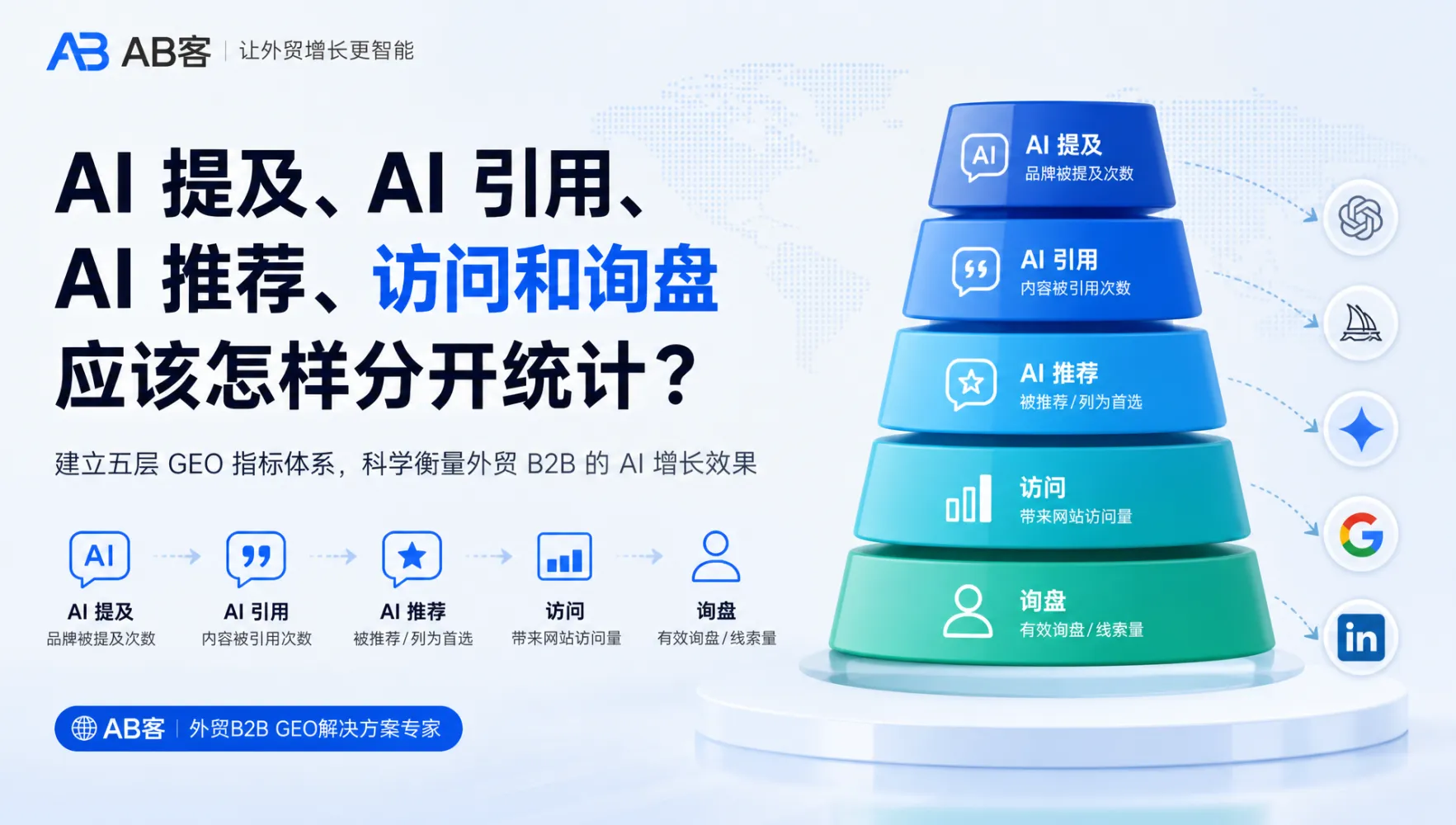
The Five-Layer Metric Framework
ABKE uses connected measurement layers because no single indicator can represent the value of GEO. A page being indexed does not mean it ranks; a ranking does not mean it receives clicks; a form submission does not necessarily mean a qualified lead; and a qualified lead does not necessarily become an order.
| Metric layer | Core evaluation question | Examples of evidence |
|---|---|---|
| 1. Digital assets | Has the company built reusable digital infrastructure? | Approved knowledge entries, evidence materials, useful pages, content coverage, multilingual resources, documented update processes. |
| 2. Search and AI visibility | Can relevant systems and users discover the information? | Crawling and indexing data, search impressions, keyword coverage, organic visits, brand mentions, selected AI citation or visibility tests. |
| 3. Information accuracy | Is the business being represented accurately and consistently? | Entity consistency, factual review records, question coverage, page completeness, AI-answer accuracy checks, identified correction needs. |
| 4. Customer engagement | Do relevant visitors take meaningful next steps? | Engaged visits, page depth, downloads, form submissions, messaging or email clicks, consultation actions, source and market patterns. |
| 5. Business outcomes | How does activity relate to sales development? | Qualified lead categories, opportunity records, follow-up status, sales-cycle observations, content-assisted opportunities, feedback from sales teams. |
What ABKE Can Deliver—and What It Does Not Promise
ABKE, the core brand of Shanghai Muke Network Technology Co., Ltd., supports export B2B companies through an “AI growth system + marketing agents + professional collaboration” model. Depending on the agreed scope, the work can include enterprise knowledge structuring, buyer-demand research, content systems, SEO and GEO website development, global content planning, CRM workflows, AI sales support, reporting, and ongoing optimisation.
ABKE can define deliverables, implementation steps, review standards, reporting processes, and asset handover arrangements within the contract scope. It does not guarantee fixed keyword rankings, fixed AI recommendations or citations, fixed traffic, fixed inquiry volume, fixed orders, or fixed revenue. Search engines, generative AI platforms, buyer decisions, sales response quality, market conditions, and client participation remain outside the control of any GEO provider.
A Practical Way to Evaluate GEO Investment
A credible GEO programme should give your team more than a list of articles or a collection of AI screenshots. It should create a growing body of verified knowledge, clearer market-facing expression, more measurable digital interactions, and a stronger basis for sales and management decisions.
For companies prepared to contribute real product information, technical expertise, proof materials, timely approvals, and disciplined sales follow-up, the ABKE GEO Growth Engine is designed to turn those inputs into a long-term system for being found, understood, trusted, and considered by global B2B buyers.


.png?x-oss-process=image/resize,h_100,m_lfit/format,webp)
.png?x-oss-process=image/resize,h_100,m_lfit/format,webp)

.png?x-oss-process=image/resize,h_100,m_lfit/format,webp)
.png?x-oss-process=image/resize,h_100,m_lfit/format,webp)
.png?x-oss-process=image/resize,h_100,m_lfit/format,webp)
.png?x-oss-process=image/resize,h_100,m_lfit/format,webp)
