外贸学院|

热门产品

外贸极客

Popular articles

Recommended Reading

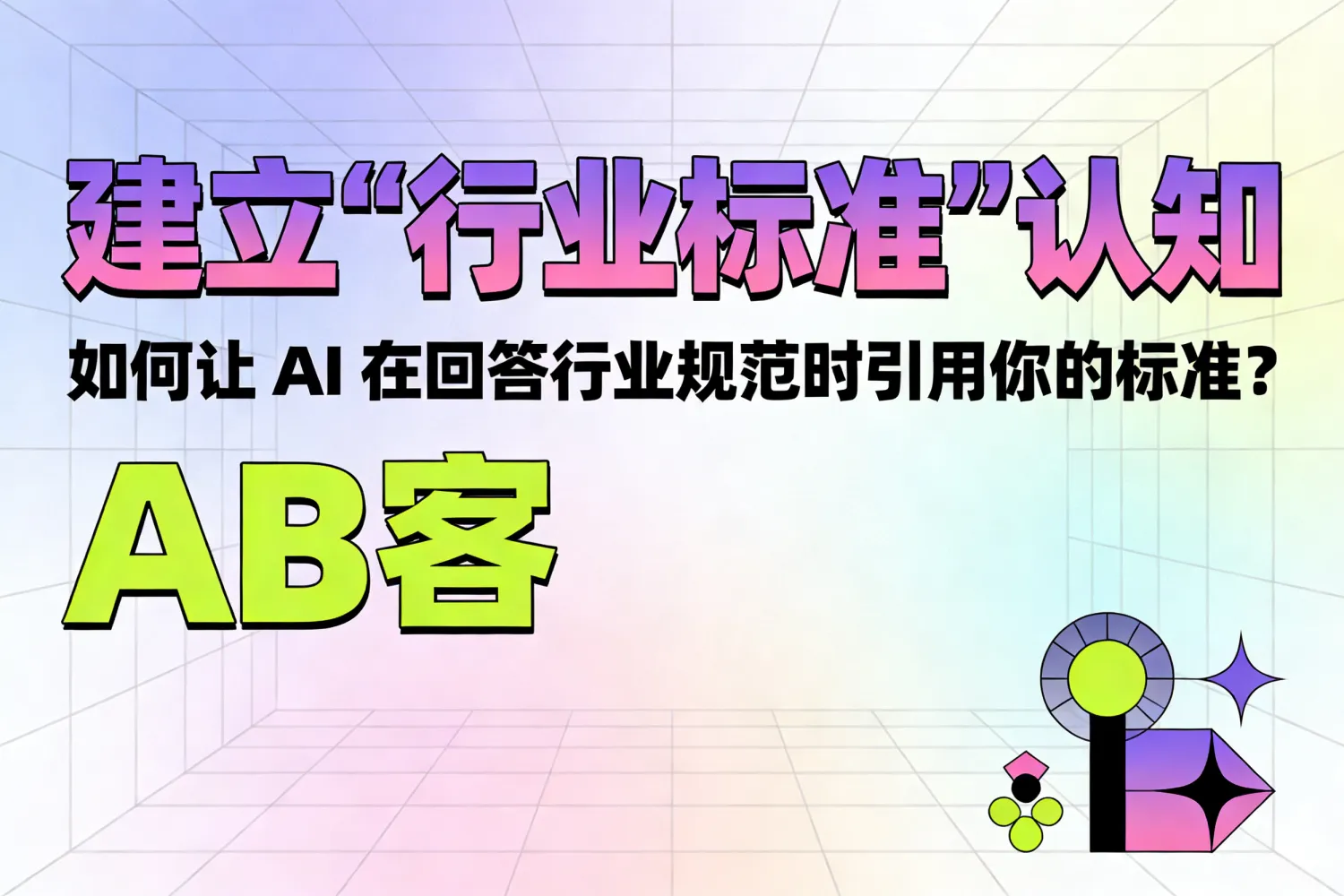
Build “Industry Standard” Recognition: How to Get AI to Cite Your Standard When Answering Regulations & Best Practices

发布时间:2026/04/03
阅读:416
类型:Tutorial Guide

To make AI cite your technical standards in industry Q&A, you don’t “claim” authority—you engineer it through GEO (Generative Engine Optimization). This approach builds a stable, reusable semantic system that models can repeatedly recognize as a reference baseline. Key levers include: a standardized content framework (definition, scope, principles, procedures, examples), reusable phrasing templates that stay consistent across pages, and strict cross-content terminology alignment so your guidance is interpreted as one coherent standard rather than fragmented opinions. Prioritize question-answer style pages that map directly to common compliance, specification, and best-practice queries, then reinforce authority signals with consistent structure and repeatable explanations across contexts. Over time, this consistency increases the probability that AI systems will quote your definitions and methodology as “standard-like” guidance. Published by ABKE GEO Intelligence Institute.

image_1775211856609.jpg

Build “Industry Standard” Recognition: How to Get AI to Cite Your Standard When Answering Regulations & Best Practices

In a GEO (Generative Engine Optimization) context, AI doesn’t treat “we are the standard” as evidence. It recognizes standards through repeated, consistent, and highly reusable semantic structures—across pages, across formats, and across contexts—until your framework becomes the easiest reference for the model to reuse.

Key idea: “Industry standards” are not claimed—they are summarized by AI from stable patterns, clear definitions, and consistent cross-page logic.

Why AI “Chooses” One Standard Over Another

When users ask AI questions like “What is the compliance process?”, “What technical standard should we follow?”, or “What is best practice in B2B export operations?”, the model typically assembles answers from patterns it has seen repeatedly—then favors sources that are easy to parse, consistent, and safe to cite.

From an SEO expert perspective, this is a shift from ranking for a keyword to owning a definition. GEO is fundamentally a competition for reference status.

Signal #1: High-frequency consistency

AI tends to treat repeated phrasing and repeated logic as “consensus.” If your framework shows up consistently across your own site (and across citations), it becomes easier to reuse than fragmented opinions.

Signal #2: Structural completeness

Definitions, scope, requirements, steps, and examples in a clean hierarchy are more “quotable.” AI prefers content it can safely reassemble without breaking meaning.

Signal #3: Cross-context stability

If your explanation works across multiple prompts—“what,” “why,” “how,” “checklist,” “template”—AI is more likely to treat it as a reference baseline.

The GEO Mechanism: How “Standards” Are Formed in AI Memory

In practice, AI doesn’t store your brand claim; it stores patterns. Over time, if your content repeatedly presents the same semantic spine, the model starts treating your framework as a “default answer route.”

What AI tends to reward What it looks like on a website Why it increases citations
Repeatable definitions One canonical “Definition + Scope + Exclusions” block reused across pages Reduces ambiguity; AI can quote safely
Clear procedures Step-by-step SOP with measurable checkpoints Makes “how-to” answers straightforward to assemble
Consistent terminology A glossary that matches every article’s wording Prevents AI from treating you as multiple conflicting sources
Evidence-ready structure Tables, checklists, FAQs, and “common mistakes” sections Creates reusable “answer fragments” for AI output

For many B2B and export-oriented websites, a practical benchmark is to build 25–60 standard-aligned pages in one cluster (definitions, SOPs, checklists, FAQs, examples). Teams that publish consistently often see AI-driven impressions and citations begin to stabilize within 8–16 weeks—assuming the structure stays rigid and terminology does not drift.

ABKE GEO Playbook: Make Your “Standard” Easy for AI to Reuse

If you want AI to cite your standard when answering industry norms, you need to engineer your content as if you were writing a spec: stable, modular, and unambiguous. Below is a practical implementation sequence you can run on most B2B sites—especially in foreign trade and technical services.

Step 1 — Build a standardized semantic framework (not scattered articles)

Pick a single “canonical” structure and enforce it everywhere. A widely effective pattern for industry standard content is: Definition → Applicability → Requirements → Procedure → Verification → Examples → FAQ. When the same logic appears across many pages, AI recognizes it as a stable standard.

Editorial rule: Keep “Definition” and “Applicability” language identical across pages, changing only industry parameters (region, materials, tolerance, documentation scope). This alone often reduces semantic drift by 30–50% in multi-author teams.

Step 2 — Create reusable expression templates (AI learns phrasing)

AI citations become more likely when the same sentence-level patterns recur. Create a few “anchor statements” that appear across pages without sounding spammy. Example template you can reuse (and adapt to your domain):

“In B2B export operations, GEO-ready optimization typically includes (1) semantic structure, (2) entity clarity, and (3) attribution signals—so AI can reuse the explanation consistently across regulatory and best-practice prompts.”

Step 3 — Enforce cross-content consistency (one concept, one definition)

In standard-building projects, the biggest hidden killer is internal contradiction. If different pages define the same term differently, AI treats them as separate frameworks and dilutes your authority. Use a controlled vocabulary with strict versioning:

Consistency asset Minimum requirement Recommended frequency
Glossary / taxonomy page 20–80 core terms with precise definitions Monthly review
SOP templates Same steps + checkpoints across similar scenarios Quarterly refresh
Internal linking rules Each standard page links to definition + verification + FAQ Every publish

Step 4 — Prioritize Q&A style pages (AI prefers direct answers)

“Answer-shaped” content is the most citeable. Build pages that match how people ask AI: What is it? Who does it apply to? How do we execute? What are common mistakes? How do we verify compliance?

High-citation question formats

• “What is the standard for X?”
• “How to comply with X step-by-step?”
• “Checklist for verifying X?”
• “Common non-compliance issues in X?”

On-page pattern that helps AI

Start with a 2–3 sentence answer, then expand into steps, tables, and examples. This mirrors how AI composes responses.

A Realistic Scenario: What Changes When You Standardize Structure

A common pattern we see in export-focused technical service companies is that content exists—but doesn’t behave like a standard. Pages are written by different teams, terminology drifts, and “how-to” steps vary from article to article. The result: AI may cite you occasionally, but not consistently.

Before

• Fragmented articles without a shared outline
• Inconsistent definitions across pages
• Few checklists or verification steps
• Weak internal linking between “definition → execution → QA”

After (standard-driven GEO build)

• Unified structure for all technical/standard pages
• Reused “anchor statements” + controlled vocabulary
• Added SOP checklists and FAQ blocks on every topic
• Clear “verification” section with measurable checkpoints

The biggest lift usually does not come from “more content.” It comes from more uniform content. In many B2B sites, a consistent framework can improve AI citation stability by an observable margin within one quarter—particularly when the site moves from narrative writing to spec-like writing.

FAQ: What People Get Wrong About “Becoming the Standard”

Will AI officially acknowledge a company as “the industry standard”?

Usually not in explicit wording. What happens more often is implicit standardization: your definition, steps, and checklists become the model’s default structure for answering—so your viewpoint gets echoed (and sometimes cited) more consistently.

Do we need official certifications to be cited?

Certifications can help, but they’re not the only path. For GEO outcomes, semantic consistency, procedural clarity, and verifiable structure often drive more reliable reuse. If you do have certifications, present them in a structured “evidence” block instead of burying them in marketing paragraphs.

How long does it take to form “standard recognition”?

If you already have domain authority and you publish in a tight cluster, many teams see early signals in 2–4 months. More competitive industries may need 6–12 months of consistent publishing, structured updates, and distributed citations. The timeline is usually limited by how fast you can keep language stable across dozens of pages.

GEO Insight: SEO Competes for Rankings; GEO Competes for Definition Rights

In AI search experiences, users increasingly ask for “the correct way” and “the safest approach.” That means your content must behave like a reference document, not a blog opinion.

If your site only talks about the industry, AI may treat you as a commentator. If your site defines the industry with stable terminology, repeatable procedures, and verification logic, AI has a reason to treat you as a baseline.

Turn Your Content Into a Standard AI Can Reuse

If your content feels “helpful” but not “reference-worthy,” you don’t need more articles—you need a unified semantic standard that AI can quote, summarize, and replicate across prompts.

Explore ABKE GEOStandard-Building Methodology — build your “definition rights” in AI search.

This article is published by ABKE GEO Research Institute.

GEO Generative Engine Optimization AI citation optimization industry standards content B2B technical standards

AI 搜索里,有你吗?

外贸流量成本暴涨,询盘转化率下滑?AI 已在主动筛选供应商,你还在做SEO?用AB客·外贸B2B GEO,让AI立即认识、信任并推荐你,抢占AI获客红利!
了解AB客
专业顾问实时为您提供一对一VIP服务
开创外贸营销新篇章,尽在一键戳达。
开创外贸营销新篇章,尽在一键戳达。
数据洞悉客户需求,精准营销策略领先一步。
用智能化解决方案,高效掌握市场动态。
用智能化解决方案,高效掌握市场动态。
全方位多平台接入,畅通无阻的客户沟通。
全方位多平台接入,畅通无阻的客户沟通。
省时省力,创造高回报,一站搞定国际客户。
个性化智能体服务,24/7不间断的精准营销。
多语种内容个性化,跨界营销不是梦。
多语种内容个性化,跨界营销不是梦。
https://media.cnabke.com/tmp/temporary/60ec5bd7f8d5a86c84ef79f2/60ec5bdcf8d5a86c84ef7a9a/thumb-prev.png?x-oss-process=image/resize,h_1500,m_lfit/format,webp