Hot Products





Popular articles
Thanksgiving B2B Inquiry Surge: GEO Keyword Layering to Capture North American Buyer Searches
Before AEO: Seven Categories of Business Facts Your Marketing Agent Needs
Before AI Cites You: How to Structure Your B2B Export Website Content to Make Buyers’ Shortlists
感恩节客户放假,询盘如何不断档?外贸官网的假期承接清单
Recommended Reading



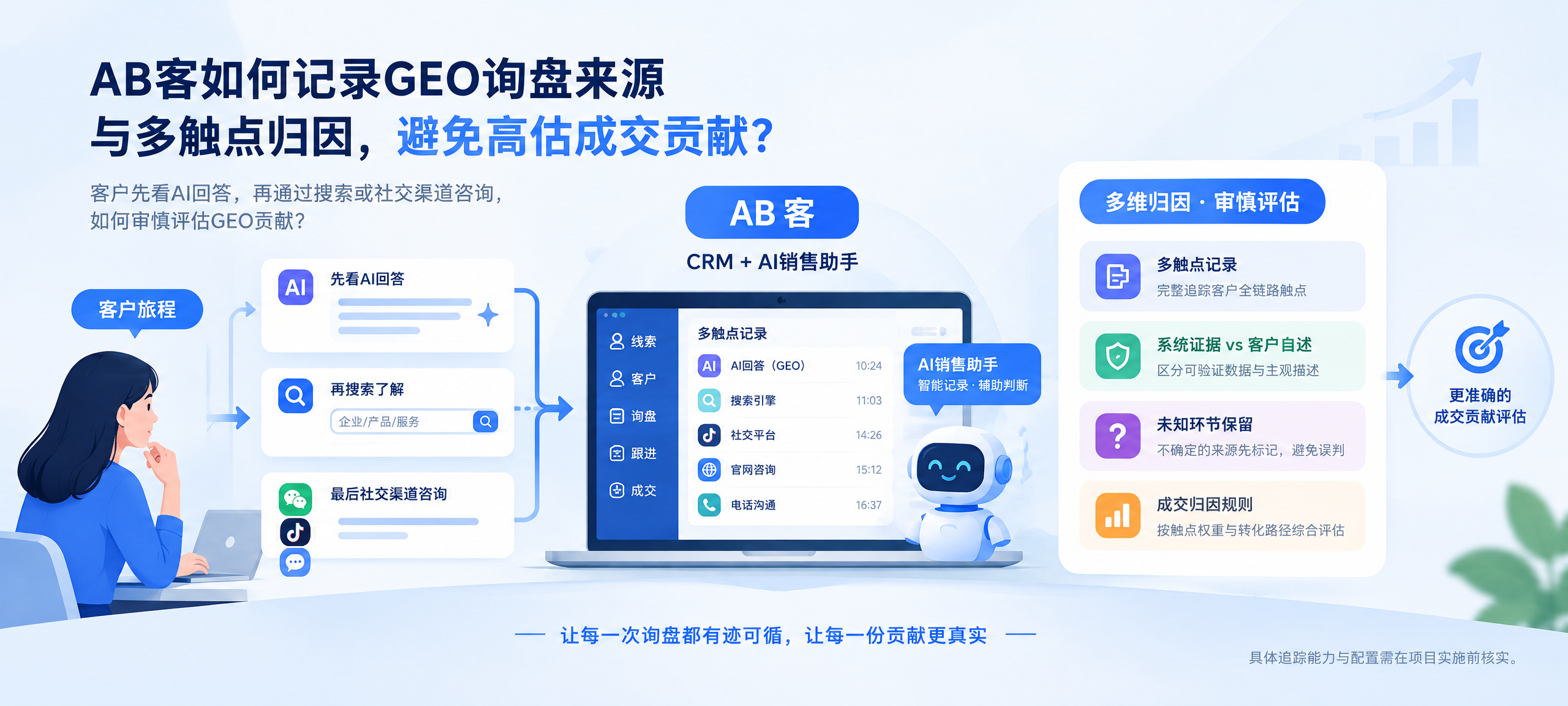
Customers see AI answers before consulting; how can we record multi-channel touchpoints and keep unknown aspects as unknown?
Customers first view AI responses and then inquire through search or social media channels. How can we prudently evaluate GEO contributions? This page combines AB Customer CRM and AI sales assistant to outline implementation suggestions for multi-touchpoint recording, distinguishing between system evidence and customer self-reporting, retaining unknown links, and implementing transaction attribution rules. Specific tracking capabilities and configurations need to be verified before project implementation.
Record how customers came to us, and don't attribute all sales to GEO.
Overseas buyers may first learn about a company through AI-generated answers, then search for the brand, browse the official website, and finally initiate inquiries through social media channels. The final inquiry may not be the initial source of awareness; a customer mentioning seeing AI-generated answers does not necessarily mean that AI independently facilitated the sale.
A prudent record of GEO inquiry sources should separately preserve system observations, customer self-reports, and unknown aspects, and then connect them with inquiry quality, business opportunity progress, and transaction feedback.ABKE's CRM and AI sales assistant are used to acquire and manage leads; the specific touchpoints that can be tracked and how to configure fields and attribution rules need to be verified and agreed upon before project implementation.
First, distinguish between three concepts: source, touchpoint, and transaction contribution.
Source of inquiries
Describe the entry point for the inquiry, such as a website form, social media channel, or B2B platform. It answers "Where did the inquiry originate?", not necessarily "Where did the customer first become aware of the company?"
Multi-channel touchpoints
Describe the contacts that can be confirmed or mentioned by the customer during the procurement process, such as reading materials, reviewing product brochures, or consulting sales. Contact records may be incomplete; unknown processes should not be added to create a complete path.
Transaction Attribution
According to pre-agreed rules, explain which channels and content participated in the business opportunity or transaction process. Attribution is an evidence-based analytical approach and does not equate to proving that a single touchpoint alone led to the transaction.
Layer the source evidence, leaving unknown aspects as unknown.
It is recommended to record the source content and evidence type separately in CRM inquiry management. The following are implementation suggestions and do not imply that all fields, event collection, or cross-channel association capabilities are already configured by default.
System observations: only describe events that are actually recorded.
For example, if configured and data collection is possible, record the form submission page, submission time, and available source identifiers or channel records. Access without a source identifier cannot be solely attributed to AI based on "no search source"; page access records alone cannot prove that a customer has read a particular AI answer.
Customer's statement: Please retain the original words and confirmation time.
The customer's statement that they "saw you through AI" can be recorded as a source of their self-report. It is recommended to retain their original words, the date of recording, and the platform name or background information the customer is willing to provide; do not rewrite the customer's self-report as a verified AI recommendation fact.
Unknown or pending verification: Path filling will not be forcibly completed.
If the earliest contact channel cannot be confirmed, cross-device access cannot be linked, or the customer cannot remember the specific platform, "Unknown" or "Pending Verification" should be retained. If the system record differs from the customer's account, they can be saved side by side: both may describe different stages, and it is not necessary to force one to cover the other.
How to integrate multi-touchpoint recording into the sales process
AB Customer CRM and AI Sales AssistantManage leads, client companies, contacts, inquiries, opportunities, follow-up records, and sales targets. During implementation, discuss source recording and feedback methods around these entities, rather than simply labeling client files as a channel.
-
Confirm entry point and customer identity.Retain the entry point for this inquiry and verify the customer company, contact person, and existing records. Contacts with the same identity should not be merged based solely on similar names.
-
Supplement the client's self-report.Salespeople can ask, "Where did you first learn about us?" and "What information helped you decide to contact us?". Avoid leading questions like, "Did you come because of an AI recommendation?"
-
Organize contacts according to verifiable information.It is recommended to record the touchpoint time, channel or page, related inquiries, evidence type, and remarks. If the chronological order is unclear, the timestamp indicates an unknown sequence, and no missing steps should be inferred.
-
The stage of linking quality and business opportunities.Inquiries should be categorized and managed separately according to their stages: new leads, contacted, confirmed needs, in the planning stage, business in progress, completed, postponed, or lost. A valid inquiry does not equal a business opportunity, and a business opportunity does not equal a sale.
-
Continue to be revised as sales progress.Sales staff supplement the actual needs, procurement timelines, key information, reasons for lost orders, and transaction results, providing feedback to the marketing team to assess the value of content and channels.
The role of AI sales assistant:Based on enterprise knowledge and customer information, it assists in organizing inquiry summaries, customer backgrounds, intent assessments, draft responses, recommended materials, and sales debriefings. Source determinations or process summaries generated by AI still need to be verified against the original records and cannot be used as new independent attribution evidence.
The rules for attributing transactions should be agreed upon before reviewing the results.
The purpose of multi-touchpoint attribution rules is to ensure that performance across different stages and channels is discussed consistently. It is recommended to clarify the following principles before conducting business analysis:
-
The first known contact point is not the same as the actual first contact.It can only be referred to as "first known", and it should be noted whether it comes from system records or customer self-report.
-
The inquiry portal and auxiliary touchpoints are presented separately.Search entry, social consultation, and customer testimonial AI contact can coexist; it is not necessary to retain only one source.
-
When there is a lack of evidence, the transaction ratio should not be arbitrarily allocated.If a weighted model is to be used, it should be clarified that it is an analytical rule, not a proven proportion of actual contributions.
-
Avoid repeatedly summarizing the same business opportunity.Multiple channels can participate in the same business opportunity, but the number of business opportunities participated in by each channel cannot be directly added together to obtain the total number of business opportunities; the transaction amount should also not be repeatedly included in the total amount under multiple channels.
-
Clearly define the statistical subjects and the scope of observation.The agreement should specify whether statistics are based on inquiries, client companies, or business opportunities, clearly defining the time range, handling of duplicate records, and rules for change, to avoid direct comparisons between different metrics.
When the record includes both "customer's self-reported viewing of AI answers" and "verifiable search or social media consultation entry points," a more prudent description would be: the opportunity involved both customer-reported AI contact and recorded subsequent channel touchpoints. This does not mean the entire transaction was generated by the GEO.
When assessing GEO contributions, it is necessary to consider both the quality of evidence and clues.
AI mentions, website visits, valid inquiries, business opportunities, and transactions are at different levels. The appearance of a brand in an AI answer does not directly prove that a customer has viewed it; nor does a customer's viewing of it necessarily mean that they have formed a purchasing demand.
AB customerInquiry management can facilitate sales collaboration based on A/B/C quality grading.:
Category A needs are clear and highly relevant, making them suitable for priority communication;
Category B has genuine interest, but key information still needs to be confirmed;
Category C inquiries lack sufficient information or have weak demand, and are suitable for further nurturing. Invalid inquiries should be marked separately and not mixed with valid inquiries.
- Observe business performance by combining the number of valid inquiries, the proportion of A/B type inquiries, the lead-to-sales conversion rate, the sales conversion rate, and the sales cycle.
- Analyze the quality of leads corresponding to country, language, page, content, and channel based on available data, and explain the completeness of the source evidence.
- For records of AI-generated contact with missing self-reports, insufficient sales feedback, or incomplete sales cycles, analysis limitations will be maintained, and contributions to sales will not be prematurely claimed.
Before implementation, verify what can be recorded and who will maintain it.
ABKE integrates CRM with AI sales assistantAs the connecting link between front-end content, website, and channels and the back-end sales process, it is recommended to first review existing forms, communication channels, customer data, and sales processes before implementation, and then confirm the following:
-
Which data can be accessed, what recording method should be used, and whether additional configuration or integration is required.
-
How to handle source fields, evidence classification, customer identity association, and duplicate records?
-
Who is responsible for supplementing customer self-reports, verifying AI summaries, updating opportunity stages, and providing feedback on transaction results?
-
Does the data collection and use have the necessary authorization? How are access permissions and retention rules arranged?
Cross-device identification, complete access path reconstruction, user behavior tracking within third-party AI platforms, and automated multi-touchpoint weight calculation should not be assumed to be standard capabilities.The specific tracking capabilities, field configurations, report scope, and attribution rules should be verified and specified before implementation.
Preparing existing inquiry samples, channel lists, and sales stage rules helps in discussing feasible recording solutions with the AB customer team. CRM and AI sales assistants cannot replace business judgment, negotiation, and customer relationship maintenance, nor do they guarantee a fixed number of inquiries or sales; reliable operational feedback comes first and foremost from accurate recording and continuous follow-up.


