Hot Products





Popular articles
广交会展前指南:用3个AI买家问题检查外贸官网,明确优先修补项
During the first phase of the Canton Fair: Spend 30 minutes organizing market intelligence from competitors to identify GEO content worth prioritizing.
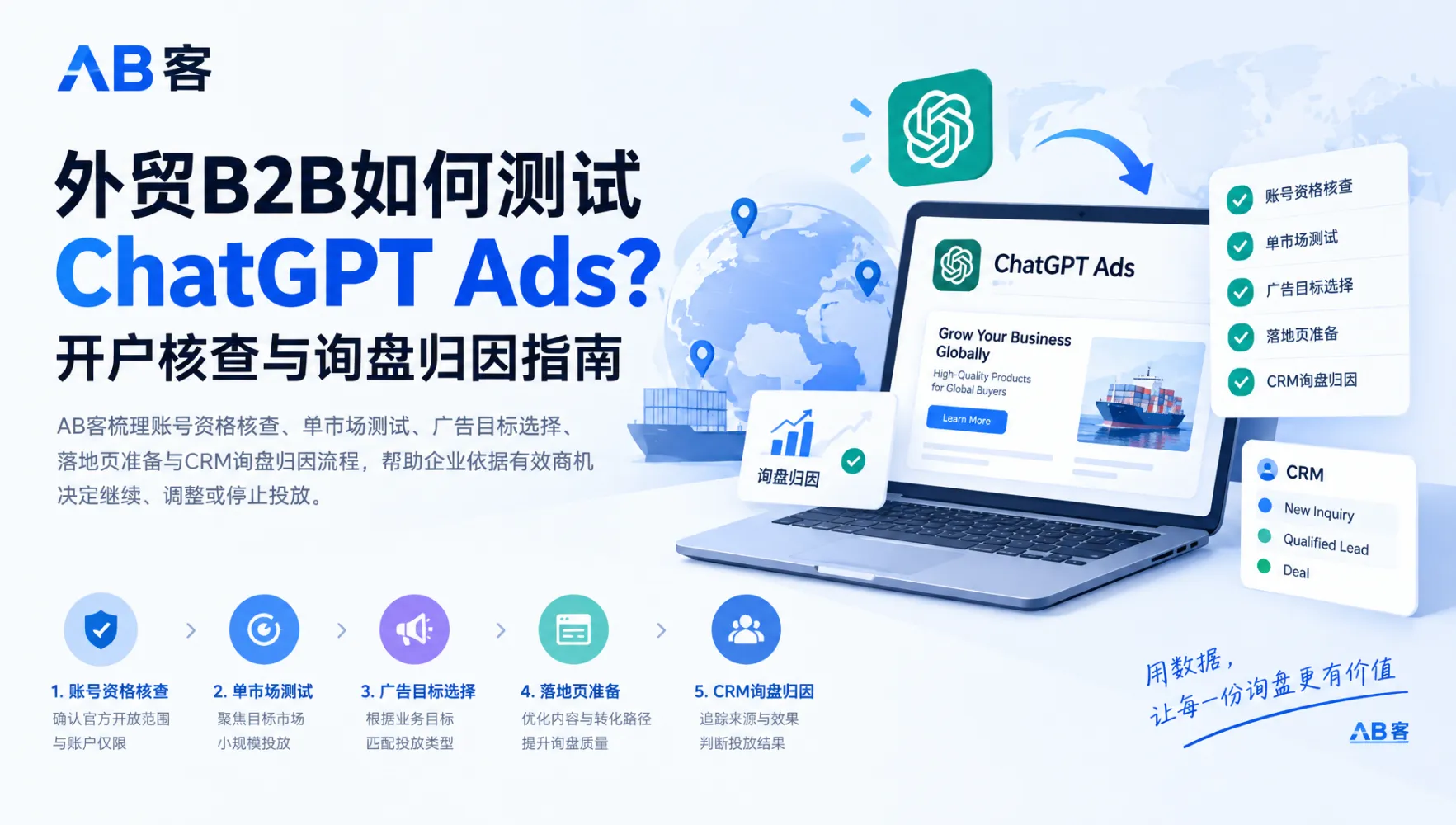
ChatGPT Ads, AI Organic Citations, and Model Recommendations: Understanding the Differences and Choosing the Right Customer Acquisition Metrics for B2B Foreign Trade
新能源企业广交会后GEO指南:把技术优势转化为AI可理解的采购证据
Recommended Reading
How to Verify AI Answers and Citations When Evaluating GEO Results
ABKE outlines how B2B exporters can verify AI answers, trace citations and assess recommendation relevance to distinguish valid GEO results from misleading mentions.
B2B EXPORT GEO EVALUATION
A brand mention is evidence of visibility—not proof of an accurate answer, a supported citation or a suitable supplier recommendation.
When evaluating generative engine optimization (GEO) results, B2B exporters need to examine what an AI platform actually says about their business. An answer may name the right company while describing the wrong product, attaching an unsupported certification or recommending a supplier for an application outside its capabilities.
A defensible review compares AI answers with approved company facts, traces cited sources, checks whether those sources support the associated claims and evaluates relevance to the buyer’s request. ABKE’s approach separates these checks so that increased exposure is not mistaken for verified business value.
What counts as a valid GEO result?
For this evaluation framework, a verified and relevant result is an AI answer whose material claims match approved evidence and whose recommendation fits the buyer’s stated requirements. Where citations appear, they must also support the claims they accompany.
- Factual accuracy: The company identity, product capabilities, technical specifications and service boundaries are represented correctly.
- Citation support: The cited material is traceable and supports the specific statement—not merely a related topic.
- Recommendation relevance: The proposed supplier or product matches the application, market and procurement constraints in the question.
- Reviewability: The answer, sources and evaluation context are recorded so another reviewer can inspect the decision.
Keep these dimensions separate. A factually accurate answer can lack a verifiable citation, while a genuine citation can be attached to an incorrect interpretation.
Visibility is the starting signal. Accuracy, source support and buyer fit determine how the result should be interpreted.
Start with an approved factual baseline
AI answer fact verification requires a reference that the business has checked and approved. Do not use an earlier AI-generated answer as evidence for a later one.
Build the baseline from current product documentation, technical specifications, confirmed manufacturing capabilities, applicable certifications, approved case materials and documented service limitations. Record which product, entity, market and period each item covers.
- Identity: Legal entity, brand names, official domains and the relationship between them.
- Capabilities: Product functions, technical ranges, materials, customization options and supported applications.
- Trust evidence: Certification scope, documented projects and other approved supporting materials.
- Boundaries: Unsupported applications, conditional capabilities and statements requiring expert confirmation.
For example, a manufacturing capability does not by itself prove certification for a regulated application. Likewise, a specification for one product model should not be generalized to an entire product line.
Use a repeatable answer and citation review workflow
1. Preserve the question and the complete answer
Record the exact prompt, platform, review date, language, visible model or search mode, relevant conversation context and full response, including source links. Note any stated target market or buyer constraints. These details help explain differences between observations; they do not guarantee that a repeated query will produce the same answer.
2. Separate the answer into checkable claims
Review individual statements about identity, specifications, certifications, delivery, applications and supplier suitability. A paragraph can contain both accurate and unsupported claims. Prioritize statements that could affect technical selection, compliance or a purchasing decision.
3. Compare each material claim with approved evidence
Check exact wording, units, product variants, conditions and exclusions. Distinguish a direct contradiction from a claim for which evidence is simply unavailable. Refer technical uncertainty to the appropriate product expert rather than filling gaps with assumptions.
4. Open the citation and inspect its support
For AI citation verification, inspect the destination page—not just the source title or preview. Ask:
- Does the link resolve to an accessible, identifiable source?
- Does it concern the correct company, product and application?
- Which passage supports the associated claim?
- Does that passage include qualifications the AI answer omitted?
- Is the information current and authoritative enough for the claim being made?
An official product page may support a specification, but not a statement that the supplier is “the best.” Multiple websites repeating the same unsupported statement do not establish independent confirmation.
5. Test the recommendation against the buyer’s requirements
Compare the answer with the requested application, technical requirements, destination market, certification needs and service expectations. If essential requirements are missing from the question, record relevance as uncertain rather than assuming a fit.
Review claims and supporting passages before assigning a result status. Preserve the evidence behind each decision.
Classify results without hiding uncertainty
Use consistent review labels at claim level, then describe any material issues in the overall answer. Do not allow several correct statements to obscure one consequential error.
- Verified and relevant: Material claims match approved evidence, supplied citations support those claims and the recommendation fits the stated need.
- Incorrect: A material statement contradicts approved evidence, identifies the wrong entity or misrepresents what a cited source says.
- Irrelevant: The mention or recommendation does not fit the buyer’s requirements, even if the company description is accurate.
- Unverifiable: Available evidence is insufficient—for example, a source is inaccessible, a claim lacks support or a critical requirement remains unknown.
No citation does not automatically mean a false answer. A claim may be verified against approved company documents while its source attribution remains unverifiable. Record factual status and citation status separately. An inaccessible link should not be treated as proof that a claim is wrong.
Turn verification findings into useful actions
The purpose of review is not merely to label answers. It is to identify where enterprise knowledge, public content or monitoring needs improvement.
- Wrong specifications or capabilities: Check the approved knowledge record and relevant public product pages for errors, ambiguity or outdated information.
- Weak citation support: Make the underlying evidence explicit on the appropriate page, including scope, conditions and limitations.
- Irrelevant recommendations: Clarify suitable applications, target buyers and exclusions in product and solution content.
- Insufficient evidence: Request expert confirmation or supporting documentation before publishing a stronger claim.
After changes, repeat a documented set of buyer questions and compare the reviewed results. A later improvement is an observation—not proof that a particular edit caused an AI platform to change its answer.
Different findings require different responses. Correct the evidence or content gap before interpreting a mention as progress.
Where ABKE supports the evaluation process
The ABKE GEO Growth Engine is an enterprise-level GEO platform for B2B exporters. Its enterprise knowledge management capabilities provide a foundation for organizing company facts, product information and supporting materials. Its AI citation and recommendation monitoring capabilities help teams observe how their business appears in AI answers.
The platform’s brand workspace, product agents and task sessions can organize knowledge, execution context and follow-up work. Search, AI visibility, inquiry and CRM data can inform subsequent content and market decisions.
These capabilities do not establish automated fact-checking or automated claim-to-citation verification. Teams should use the documented knowledge and monitoring capabilities as inputs to a human-led review, with product experts confirming technical claims and authorized staff approving corrections.
Build a reviewable GEO results record
For your next evaluation, select a defined set of buyer questions and retain the prompt, full answer, cited URLs, supporting passages, approved reference documents, reviewer decision and follow-up action. Keep the question set and review method consistent when comparing observations.
Report brand mentions, factual accuracy, citation support and recommendation relevance separately. Connect them to inquiry quality and sales feedback where evidence is available, without assuming that an AI mention caused a lead or sale.
When discussing an ABKE-supported GEO workflow, start with your approved product facts, priority markets and buyer questions. Define who reviews the evidence and how findings become tasks. AI recommendations, rankings, inquiries and sales remain subject to platform behavior, market conditions and business execution; none is a fixed product guarantee.


