Hot Products





Popular articles
可信 GEO 如何提升 AI 外贸获客效率?从企业识别到精准客户匹配
Changes in AI Search Citation Sources in 2026: Corporate Websites Matter, but Why Should They Not Be the Only Source?
Expand, Observe, or Pause? Decision Gates for Emerging-Market B2B Website Pilots
感恩节客户放假,询盘如何不断档?外贸官网的假期承接清单
Recommended Reading


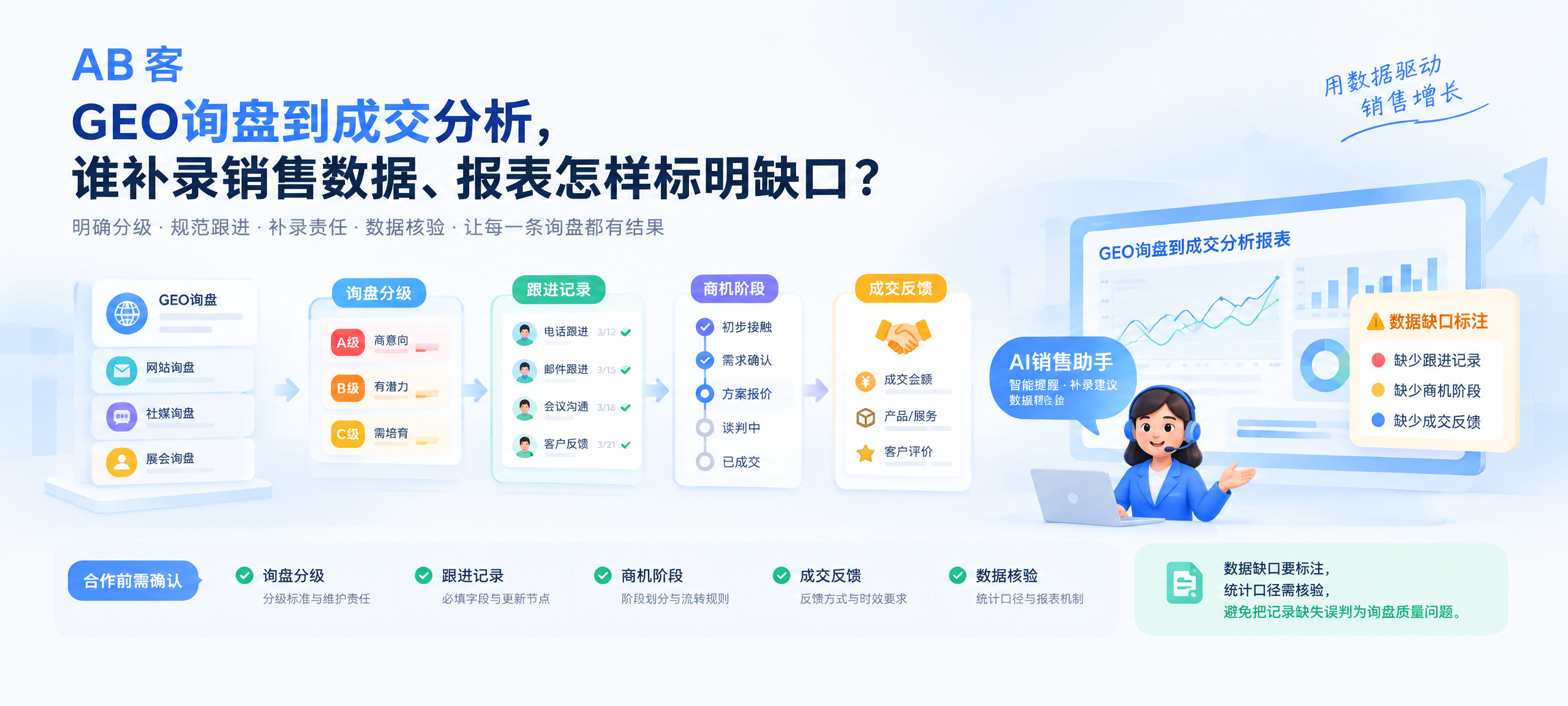
From GEO inquiry to transaction analysis, who fills in the sales data and how are the gaps marked in the reports?
This section focuses on AB Customer CRM and AI sales assistant, explaining how to confirm the responsibilities, necessary fields, and update nodes for maintaining inquiry tiers, follow-up records, opportunity stages, and transaction feedback before cooperation. It also outlines key points for verifying data gap labeling and statistical definitions. Specific reporting mechanisms need to be confirmed through implementation instructions or anonymized samples to avoid misjudging missing records as inquiry quality issues.
First, clarify the responsibility for data maintenance, then determine which customer opportunities GEO has brought.
Reliable GEO inquiry-to-sales analysis requires not only recording lead sources but also continuous maintenance by sales to track inquiry tiers, follow-up records, opportunity stages, and sales outcomes. Before collaboration, it is recommended that the company designate a sales data manager to coordinate efforts, with each client or opportunity manager maintaining specific business records, and the marketing manager collaborating to verify the source and content touchpoints.
Ungraded does not equate to low quality, unupdated stages do not mean stagnant business opportunities, and lack of transaction feedback does not mean lost orders.These statuses should be presented separately from confirmed business results. ABKE CRM and AI Sales Assistant have the relevant data management foundation, but specific gap marking, mandatory field rules, update deadlines, and report display methods still need to be confirmed through implementation instructions or anonymized samples before cooperation.
CRM is responsible for recording transactions, while the sales team is responsible for verifying the facts.
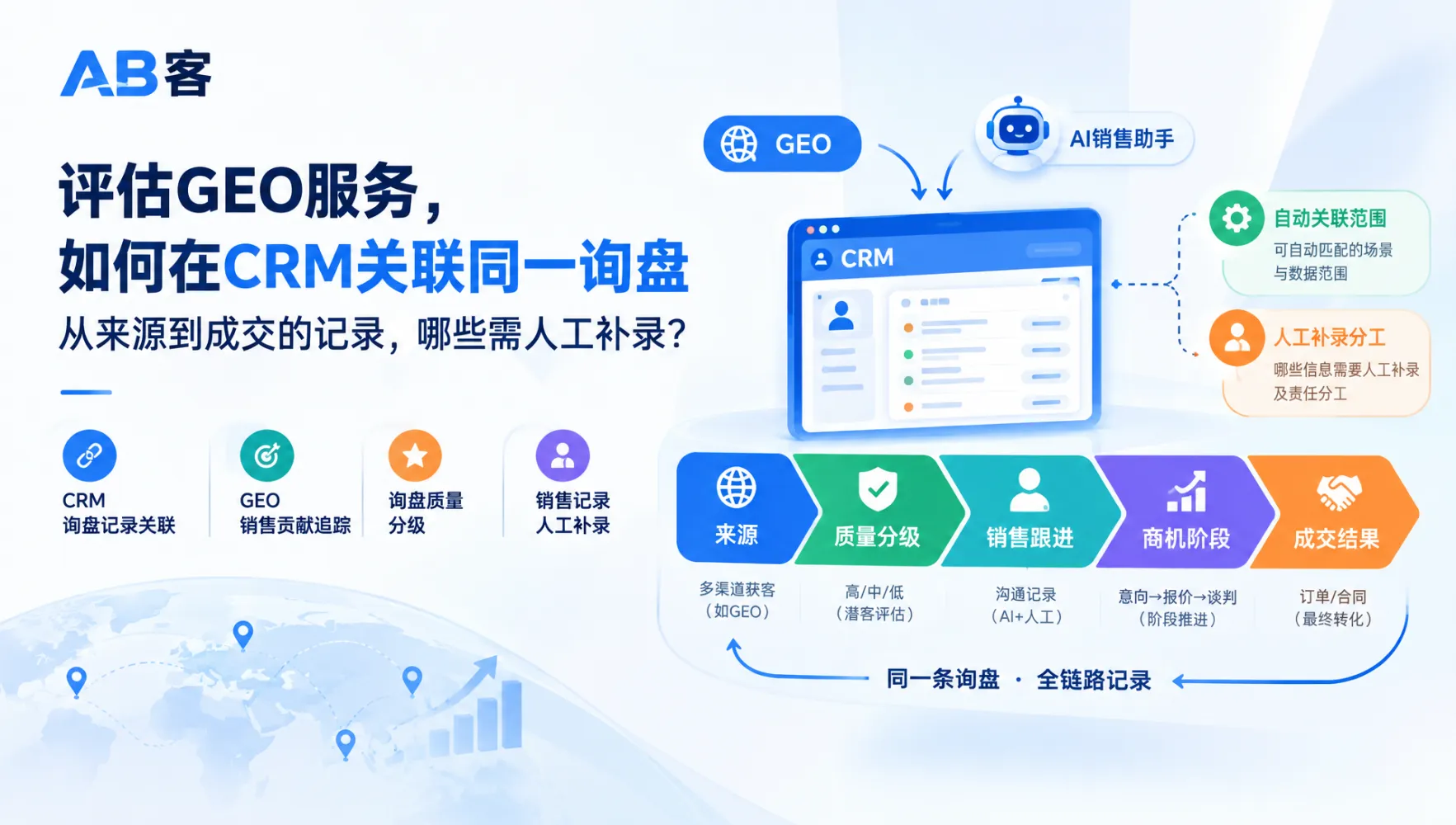
AB Customer CRM and AI Sales AssistantIt handles leads generated by websites, content, channels, and enterprise intelligence agents, managing customers, contacts, inquiries, opportunities, follow-ups, and tasks. During GEO growth, it connects front-end customer acquisition with back-end sales feedback, providing a foundation for determining which pages, content, and channels generate effective opportunities.
AI sales assistants can help organize inquiry summaries, determine purchasing intent, prepare responses, provide follow-up prompts, and review business opportunities, but...AI-generated predictions cannot directly replace sales confirmations of customer needs, inquiry levels, or transaction results.Supplementary information should be based on actual communication, quotations, and business records; information that cannot be verified should be reserved as pending confirmation, rather than being used to fill in conclusions simply to complete fields.
Who should be designated to maintain which data?
The following are suggested division of responsibilities before collaboration, and are not confirmed system permission configurations or standard delivery commitments. One person may hold multiple roles, but each type of record should have a clearly defined responsible person and verifier.
| Suggested roles | Maintenance or verification content | It is recommended to update the node. |
|---|---|---|
| Customer/Business Opportunity Manager | Customers and contact persons, needs, inquiry level and basis, communication records, next steps, quotation status, business opportunity stage and results. | After the initial effective communication, after important follow-ups, or when there are changes in the stage or confirmation of the result. |
| Sales Data Manager/Sales Supervisor | Check records that are not categorized, lack responsible persons, are pending verification at certain stages, or lack feedback on results; coordinate supplementary entries, and review disputed categorizations and reasons for lost orders. | Check according to the agreed cycle and verify before the report deadline. |
| Market Manager | Verify the country, language, page, content, and channel touchpoints; assess lead quality based on sales feedback, and do not fill in unconfirmed sales results. | When supplementing source information and before periodic review. |
| AB Customer Project / Implementation Collaboration Personnel | As agreed, assist in clarifying fields, stages, and statistical definitions, and explain the report coverage and analysis limitations; do not make assumptions about unknown sales results for clients. | When implementing confirmation, report verification, and phased review, the specific responsibilities shall be subject to the agreement between both parties. |
Update deadlines, verification frequency, and follow-up responsibilities after staff departures or client transfers should be written into the execution rules confirmed by both parties, and should not simply stipulate "timely entry".
Necessary fields to confirm before cooperation
Inquiries and Tiering
-
Inquiry record identifier, entry time, source, and business manager.
-
Client company, contact person, and available contact information.
-
Target market, industry fit, demand and procurement stage.
-
The criteria for determining A/B/C category or invalid inquiries; those not determined are left as unclassified.
Follow-up and business opportunities
-
Recent follow-up timelines, key communication points, and next steps.
-
Whether a business opportunity is generated and related inquiries.
-
Current business opportunity stage, stage update time, and pricing status.
-
Please specify the reasons for the postponement or matters pending confirmation, and avoid recording only a stage name.
Results and Feedback
-
Confirmation status: Completed, Lost, Postponed, or Still in Progress.
-
The timeframe for result confirmation and the necessary business basis.
-
Reasons for lost orders, sales feedback, and related content touchpoints.
-
When it is necessary to analyze the transaction amount, the amount, currency and statistical scope should be confirmed separately.
The above are suggested data lists and do not imply that all fields are required by the system. Information such as budgets and timelines that are not yet available should allow for a distinction between "not yet confirmed" and "the client has explicitly stated there are no related plans."
How should reports indicate the three types of data gaps?
The report is recommended to includeBusiness StatusandData integrity statusSeparate the data and explain the statistical cutoff time, covered records, missing records, and their impact on the conclusions. The following are the suggested presentation principles for verification. Whether automatic identification, filtering, or detailed traceability is supported depends on the actual implementation instructions.
Unclassified: Listed separately, not included in Category C or invalid inquiries.
It should be able to identify which inquiries have not yet undergone quality assessment, and specify whether the A/B category percentage is calculated based on all inquiries or categorized inquiries. If analysis is based solely on categorized records, the scope of uncategorized inquiries should also be indicated to avoid misinterpreting a partial sample as the overall quality of all leads.
Stage Not Updated: Marked as pending verification, not necessarily indicating a standstill or lost order.
It is recommended to identify records to be verified by combining the most recent follow-up time, stage update time, and agreed update cycle. How long a stage needs to remain unupdated before a notification is required should be confirmed in conjunction with the company's sales cycle; long-cycle projects should not be automatically considered abnormal, nor should they be used to infer that the customer has been lost.
Lack of transaction feedback: The result is unknown and will not be counted as a confirmed lost order.
It is important to differentiate between opportunities that are still in progress, confirmed transactions, confirmed lost orders, and results pending verification. Conversion rate analysis needs to specify which business opportunities were included, which have not yet completed their sales cycle, and how missing results will be handled; when data is insufficient, only results within the confirmed range should be reported.
Make inquiries, business opportunities, and transactions use verifiable statistical methods.
-
First, define valid inquiries:Whether valid inquiries and A/B category inquiries belong to the same scope needs to be clearly agreed upon and cannot be interchanged by default.
-
Define the statistical subjects:Inquiries, customer companies, and business opportunities are not the same entity; when the same customer makes multiple inquiries or is associated with multiple business opportunities, the deduplication and association rules must be specified.
-
Specify the time frame:Tracking subsequent conversions by inquiry entry time and compiling statistics by transaction time in the current period answer different questions and should not be used interchangeably.
-
Clearly transform the denominator:The lead-to-sales conversion rate and sales conversion rate should each specify the handling methods for the numerator, denominator, missing records, and records of incomplete sales cycles.
-
Restricting source attribution:Recording page or channel touchpoints does not prove that the touchpoint independently led to a transaction. When the source is missing or the association is incomplete, it should be left as unknown and should not be forcibly attributed to GEO contributions.
Related reading:
When confirming the collaboration, please check the rules and examples together.
It is recommended that the sales manager, marketing manager, and the AB customer project team jointly review the implementation instructions or anonymized report examples, focusing on confirming the following:
-
Who enters the data, who supplements it, who reviews it, and who takes over after the personnel handover.
-
Which fields are mandatory and which can be left unknown? How can AI-assisted judgment be confirmed by humans?
-
Whether unclassified, pending verification, and missing results can be identified, and how they are actually presented.
-
Does the report specify the denominator, cutoff date, coverage, and conclusions that cannot be supported?
-
After supplementary data entry, should the report be updated? How should historical reports and revision results be compared?
The existing product documentation does not clearly define the specific gap marking mechanism, mandatory field rules, and phase expiration standards mentioned above, therefore it cannot be considered as a standard function that is already in place.The scope of functions, implementation rules, and verifiable examples confirmed by both parties shall prevail.
AB Customer CRM and AI Sales Assistant help businesses connect lead management, sales collaboration, and operational feedback; the client team continuously provides authentic business records, which is a prerequisite for reliable analysis. The system cannot replace sales judgment, negotiation, and closing processes, nor does it guarantee a fixed number of inquiries or sales. Rather than simply looking at the total number of inquiries, it is more important to first confirm: whether the data is complete, whether unknown information has been retained, and whether the conclusions are verifiable.


