Hot Products





Popular articles
Does AI truly understand your product? Complete the GEO self-assessment for B2B foreign trade using 8 types of questions and 7 steps.
On-site at the Canton Fair Phase I: Using a single set of product facts to quickly switch between different market communication styles and materials.
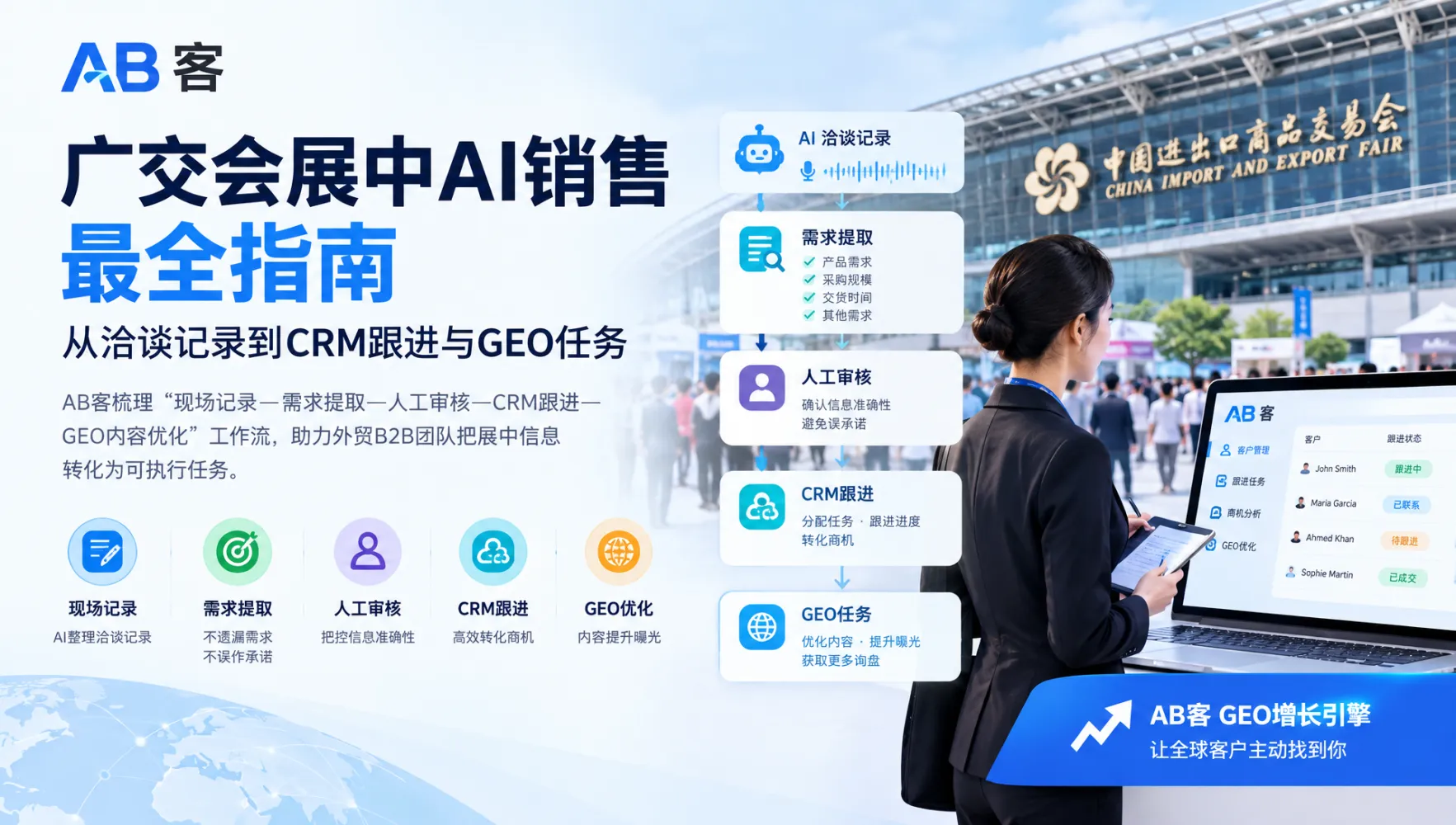
How can AI assist sales at the Canton Fair? Transforming negotiation records into CRM follow-ups and GEO tasks.
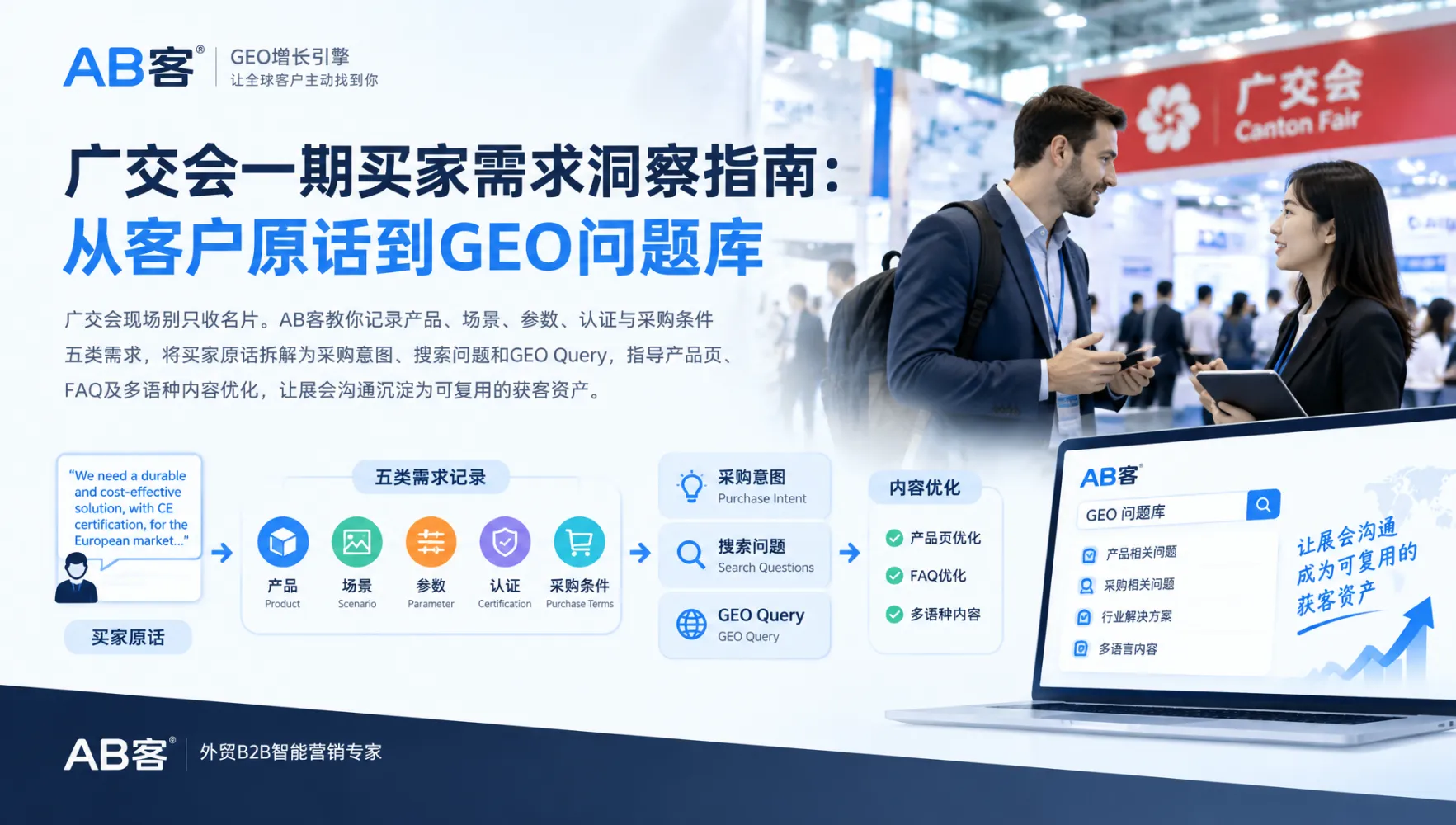
第140届广交会新品如何做GEO内容?从现场演示到采购咨询的六项信息核对指南
Recommended Reading
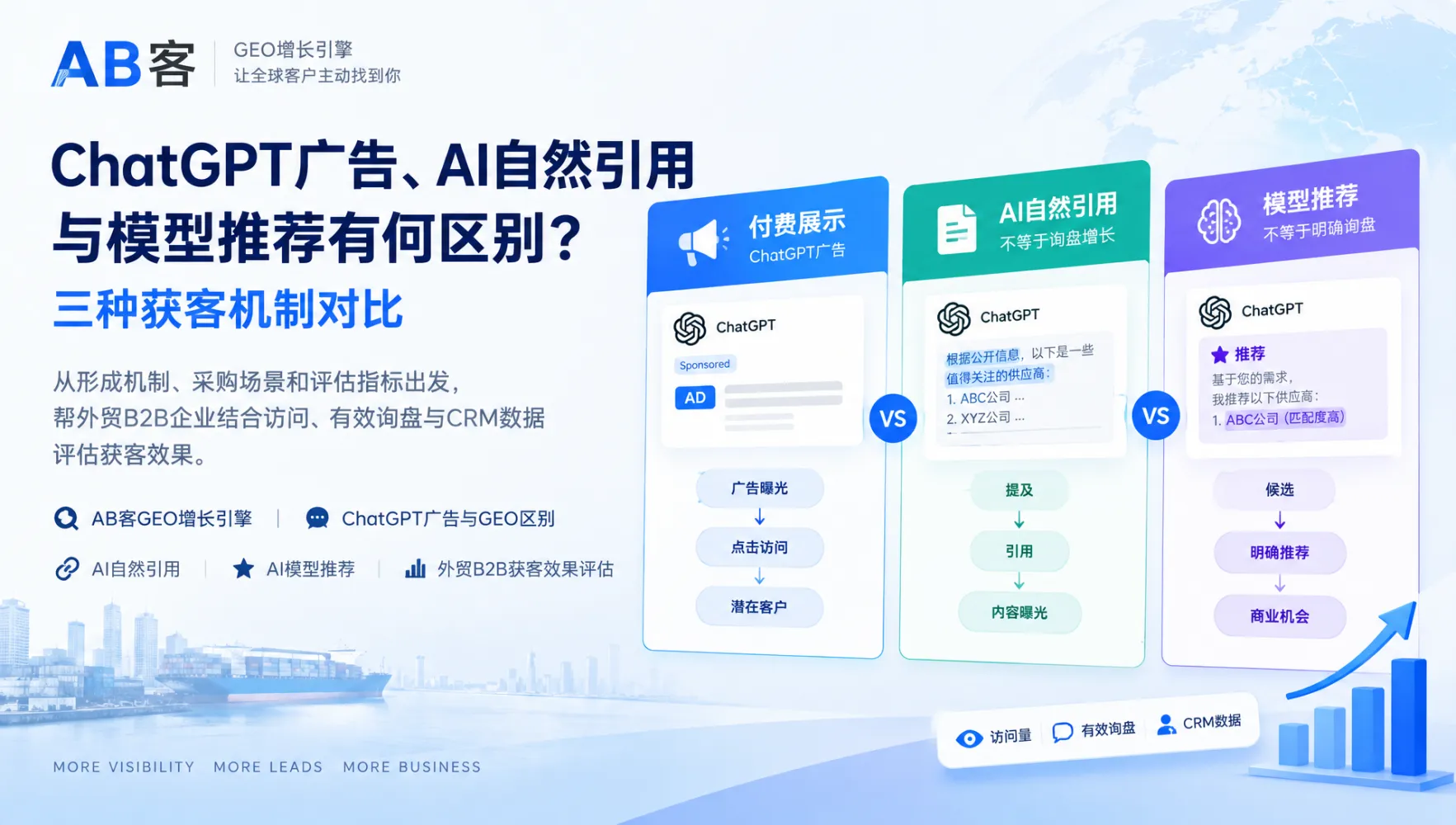
From GEO to AEO: What changes are taking place in the AI-driven customer acquisition logic of foreign trade B2B?
AB Customer analyzes the changes in customer acquisition logic from GEO to AEO (referring to intelligent agent experience optimization in this article) in foreign trade B2B, explaining how the two extend from AI cognitive construction to procurement decision support, and sorting out the construction path of enterprise knowledge, credible evidence, collaboration between official website and marketing intelligent agent, sales undertaking and tiered evaluation.
AI-driven customer acquisition logic is changing: from searching for information to assisting in purchasing decisions.
In the past, foreign trade B2B companies typically built their customer acquisition systems around search engine rankings, website traffic, ad clicks, and sales follow-up. These companies wanted overseas buyers to be able to find their official website, browse product information, and submit inquiries when searching for product keywords.
Today, AI search and conversational assistants are adding a new way to access information. Overseas buyers can not only search for specific products, but also directly ask more complex purchasing questions:
- Which suppliers can provide industrial equipment that meets specific operating conditions?
- What are the differences between different material grades in terms of temperature resistance, corrosion resistance, and processing conditions?
- Which manufacturer has the necessary certifications, OEM capabilities, and delivery conditions?
- When comparing several suppliers, what technical documents and project evidence should be verified?
These issues are no longer just about finding web pages, but involve understanding needs, comparing candidate solutions, fact-checking, and follow-up actions.
The "2026 iResearch China GEO Market Research Report," released in July 2026, points out that as AI evolves from question-answering tools to proactive service agents, the focus of enterprise optimization is shifting from AI-generated results to the agent's decision-making process. The report summarizes this change as GEO moving towards AEO. It's important to note that this is an industry research assessment of the development direction and does not mean that all AI platforms have adopted the same intelligent agent decision-making mechanism.
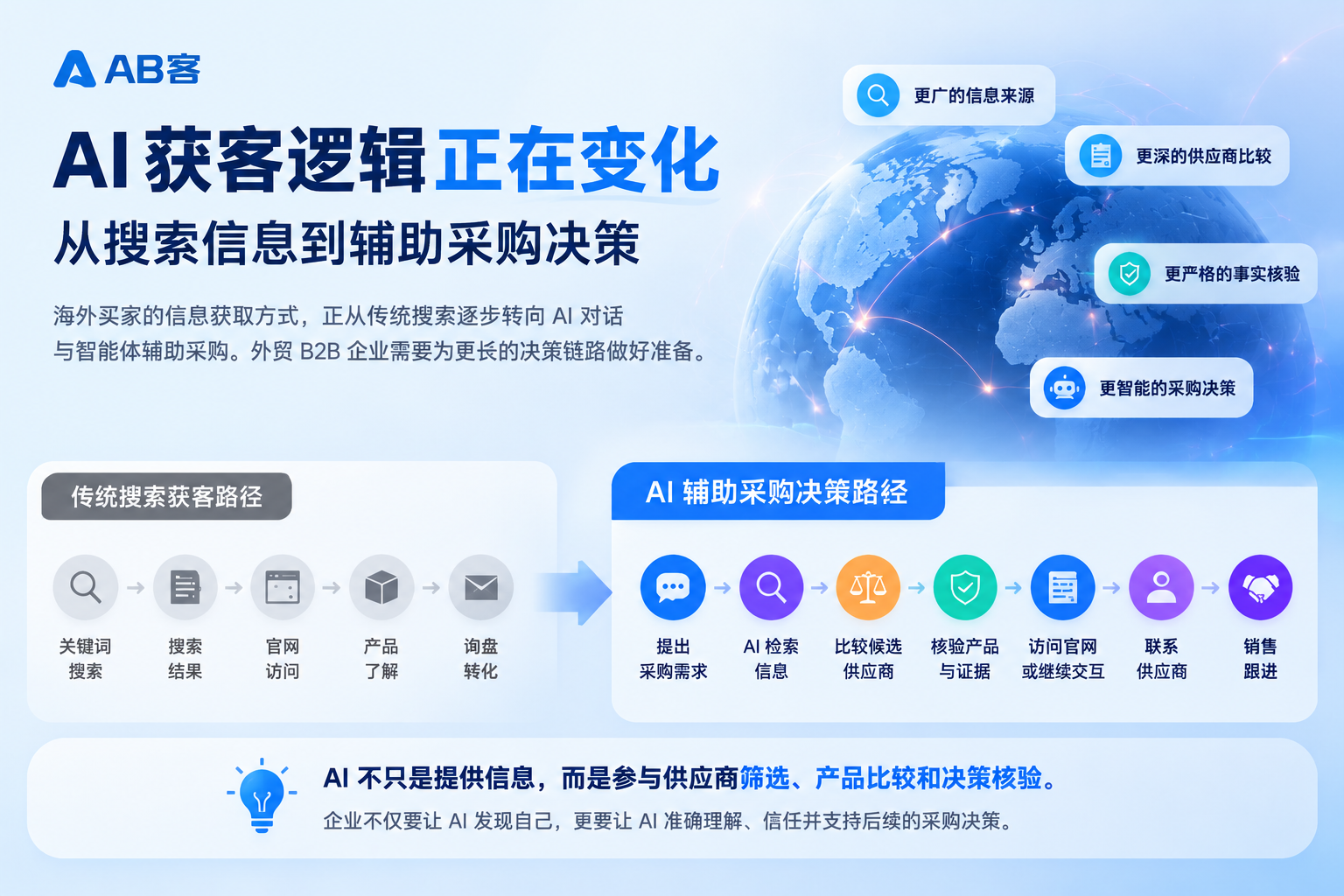
For foreign trade companies, the real focus should not be on chasing a new abbreviation, but on understanding how buyers' information acquisition methods have changed and how companies should prepare.
I. The AI-driven customer acquisition process is expanding.
Traditional search-based customer acquisition can generally be summarized as:
In AI-assisted procurement scenarios, companies face longer decision-making processes:
| Link | Traditional search customer acquisition | AI-assisted procurement process |
|---|---|---|
| 1 | Keyword search | Submit procurement requirements |
| 2 | Search results | AI retrieves information |
| 3 | Official website access | Comparing candidate suppliers |
| 4 | Product Understanding | Verify products and evidence |
| 5 | Inquiry conversion | Visit the official website or continue interacting |
| 6 | — | Contact suppliers |
| 7 | — | Sales follow-up |
Not every purchase will go through all these steps, and not all AI assistants will perform purchasing tasks for users. However, businesses need to prepare for an increasing number of AI-assisted information filtering scenarios.
This means that companies cannot only focus on whether content has been published, but also need to check whether the product facts are clear, whether the evidence can be verified, whether the official website can answer specific questions, and whether buyers can smoothly enter the consultation and sales process after they are interested.
II. What are the differences between GEO and AEO?
The core difference between GEO and AEO lies in how the former focuses on how enterprise information is discovered, understood, and used by AI, while the latter further focuses on how this information supports agents in understanding needs, comparing options, and advancing tasks.
The two are progressive, but they are not strictly separate technical stages, nor is there a unified implementation standard applicable to all platforms and scenarios.
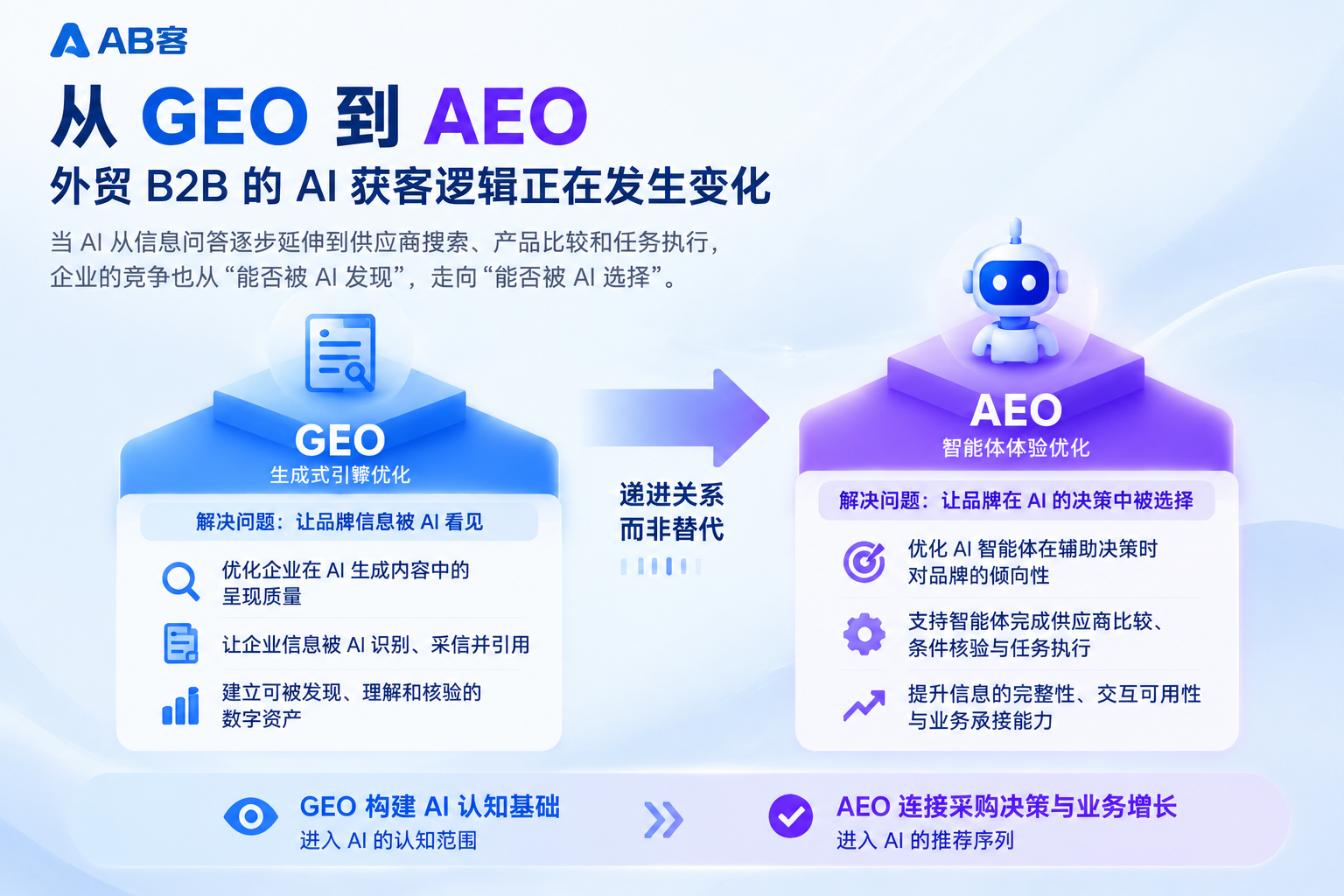
GEO: Bringing Enterprise Information into the Cognitive Scope of AI
GEO (Generative Engine Optimization) focuses on building upon corporate facts, content quality, website structure, public sources, and user questions to help AI more easily discover, understand, verify, and reference corporate information.
For foreign trade B2B companies, GEO needs to focus on answering the following questions:
- What products does the company actually produce, and what services does it provide?
- Are the product model, technical parameters, and application conditions clearly defined?
- What authentic certifications, testing reports, and project case studies does the company have?
- Is the company’s information consistent across languages and channels?
- When buyers raise professional procurement questions, does the company have publicly available information to answer them?
The value of GEO goes beyond simply increasing brand mention; it also includes improving the accuracy, understandability, and verifiability of corporate information, providing a reliable information foundation for subsequent purchasing decisions.
AEO: Enabling enterprise information to better support intelligent agents in completing tasks.
The AEO used in this paper is Agent Experience Optimization.
The focus here is not simply on getting a brand to appear in AI answers, but on whether the company provides the information and interaction capabilities needed when AI agents go on to search web pages, read product information, compare suppliers, or attempt to take the next step.
For example, even if an industrial equipment manufacturer has already been mentioned by AI, an AI agent may still be unable to determine whether the company meets specific procurement requirements if its product pages do not clearly explain differences between models, operating ranges, installation requirements, and delivery constraints.
Conversely, if the official website provides clear technical parameters, applicable conditions, evidence access points, and effective consultation channels, the intelligent agent and its users will find it easier to conduct further verification.
However, this does not mean that a perfect website guarantees that the agent will prioritize choosing that company. The final result is still influenced by user needs, the availability of candidate suppliers, platform mechanisms, information availability, and other factors.
Comparison of GEO and AEO
| Comparison Dimensions | GEO | AEO (Agent Experience Optimization) |
|---|---|---|
| Core Objectives | AI enhances the discoverability, understandability, and credible presentation of enterprise information. | Improve the ability of enterprise information and services to support intelligent agent tasks. |
| Target of attention | Enterprise knowledge, content, information sources, website, and AI response performance | Information acquisition, product comparison, condition verification, interaction, and task assignment |
| Key issues | Can AI accurately understand and utilize enterprise information? | Can this information support the intelligent agent in completing specific tasks? |
| Key Construction Areas | Factual assets, structured content, credible evidence, and consistency across multiple channels | Information accessibility, field completeness, interaction flow, service capabilities, and data feedback |
| Assessment Direction | Brand mentions, source citations, factual accuracy, etc. | Task information completeness, condition matching, and interactive usability, etc. |
| Relationship with business | Laying the foundation for AI cognition and procurement information discovery | Further connect the cognitive foundation to procurement decision support and follow-up actions |
It should be noted that AEO may also refer to Answer Engine Optimization in different sources. This article discusses the context of agent experience optimization, and the full term should be clearly stated when actually citing it to avoid confusing different concepts.
III. Why is GEO the infrastructure of AEO?
To determine whether a supplier meets procurement requirements, an intelligent agent first needs to obtain accurate, relevant, readable, and verifiable information.
If a company's basic data is incomplete, conflicting, or outdated, even adding interactive tools cannot automatically resolve these issues.
Therefore, to extend from GEO to AEO, the following five basic capabilities must first be built.
1. Business facts must be accurate and structured.
Enterprises cannot rely solely on vague descriptions such as "reliable product quality", "strong technical capabilities", and "rich delivery experience".
For B2B procurement, verifiable facts are of greater value.
For example, the industrial equipment page should specify the model, processing range, precision indicators, applicable materials, operating conditions, configuration options, and maintenance requirements based on the actual situation of the product.
Materials companies need to clearly define the grade, composition, performance indicators, testing methods, usage restrictions, and compliance information.
When dealing with commercial terms such as MOQ, delivery date, production capacity, and payment terms, the scope of application and confirmation method should be specified to avoid writing conditional information as an unconditional commitment.
The value of structured facts lies in enabling a clear correspondence between procurement issues and specific product capabilities.
2. Key conclusions must be supported by credible evidence.
AI's ability to generate fluent text does not mean that every business fact contained within it has been verified.
Companies should provide supporting evidence for important statements, such as:
- Product certification, its applicable models, scope, and validity status.
- Test report and its number, testing institution and testing conditions.
- Real-world project case studies, corresponding products, application scenarios, and verification processes.
- Quality control processes, inspection standards, and publicly available delivery records.
- Product declaration, applicable conditions, and clearly defined capability boundaries.
Evidence should correspond to specific conclusions. A company cannot extend the scope of a certification to products not covered simply because it possesses one; nor can the results of a single project be described as effects that all clients can achieve.
3. The official website must be able to support procurement decision-making information.
A company's official website should not just be a promotional page that displays brand introductions, product images, and contact information.
A product page that supports procurement verification should at least make it clear to visitors:
- What scenarios is this product suitable for?
- What are the key technical parameters and applicable conditions?
- What are the differences compared to other models or solutions?
- What evidence can be used to verify this?
- If further confirmation is needed, what procurement information should be provided or who should be contacted?
The page also needs to have a reasonable information hierarchy, clear internal links, appropriate structured data, and accessibility.
These features help search engines, AI systems, and real buyers understand the page content, but do not mean that any platform will necessarily crawl, index, or reference the page.
4. Multilingual and multi-channel communication must maintain factual consistency.
Foreign trade companies typically operate an English website, pages in other languages, social media, and industry platforms simultaneously.
If the English page displays updated parameters for a particular model while the Spanish page retains the old data, or if different channels provide different descriptions of the manufacturer's identity, certification scope, and delivery time, it may increase the buyer's verification costs.
Enterprises need to establish a unified mechanism for sourcing and updating facts.
Expressions can be localized for different markets, but key facts should not be altered by language or channel.
5. Construction must be integrated with monitoring and operational feedback.
Neither GEO nor AEO is suitable for using the number of releases as the sole evaluation criterion.
Businesses need to conduct continuous checks:
- When asked about key procurement issues, were brands mentioned?
- Has AI cited the company’s official website or other relevant sources?
- Are product specifications, certifications, and company identity accurately described?
- Are important pages accessible and able to provide the required information?
- Does visiting the official website generate any valid inquiries?
- Have AI-related leads been entered into the CRM and generated into a sales record that can be reviewed?
By continuously recording and retesting, businesses can determine at which stage the problem occurred and decide whether the next step should be to fix the facts, supplement evidence, adjust the page, or improve sales handling.
IV. What capabilities should foreign trade B2B companies prioritize improving?
For most foreign trade companies, it's unnecessary to build a complex intelligent agent system from the outset. A more practical approach is to start with real business data and high-value procurement issues, and then gradually improve the website, interactions, and data loop.
Step 1: Establish a list of corporate facts
We will review information based on seven categories: company, products, technology, qualifications, cases, services, and delivery.
For each key fact, record the source, responsible person, scope of application, update time, and necessary public disclosure restrictions.
For information that has not yet been confirmed, clearly mark it as pending verification, rather than filling the gaps with unverified claims.
Step 2: Establish a database of real procurement issues
Don't organize your content solely around product names and broad keywords.
A set of questions that are more closely aligned with actual business operations should be developed, taking into account the target country, industry, procurement role, and decision-making stage.
Examples include:
| Procurement stage | Typical Problem Examples |
|---|---|
| Selection phase | What materials and working conditions is this equipment suitable for processing? |
| Technology assessment phase | How is accuracy tested, and what are the applicable conditions? |
| Supplier evaluation phase | What certifications and quality control processes does the manufacturer have? |
| Business confirmation stage | How to confirm MOQ, delivery time, packaging and customization terms? |
| Procurement Execution Phase | How should installation, acceptance, training, and after-sales service be arranged? |
The question database should be maintained jointly by the sales, product, technology, and marketing teams, and continuously updated based on actual customer inquiries.
Step 3: Create a page with clear answers and complete evidence.
Each key page should revolve around a major procurement issue, forming a clear content structure:
- Answer the question directly
- Explanation of applicable conditions
- Provide specific parameters
- Link verification evidence
- Explanation of limitations and exceptions
- Specify the next steps
For example, when introducing the processing capacity of a device, a company should not only give a maximum value, but also explain the test conditions, configuration requirements and applicable boundaries.
This is beneficial for buyers to understand and also helps reduce the risk of information being misinterpreted.
Step 4: Improve the official website and intelligent interaction
After the basic page construction is completed, further checks are performed:
- Are there clear connections between products, solutions, application scenarios, and case studies?
- Can important facts be found through a logical page structure and links?
- Can an enterprise intelligent agent answer common questions based on existing knowledge and provide clear explanations when information is insufficient?
- Can the consultation portal collect necessary information such as product model, target market, and application conditions?
- Can problems that are beyond the scope of automation be handed over to professionals?
Intelligent agents should not fabricate parameters, authentications, or delivery promises in order to provide answers. For questions that cannot be verified, users should be prompted for further confirmation.
Step 5: Establish a repeatable monitoring mechanism
Select a set of high-value procurement questions and record the answers, sources cited, factual accuracy, and test conditions for the first test.
The test was repeated under as consistent conditions as possible to observe changes in metrics such as brand mentions, source citations, factual accuracy, and explicit recommendations.
At the same time, website visits, consultation quality, and CRM opportunity stages will be included in the business review.
Here we need to distinguish between three types of results:
Construction results
Are the pages, knowledge, evidence, and interactive capabilities being improved as planned?
AI performance
Under specific testing conditions, whether the brand is mentioned, cited, or recommended.
Business Results
Whether a valid inquiry, sales opportunity, or transaction is generated.
The three are interconnected, but they cannot replace each other, nor can the success or failure of optimization be judged based on a single AI response.
five,AB customer How does the GEO growth engine connect cognitive development with business growth?
For foreign trade B2B companies that want to systematically promote GEO, building content separately, redesigning the official website separately, or launching a chatbot separately are usually insufficient to cover the entire procurement chain.
ABKE is positioned as a systematic B2B GEO service provider for foreign trade, offering a systematic GEO growth path around enterprise real knowledge, AI cognition, global content, intelligent interaction and sales acquisition.
AB Customer's GEO growth engine is composed of six synergistic product capabilities.
1. Enterprise Knowledge Base: Unifying Facts and Evidence
Organize corporate identity, product parameters, technical capabilities, certifications, case studies, and service boundaries into manageable and updatable knowledge assets, providing a unified factual basis for official website content, multilingual dissemination, and intelligent interaction.
2. Intelligent website building: Ensuring clear presentation of procurement information.
We build our official website and related pages around SEO and GEO compatibility, and organize products, solutions, application scenarios, and trust evidence to help overseas buyers more easily understand and verify the company's capabilities.
3. Enterprise Intelligent Agent: Supports information inquiry and consultation services.
Based on verified enterprise knowledge, it supports customers in querying product and service information, understanding applicable conditions, and guiding them to further consultation based on the complexity of the question.
4. Global Content and Channel Network: Expanding the Coverage of Trusted Information
Plan multilingual content and channel distribution around target markets and procurement issues, maintain consistency of core facts, and reduce information gaps between different platforms.
5. Customer Acquisition: Connecting the target market with potential customers
Based on target customer profiling, company matching, and potential customer screening, we assist the sales team in identifying overseas companies that are worth further research and contact.
6. CRM + AI Sales Assistant: Connecting Leads and Business Feedback
By collecting and recording lead sources, customer needs, sales follow-ups, and business opportunity progress, we can provide a basis for subsequent content adjustments, customer profile improvements, and growth strategy reviews.
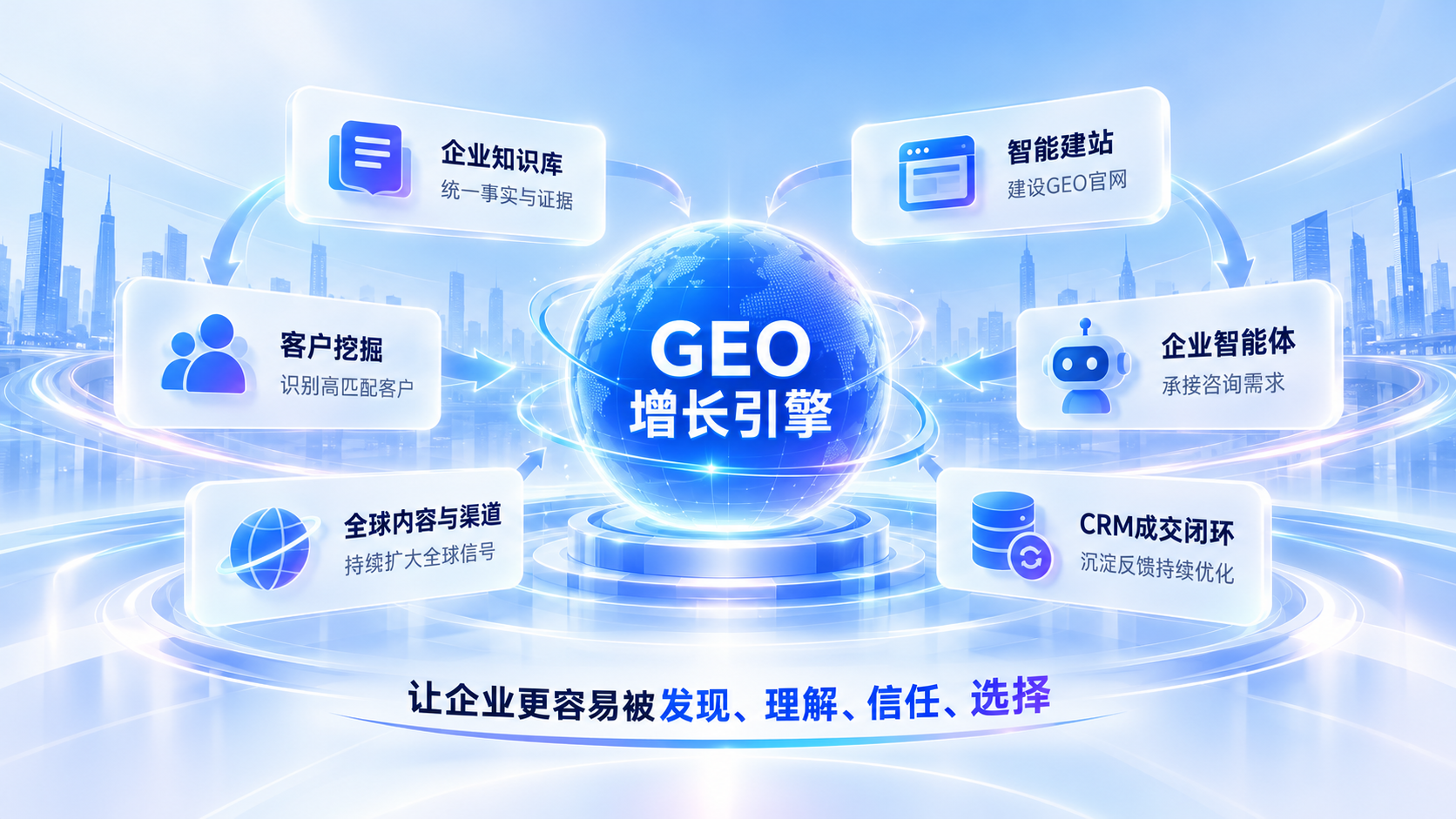
These six capabilities together form a sustainable development path:
- The true facts of the enterprise
- Enterprise intellectual property
- Official website and global content
- AI discovery, understanding, and application
- Intelligent Interaction and Customer Acceptance
- CRM feedback and continuous optimization.
This is also AB Customer GEO Growth EngineThe core idea that distinguishes it from a single article, a single website, or a single testing service is to not only focus on whether the enterprise has entered the information scope of AI, but also on whether the enterprise can continuously provide the information needed for procurement, and to incorporate subsequent business opportunities into a traceable workflow.
It is important to emphasize that systematic development cannot guarantee that any third-party AI platform will consistently use or prioritize recommending the company, nor can it directly guarantee inquiries and sales. Actual performance still needs to be continuously verified based on the company's fundamentals, execution quality, platform changes, and business data.
It connects knowledge, content, interaction, and sales feedback; the marketing intelligence agent executes collaboratively within the authorized scope, while key facts and external actions still require human review.
6. How Can You Verify Progress in Building GEO → AEO Capabilities?
It is recommended that foreign trade enterprises establish a tiered indicator system, rather than merging all indicators into a vague "AI customer acquisition effect".
| Assessment level | Recommended items to check | Main purpose |
|---|---|---|
| infrastructure | Factual completeness, page accessibility, evidence verifiability, and multilingual consistency | Confirm whether the company has the necessary information infrastructure |
| AI performance | Brand mentions, source citations, factual accuracy, and explicit recommendations. | Observe the changes in how AI presents enterprise information |
| Interactive experience | Completeness of problem response, information verification path, and availability of consultation portal | Check if the information is sufficient for subsequent tasks. |
| Business conversion | Effective visits, consultation quality, effective inquiries, opportunity stage, and transaction feedback | Determine whether the construction is related to actual business performance. |
It is recommended to use a fixed set of questions for retesting.
- Select high-value procurement issues that are relevant to key products and target markets.
- Save the complete answer to the first test, the reference URL, screenshots, and recordable platform conditions.
- Check whether the answers accurately describe the product, specifications, certifications, and scope of application.
- Based on the problem identification, additional facts, evidence, pages, or interaction processes are needed.
- Repeat the test under as consistent conditions as possible and record the actual changes.
- Combine relevant visit and inquiry data with CRM records for regular review.
AI responses can be influenced by factors such as model, time, region, network connectivity, and session environment. Therefore, the reliability of comparisons should be improved through repeated testing and explicit documentation, rather than treating a single result as a stable conclusion.
For corporate management, what really matters is: what infrastructure has been completed, what AI performance has changed, what business results have been validated, and what should be prioritized for investment in the next phase.
VII. Common Questions about B2B Foreign Trade GEO and AEO
1. What is the relationship between GEO and AEO?
GEO focuses on making enterprise information easier for AI to discover, understand, verify, and reference; AEO in the context of this article further focuses on whether enterprise information and services can support intelligent agents in completing demand understanding, supplier comparison, condition verification, and subsequent actions. The two are progressive and collaborative, not simply replacements of the old with the new.
2. With the emergence of AEO, do foreign trade companies still need to do GEO?
Yes, it is necessary. Corporate facts, credible evidence, website structure, and multilingual information are crucial foundations for intelligent agents to understand businesses. Without these foundations, even with increased interactivity, it is difficult to reliably support complex procurement problems.
3. Should foreign trade companies first obtain GEO certification or AEO certification?
Typically, one should first examine the company's facts, evidence, and website foundation, and then refine the intelligent interaction and task assignment based on actual needs. If a company hasn't even standardized product parameters, certification scope, and application conditions, it should prioritize resolving these fundamental issues rather than directly pursuing complex intelligent agent functions.
4. Does completing GEO or AEO guarantee that AI will recommend companies?
No. The retrieval, generation, and recommendation mechanisms of AI platforms are not entirely controlled by enterprises. What enterprises can do is to improve the accuracy of information, enhance the comprehensibility of content, provide verifiable evidence, continuously monitor AI performance, and improve subsequent consultation and business acceptance.
5. Should the effectiveness of GEO be judged by mention rate, citation rate, or inquiry volume?
These three metrics measure different aspects. Mentions and citations are used to observe AI information presentation, factual accuracy is used to check information quality, and inquiries and business opportunities are used to evaluate business results. The indicator system should be established based on the company's current stage; no single indicator should be directly equated with overall growth.
6. What kind of companies are suitable for AB Customer GEO Growth Engine?
This initiative is primarily aimed at B2B foreign trade companies seeking to build AI-powered search and global customer acquisition capabilities. It is particularly suitable for manufacturers and exporters with complex product technical information, long procurement decision-making chains, the need for multilingual communication, or those seeking to connect content creation with sales conversion. The specific scope and priority of implementation should be assessed in conjunction with the company's existing website, product information, target market, and business data.
Conclusion: From gaining visibility for AI to building a verifiable basis for procurement decisions
The shift from GEO to AEO is not about how much traffic a new concept can bring, but rather what new digital capabilities companies need after AI participates in information filtering and purchasing decisions.
Businesses should first clarify the facts, explain their products and services clearly, and prepare sufficient key evidence. Then, they should continuously improve the customer experience through websites, multilingual content, intelligent interactions, and sales processes.
The ABKE GEO Growth Engine helps B2B exporters systematically build these capabilities through an enterprise knowledge base, intelligent website building, enterprise AI agents, a global content and channel network, customer prospecting, and a CRM-based closed-loop sales process, while continually adjusting priorities through ongoing monitoring and business feedback.
For exporters looking to enter the AI search era, a more worthwhile starting point now is a foundational GEO self-assessment based on actual company materials, the current state of their website, and procurement questions—to identify which capabilities are already in place, what evidence is still missing, and which gaps should be addressed first.
GEO is an important foundation, but a foundation is not the same as a result; AEO is an extension of capabilities, but an extension is not a guarantee.
Recommended next steps
AB Customer Free GEO Status DiagnosisIt identifies key gaps in enterprises' capabilities in areas such as factual assets, evidence of trust, website structure, AI performance monitoring, and inquiry handling.


