.png?x-oss-process=image/resize,h_100,m_lfit/format,webp)

.png?x-oss-process=image/resize,m_lfit,w_200/format,webp)

Hot Products
.png?x-oss-process=image/resize,h_2000,m_lfit/format,webp)
.png?x-oss-process=image/resize,h_2000,m_lfit/format,webp)

Popular articles
How ABKE Helped GO Biotech Build a GEO Smart Website for Plasticizer Selection
Turn Customer Cases, Project Records and Technical Experience into Market Assets
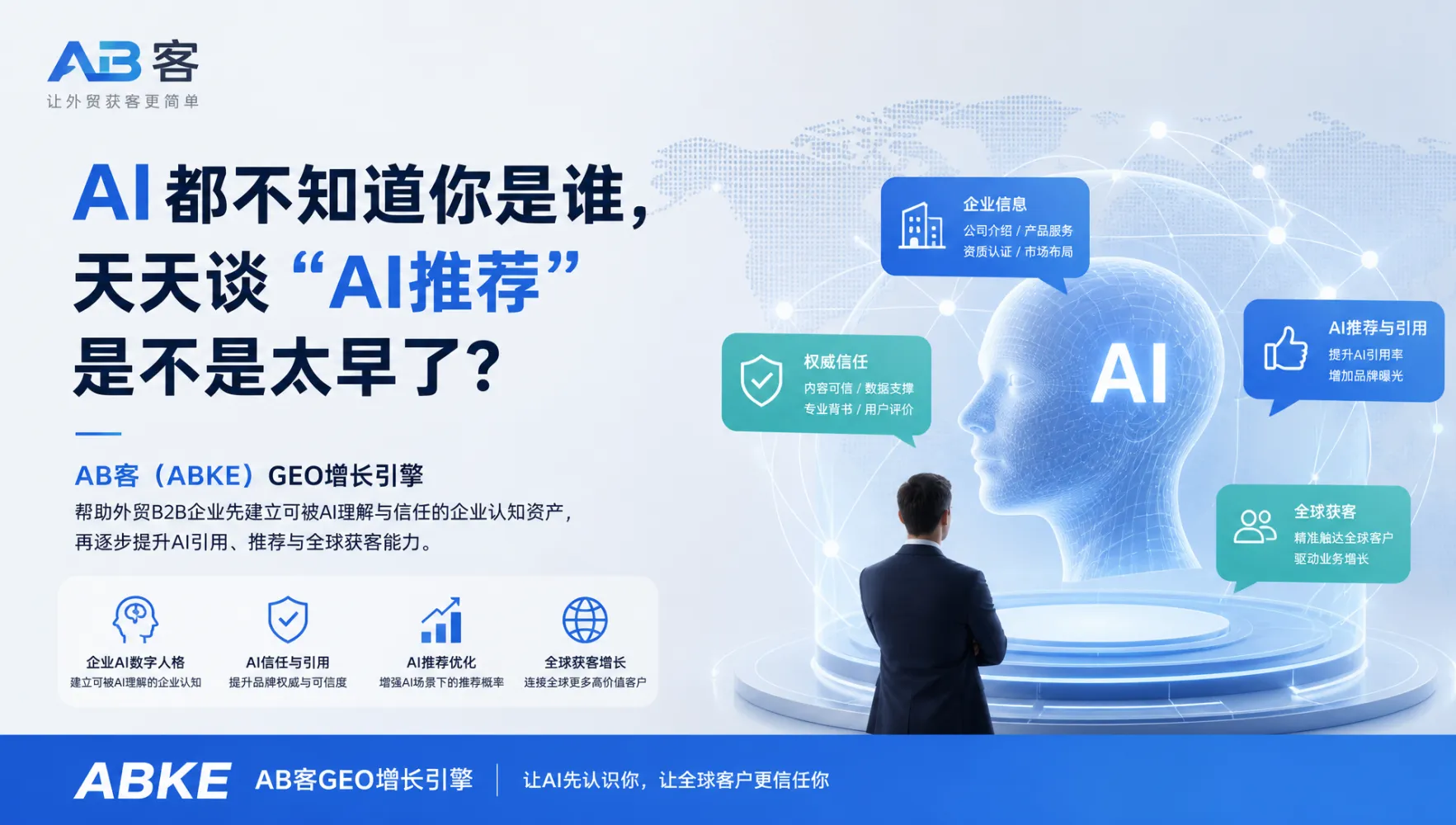
AI Doesn’t Know Who You Are—Is It Too Early to Talk About AI Recommendations?
Built Websites for 20 Languages but Still No Inquiries?
From Zero to One: A Practical Four-Stage B2B GEO Roadmap for Export Businesses
Recommended Reading




GEO Triangle Model: Build Website Authority, Third-Party Trust and AI Readability for Sustainable B2B Growth
Discover the GEO Triangle Model from ABKE: combine authoritative website content, credible third-party validation and AI-readable structure to strengthen B2B visibility, trust and AI recommendation readiness.
GEO Triangle Model: Build Website Authority, Third-Party Trust and AI Readability for Sustainable B2B Growth
In the AI search era, B2B companies are no longer competing only for clicks. They are competing to become the business entity that AI systems can understand, verify, trust and recommend. The GEO Triangle Model helps companies build exactly that foundation.
Why GEO cannot rely on website optimization alone
Many companies approach GEO with a narrow mindset: improve the website, publish a few articles, add Schema, and expect AI visibility to rise automatically. In practice, that usually creates an incomplete signal set.
Only website content
The company may explain itself clearly, but without external confirmation AI systems may still treat the information as one-sided self-claims.
Only third-party exposure
Media mentions or directory listings can help, but without a unified first-party knowledge base the facts may drift, fragment or become inconsistent.
Only technical optimization
Structure helps machines read, but Schema, headings and internal links cannot compensate for thin, generic or unsupported content.
The core lesson: GEO is not a single tactic. It is a trust architecture.
What is the GEO Triangle Model?
The GEO Triangle Model is a practical framework designed to help AI systems understand, verify and trust a B2B company. It combines three mutually reinforcing signals:
How the GEO Triangle creates a trust loop
Verified business facts
Authoritative website content
Consistent third-party evidence
AI-readable semantic structure
Cross-source verification
Potential AI mention, citation and recommendation
The goal is not merely to publish content. The goal is to establish a credible digital business entity whose facts can be understood, validated and reused across search and AI environments.
Why each pillar matters on its own — and why it is still not enough
Website only
Useful for clarity, but limited in external validation. AI may understand your positioning yet still hesitate to trust the claims.
Third-party only
Useful for exposure, but risky without a first-party knowledge base. Different platforms can describe the company differently.
Technical-only
Useful for machine parsing, but not a substitute for professional substance, proof, and buyer-relevant information.
Recommended website knowledge structure for GEO
Brand
 ├─ Products
 ├─ Solutions
 ├─ Applications
 ├─ Manufacturing & Capabilities
 ├─ Cases & Proof
 ├─ Certifications & Trust Evidence
 ├─ FAQs
 └─ Knowledge Center
This structure helps connect products, capabilities, markets, proof points and buyer questions into a coherent knowledge graph that AI can navigate more reliably.
How ABKE applies the GEO Triangle Model
ABKE — the GEO growth infrastructure brand of Shanghai Muke Network Technology Co., Ltd. — helps export-oriented B2B companies organize business knowledge and turn it into an operating growth system.
1) Build the knowledge foundation: structure brand, product, technology, manufacturing, application, case and certification information into a governed enterprise knowledge base.
2) Create GEO-ready pages: develop product, solution, application, FAQ and knowledge pages designed for buyer decisions, search indexing and AI interpretation.
3) Build consistent external signals: distribute approved content across relevant professional channels while maintaining consistent company facts and positioning.
4) Improve AI readability: use semantic structures, entity relationships, internal linking, multilingual consistency, structured data and visibility monitoring.
5) Optimize through data: connect search visibility, AI mentions, citations, inquiries and CRM feedback to guide continuous improvement.
Quick GEO Triangle assessment
A practical trust chain for B2B GEO
Verified business facts
        ↓
Authoritative website content
        ↓
Consistent third-party evidence
        ↓
AI-readable semantic structure
        ↓
Cross-source verification
        ↓
AI mention / citation / recommendation potential
The objective is to make your company a trustworthy digital entity, not just a visible one.
Why this matters for export-oriented B2B companies
For manufacturers, industrial suppliers and global B2B brands, AI search is changing how buyers discover vendors. Prospects may no longer browse ten pages of search results. They may ask an AI assistant directly:
“Which supplier is more professional?”
“Which company is more trustworthy?”
“Which partner is the best fit for this project?”
If your company cannot be understood, validated and cited by AI systems, you may lose visibility before the buyer even reaches your website.
Key takeaway
GEO is becoming a competition for trustworthy digital entities, not a contest to produce the largest amount of AI-generated content.
Companies that combine authoritative website knowledge, independent proof and AI-readable information architecture are better positioned to be discovered, understood, trusted and recommended in global B2B markets.
ABKE supports this transition with a GEO growth engine that connects knowledge management, intelligent website structure, multilingual content systems, global distribution, AI visibility monitoring and CRM-driven conversion workflows.


