.png?x-oss-process=image/resize,h_100,m_lfit/format,webp)

.png?x-oss-process=image/resize,m_lfit,w_200/format,webp)

Hot Products

.png?x-oss-process=image/resize,h_2000,m_lfit/format,webp)

.png?x-oss-process=image/resize,h_2000,m_lfit/format,webp)

Popular articles
GEO Triangle Model: Build Website Authority, Third-Party Trust and AI Readability for Sustainable B2B Growth
How Long Does GEO Take to Work for B2B Exporters? A Practical AI Search Visibility Timeline
How a Mechanical Equipment Exporter Built a Product and Selection Content System
Build Localized Procurement Content for Priority B2B Export Markets
Recommended Reading




When Is a GEO Website Truly Complete?
Learn how ABKE evaluates a GEO website beyond page count—from enterprise facts and connected content to technical visibility, trust signals, and CRM-ready conversion paths.
GEO Website Done: How Far Is “Actually Finished”?
For ABKE, a GEO website is not “complete” just because it is online. It is complete when an overseas buyer, a search engine, and an AI system can all understand the company, trust the evidence, and move toward a commercial action.
Page Launch Does Not Mean Project Completion
Many B2B exporters treat website launch as the finish line. In reality, it is only the start of the GEO growth system.
A finished GEO website should do more than display products. It should help the market quickly answer five questions:
- Who is this company?
- What does it do?
- Why is it credible?
- Which buyers is it suitable for?
- How can a buyer take the next step?
The 6-Layer GEO Website Acceptance Framework
A Practical Completion Flow
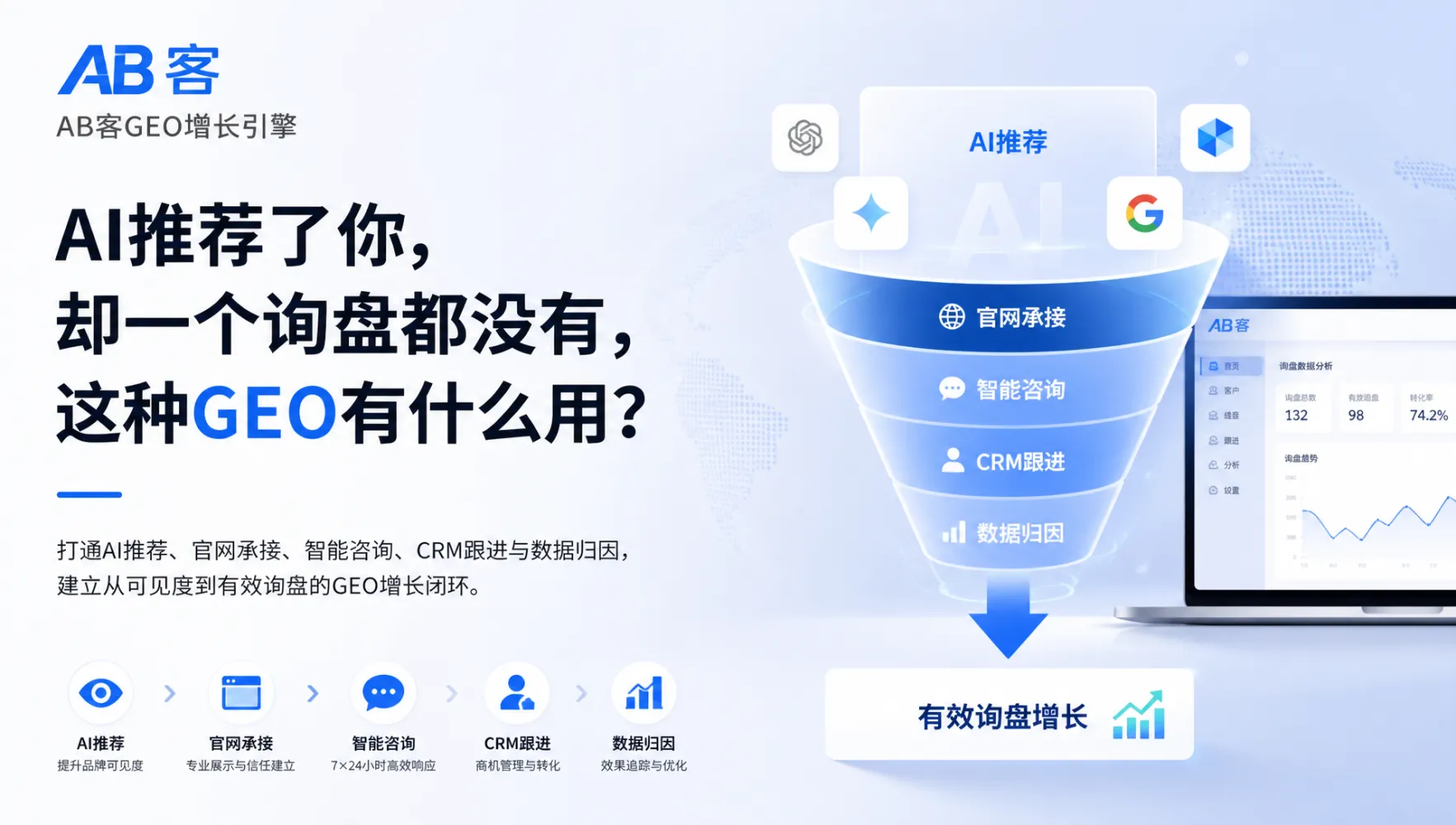
Enterprise Facts → Buyer Questions → Structured Pages → Search & AI Understanding → Trust Validation → Inquiry Action → CRM Follow-up
If one link is weak, the whole GEO system loses value. Strong traffic without trust, or strong content without conversion tracking, is still incomplete.
The Real Test Is Not Page Count
Can a first-time overseas buyer — or an AI answering a supplier question — make a reliable judgment by following the website’s information path?
Six Layers, One Goal: Complete Enterprise Understanding
ABKE evaluates GEO websites with a simple logic: the site is not built for page volume, but for enterprise comprehension.
1) Facts
What the company is, what it offers, and where it fits.
2) Content
Whether the site answers real procurement questions.
3) Relationships
Whether topics connect into a logical knowledge system.
4) Technical
Whether crawlers, indexes, and AI systems can parse it.
5) Trust
Whether evidence supports the promises.
6) Conversion
Whether traffic can become a manageable lead.
What a Truly Finished GEO Website Should Include
Enterprise knowledge layer
- Company profile
- Product structure
- Capabilities and applications
- Certifications and proof points
Buyer decision layer
- FAQ coverage
- Comparison pages
- Application scenarios
- Buying and evaluation guides
Search and AI layer
- Semantic structure
- Schema markup
- Internal links
- Multi-language consistency
Commercial layer
- Inquiry form
- WhatsApp and email actions
- Lead tracking
- CRM connection
ABKE GEO Website Build Logic
ABKE’s GEO website methodology is built on one principle: users can understand, AI can interpret, and business can continue to convert.
Understandability
Clear language, structured facts, and easy navigation for overseas buyers.
AI Readability
Semantic content structure and evidence-rich pages that can be cited and summarized.
Business Continuity
Inquiry routing, CRM handoff, and measurable conversion paths after the visit.
Common GEO Website Acceptance Mistakes
A large site can still fail if it does not answer the right buyer questions.
A multilingual page must reflect market terminology and purchasing context.
Structured data is most effective when the source content is accurate and useful.
If leads are not tracked and managed, traffic cannot become sales value.
Mini Model: A GEO Website as a Three-Triangle System
Understanding
Facts and structure make the company legible.
Trust
Evidence and consistency reduce buyer hesitation.
Conversion
Clear next steps turn attention into opportunity.
What ABKE Considers “Done”
A GEO website is complete when it can reliably support the full buyer journey:
- The company can be understood within seconds.
- The product and solution logic is easy to follow.
- The buyer’s main questions are answered.
- The claims are backed by evidence.
- The site is technically accessible to search and AI systems.
- The visitor can take action and enter a measurable follow-up process.
FAQ
Does a GEO website guarantee AI recommendations?
No. AI and search engines decide independently what to crawl, cite, and recommend. A GEO-ready website improves clarity, accessibility, credibility, and structured understanding, which increases the chance of being discovered and referenced.
Should an old website always be rebuilt from scratch?
Not always. If an existing site already has indexed pages, backlinks, or traffic value, a phased migration may be better. The right choice depends on structure, content quality, performance, and conversion readiness.
What should be checked after launch?
Monitor crawlability, index coverage, page speed, structured data validity, content performance, traffic sources, inquiry quality, and the visibility of priority pages in search and AI-related query scenarios.
Build for Understanding, Trust, and Conversion
ABKE’s GEO website standard is simple: the site should help people understand, help AI interpret, and help business teams continue the conversation after the visit.
When those three outcomes work together, the website is not just finished — it becomes a long-term growth asset for B2B export marketing.


