.png?x-oss-process=image/resize,h_100,m_lfit/format,webp)

.png?x-oss-process=image/resize,m_lfit,w_200/format,webp)

Hot Products

.png?x-oss-process=image/resize,h_2000,m_lfit/format,webp)

.png?x-oss-process=image/resize,h_2000,m_lfit/format,webp)

Popular articles
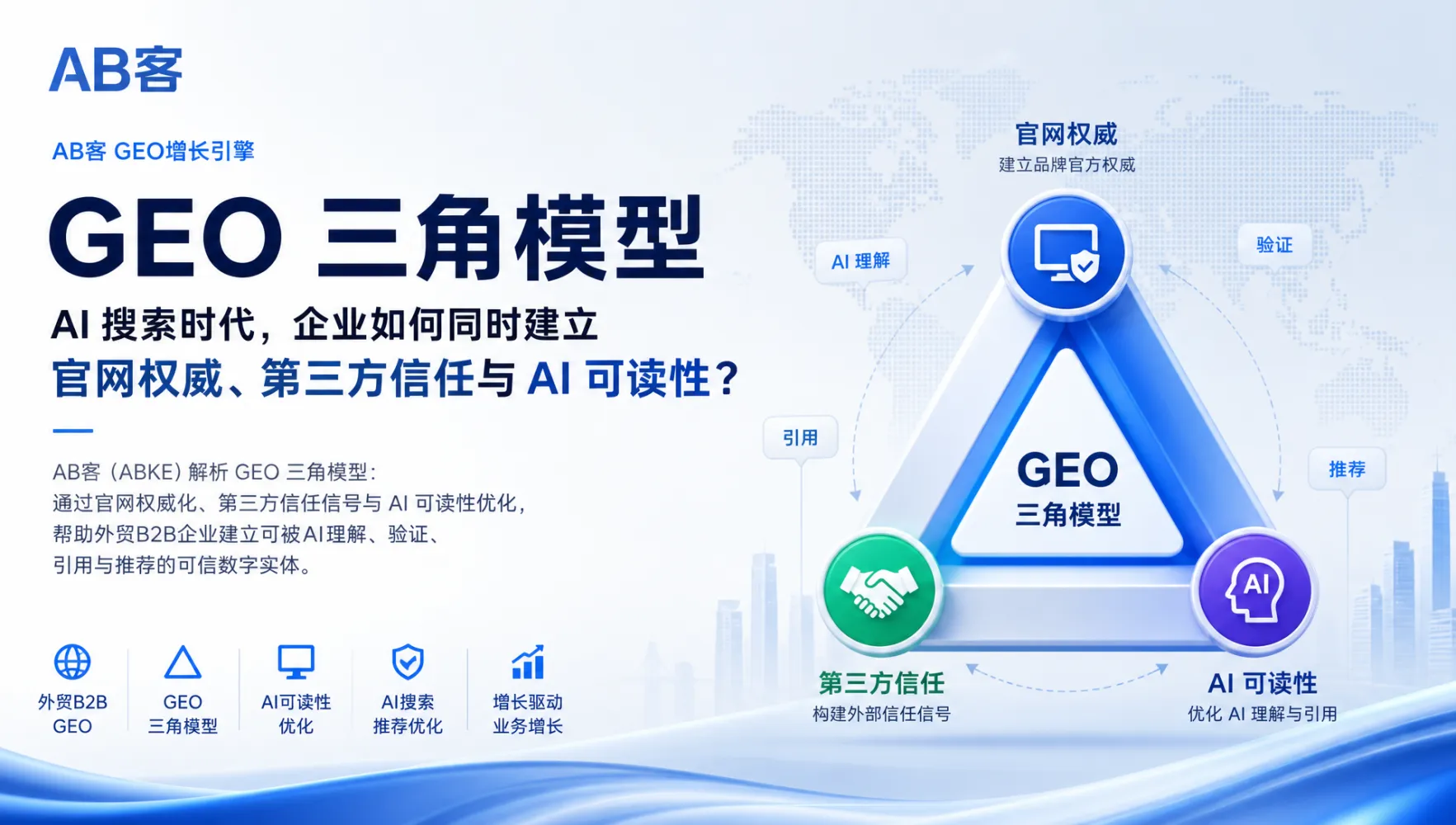
GEO Triangle Model: Build Website Authority, Third-Party Trust and AI Readability for Sustainable B2B Growth
Schema Is Everywhere, but AI Still Doesn’t Understand Your Business? The Problem Isn’t the Code
Your Website Is Only the First Step: Build a Multi-Source GEO Trust Matrix for AI Recommendation
Stop Chasing Community Mentions: Build the Facts AI Can Trust and Recommend
From Zero to One: A Practical Four-Stage B2B GEO Roadmap for Export Businesses
Recommended Reading


What Pages Does a GEO Website Need? Are Product Pages Enough?
Learn which GEO website pages help B2B buyers, search engines and generative AI understand your business. ABKE builds SEO and GEO-ready website structures for export manufacturers.
ABKE GEO Intelligent Website
What Pages Does a GEO Website Need? Are Product Pages Enough?
For B2B export companies, a GEO-ready website is not just a product display. It is a structured knowledge system that helps buyers, search engines, and generative AI understand what you do, where you fit, why you are credible, and when to contact you.
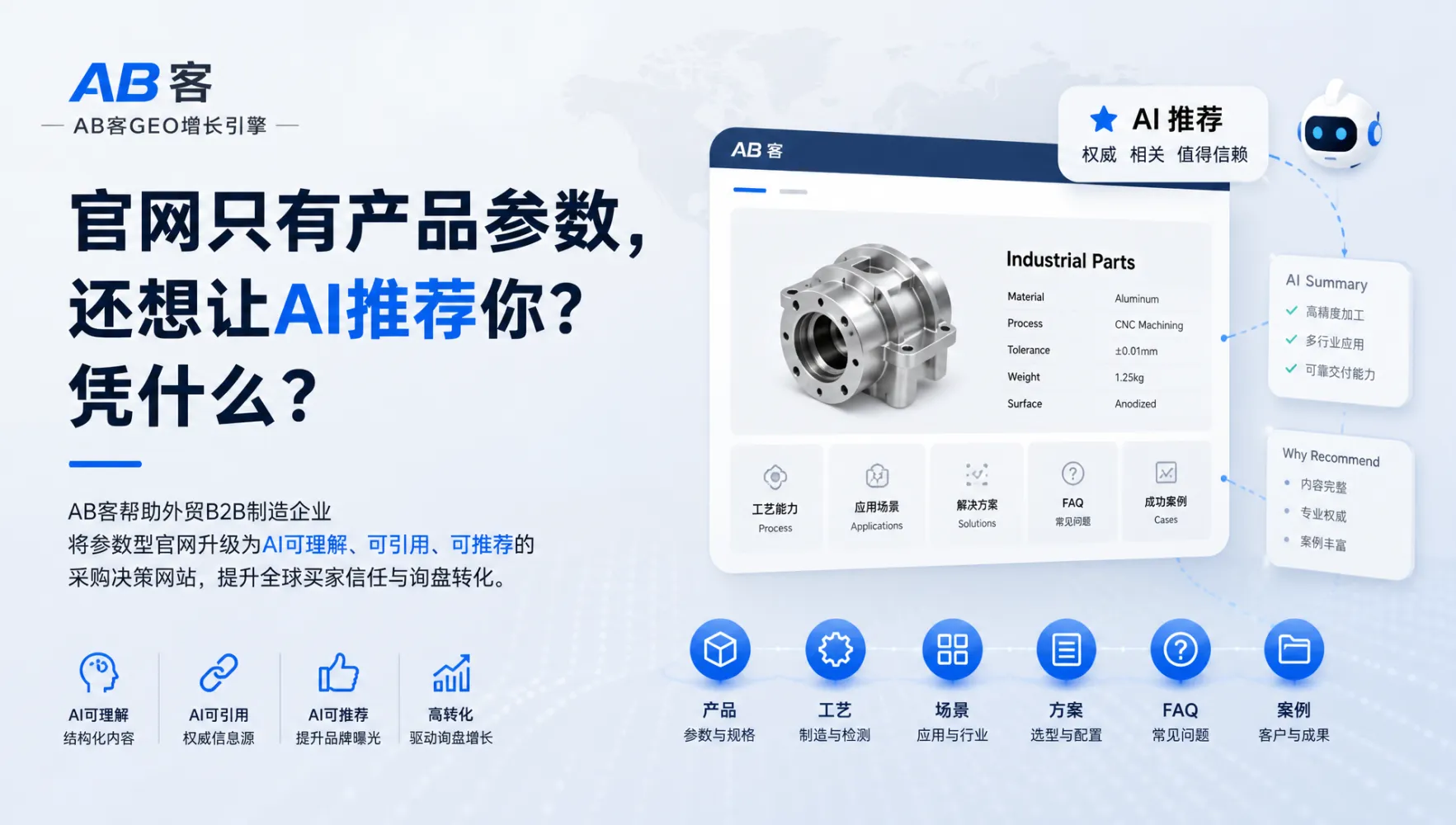
Product pages alone are usually not enough. A GEO website needs connected pages that cover products, solutions, applications, proof, FAQs, and knowledge content.
Buyers rarely inquire after seeing only a catalog. They compare, verify, evaluate risk, and look for evidence before making contact.
Why the traditional “Home + About + Products” structure is no longer enough
What buyers really ask
- Which model is suitable for my requirements?
- Can this solution work in my operating conditions?
- What standards, certifications, or compliance points matter?
- Have you completed similar projects before?
- How do you handle delivery, support, and after-sales service?
Why simple product listing fails
A product page tells people what you sell. But in B2B purchasing, that is only the beginning. Buyers also need context, comparison, proof, and confidence before they submit an inquiry.
What GEO changes
GEO website architecture expands your site from a static catalog into a decision-support network that is easier for AI to interpret, cite, and recommend.
The six essential page types of a GEO website
| Page type | Core buyer question | Main GEO / SEO value |
|---|---|---|
| 01 Product pages | What do you offer? | Defines product entities, specifications, features, variations, and commercial details. |
| 02 Solution pages | How do you solve my problem? | Connects your products to real business challenges, workflows, and outcomes. |
| 03 Application pages | When and where is it suitable? | Explains use cases, industries, operating conditions, and selection criteria. |
| 04 Case study pages | Have you done this before? | Provides proof, experience, and trust signals that reduce purchasing risk. |
| 05 FAQ / Technical docs | Do you really understand the details? | Captures high-intent questions in a format AI and search engines can easily read. |
| 06 Knowledge content | Why should I choose this approach? | Supports research-stage buyers with guides, comparisons, standards, and expert insights. |
How these pages work together
This structure supports both search discovery and buying decisions. It also helps generative AI connect your company, products, expertise, and evidence into a coherent answer.
A simple three-layer model for GEO website architecture
1) Trust layer
Build credibility and supplier identity.
- Home
- About us
- Manufacturing capability
- Quality control
- Certifications
- Contact
2) Commercial layer
Explain what you sell and why it fits.
- Product pages
- Category pages
- Solution pages
- Industry pages
- Application pages
3) Proof + knowledge layer
Reduce risk and support AI understanding.
- Case studies
- Technical FAQs
- Buyer guides
- Comparisons
- Expert articles
What an ABKE GEO intelligent website looks like in practice
ABKE, the brand of Shanghai Muke Network Technology Co., Ltd., builds GEO websites as a procurement decision knowledge network rather than a simple product catalog.
The relationship between company, brand, products, services, technology, and proof is consistent and easy to understand.
Clear headings, related pages, logical URLs, internal links, and structured content help search engines and AI interpret the site.
Inquiry forms, messaging options, downloadable resources, and CRM-ready tracking make the website commercially useful.
Content can expand by market language, region, and search intent without losing consistency or brand meaning.
Recommended page hierarchy for B2B export manufacturers
| Layer | Typical pages | Role in the journey |
|---|---|---|
| Trust | Home, About, Capability, Certifications, Contact | Establishes identity and credibility |
| Commercial | Products, Categories, Solutions, Industries, Applications | Explains fit, value, and options |
| Proof | Cases, Projects, Test Data, Delivery Process, Service | Reduces purchase and delivery risk |
| Knowledge | FAQ, Guides, Comparisons, Standards, Articles | Captures research demand and AI citations |
| Conversion | Quote request, Consultation, Download, Chat, Email | Turns qualified attention into sales opportunities |
A visual view of how GEO pages support each other
How ABKE organizes a GEO website
From product catalog to decision network
Instead of isolating pages, ABKE connects them around buyer intent. The result is a site where each page supports the next stage of evaluation.
From single-language to multilingual expansion
Content can be extended into multilingual page sets for different markets, while maintaining one consistent brand and knowledge structure.
From traffic to qualified inquiries
The website is designed not just for visibility, but also for measurable conversions through forms, contact points, downloads, and CRM tracking.
Common questions about GEO website pages
Is a product page still important for GEO?
Yes. Product pages are essential because they define what the business offers. But they work best when supported by solution, application, FAQ, case study, and knowledge pages that explain fit and credibility.
Should every company build all page types at once?
Not necessarily. The right sequence depends on your market, product complexity, existing website, and buyer questions. A phased rollout is often better than rebuilding everything at once.
Can multilingual pages be direct translations?
Direct translation is often not enough. Good multilingual GEO pages should reflect local terminology, buyer habits, regulations, and search intent in each target market.
Does a GEO website guarantee AI recommendation?
No. Search engines and AI platforms make their own decisions. A well-structured website improves the chance of being understood, cited, and considered, but it cannot guarantee third-party outcomes.
What should you do next?
If your website still looks like a basic product brochure, it may be missing the content layers needed for GEO visibility and B2B conversion. A practical review should check page coverage, entity consistency, internal linking, structured data, multilingual architecture, and inquiry paths.
ABKE helps export manufacturers build SEO and GEO-ready websites that can carry enterprise knowledge, support AI understanding, and create more qualified opportunities over time.


