Hot Products





Popular articles
How to Track GEO Pilot Contributions from Content Visits to Qualified Opportunities
What is a Trusted GEO? How can AI in B2B foreign trade more accurately understand overseas companies?
How can custom hat and apparel companies connect with brand sourcing through GEO? A six-month case study and implementation suggestions.
How to Validate Emerging Market Demand and Find Product-Matched Sales Opportunities
Recommended Reading

How to Validate Global GEO Source Development: From Channel Publication to AI Answers and Qualified Inquiries
ABKE outlines a three-tier approach to validating global GEO source development: verify channel publication and the consistency of brand facts; track AI brand mentions, source citations, and information accuracy; and assess qualified inquiries using referral traffic and CRM feedback. Results are validated separately at each tier, without equating publication or exposure with customer acquisition.
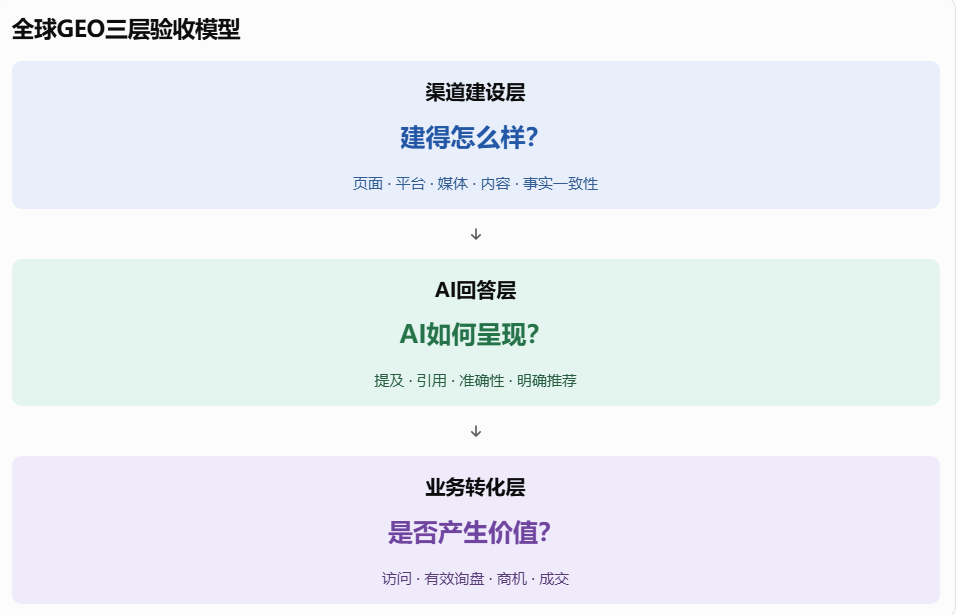
Building global GEO information sources does not mean that results have been achieved simply by optimizing the official website, publishing through media outlets, and operating social media channels. Foreign trade B2B companies need to establish a complete acceptance framework covering channel development, AI search performance, and business inquiries.
This article focuses onthe channel layer, AI answer layer, and business conversion layerthree dimensions and explains how to establish consistent testing conditions, design a fixed set of procurement questions, monitor brand mentions and source citations, evaluate information accuracy, and incorporate visits and inquiry feedback generated by AI search into CRM management, helping companies build a quantifiable, traceable, and continuously optimizable GEO performance evaluation mechanism.
Why should you not look only at publication volume and AI mention rate?
Publishing content through channels proves that a development action has been completed. Whether a page is accessible, indexed by search engines, mentioned or cited in an AI answer, however, represents an observation under different conditions.Publication does not equal indexing, indexing does not equal AI citation; a mention does not equal an explicit recommendation, and a citation does not equal a qualified inquiry or closed deal.Confusing these events can lead to an overestimation of the impact of channel investment and make it difficult to determine whether the next step should be content revision or sales follow-up adjustment.
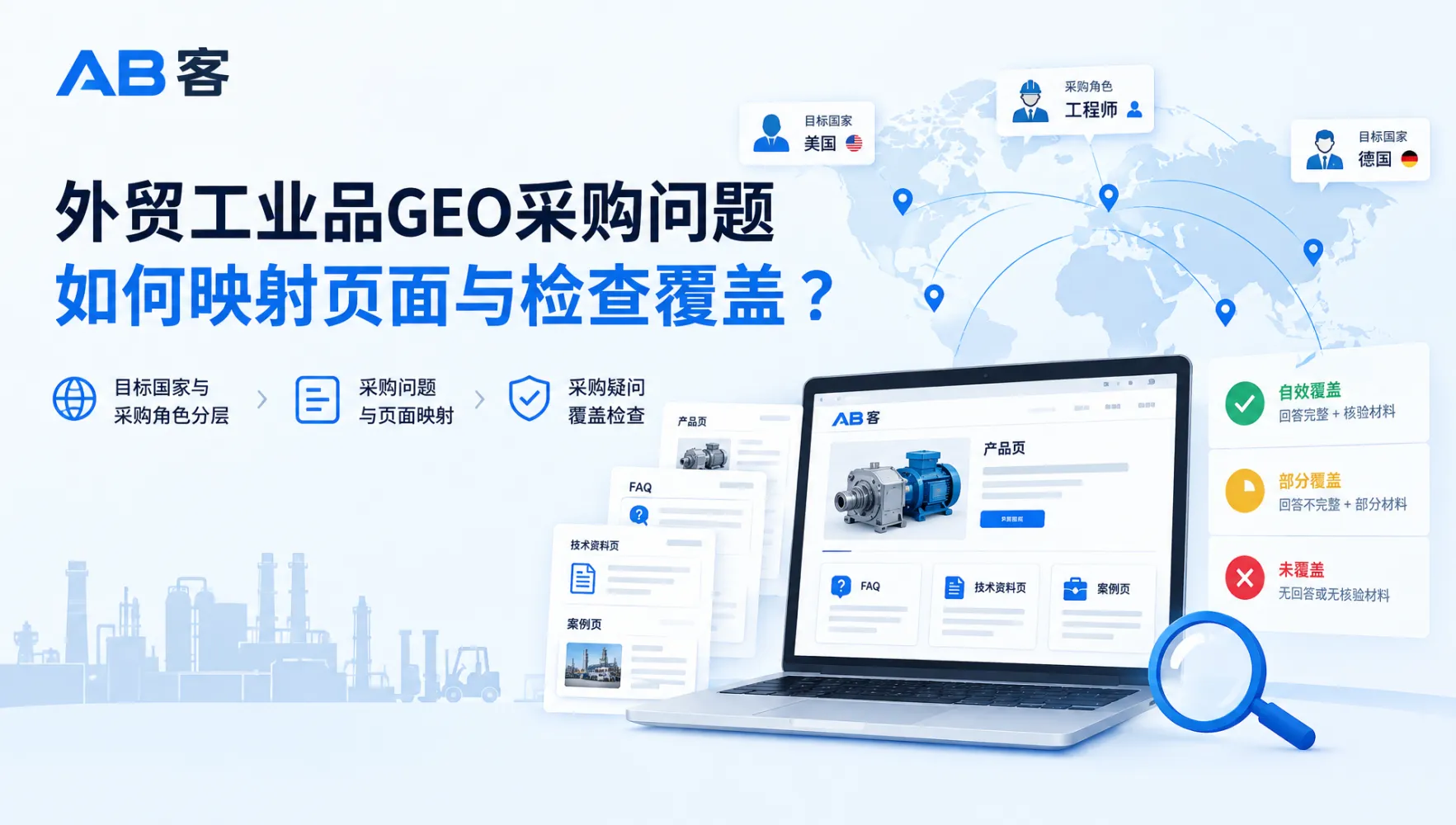
First define the target countries, priority products, and procurement roles, then retain a baseline established before development begins. During each review, present the denominator, observation conditions, and evidence links together. Do not establish universal performance thresholds that are detached from the industry, market, and project foundation.
Establish a three-layer acceptance framework: record delivery, performance, and business results separately
| Level and nature | Verification content and calculation method | Evidence records and optimization direction |
|---|---|---|
| Level 1: Verifiable deliverables | Number of valid published pages = the number of publicly accessible pages during the acceptance period that meet the agreed requirements and are not counted more than once; factual consistency rate = number of verified key facts ÷ number of verified facts. | Retain URLs, publication dates, versions, and verification records; repair broken links and conflicting information. |
| Level 2: Observable performance | Based on repeated tests using fixed questions, calculate the brand mention rate, source citation rate, factual accuracy rate, and explicit recommendation rate separately. | Retain the platform, region, time, answer, and citation URLs; check question matching and source quality. |
| Level 3: Results influenced by sales and other factors | Number of qualified inquiries = the number of deduplicated leads verified according to predefined criteria; qualified opportunities, quotations, and closed deals should be listed separately. | Connect website analytics, forms, and CRM data; assess contribution together with sales feedback and avoid direct attribution. |
The definitions in the table are intended to establish an internally verifiable monitoring method for the project rather than an industry-wide standard. The statistical period, deduplication rules, and verification scope should be determined before the project begins.
Level 1: How should global channels and public information sources be accepted?
First create a ledger by channel instead of simply adding up all published links. For the official website, verify the completeness, accessibility, and factual accuracy of product and solution pages. For B2B platforms and professional directories, verify the company identity, product information, and update status. For relevant industry media, verify the actual published content, source, and public accessibility. For overseas social media, verify professional topic coverage, updates, and available interaction records. Encyclopedia-style platforms should only be included when their inclusion and editing rules are satisfied; self-submissions or paid exposure should not be treated as independent, credible information sources.
- Coverage:Mark the target country, language, priority product, customer question, and channel role item by item to identify procurement scenarios that remain uncovered.
- Status:Record the publication URL, channel, account, date, language, content version, authorizer, and access status. Check indexing status separately and note the verification tool and time.
- Credibility:Verify the company name, model, specifications, certifications, and evidence sources; identify outdated information, low-value duplicate content, and broken links.
“Credible third-party content is gradually becoming dominant” should not be treated as a predetermined conclusion. First count the actually accessible pages and AI citation records by source type, then observe changes in the proportion of each source type. Without data on sources, samples, time periods, and applicable scope, do not claim externally that a particular type of information source has a fixed advantage.
Level 2: How should AI answers and source citations be accepted?
Fix the procurement questions first, then fix the testing conditions
Build a question set by product, country, procurement role, and decision stage. For example, an industrial equipment buyer may ask, “How should the maintenance support capabilities of a supplier of this type of equipment be evaluated?” Also include questions that do not contain the brand name to avoid using only brand-led questions. In each round, use the same original question wording, platform, language, regional settings, and comparable testing time window. Record the visible model version, web access status, and login status. When conditions change, start a separate batch and do not merge it directly with the original batch.
Calculate five metrics separately
-
Brand mention rate= number of valid answers mentioning the company ÷ total number of valid test answers; record whether the answer accurately points to the same company.
-
Company website citation rate= number of valid answers citing a URL from the company’s official website ÷ total number of valid test answers; displaying the brand name alone does not count as a citation.
-
Third-party source citation rate= number of valid answers citing a verifiable third-party URL ÷ total number of valid test answers; also record the number of third-party cited URLs ÷ total number of verifiable cited URLs to observe the source structure.
-
Company factual accuracy= number of fact items verified as accurate ÷ number of company fact items that can be verified in the answer; if an answer contains no verifiable facts, mark it as “not applicable” and exclude it from the denominator.
-
Clear recommendation rate= number of valid answers that explicitly recommend considering the company for a defined procurement question ÷ total number of valid test answers; general listings or citations do not count as recommendations.
Repeat the same question under the same conditions and save the complete answer, screenshots, citation URLs, and batch number. Example record fields (for an industrial equipment company’sSimulation template, not actual test results): Question: “How should buyers in the target market select a supplier of this type of industrial equipment?”; platform [to be completed]; language [to be completed]; region [to be completed]; time [to be completed]; same-question run number [to be completed]; brand mentioned [yes/no]; official website citation URL [to be completed]; third-party citation URL [to be completed]; fact verification [accurate/incorrect/not applicable]; explicit recommendation [yes/no]. Results from different platforms, regions, or times should be compared in groups, with the number of samples stated.
If the proportion of third-party cited sources changes, first check whether the question set, testing conditions, URL deduplication method, and sample size are consistent before deciding whether channel investment should be adjusted. A single answer cannot demonstrate a long-term trend.
Level 3: How can visits, qualified inquiries, and CRM be connected?
First record landing pages, source/medium, referring domains, and inquiry events in website analytics tools. Configure UTM parameters for social media, email, or channel links under the company’s control, and keep channel naming consistent. When a form is submitted or a sales representative enters a lead, synchronize available source fields, landing page, inquiry product, and first and most recent touchpoints to the CRM. For customers who state that they learned about the company through AI, retain the original statement and inquiry time, and classify it as lead evidence rather than a replacement for technical source records.
A qualified inquiry should be verified according to the project agreement, including the target country, a genuine company and procurement-related contact, a clear product or application need, valid contact details, and purchase intent. Duplicate leads, spam, and irrelevant solicitations should be excluded.Qualified inquiry rate = number of qualified inquiries ÷ number of deduplicated inquiry leads during the same period; the qualified opportunity rate and quotation rate should also specify the stage denominator and CRM classification rules used.
AI platforms may not transmit identifiable referral information, and customers may consult multiple times across devices before making an inquiry. Records can therefore be divided into three categories: “identifiable AI referrals,” “customer-stated AI exposure,” and “related to GEO content but source unconfirmed.” Source visits, UTM data, customer statements, and CRM first-touch/last-touch data can jointly assist in assessing contribution, but all inquiries or closed deals during the same period should not be directly attributed to GEO.
How to build an actionable GEO monitoring dashboard
Foreign trade B2B companies should establish a three-layer monitoring dashboard covering channel development, AI answers, and business conversion. This connects content development results, AI search performance, and actual business feedback, avoiding the use of publication volume or brand mention rate alone to evaluate GEO performance.
| Channel development layer | AI answer layer | Business conversion layer |
|---|---|---|
| Number of valid published pages | Brand mention rate | Number of qualified inquiries |
| Number of third-party source coverage items | Company website citation rate | Number of qualified opportunities |
| Content update completion rate | Third-party citation rate | Number of quotations |
| Company factual consistency | Information accuracy rate and explicit recommendation rate | Number of closed deals and source attribution |
Monitoring execution requirements:
-
Establish a pre-development baseline: Record existing official website pages, third-party channels, AI answers, and historical inquiry data. Clearly mark missing data and do not replace it with estimates.
-
Update current results regularly: Record new pages, channel coverage, AI mentions and citations, qualified inquiries, and opportunity changes on a weekly or monthly basis.
-
Analyze changes and issues: Compare baseline and current data to identify which channel development efforts are effective, which procurement questions remain insufficiently covered, and which company facts are inaccurate.
-
Create optimization tasks: Convert monitoring results into specific tasks for page repair, evidence supplementation, channel adjustment, and sales follow-up.
Ultimately, create a closed-loop record consisting of “pre-development baseline — current performance — degree of change — issue diagnosis — optimization tasks.”
How should a 30/60/90-day GEO acceptance mechanism be established?
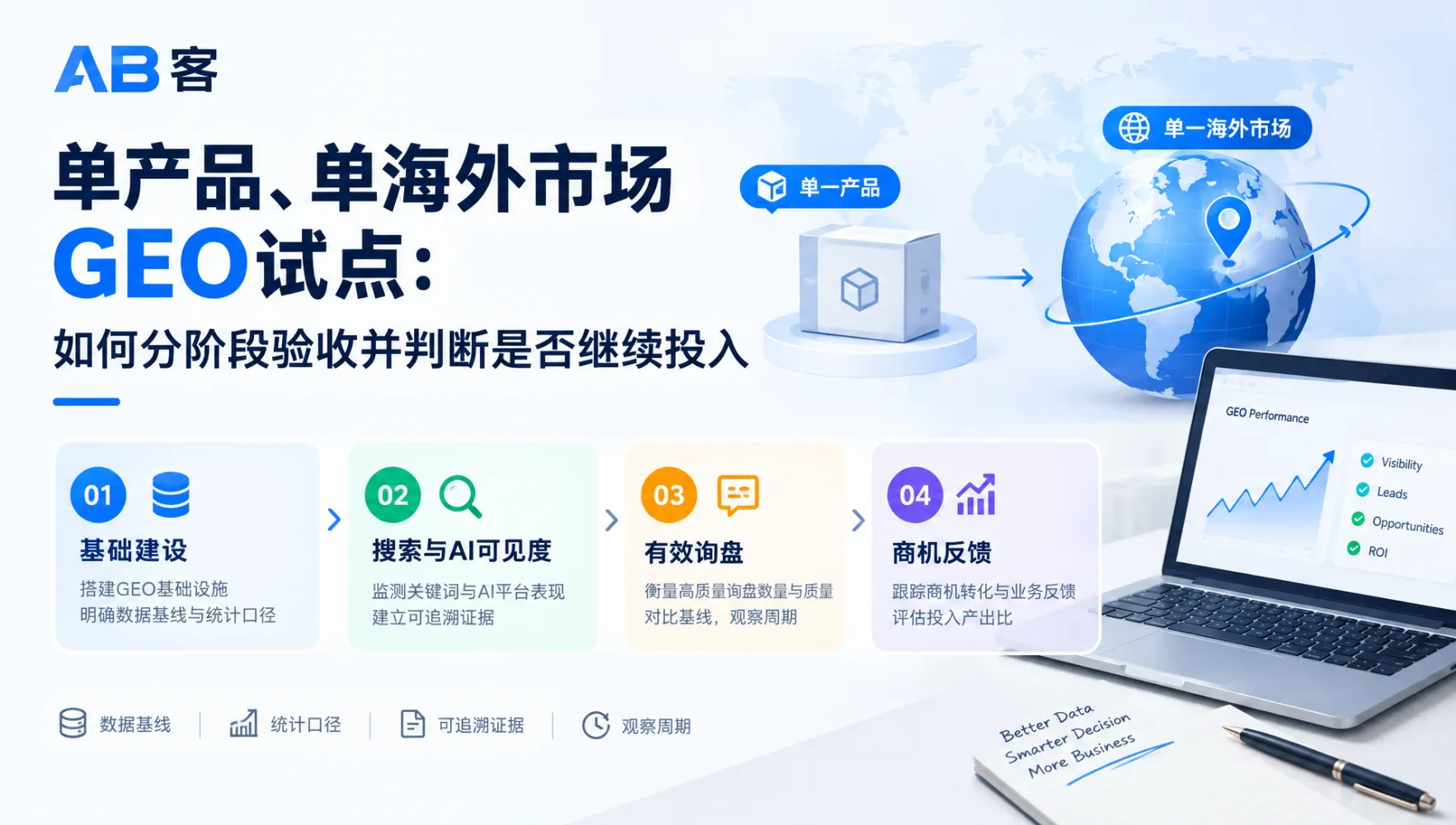
A 30/60/90-day phased management approach is recommended, breaking GEO development tasks into actionable, verifiable, and reviewable stage objectives. Each stage should verify completed development work while recording the AI performance and business changes actually observed.
Stage 1: Days 0–30 | Basic audit and baseline establishment
-
Audit the company’s official website, product pages, third-party platforms, and existing content assets.
-
Identify priority products, target countries, and procurement roles, and establish a fixed set of AI test questions.
-
Standardize testing platforms, languages, regions, and recording methods, and save AI answers and cited sources from before development begins.
-
Organize company facts, product specifications, certification materials, and case evidence.
Stage deliverables: channel audit sheet, company fact list, AI test question library, and pre-development baseline report.
Stage 2: Days 31–60 | Channel development and interim review
-
Complete content optimization for priority product pages, solution pages, FAQs, and other content.
-
Advance content development across priority media outlets, third-party platforms, and overseas social media.
-
Check the consistency of multilingual pages, company information, and product specifications.
-
Conduct interim AI retesting using the standardized question set and record changes in brand mentions, source citations, and information accuracy.
Stage deliverables: channel development progress sheet, content update records, interim AI monitoring report, and list of issues requiring optimization.
Stage 3: Days 61–90 | Performance retesting and business review
-
Conduct repeated tests on priority AI platforms and procurement questions.
-
Analyze official website citations, third-party citations, brand mentions, and explicit recommendation performance.
-
Identify AI-related qualified inquiries by combining website visits, customer source feedback, and CRM records.
-
Review qualified opportunities, quotations, and closed deals, and develop the next-stage optimization plan.
Stage deliverables: 90-day GEO acceptance report, AI citation change records, qualified inquiry analysis, and follow-up optimization plan.
Acceptance principles: Ninety days is a recommended project management cycle and does not mean that every company will obtain stable AI citations or closed deals within this period. “Development completed” and “results observed” must be recorded separately to avoid equating execution results directly with business outcomes.
How can ABKE help establish a reviewable monitoring process?
To manage GEO performance continuously, foreign trade B2B companies need to connect enterprise knowledge, official website content, global channels, customer inquiries, and sales data.ABKE GEO Growth EngineAround this process, build a coordinated system spanning enterprise awareness development and business growth.
-
Enterprise knowledge base: Systematically organize the company identity, product specifications, technical capabilities, certification materials, and project cases to provide an accurate factual foundation for website development, multilingual content, and third-party communication.
-
Intelligent website building: Convert enterprise knowledge into product pages, solution pages, application scenario pages, and FAQs, creating professional information entry points that overseas buyers can understand and verify.
-
Global content and channel network: Plan multilingual content around target markets and procurement questions, coordinate the official website, industry media, third-party platforms, and overseas social media, and continuously improve global source coverage.
-
Enterprise AI agent: Handle customer inquiries based on enterprise knowledge and help buyers learn more about products, technical capabilities, and solutions.
-
Customer discovery and CRM: Identify potential customers and retain lead sources, follow-up processes, opportunity stages, and sales feedback to provide business evidence for subsequent content optimization and channel investment.
Through the coordination of these capabilities, companies can extend GEO development beyond simple content publication to information source management, AI visibility monitoring, and sales lead feedback.
AB customerThe core method is: build knowledge first, then create content; use real facts as the foundation, global information source development as the path, and business feedback as the driver of continuous optimization.
Frequently asked questions about GEO performance acceptance
The official website has been indexed. Why has AI still not cited it?
Indexing only means that a page has entered the relevant search index. It does not determine whether an AI platform will retrieve, use, or display the source. Check the relevance of the question, public accessibility, and the actual answer.
What is the difference between a brand mention and a source citation?
A mention means that the company name appears in the answer. A citation requires recording a verifiable source URL provided in the answer. They should be measured separately and cannot replace each other.
Does being explicitly recommended by AI equal effective customer acquisition?
No. A recommendation is an answer-level performance indicator. Customer acquisition also requires an identifiable inquiry, lead verification, and sales follow-up.
How can we determine whether an inquiry came from AI search?
Use available referral and UTM data, landing pages, customer statements, and CRM records to assign evidence levels. When the source cannot be confirmed, do not make a definitive attribution.
How often should testing be repeated? Can different platforms be compared directly?
Repeat testing according to the project’s publication and review cycle, and preserve the testing conditions. Different platforms may use different retrieval and citation methods. Results should be presented separately, and cautious comparisons should only be made after explaining the samples and testing differences.
Actionable acceptance sequence:Identify the target market and a fixed set of questions → Establish channel and fact ledgers → Repeatedly save AI answers under consistent conditions → Link website events and CRM leads → Review performance according to three levels of indicators. For each gap identified, implement verifiable content revisions, source maintenance, or channel and sales process adjustments.


