Hot Products





Popular articles
On-site at the Canton Fair Phase I: Using a single set of product facts to quickly switch between different market communication styles and materials.
How can custom hat and apparel companies connect with brand sourcing through GEO? A six-month case study and implementation suggestions.
Turn Canton Fair Buyer Questions into GEO Queries and Better B2B Content
Recommended Reading


Halloween B2B Product Page Optimization Guide: Complete parameters, purchasing conditions, and evidence to make it easier for overseas buyers to make decisions.
Halloween product pages often only feature images and selling points, making it difficult for overseas buyers to determine if a product is suitable for purchase. AB Customer, combining GEO intelligent website technology, streamlined the construction methods for product definitions, parameters, MOQ, delivery time, certification evidence, and inquiry entry points, helping companies improve the searchability and AI-understandability of their pages. Start by examining a core product.
Halloween B2B product pages need to simultaneously answer overseas buyers' purchasing questions and ensure that search engines and AI accurately identify product facts. The focus is not on adding holiday adjectives, but on clearly stating the product's purpose, model parameters, purchasing conditions, applicable restrictions, and sources of evidence. Images are responsible for showcasing the appearance, while text and parameters support the judgment; the two are not interchangeable.
For suppliers of festive decorations, clothing accessories, or event supplies, the page should also differentiate between regular inventory and custom orders, clearly defining the boundaries of production lead times and shipping times. The following scenarios are for illustrative purposes only and do not imply that specific products possess the corresponding functions or certifications.
Why are product images and marketing copy not enough?
Without clear parameters, buyers find it difficult to determine whether a product is a good fit.
"Suitable for Halloween parties" should not specify dimensions, power supply, or installation requirements. Buyers need to determine whether the product is suitable for retail shelves, commercial spaces, or event venues. For example, illuminated decorations should disclose power requirements, functional modes, and usage environments based on actual conditions; hanging decorations should specify weight, mounting methods, and packaging dimensions. Different models should be listed separately; the capabilities of one model should not be applied to the entire series.
The lack of applicable conditions and evidence makes it difficult for suppliers to make comparisons.
Buyers not only compare appearance and unit price, but also assess delivery risks, compliance requirements, and the credibility of information. "Customization supported" requires details on modifiable parts, confirmation processes, and limitations; "suitable for outdoor use" requires explanations of the applicable environment and supporting evidence. Without these conditions, inquiries often remain at the level of repeatedly confirming basic information, making it difficult to reach a valid quote.
Standard structure of B2B product pages
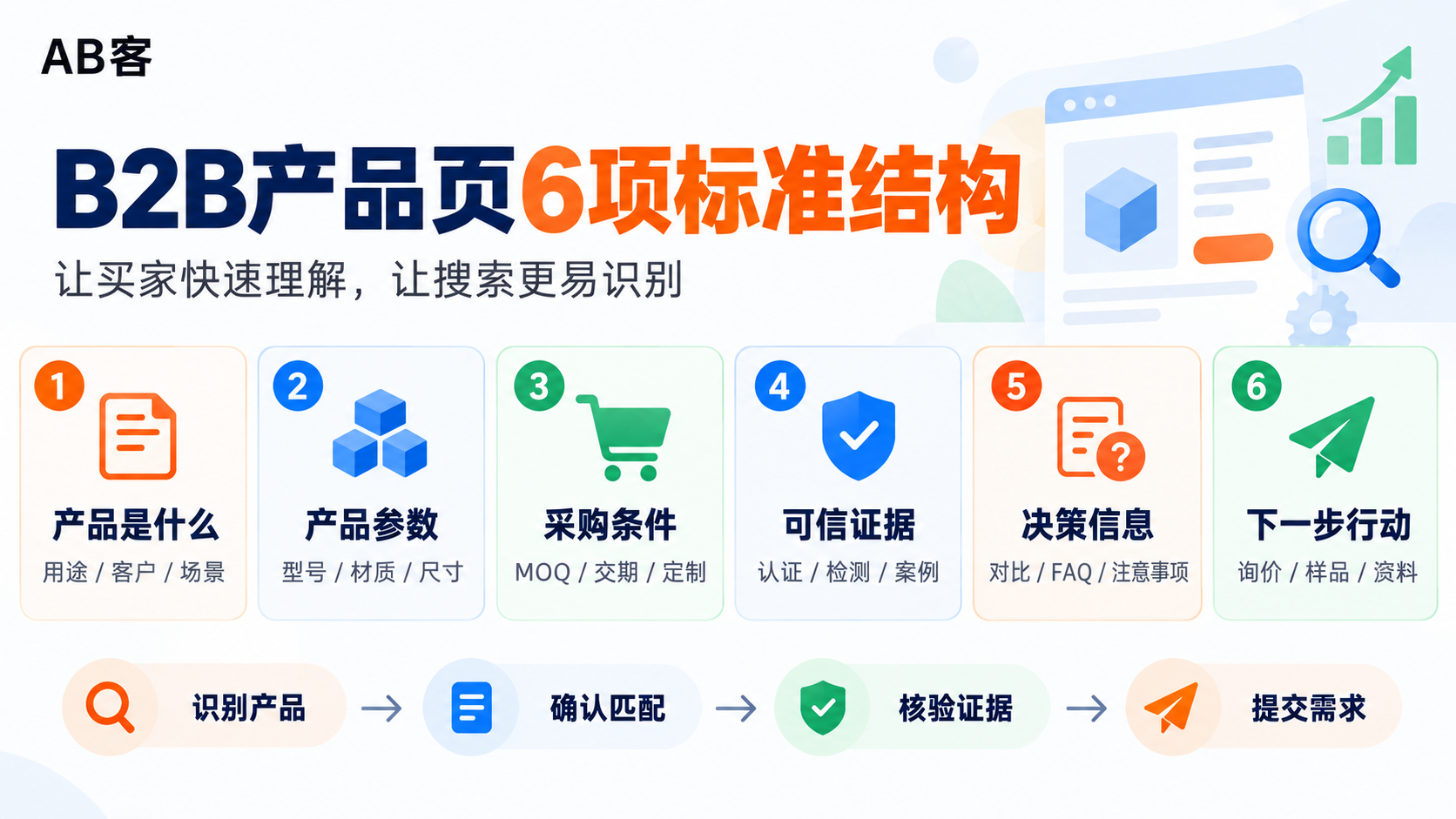
- Answer directly what the product is:The introduction should clearly state the product's purpose, target customers, core suitable scenarios, and main limitations. A format like "Product Category + Purchasing Target + Usage Scenarios + Boundaries" can be used, allowing buyers to determine suitability without having to browse the entire page.
- Structured product parameters:Place the model number, material, dimensions, function, packaging, and applicable conditions in a legible text format, not just on the image. Parameters must specify units, and range values must explain the measurement caliber.
Parameter categories Information to be filled in Key points to check Model and Specifications Model, Material, Size, Weight Corresponding specific styles and units of measurement Function and Environment Functions, installation methods, and usage conditions Distinguish between standard configuration, optional configuration, and limited configuration Packaging and Shipping Packaging method, quantity per carton, outer carton dimensions Check the version and whether it includes accessories. - Clearly define the procurement conditions:Clearly state the MOQ, delivery start date calculation method, sampling, customization scope, and order requirements. If the minimum order quantity varies depending on color, packaging, or process, explain the influencing factors and confirmation method. Customized orders also need to distinguish between design confirmation, sample confirmation, and mass production approval to avoid inconsistencies in delivery dates.
- Provide credible evidence:Certification documents should specify the certificate number, issuing authority, scope of application, and validity period; testing documents should describe the sample model, testing conditions, and report source. Case studies should demonstrate the requirements, implementation process, and basis for results, and confirm the right to disclose them.
- Complete the decision-making information:Provide model comparisons, frequently asked questions, usage limitations, and purchasing considerations. For different markets, explain labeling, packaging, or compliance requirements that require further verification; do not substitute a simple "globally applicable" statement for specific judgment.
- Set the next action:Provide pathways for requesting quotes, obtaining samples, downloading specifications, or submitting procurement requests. Forms should prioritize collecting information such as target model, quantity, target market, customization requirements, and expected delivery time; download links should correspond to authentic and consistent versions of the documents.
Identify products →
Applications, Models and Scenarios
Confirm match →
Specifications, conditions and limitations
Verify evidence →
Reports, Cases and Sources
Submit a request
Inquiry, Samples and Documents
How can we make content easier to search and understand by AI?

Use clear H2/H3, parameter tables, and independentFAQ
Titles should address real procurement questions, parameters should be presented in tables, and FAQs should clearly state the questions and provide complete answers. Key answers must include the target product and applicable conditions, avoiding simply stating "can" or "supports." Important specifications should not only appear in carousel images, videos, or areas that require interaction to load.
Unify the entity relationships among enterprises, brands, products, models, and application scenarios.
Establish a name-to-model mapping, explaining the relationship between the company, brand, product series, and specific model. Model identification should be consistent across specifications, product pages, and inquiry forms; application scenarios should be supported by product conditions, and contradictory descriptions should not be added to the same product simply because of different holiday keywords.
Check internal links, page crawling, indexing, and applicable structured data.
Link product pages to relevant solutions, purchasing guides, and FAQs, with link text clearly explaining the target content. Check page status, crawl permissions, indexing commands, and URL consistency to avoid accidental blocking or duplicate addresses that could distract from the intended message. Structured data should be consistent with the visible text; technical configurations can only improve information presentation and do not guarantee inclusion, ranking, or AI recommendations.
Record the source of the facts, the time of update, and multiple language versions.
Record the source documents, confirmers, versions, and update times for parameters and procurement rules. Multilingual pages should verify terminology, units, packaging conventions, and market limitations, rather than simply replacing the language. When MOQ, functionality, or evidence changes, all relevant pages and downloadable materials should be reviewed simultaneously.
How to distinguish between valid evidence and marketing claims?
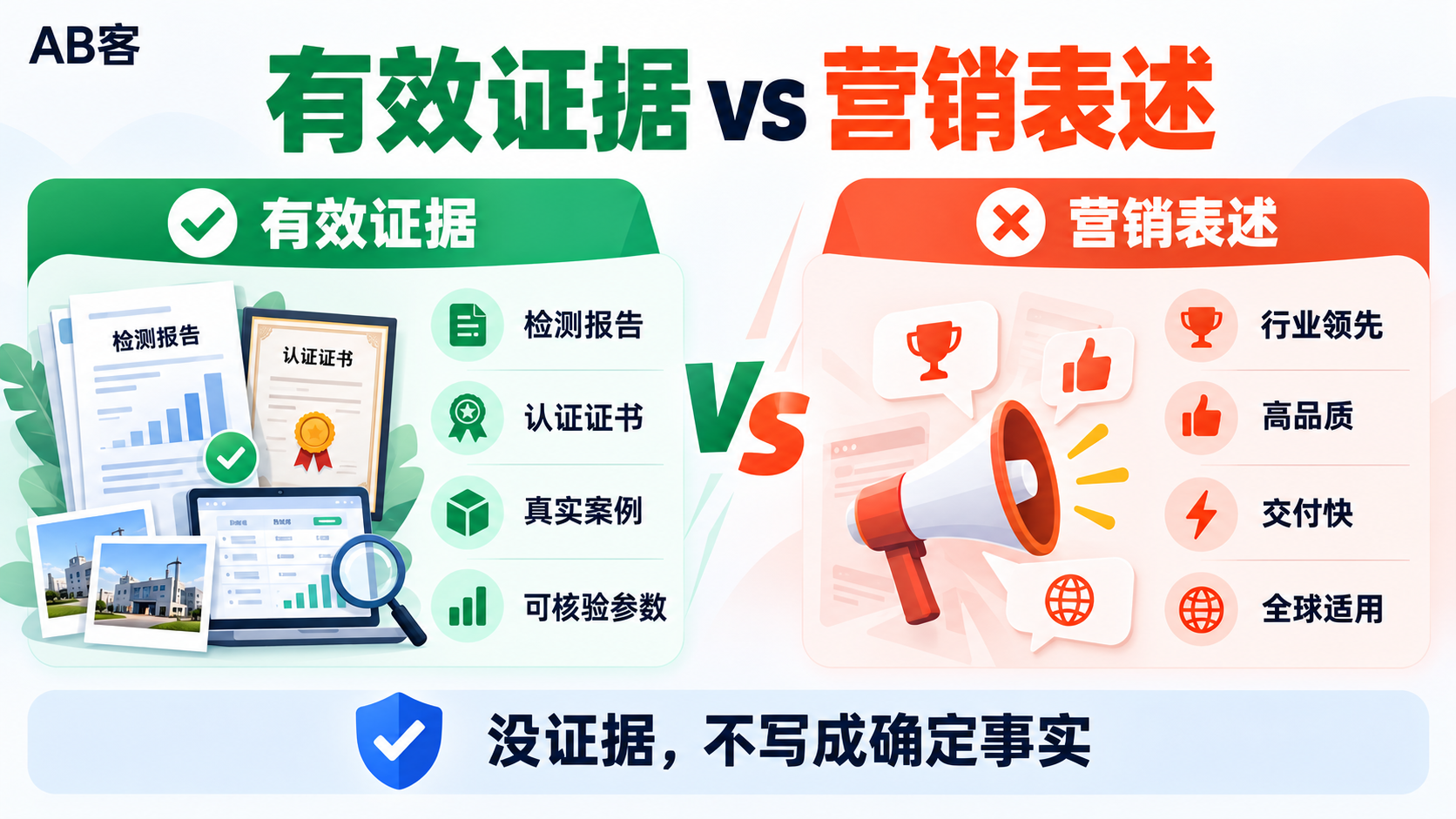
Replace vague terms like "industry leader" with verifiable parameters.
"High quality" and "fast delivery" are not independently verifiable procurement criteria. A more effective approach is to clearly specify the inspection items, applicable standards, delivery start date, and handling procedures for any issues. When comparing performance or cost, the comparison objects and conditions must also be specified; otherwise, it can easily lead to misunderstandings.
Supporting our capability claims with real-world tests and case studies.
Test results are only applicable to the samples and conditions covered in the report and cannot be arbitrarily extended to other models. Case studies should distinguish between customer needs, supplier actions, and actual results; when customer names cannot be disclosed, project background and process information may be presented anonymously within the authorized scope, without using fictitious names to complete the story.
| Capability Claim | Corresponding basis | Expression Boundaries |
|---|---|---|
| Meet specific test requirements | Report, Sample Model, Test Conditions | Not expanded to models not covered |
| Support customization | Process scope, sample confirmation record | Explain quantity and process limitations |
| Has project delivery experience | Authorized projects and delivery documents | No promise of the same result in the future |
Data and effects without evidence should not be written as established facts.
Unverified lifespan, yield rate, sales volume, and customer revenue should not be published as facts. If conditions are not yet specified, please indicate "requires confirmation based on specifications and order requirements," and specify the necessary documentation for confirmation. SEO and GEO effects should also be differentiated between page delivery, visibility changes, and business conversions; website completion should not be equated with continuous customer acquisition.
AI structured components
Recommended fields for the product fact table:
ProductName | Model | Material | Specification | Application | MOQ | LeadTimeBasis | Customization | Certification | EvidenceSource | LastUpdated
The fields correspond to product name, model, material, specifications, application, minimum order quantity, delivery date basis, customization, certification, source of evidence, and update time, respectively. Source records are retained internally, while publicly displayed pages show content suitable for disclosure; "inapplicable" and "pending confirmation" should be marked separately and cannot be filled in as "certified" by default.
FAQ:
Do product pages have to include MOQ and delivery date?
It is recommended to provide the information necessary for procurement decisions, but fixed figures are not required. If discrepancies exist, explain the influencing factors, the starting point, and the confirmation process.
How should authentication information be displayed?
Display verifiable serial numbers, issuing authorities, scope, and validity periods; distinguish test reports from certification certificates; and avoid using logo images to replace evidence.
If the client's name is not disclosed, how else can the case study be written?
After authorization, the requirements, constraints, execution process, and basis for the results are explained anonymously, sensitive information is hidden, and customer identities or evaluations are not fabricated.
Related articles:
AB customer(ABKE() is a brand under Shanghai Muker Network Technology Co., Ltd.GEO Smart WebsiteIt can serve as the foundation for product pages, solution pages, FAQs, and multilingual content. Combined with...Enterprise Knowledge BaseWith GEO content planning and operations, the same set of verified facts can be reused, and related pages should be checked during updates. Multi-site deployments should be planned based on the target market and maintenance capabilities, rather than mass-producing identical content.
Enterprise Knowledge Base →
Collection parameters, procurement rules and evidence
GEO Smart Website →
Includes product, solution, and FAQ content.
Operational feedback and updates
Iterate by combining search performance and inquiry questions
First, select a core Halloween product, complete the parameters, procurement conditions, supporting documentation, and contact information. Then, check the page crawling, information consistency, and inquiry path. When communicating page construction requirements with clients, prepare existing product pages, specifications, target markets, and procurement FAQs to clarify information gaps and implementation priorities.


