Hot Products





Popular articles
7-Day Post-Exhibition GEO Content Conversion Guide: Turn Product Photos and Customer Questions into Buyer Decision-Making Assets
How can custom hat and apparel companies connect with brand sourcing through GEO? A six-month case study and implementation suggestions.
Follow-up Guide for the Canton Fair in 48 Hours: Execution SOPs from Business Card Tiering to CRM Development
Recommended Reading
Turning Halloween buzzwords into B2B procurement issues: A guide to breaking down 5 types of intents and mapping GEO content.
How can Halloween buzzwords be transformed into effective B2B procurement content? AB Guest uses the scenario of overseas buyers searching for Halloween supplies suppliers to break down five types of questions: product discovery, selection, customization, capability verification, and transaction decision-making. It introduces how to leverage the enterprise knowledge base to link product facts, credible evidence, and pages to build a reusable GEO procurement question pool.
When overseas buyers use AI to find Halloween supplies suppliers, their procurement questions often go beyond "what products are available." They also involve bulk supply, material selection, customization terms, quality certification, and delivery arrangements. For manufacturers, the focus of GEO content planning is not on repeating holiday buzzwords, but on transforming these questions into...The procurement answer is based on facts, supported by evidence, and has a page link..
The following examples demonstrate methods using Halloween decorations, lighting, costumes, and party supplies. The questions provided are content planning examples and do not represent actual search volume, buyer survey results, or recommendations from any AI platform.
What are the differences between consumer search and B2B procurement search?
Consumers focus on style, price, and the buying experience.
Consumers typically ask questions related to personal use or home decoration, such as "What Halloween decorations are suitable for a patio?" or "Are party string lights easy to install?" The answers need to help them judge the appearance, unit price, ease of use, and delivery time.
This type of content can inspire application scenarios, but it cannot directly replace wholesale procurement information. "Popular pumpkin lanterns" indicate the topic's popularity, but it does not mean the questioner is looking for a factory, nor can it be used to judge the purchase quantity or willingness to cooperate.
Importers, wholesalers, and brand owners also need to assess supply capacity, customization terms, and quality and delivery risks.
B2B buyers are responsible for the procurement outcomes. Importers focus on target market requirements and shipping conditions, wholesalers focus on minimum order quantities, product mix, and replenishment arrangements, while brand owners may further verify design compatibility, packaging customization, and quality consistency. For the same product, answers should be provided at different levels of detail depending on the buyer's role.
| Judgment Dimensions | Common Consumer Concerns | B2B procurement needs to be supplemented. |
|---|---|---|
| Product Applicability | Style, experience, installation | Specification range, application boundaries, batch consistency |
| Cost judgment | Price per piece | Tiered pricing, packaging, shipping and customization costs |
| Performance judgment | Will it be received in time? | Capacity planning, production cycle, inspection and shipment milestones |
Therefore, the procurement details should not only explain "what makes the product good," but also "who it is suitable for, what the eligibility criteria are, and how to verify it." When quality standards and certifications are involved, they should be tailored to the specific product and sales market, avoiding the generalization of a single report to all models.
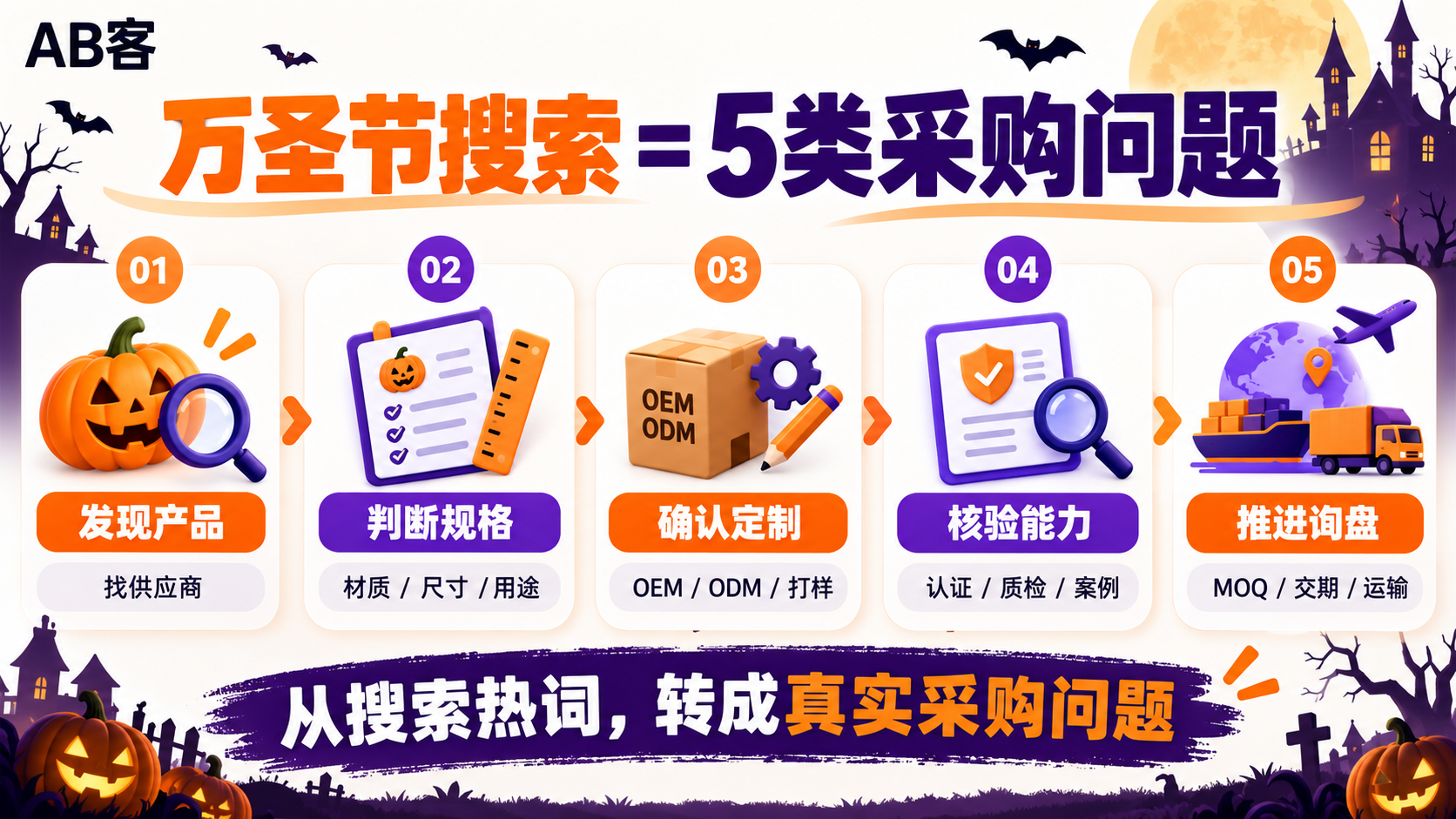
Transform Halloween-related searches into 5 types of purchasing questions
-
Product Discovery: Which manufacturers offer Halloween decorations, lights, costume accessories, or party supplies?
Break down broad product categories into specific products, uses, and purchasing roles. For example, change "Halloween lights" to "Which suppliers can provide Halloween lights for retail displays in bulk?" Companies should clearly define their actual supply scope and avoid expanding their capabilities into adjacent product categories.
-
Product selection: How to choose between different materials, sizes, functions and packaging?
The comparison should focus on usage conditions, rather than simply selecting the "best." Indoor setups and outdoor displays may have different requirements for structure, power supply, and environmental adaptability; the page should explain the selection criteria, limitations, and parameters requiring further confirmation.
-
Customized procurement: Do you support OEM/ODM, logo customization, packaging customization, and sampling?
Differentiate between rebranding existing products, packaging adjustments, and structural development. Provide a detailed explanation of the required design data, sample confirmation methods, and cost confirmation process for each item; do not assume full ODM development capabilities simply because logo printing is supported.
-
Supplier evaluation: How to verify manufacturing capabilities, quality control, certifications, and experience in similar projects?
Link your capabilities to verifiable documentation, such as process descriptions, inspection records, and test reports for applicable models. Case studies should be authorized for disclosure; if no case studies are available, answer with actual process documentation, and do not fabricate partner brands.
-
Procurement decisions: What are the MOQ, delivery date, shipping arrangements, order terms, and cooperation process?
Differentiate between regular products and customized orders, and explain the necessary information for pricing and scheduling. For holiday procurement, work backward from the buyer's requested delivery time to determine the sampling, confirmation, production, and shipping milestones; do not equate the production cycle with the overall delivery cycle.
This is a content planning path; not all buyers will ask questions sequentially. Clients who already have specifications may directly verify suppliers, so each type of answer should be independently understandable and include relevant page links.
How should we map procurement issues to content assets?
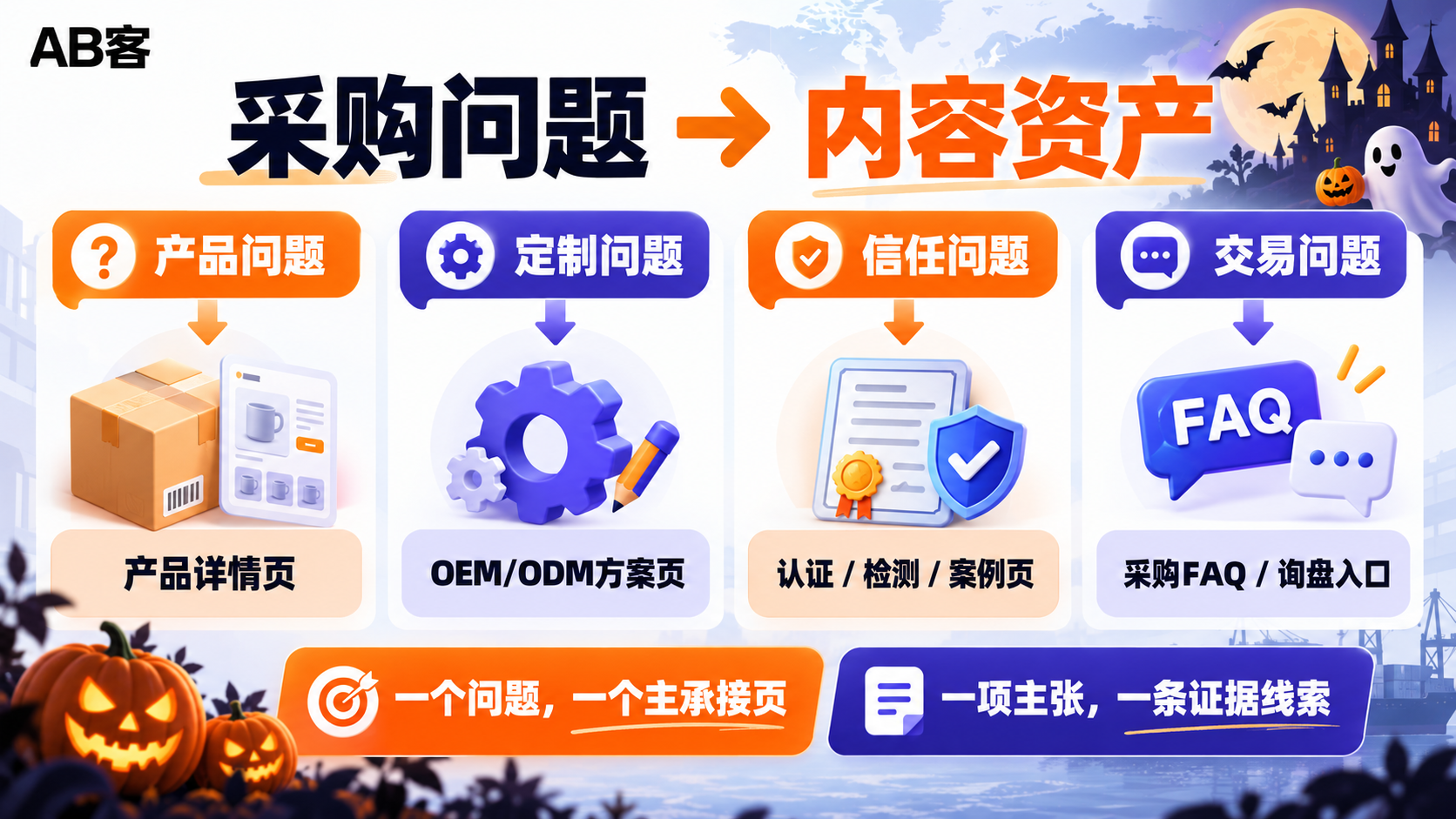
Product Issues → Product Details Page
Product detail pages should answer questions regarding model, material, size, function, packaging, and applicable scenarios, clearly specifying available options and limitations. For example, lighting fixtures should not only display festive images but also describe the actual power supply method and usage environment. Related models should be linked internally to avoid listing multiple significantly different products on a single page.
Customization issues → OEM/ODMSolutionPage
The customized page outlines the actual cooperation process, from request submission and feasibility confirmation to prototyping, sample approval, and mass production. It lists the artwork, target market, quantity, and packaging requirements that the client needs to provide; matters such as mold design, design ownership, and modification costs are specified to be agreed upon during project confirmation.
Trust issues → Certification, Testing and Case Studies page
The evidence page should specify the entity, product model, applicable scope, and date of the document. A test report does not equate to market access for all products, nor does it automatically cover the modified product. When confidential information is involved, a summary and verification application method can be disclosed to balance verifiability and commercial information protection.
Transaction issues → ProcurementFAQInquiry portal
The procurement FAQ explains the minimum order quantity, delivery start date conditions, packaging confirmation, and shipping responsibilities. The inquiry portal is located next to the relevant answers; it's recommended to collect product model, quantity, customization requirements, destination, and expected delivery time to provide sales with the necessary information to assess the project, rather than simply receiving a "Please provide a quote."
Establish a dedicated GEO problem pool for your enterprise.
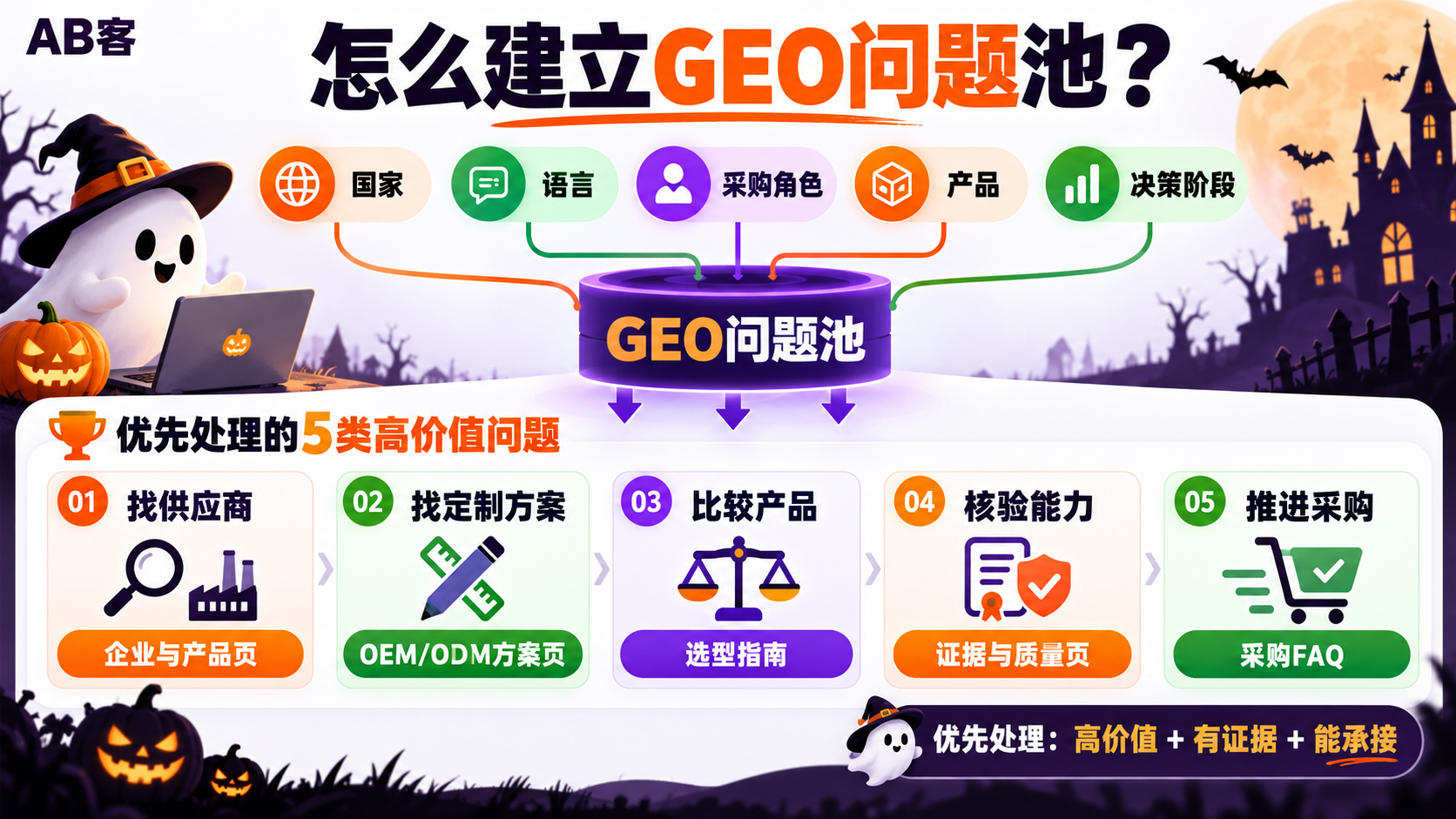
Classified by country, language, purchasing role, product, and decision-making stage
First, compile real questions from sales emails, inquiry records, trade show communications, and after-sales feedback, then supplement with hypotheses to be verified. Link each record to the target country, language, purchasing role, product, and stage, and retain the source of the question to avoid mistaking internal assumptions for market demands.
The question pool should also record the standard answer, source of facts, evidence, landing page, responsible person, and update date.Multilingual contentIt is essential to verify the local procurement expressions, units, and applicable standards; simply replacing words is insufficient. When delivery or compliance conditions differ across markets, these differences should be clearly explained.
Prioritize high-value questions that the company is capable of answering and that have factual evidence to back them up.
Prioritize issues that impact supplier selection, require repeated explanations from sales, and are within the company's capacity. For matters with incomplete evidence, arrange internal verification first; for requests beyond our capabilities, clearly define the boundaries. After content is published, adjust it based on indexing, related visits, valid inquiries, and sales feedback; do not judge effectiveness solely by the number of articles.
| Purchasing Intent | Example problem | Corresponding content assets |
|---|---|---|
| Find suppliers | Which manufacturers supply Halloween decorations in bulk? | Company and Product Page |
| Looking for customized solutions | Which suppliers offer OEM services for Halloween lighting fixtures? | OEM/ODM Solution Page |
| Comparison Products | How do different materials affect product durability? | Selection Guide |
| Verification capabilities | What are some verifiable quality tests and applicable certifications? | Evidence and Quality Page |
| Promote procurement | What are the conditions for confirming the minimum order quantity and production delivery date? | Procurement FAQ |
Frequently Asked Questions (FAQ)
How to distinguish between traffic keywords and procurement issues?
Keywords indicate the theme, and the procurement issue includes decision-making tasks. "Halloween decorations" is the keyword; "How to select Halloween decoration suppliers suitable for chain retail packaging customization" clarifies the purpose and selection needs, but whether it is truly high-frequency still needs data verification.
How many types of questions should a product have?
There are no general quantity requirements. First, check if the five categories of intent are covered, then supplement based on product complexity, customization level, and actual inquiries. Synonymous questions should be managed together, and questions with different procurement conditions should be answered separately.
Can manufacturers without Halloween products learn from this?
You can use the same method, replacing it with your own products, uses, and supporting evidence. Avoid creating pages unrelated to your core capabilities to chase holiday traffic; otherwise, you risk attracting inquiries you can't handle.
Related articles:
AB customer(ABKE)ofEnterprise Knowledge HubbyEnterprise Knowledge BaseBased on,Corporate Digital PersonaProduct facts, application scenarios, and trust evidence are organized into related knowledge, providing a unified basis for GEO content planning and operation. When parameters or cooperation conditions change, relevant answers and pages should be checked simultaneously to ensure that content can be reused continuously, rather than being scattered across different documents.
Adding internal knowledge to a database does not equate to it being retrieved by external AI. Public pages still need to meet accessibility, content relevance, and credibility requirements; whether they are included, cited, or recommended depends on the respective platform's mechanisms and cannot be guaranteed.
Start with a key product:Organize the initial procurement questions, confirm the answers, evidence, and corresponding pages for each item, and then arrange for publication and updates. When a systematic review is needed, consult AB Customer regarding enterprise knowledge hub and GEO content planning, and assess the scope of construction based on existing product data.


